What Is the Jackery Explorer 2000 v2 and Who Is It For?
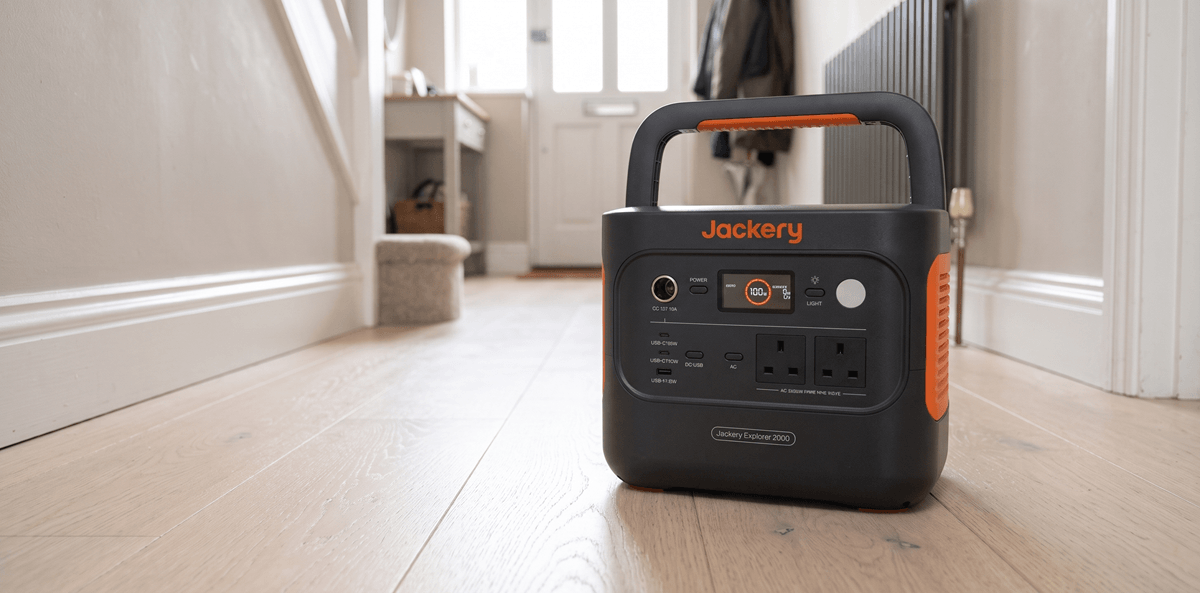
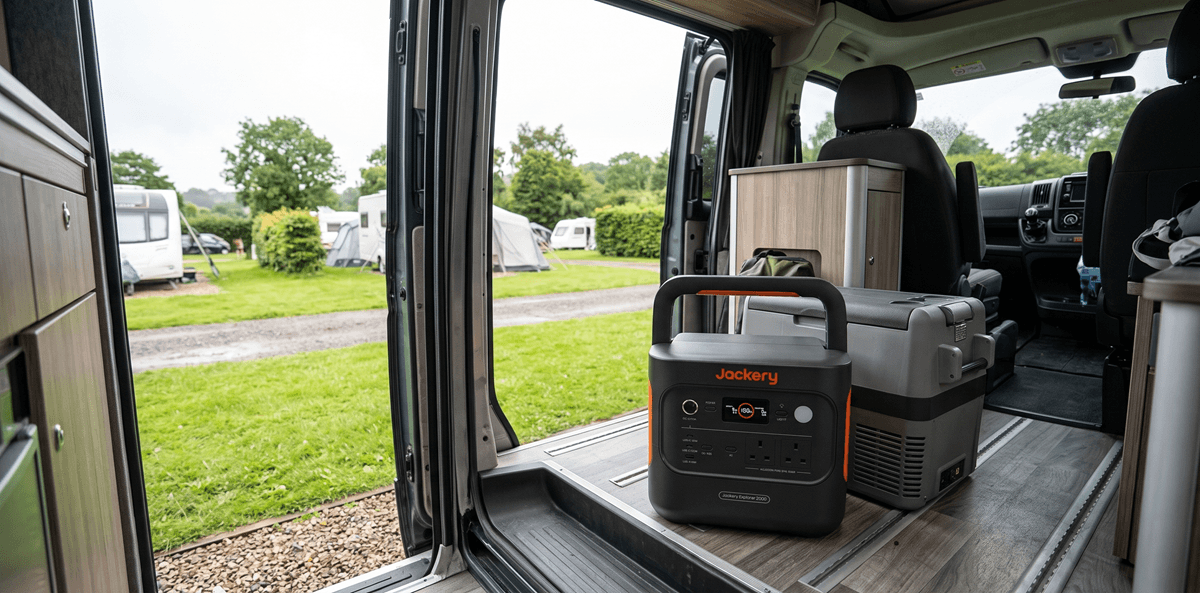
The Jackery Explorer 2000 v2 (model JE-2000D) is a 2,042Wh LiFePO4 power station that went on sale in the UK in early 2025. The UK version has two three-pin sockets and 2,200W of output, and it weighs 17.5kg. It suits campervans, car camping and power cuts, but you can’t add batteries to it.
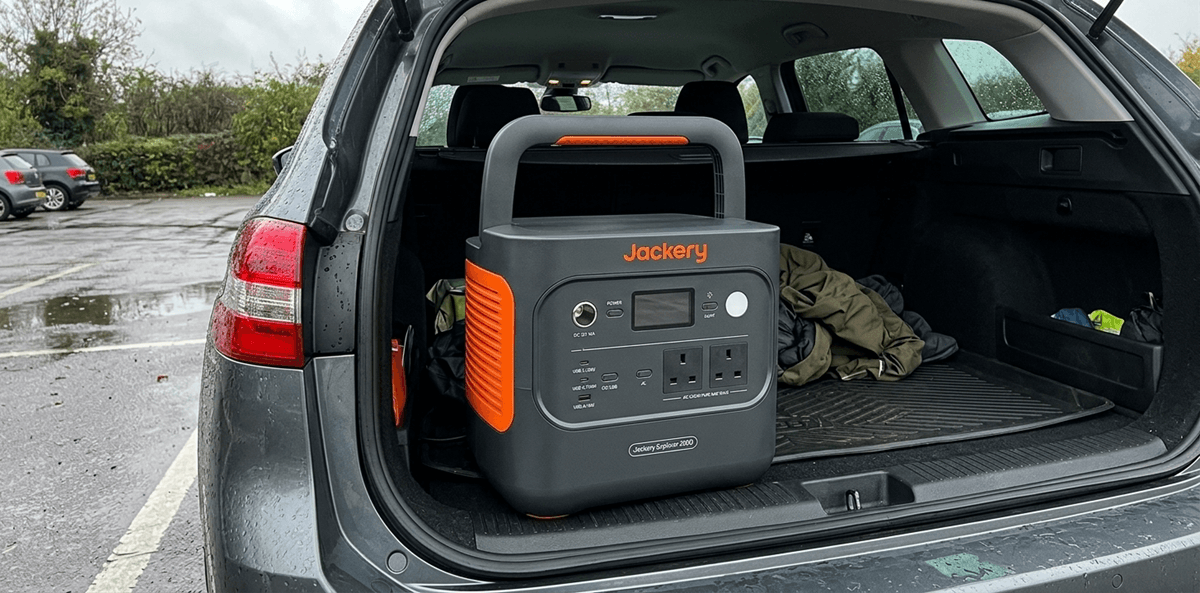
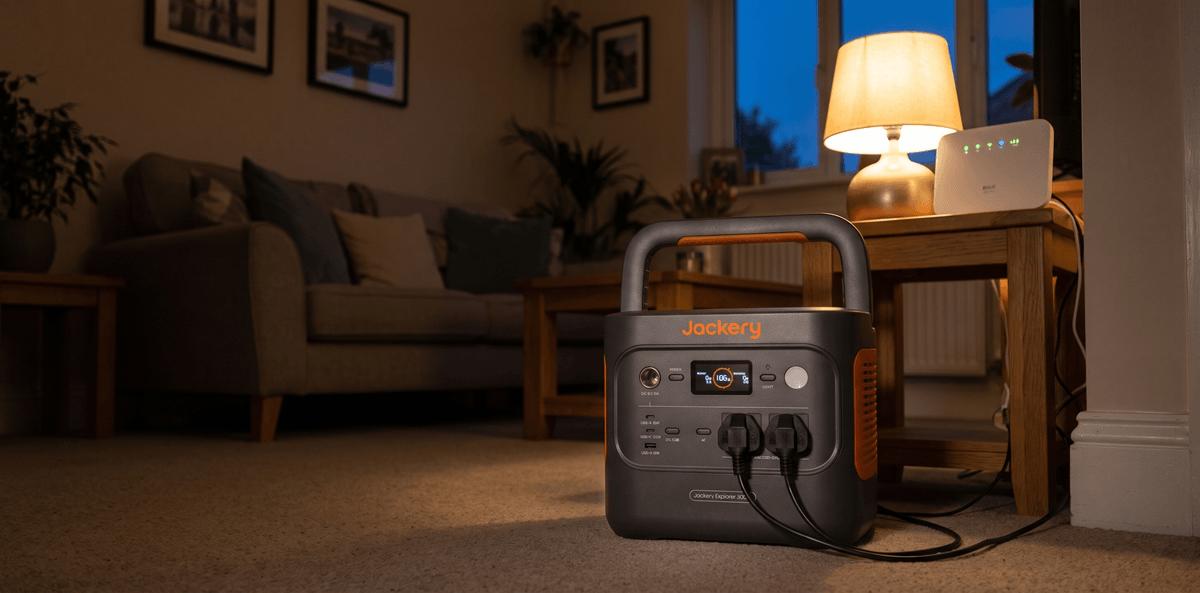
This is a big-output unit that one person can still move. The Independent named it the best portable power station for camper vans and gave it 4.5 out of 5. Its tester says most people can shift it a short distance on their own, and it’s about the size of a small cool box.
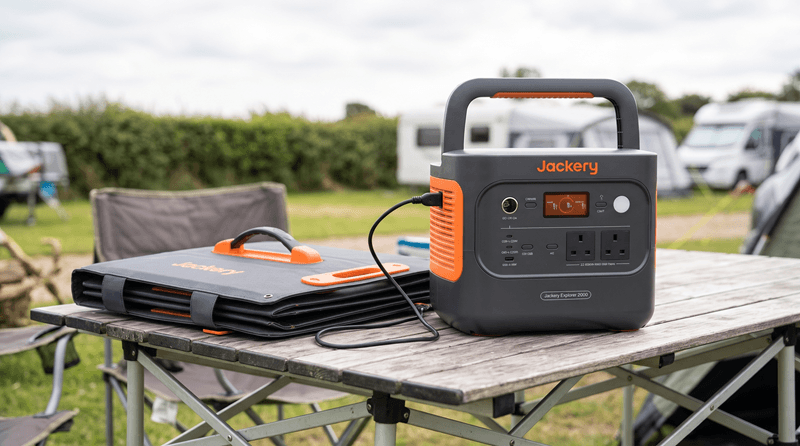
Camping is its other strong job. OutdoorGearLab gave the US model its Editors’ Choice and its “Best for Off-grid Camping” award. Our campervan power station shortlist shows how it sits against bigger, heavier units.
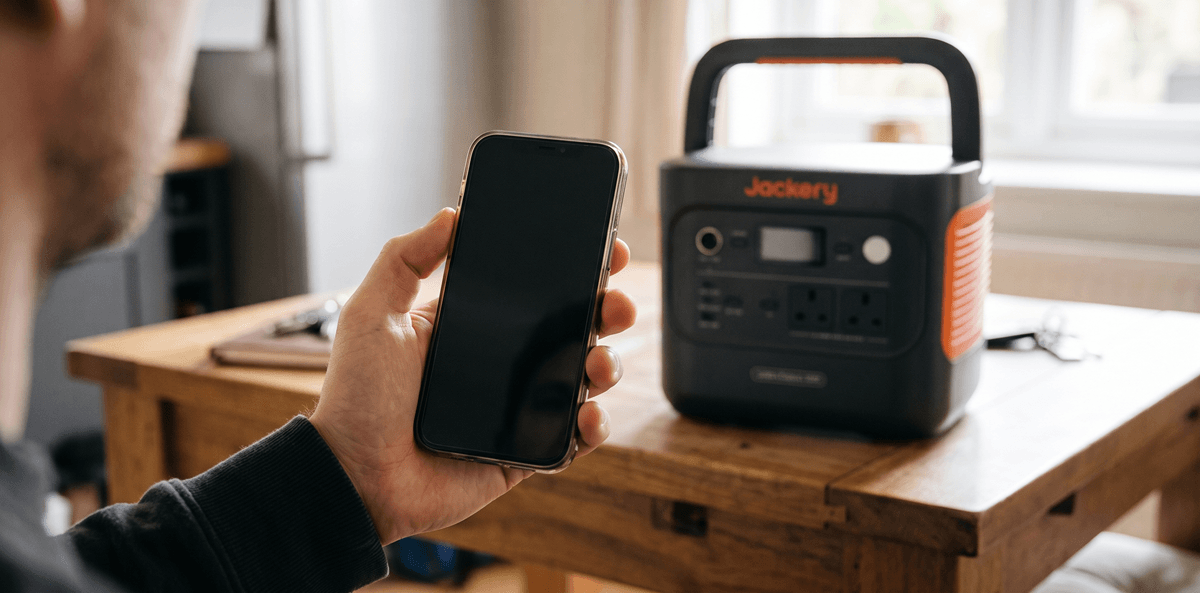
Power cuts are the third job. TechRadar’s reviewer found it more than capable of everyday needs at home. It switches to battery in under 20 ms, per Jackery UK. That’s slower than some rivals, which we cover below.
One warning before you read other reviews. Most English tests use the US model, with three 120V sockets. The UK unit has two. Every figure on this page is for the UK version unless we say otherwise.
Key Specifications at a Glance
| Spec | UK figure | Source or note |
|---|---|---|
| Model | JE-2000D | Jackery user manual |
| Capacity | 2,042Wh | Jackery UK specs table |
| Battery | LiFePO4 | Jackery UK |
| AC output | 2,200W rated, 4,400W surge peak | Two UK three-pin sockets, 230V |
| USB ports | USB-C 100W and 30W, USB-A 18W | Jackery UK |
| Car socket | 12V, 10A | Jackery UK |
| Mains charging | About 1.7 hours to full | Standard mode, Jackery UK |
| Fastest mains charging | 0 to 80% in about 52 minutes | Emergency Super Charge, switched on in the app |
| Solar input | 400W max, 16 to 60V | Two DC8020 inputs |
| Car charging | About 24 hours | From a 12V socket |
| UPS switchover | Under 20 ms | Jackery UK |
| Weight | 17.5kg | Amazon UK lists 17.9kg; we use Jackery's figure |
| Size | 33.5 x 26.4 x 29.2cm | Jackery UK |
| Cycle life | 4,000 cycles to 70% or more | Jackery UK |
| Operating range | Charge 0 to 45°C, discharge -10 to 45°C | Jackery UK |
| Expansion | None | Jackery UK FAQ |
| Warranty | 3 years, plus 2 more if you register | Jackery UK FAQ |
| App | Wi-Fi (2.4GHz) and Bluetooth | Jackery user manual |
Jackery’s own figures disagree in two places. Its FAQ says two 200W panels fill it in about 5.5 hours, but its charging table says 7.5 hours for the same pair. We use the table. Amazon UK lists 17.9kg, while Jackery says 17.5kg.
Measured capacity is lower than the label, as with every power station. OutdoorGearLab got 84% of the rated energy out through the AC sockets on the US model. That matches the 85% we use for runtime estimates.
Explorer 2000 v2, 2000 Plus v2 or 2000 Pro: Which One Are You Actually Buying?
The 2000 v2 is the light, fixed-size model. The Explorer 2000 Plus v2 went on sale in the UK on 14 October 2026. It adds battery expansion up to 12kWh, three sockets and 800W of solar, but weighs about 19kg. The older Explorer 2000 Pro is the model the 2000 v2 replaced.
| Spec | Explorer 2000 v2 | Explorer 2000 Plus v2 |
|---|---|---|
| Capacity | 2,042Wh | 2,048Wh |
| AC output | 2,200W, 2 UK sockets | 2,400W, 3 UK sockets |
| Solar input | 400W | 800W |
| Weight | 17.5kg | About 19kg (Jackery quotes 18.8kg and 19.1kg in different places) |
| Expansion | None | Up to 12kWh with Battery Pack 2000 |
| UPS switchover | Under 20 ms | 10 ms |
| Cycle life | 4,000 to 70% | 6,000 to 70% |
Both columns come from Jackery: the 2000 v2 page and Jackery’s UK launch announcement for the 2000 Plus v2 on 14 October 2026. Pick the Plus v2 if you want to grow capacity or charge faster from solar. Pick the 2000 v2 if weight matters more and two sockets are enough.
Two more names cause confusion. “Solar Generator 2000 v2” is Jackery’s name for this unit sold with SolarSaga panels, not a different power station. The Yorkshire Post’s own test compares it with the 2000 Pro it replaced and finds the new model lighter. If you only need half the energy, our Jackery Explorer 1000 v2 review covers the smaller sibling.
How Fast Does the Explorer 2000 v2 Charge?
From a UK wall socket, the 2000 v2 charges fully in about 1.7 hours in standard mode. Emergency Super Charge, switched on in the Jackery app, takes it from 0 to 80% in about 52 minutes. The Independent timed a full recharge at 102 minutes. A 12V car socket takes about 24 hours.
Jackery’s product page lists the 1.7-hour standard charge and the 52-minute emergency figure. The Independent’s 102 minutes sits close to Jackery’s standard time. US tests run slower on 120V mains: OutdoorGearLab measured 2.5 hours.
Jackery’s user manual recommends normal speed for everyday charging and keeps emergency mode for when you need it. Quiet Charging Mode, also in the app, slows charging to cut fan noise.
For vans, the car socket is a slow top-up. The manual says to start the engine first and avoid using the car charger on bumpy roads. A faster option arrived in October 2026. Jackery UK now sells a 600W DC-DC alternator charger that works with its DC8020-input models, including the 2000 v2. The 2000 v2’s own DC input tops out at 400W, so expect no more than that.
You can also combine mains with solar or the car socket, Jackery says, but not solar and the car socket together.
Is a Solar Panel Worth It for the Explorer 2000 v2 in Britain?
Yes for top-ups, no for fast refills. The 2000 v2 takes up to 400W of solar across two inputs. Jackery’s table says four SolarSaga 200W panels fill it in about 6 hours of ideal sun. In a typical British day you’ll get less, so treat solar as a way to slow the drain.
The 400W cap is the main complaint in independent reviews. The Solar Lab calls it its biggest gripe, and TechRadar lists it as a con. The newer 2000 Plus v2 takes 800W, and the Bluetti Elite 200 V2 takes 1,000W.
Jackery’s FAQ sets the panel rules. You can connect one, two or four panels. With four, you need two of Jackery’s SolarSaga adapters. If you use both inputs, each side must carry the same panel model and the same number of panels.
Jackery’s table gives 15 hours with one 200W panel and 7.5 hours with two, both in ideal sun. Smaller 100W panels take about twice as long. Our UK solar charging guide explains panel sizing for British light and third-party panels.
What Can the Explorer 2000 v2 Actually Power?
On one charge, the 2000 v2 should run a 12W Wi-Fi router for about 145 hours or a 60W laptop for about 29 hours. A 100W TV setup should last about 17 hours. Those are our estimates, using 85% of 2,042Wh. Anything drawing more than 2,200W, including most full-size UK kettles, won’t run.
Our sum is 2,042Wh x 0.85, which gives about 1,736Wh, divided by the appliance’s watts. These are estimates, and your appliances will differ. OutdoorGearLab’s 84% measurement suggests the allowance is fair.
UK tests line up. The Independent ran a hairdryer at full heat for about an hour and fast-charged a laptop and phone for about 26 hours. TechRadar saw an air fryer use about 20% of the battery in 25 minutes.
Kettles are the usual question. Check the rating plate first. The 2000 v2 runs anything up to 2,200W, so an 800W travel kettle is fine and a 3,000W kitchen kettle is not. Our Jackery brand guide compares output across the range. Fridge runtimes depend on the fridge, so they’re in the FAQ below.
Does the Explorer 2000 v2 Work as a UPS in a Power Cut?
Yes, with a caveat. Jackery says the 2000 v2 switches to battery in under 20 ms, and its FAQ cites the UL1778 UPS standard. That keeps a router, lamp or fridge running through a cut. The Anker SOLIX S2000 quotes 10 ms or less, so check your kit if it’s fussy, such as a desktop PC.
It also passes mains power through while charging. Jackery’s FAQ calls this pass-through charging, so you can run appliances and recharge at the same time. Jackery’s user manual says the AC sockets run from the mains while it’s plugged in.
If you leave it unattended, Energy Saving Mode turns all outputs off after 12 hours with no charging or load, per the manual. Turn that mode off if you want it on standby as a UPS. Questions about leaving a Jackery on the mains all the time are answered in our Jackery Explorer 500 v2 review.
For whole-home cover, it’s a plug-in unit, not a house battery. Our home backup shortlist compares options built for that job.
What Ports Does the Explorer 2000 v2 Have?
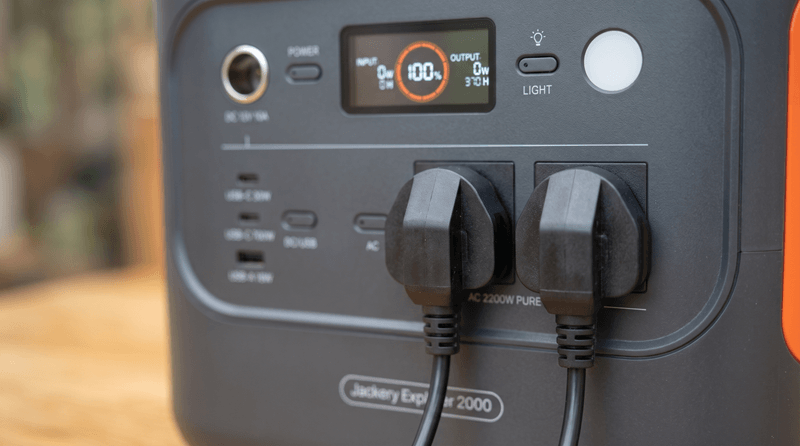
The UK 2000 v2 has six outputs. You get two UK three-pin sockets, two USB-C ports (100W and 30W), one 18W USB-A port and a 12V car socket. It also has a built-in LED light. Two mains sockets is fewer than most 2kWh rivals, so a four-way adaptor may end up in your kit bag.
- Two UK three-pin sockets Both share the 2,200W rated output. The Independent lists the low socket count as a con, and TechRadar flags it too.
- Two USB-C ports One gives up to 100W, enough for most laptop chargers. The other gives 30W for phones and tablets.
- One USB-A port It gives up to 18W for older cables and small gadgets.
- 12V car socket It gives up to 10A, which suits a 12V cool box in a van.
- Two DC8020 inputs They take solar panels, the car charging cable or Jackery's alternator charger, up to 400W.
- LED light and app The light has its own button. The Jackery app connects over 2.4GHz Wi-Fi or Bluetooth.
Check sockets in photos before you trust them. US listings and many reviews show three sockets on the front, which is the 120V model. The UK count comes from Jackery UK’s specs table.
To reset the app connection, hold the power and DC/USB buttons for 3 seconds, per Jackery’s user manual. The FAQ below covers the steps.
How Quiet Is the Explorer 2000 v2?
These are Jackery’s figures from its product page, with no distance stated. We found no independent decibel test of the UK unit, so treat them as claims.
Testers agree it’s quiet in normal use. The Independent found the fan runs even under light loads but is nearly silent. TechRadar’s reviewer could barely hear it on fast charge. Techreviewer.de found the fans audible under high load, close to the limit for use beside a bed.
Battery Life: How Long Will It Last?
Jackery rates the 2000 v2 for 4,000 cycles to 70% or more of its capacity, per its specs table. That’s about 11 years at one full cycle a day, by our sum. Don’t set it against figures quoted to 80%, because a lower end point counts more cycles.
The warranty is 3 years, plus 2 more if you register the product on Jackery UK’s form, according to its FAQ. Jackery only covers units bought from its own shop, Jackery-branded sellers on other platforms or authorised dealers. On Amazon UK, the listing we link to is sold by Jackery UK.
Storage matters too. Jackery’s user manual says to store it between 0 and 25°C for up to a year. Don’t leave it flat, because a depleted battery loses performance. Its warranty terms ask for a full charge at least once every six months. When switched off, Jackery says it uses about 5% of its charge a year.
For the wider picture on Jackery battery life, see our Jackery brand guide.
Jackery Explorer 2000 v2 vs Bluetti Elite 200 V2 vs Anker SOLIX S2000
These are the two 2kWh units we’ve reviewed that are closest in size. Figures come from the UK pages of Jackery, Bluetti and Anker, and from our own reviews of each. Anker UK rounds the S2000 to 2,000Wh.
The 2000 v2 wins no single row outright, but it’s the only one of the three with 2,000W or more under 18kg. The Bluetti leads on output and solar; the Anker on weight, sockets and switchover time. For a head-to-head, see the FAQ in our Bluetti Elite 200 V2 review.
Jackery Explorer 2000 v2 or Anker SOLIX C2000 Gen 2: Which Should You Buy?
Choose the Anker SOLIX C2000 Gen 2 for more output, faster mains charging and the option to expand to 4kWh. Choose the Jackery Explorer 2000 v2 if weight matters: it’s 1.4kg lighter. Anker UK says the C2000 Gen 2 starts shipping on 21 November, and we haven’t reviewed it yet.
| Spec | Jackery Explorer 2000 v2 | Anker SOLIX C2000 Gen 2 |
|---|---|---|
| Capacity | 2,042Wh | 2,048Wh |
| AC output | 2,200W rated | 2,400W max, 4,000W peak |
| Weight | 17.5kg | 18.9kg |
| Mains to 80% (brand) | About 52 min | 45 min |
| DC input | 400W max | 800W max (XT-60i) |
| UPS switchover | Under 20 ms | 10 ms |
| Expansion | None | Up to 4kWh (BP2000 Gen 2) |
| Cycle life | 4,000 to 70% | 4,000 to 80% |
The C2000 Gen 2 column comes from Anker UK’s product page. Anker labels its 800W input for the alternator charger and gives no separate solar figure, so we show it as DC input. Its page doesn’t state a socket count or warranty term, so we leave those out.
On paper the Anker is the stronger machine. The Jackery’s case is a lighter body, a unit you can buy today and a warranty term Jackery states clearly. Our Anker brand guide covers the rest of the SOLIX range.
Who This Is NOT For
Anyone who wants to add batteries later. It can’t be expanded, while the Explorer 2000 Plus v2 grows to 12kWh and the EcoFlow Delta 3 Max Plus expands too.
Solar-first off-grid setups. The 400W cap is joint lowest among our 2kWh reviews, and the Bluetti Elite 200 V2 takes 1,000W.
- Boiling a full-size kettle in a power cut. Kettles above 2,200W won’t run.
- Home offices with switchover-sensitive kit. Under 20 ms is the slowest of the three 2kWh units we compare above.
- Weekend campers with small loads. The Jackery Explorer 1000 v2 is far easier to carry.
Pros and Cons
- 2,200W rated output from a 17.5kg case
- 0 to 80% in about 52 minutes in Emergency Super Charge
- The Independent's pick for camper vans, rated 4.5 out of 5
- Measured 84% usable through AC in OutdoorGearLab's test
- Only two UK three-pin sockets
- Solar tops out at 400W
- No expansion, and a UPS switchover slower than some rivals
Alternatives Worth Considering
- Bluetti Elite 200 V2: more output and more solar Choose it for 2,600W and up to 1,000W of solar. It also lists 6,000+ cycles to 80%. The catch is 24.2kg, which is 6.7kg more than the Jackery.
- Jackery Explorer 1000 v2: half the energy, far lighter Choose it if you mainly charge phones, laptops and a cool box. It's the same family at a smaller size. The catch is 1,500W of output and about half the stored energy.
- Anker SOLIX S2000: lighter, with four sockets Choose it for home backup with four UK sockets and a switchover of 10 ms or less. It weighs 16.2kg. The catch is 1,500W of output, so kettles and heaters are out.
Final Verdict: Is the Jackery Explorer 2000 v2 Worth It in the UK?
Buy the Jackery Explorer 2000 v2 if you want 2kWh and 2,200W in a case one person can lift. It suits campervans, car camping and power cuts, and it charges from the mains quickly. That’s why The Independent picked it for camper vans and why it’s the lightest 2kWh unit on our campervan shortlist.
Skip it if you need more than two sockets, fast solar charging or room to expand. Its 7.7 Overall sits between the Bluetti Elite 200 V2 (7.8) and the Anker SOLIX S2000 (7.6). Solar input is its weakest score at 5.0, and value its strongest at 9.0.
We haven’t tested it, so these judgements rest on Jackery’s specs and the tests we credit above. Compare it with every pick on our best portable power stations page, and check the live price on Amazon before you decide.
Frequently Asked Questions
Roughly one to three days for most UK fridges. Jackery UK lists 3.2 to 72 hours for a household fridge drawing 15 to 520W, and 15 hours for a 90W portable fridge. TechRadar’s tester estimated about two days for a small camping fridge. A fridge-freezer using 1kWh a day should last about 1.7 days, by our sum.
No. Jackery’s UK FAQ says the Explorer 2000 v2 is not expandable, and it has no port for a second unit or extra battery. If you want to add capacity later, the Explorer 2000 Plus v2 grows to 12kWh with Jackery’s Battery Pack 2000.
Get the 1000 v2 if you mainly charge devices and run a cool box. Get the 2000 v2 if you want to run a fridge, hairdryer or microwave for longer. The 2000 v2 holds about twice the energy and gives 2,200W against 1,500W. The trade-off is weight: 17.5kg against 10.8kg.
Yes, if you need 2kWh you can move on your own. It scores 7.7 out of 10 on our scale, with 9.0 for value and 8.9 for charge speed. The Independent rated it 4.5 out of 5. Its weak points are two UK sockets, 400W of solar and no expansion.
Usually yes, if the appliance draws less than 2,200W. TechRadar’s tester ran an air fryer for 25 minutes on about 20% of the battery. One UK owner on Trustpilot says an 1,800W air fryer and a 1,400W microwave wouldn’t start. Check the rating plate before you rely on it.
Only within Jackery’s temperature limits. It charges between 0 and 45°C and runs between -10 and 45°C. The user manual says to store it between 0 and 25°C, out of direct sun. In a British winter, bring it indoors before charging if the van has dropped below freezing.
Hold the power and DC/USB buttons together for 3 seconds. Jackery’s user manual says this resets Wi-Fi and Bluetooth and unlinks the app, so you’ll need to pair it again. If the connection has timed out after 5 minutes, hold the DC/USB and AC buttons to switch it back on.