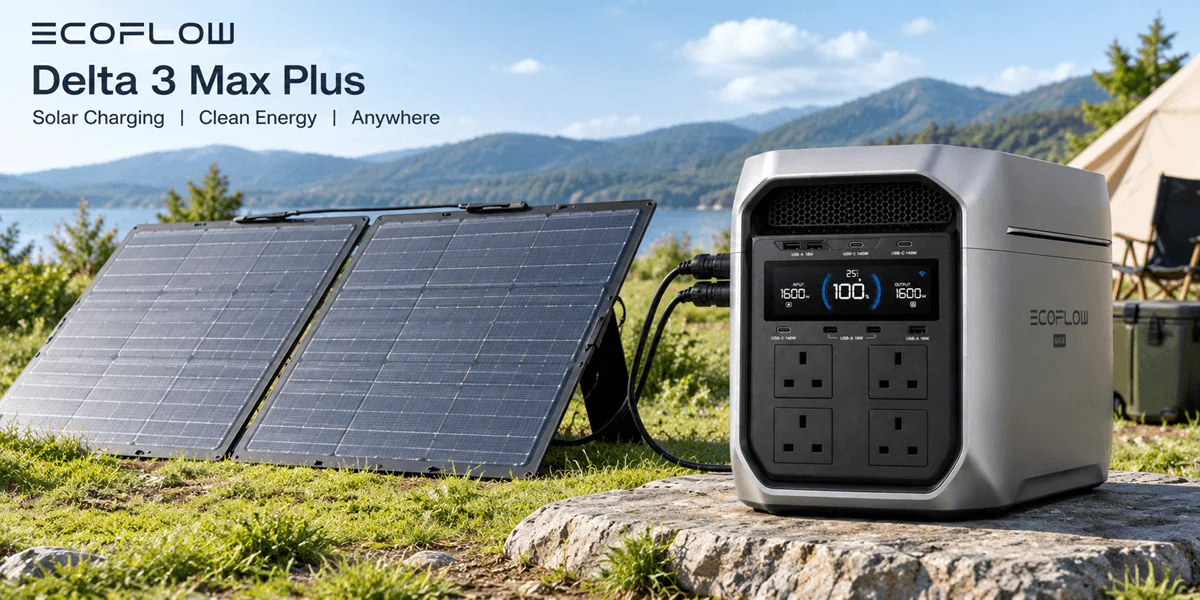
What is the EcoFlow Delta 3 Max Plus?
The EcoFlow Delta 3 Max Plus is a 2,048Wh LiFePO4 power station with 3000W continuous AC output and four UK three-pin sockets. It sits above our EcoFlow Delta 3 Plus review (the smaller 1,024Wh sibling) in EcoFlow’s UK range. It’s built for whole-home backup and power-hungry tools rather than weekend phone charging.
That capacity and output combination puts it in a different bracket to most “portable” power stations. This is less a camping accessory, more a small home battery you can carry, provided you don’t mind its 22.1kg loaded weight. EcoFlow lists it alongside the rest of the Delta 3 Max series. The naming is deliberate: Max Plus sits at the top, with more output and more solar input than the standard Delta 3 Max, despite sharing the same 2,048Wh cell.
EcoFlow Delta 3 Max Plus specs at a glance
Here’s the full spec sheet, taken from EcoFlow’s official UK listing and cross-checked where independent reviewers have measured something different.
| Spec | Value |
|---|---|
| Capacity | 2048Wh |
| Chemistry | LFP (LiFePO4) |
| AC output | 3000W continuous, 6000W surge |
| X-Boost | 3900W |
| AC outlets | 4 x BS 1363 three-pin, 230V 50Hz, 13A max per port |
| USB-A | 1 x 18W |
| USB-C | 1 x 140W, 2 x 45W |
| 12V car port | 12.6V 10A (126W) |
| Anderson Powerpole | 12.6V 30A (378W) |
| AC charge input | 2300W max |
| AC charge time | 0 to 80% in 47 minutes, 0 to 100% in 68 minutes |
| Solar input | 1000W total across 2 ports, 11 to 60V, 18A per port |
| Expansion | Up to 10kWh with 2 x Delta 3 Max Plus Smart Extra Battery |
| UPS switchover | Under 10ms claimed |
| Weight | 22.1kg |
| Noise | 25dB or under at 600W, low 40s dB near full load |
| Connectivity | Wi-Fi, Bluetooth, EcoFlow app |
| Warranty (UK) | 3+2 years (5 years total) |
| Inverter | Pure sine wave |
A pure sine wave inverter matters more than it sounds. It means the power coming out of those sockets is clean enough for sensitive electronics like laptops, routers and medical equipment. Cheaper modified-wave units only approximate that.
The warranty is useful: 3 years as standard, plus 2 more if you register the unit, for 5 years of cover in total. On cycle life, we’ll be straightforward. Every other UK review site quotes a cycle figure that EcoFlow has never published for this unit. EcoFlow states no cycle count for the Delta 3 Max Plus in its UK documentation.
What it does say is that its own internal simulation puts the battery at roughly 10 years of expected life. That’s EcoFlow’s own estimate, not an independently verified cycle figure. We’d rather tell you the number doesn’t exist than repeat one that isn’t real.
How fast does the EcoFlow Delta 3 Max Plus charge?
Fast. Mains AC charging takes it from empty to 80% in 47 minutes and to a full 100% in 68 minutes, drawing up to 2300W. That’s quick enough to top up during an evening at home, and it’s one of the strongest charge speeds in this capacity class.
Owners on UK forums and in professional reviews confirm this speed holds up in practice, not just on the spec sheet. StorageReview’s bench testing found the charging curve matched EcoFlow’s claims closely, tapering as expected once the battery approached full. If you’re used to older power stations that take three or four hours for a full charge, this is a genuine step up.
Can you actually charge it with solar in the UK?
Yes, but temper your expectations. The Delta 3 Max Plus accepts up to 1000W of solar across two MPPT ports, split evenly as 500W per port, at 11 to 60V and 18A per port. That’s the ceiling the hardware allows, not what a typical British afternoon delivers.
On a bright, clear day with well-angled panels, you’ll get close to that figure. On an overcast day, the kind the UK specialises in, expect considerably less. Solar yield tracks light intensity, not daylight hours.
Independent measurement of the solar input window confirms the voltage and current range match spec, but nobody can promise sunshine. Treat solar as a top-up for off-grid days, not your main method if you live somewhere cloudy. For more on getting the most from panels in British conditions, see our solar charging guide.
What will 2,048Wh run in a UK home?
Plenty, for a good while. Once you account for inverter losses of around 12%, you get roughly 1,800Wh of usable energy from the 2,048Wh pack. That’s enough to run a fridge-freezer for close to two days, or keep a router, laptop and lights going through an entire evening power cut.
The table below assumes that 1,800Wh usable figure and typical UK appliance draws. Treat every runtime as an estimate, not a lab measurement. Your actual mileage depends on the model, the ambient temperature and how efficiently your specific appliance runs.
| Appliance | Typical draw | Estimated runtime on 1,800Wh usable |
|---|---|---|
| Fridge-freezer (cycling, not constant) | ~1kWh per day | Around 1.8 days |
| Wi-Fi router | 10W | Around 180 hours (7.5 days) |
| Laptop | 60W | Around 30 hours |
| 55-inch LED TV | 100W | Around 18 hours |
| Electric blanket | 80W | Around 22.5 hours |
| CPAP machine (no humidifier) | 40W | Around 45 hours |
| CPAP machine (with humidifier) | 70W | Around 25.7 hours |
| Kettle (3,000W, ~3 mins per 1.7L boil) | 150Wh per boil | Around 12 boils |
| Microwave | ~1,200W | Around 1.5 hours of continuous use |
A word on the kettle: it draws close to the unit’s full 3000W continuous rating while it’s running. It works, but it uses nearly everything the unit has to give. Don’t expect to boil water and run a microwave at the same time.
If you’re taking this to a caravan or campsite, remember a UK hook-up pitch typically supplies 16A. The Delta 3 Max Plus won’t replace that hook-up for heavy draws like a fan heater or an immersion water heater. It does cover everything else on this list comfortably, and without a generator running outside your window.
What happens when the power goes out?
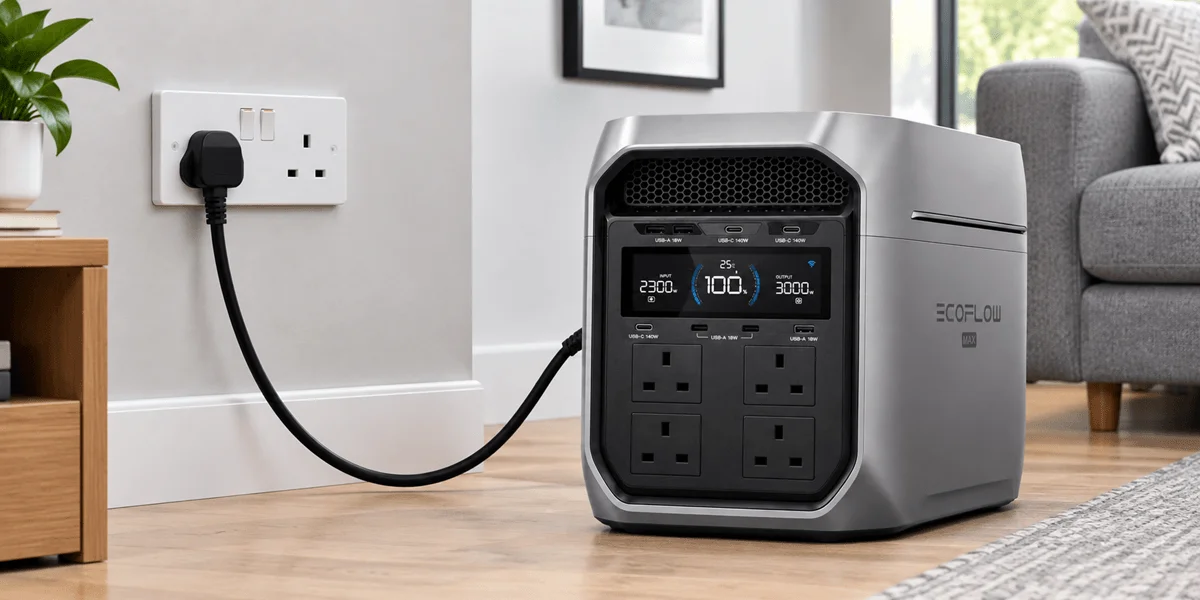
The Delta 3 Max Plus switches from mains to battery in under 10 milliseconds, fast enough that most electronics don’t notice the gap. Independent testers have measured it even quicker: 8ms and 8.4ms in separate bench tests, comfortably inside EcoFlow’s own claim.
Picture a power cut at 2am. Your fridge keeps humming without a blip, your router stays online, and a CPAP machine should carry on uninterrupted at either 40W or 70W depending on the humidifier setting. That’s the scenario this unit is built for. It’s why our best power stations for home backup guide favours a UPS-capable unit like this one over a plain power bank.
EcoFlow’s Storm Guard app feature pre-charges the unit when a storm is forecast, and pass-through charging lets it power your kit while still plugged into the mains.
There’s an honest caveat here, though. Some owners have reported the UPS switchover isn’t always reliable enough for desktop PCs and NAS units, which can be fussier than a fridge or a router. If you need a server rack or gaming PC that must never reboot, don’t assume this solves it outright. Test your setup before relying on it for anything sensitive.
Ports and sockets: what you can plug in
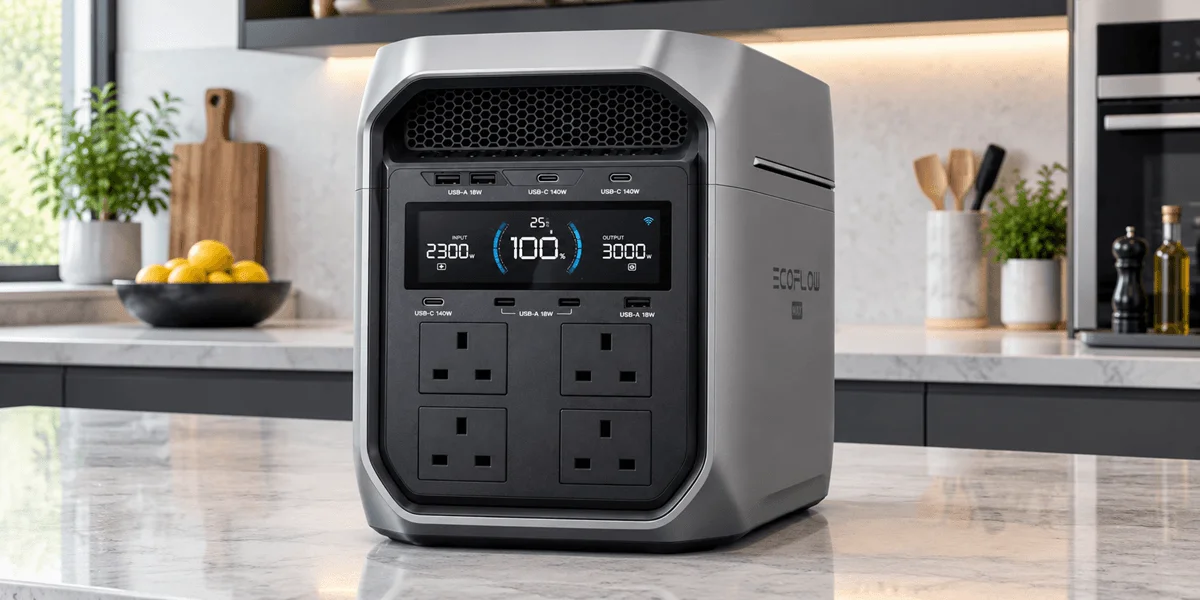
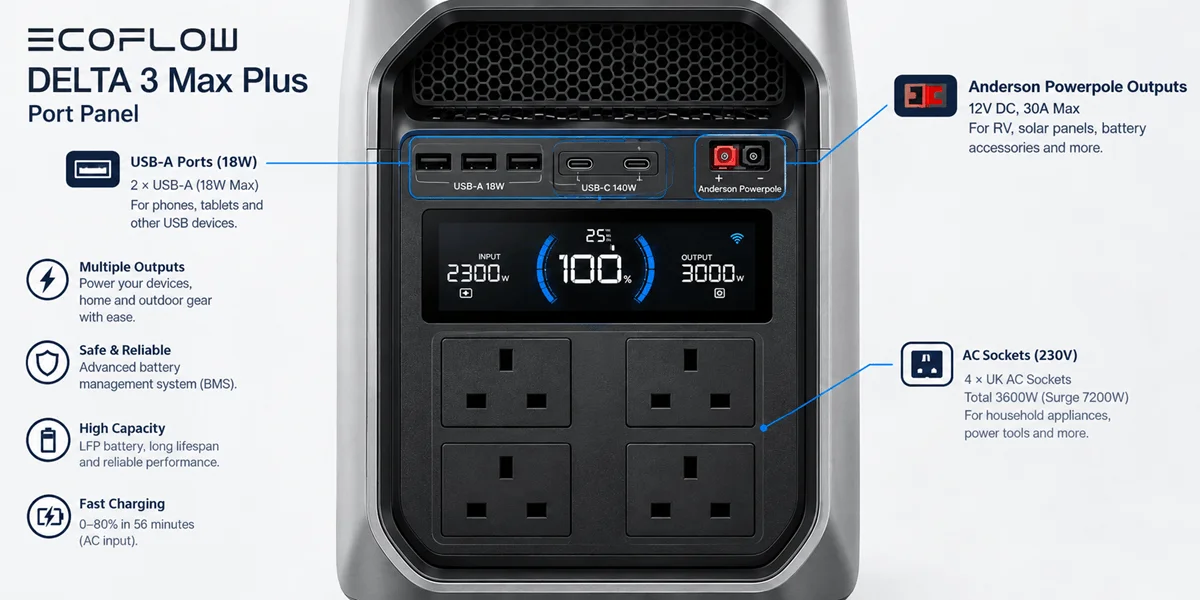
This is where the Delta 3 Max Plus does something few competitors state clearly: it has four full BS 1363 three-pin UK sockets. Not two, and not a mix of EU and UK plugs with an adaptor thrown in. That matters when you’re running a fridge, a router, a lamp and a laptop charger from one unit during a cut.
Beyond the AC sockets: one 18W USB-A port, one 140W USB-C port and two further 45W USB-C ports. There’s also a 12V car-style socket at 126W, and an Anderson Powerpole output at 378W for 12V accessories or campervan setups. If you’re comparing this against every EcoFlow model we’ve reviewed, the port selection here is among the most generous in the range.
How loud is it, really?
Quiet at typical loads, noticeably less quiet near full power. EcoFlow rates it at 25dB or under at 600W, close to the sound of a quiet library. Push it towards its 3000W continuous limit and the fans climb into the low 40s dB. That’s more like a running laptop fan or a quiet extractor fan.
In a living room during a power cut, that low 40s figure is noticeable but not disruptive. In a campervan at night running a fridge and charging a laptop, you’d likely hear it if the van is otherwise silent, though it shouldn’t wake anyone. UK reviewers testing under sustained load reported the same pattern.
Near-silent at moderate draw, audible but not intrusive once you push it hard. If overnight silence matters most, our best power stations for campervans and motorhomes guide can help, but plan to keep the load well under the maximum either way.
EcoFlow Delta 3 Max vs EcoFlow Delta 3 Max Plus: which should you buy?
Buy the Delta 3 Max Plus unless weight is your only concern. It shares the same 2,048Wh capacity as the standard Delta 3 Max but offers considerably more. That’s 3000W continuous output against 2400W, and 1000W of solar input against just 500W. The cost is extra weight: 22.1kg against 20.3kg.
The specs make the comparison fairly clear-cut once you lay them side by side.
We can’t give you the Delta 3 Max’s AC charge time here, because EcoFlow hasn’t published a verified figure and we won’t invent one. What we can tell you from current UK listings is this: the standard Delta 3 Max is sitting at a higher price than the better-specced Max Plus, which is regularly discounted.
That’s unusual, so don’t assume the “Max” name means cheaper. One UK comparison of the whole Delta 3 range reaches a similar conclusion after weighing all three side by side.
Buy the Delta 3 Max Plus if you want the strongest output in the family. Its 1000W solar ceiling matches the Delta 3 Plus rather than beating it, but nothing else in the range comes close on output. Buy the standard Delta 3 Plus instead if 1,024Wh covers your needs and 12.5kg matters more to you than raw power.
Is the extra battery worth it?
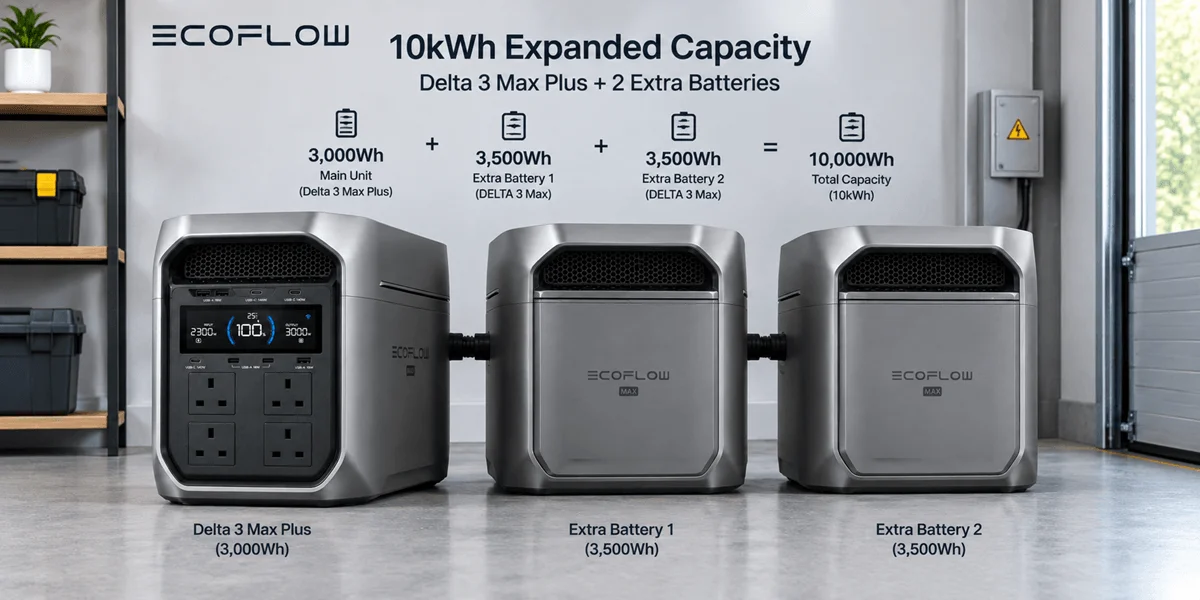
Sometimes. Adding the Delta 3 Max Plus Smart Extra Battery takes total storage up to 10kWh with two units connected, without adding AC output. You’re still limited to 3000W continuous from the main unit’s inverter no matter how many extra batteries you plug in.
Add compatible EcoFlow Delta 3 Max Plus Smart Extra Batteries to grow total capacity, up to a combined ceiling of 10kWh with two connected.
That distinction is the whole decision. If you regularly run out of runtime rather than running out of power, an extra battery solves your actual problem. It does this far more cheaply than buying a second complete power station, since you’re not paying again for an inverter, a screen or a second set of sockets you don’t need.
If it’s peak wattage that trips you up instead (an overloaded circuit, a tool that won’t start), a second battery does nothing for you at all. That’s an output problem, not a storage one, so work out which one you actually have before you spend anything extra.
What it costs to run on a UK tariff
Using the Ofgem price cap for October to December 2026, a full charge costs roughly 60p once you account for charging losses, based on the Great Britain average direct debit rate of 26.32p per kWh.
There’s also a standing charge of 54.83p per day, regardless of how much you use. Here’s the maths so you can redo it yourself. A full charge stores 2.048kWh, so at 26.32p per kWh that’s roughly 54p of electricity before any losses. Chargers aren’t perfectly efficient though.
Assume around 90% efficiency and you’re actually drawing about 2.276kWh from the wall, which brings the real cost closer to 60p per full charge. That’s a small amount to keep backup power topped up and ready.
The standing charge applies whether or not you ever plug this in. It’s not a “cost” of owning the unit, just a fact of being connected to the grid, so don’t mistake it for part of the charging bill.
Who should not buy the EcoFlow Delta 3 Max Plus
- Anyone carrying it up flights of stairs regularly, or who wants to lift it one-handed into a rucksack: at 22.1kg, this isn’t a grab-and-go unit
- Buyers who mainly need light, portable power, such as phones, small lights or the odd laptop charge: they’ll pay for capacity and output they’ll rarely use
- Workshop owners running equipment with a high start-up spike: a table saw (roughly 7,000W) and a planer thicknesser (roughly 9,000W) both exceed the 6000W surge rating, even briefly
- Anyone whose actual need is under 1,000Wh, such as charging phones and a laptop over a weekend: the smaller Delta 3 Plus will suit you better and cost less to run
Pros and cons
- Fast AC charging: 80% in 47 minutes
- 3000W continuous output covers demanding appliances and tools
- Four full UK three-pin sockets, no adaptors needed
- UPS switchover measured under 10 milliseconds in independent testing
- Solid, flex-free build quality reported consistently by owners
- Expandable to 10kWh for long-duration backup
- Quiet at everyday loads, under 25dB at 600W
- Capable companion app with scheduled charging, Storm Guard and port priority
- Fan noise climbs into the low 40s dB near full load
- Firmware bugs have been introduced by some app updates
- No car-charging cable, solar cables or Anderson adaptors included
- UPS switchover reported as not reliable enough for some desktop PCs and NAS units
- At 22.1kg, not something you'll want to carry often
- Can't handle the start-up surge of high-inrush power tools
Owner feedback broadly backs this up. Build quality is a recurring theme in positive reviews. One detailed write-up specifically praises the lack of creak or flex you sometimes find in cheaper units at this size.
Alternatives worth considering
If you want the same capacity from a slightly older generation, see how it compares to the EcoFlow Delta 2 Max (same 2,048Wh capacity). You’ll typically lose some solar input and charge speed against the newer Delta 3 Max Plus, though the underlying storage figure is identical. T3’s UK review of the newer unit notes the generational improvements are real rather than marketing spin.
Outside the EcoFlow range, the Bluetti Elite 200 V2 sits in a similar capacity and output bracket. It’s worth comparing warranty terms and app features before you commit. For buyers needing more than 3000W continuous, perhaps for a full workshop, the Bluetti Apex 300 goes further. That costs extra weight and bulk.
None of these are worse products outright; they’re different trade-offs on weight, output and price. If UK three-pin sockets, fast AC charging and expansion to 10kWh matter most, the Delta 3 Max Plus remains the strongest all-rounder.
Verdict: is the EcoFlow Delta 3 Max Plus worth it?
Yes, for the right buyer. If you want serious whole-home backup, fast charging and enough output to run real tools, not just small electronics, the EcoFlow Delta 3 Max Plus earns its place near the top of its category. It’s not for everyone: it’s heavy, and it can’t survive the biggest power tool start-up surges. Shop around for the best price, as UK retailers discount it seasonally.
Frequently Asked Questions
Yes, if you need whole-home backup, workshop power or fast charging in a single unit. It’s a strong specification for its category, with 3000W continuous output, four UK sockets and an under 10 millisecond UPS switchover. Its weight and its limits against high-inrush power tools mean it isn’t right for everyone.
Around 1.8 days on the roughly 1,800Wh usable from a full charge, assuming a typical fridge-freezer using about 1kWh per day. That figure varies with the model, the ambient temperature and how often the door opens, so treat it as an estimate.
Mains AC charging takes it from empty to 80% in 47 minutes and to 100% in 68 minutes, drawing up to 2300W. Solar charging is available too, up to 1000W across two ports, though UK weather means you’ll rarely see that full figure in practice.
Both share the same 2,048Wh capacity, but the Delta 3 Max Plus offers more continuous output (3000W against 2400W) and far more solar input (1000W against 500W). It weighs slightly more at 22.1kg against 20.3kg. Despite being the better-specced unit, it’s currently priced below the standard Delta 3 Max in UK listings.
It can keep essentials running well: fridges, routers, lighting, laptops and medical equipment like CPAP machines, switching over in under 10 milliseconds. It won’t power an entire house the way a whole-home generator or battery system would. Prioritise essential circuits rather than expecting it to run everything at once.
Yes, the LiFePO4 chemistry and built-in UPS function are designed for this kind of standby use. EcoFlow doesn’t publish a standby draw figure, so budget for a small trickle of consumption while it sits ready between cuts. It doesn’t publish a cycle count, but does state an estimated lifespan of roughly 10 years based on its own internal simulation.
Fan noise rises into the low 40s dB near full load, and some owners report firmware bugs following app updates. The box also doesn’t include a car-charging cable, solar cables or Anderson adaptors. A handful of owners report the UPS switchover isn’t fully reliable for sensitive desktop PCs and NAS units.
Up to two Delta 3 Max Plus Smart Extra Batteries, taking total system capacity up to 10kWh. Adding batteries increases storage and runtime, nothing else. The 3000W continuous output ceiling from the main unit’s inverter stays the same, regardless of how many extra batteries you connect.