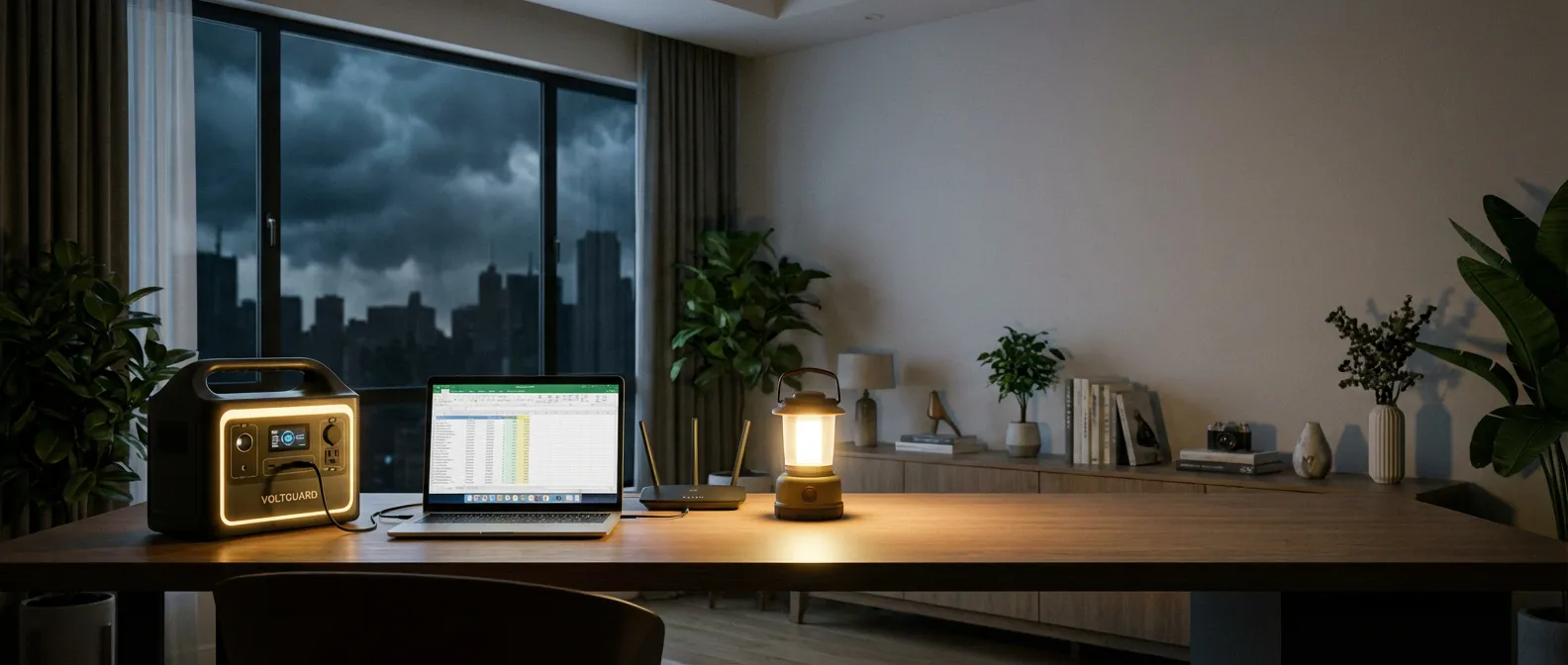
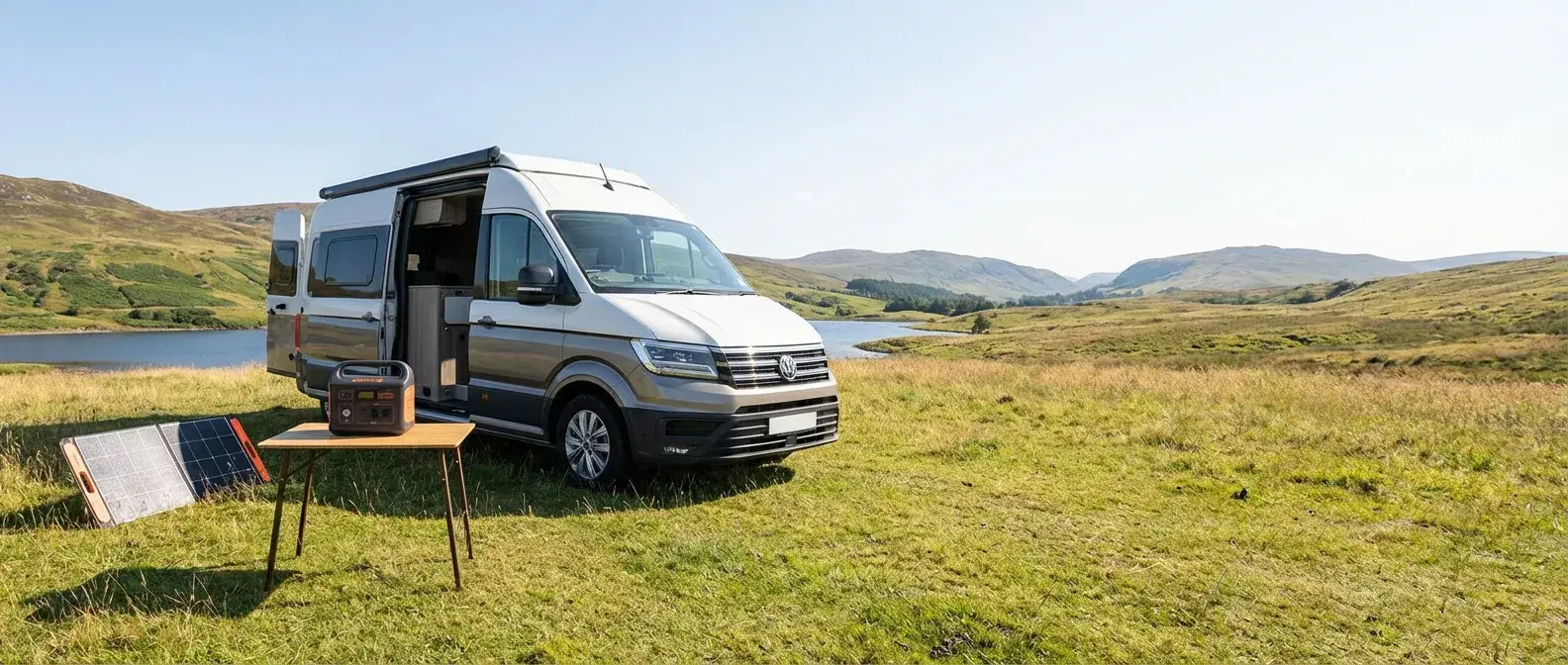
The EcoFlow Delta 2 remains our Best Overall pick for most UK buyers. It balances capacity, output and fast charging well. It’s the previous generation now, and EcoFlow’s newer DELTA 3 models, several of which are on this list, have replaced it. We’ve reviewed twelve models here, covering weekend campers, full-time van lifers, tradespeople and anyone planning for power cuts at home. Capacity ranges from the 286Wh EcoFlow RIVER 3 Plus, a compact 4.7kg unit, up to the 4,096Wh EcoFlow Delta Pro 3. That one weighs 51.5kg and is built to stay in one place through long power cuts. Between those two, you’ll find options suited to almost any UK use case.
A portable power station is a rechargeable LiFePO4 battery pack with 230V BS 1363 UK sockets, USB ports and solar-panel input. It stores mains or solar electricity and releases it on demand, running quietly with no exhaust fumes, so it works indoors as well as out. UK buyers use one for camping, van life and backup power during power cuts.
The EcoFlow Delta 2 is our top recommendation for most UK buyers. It has 1,024Wh of capacity and 1,800W of output. It charges to 80% in 50 minutes and carries a 5-year UK warranty. For camping, our top pick is the EcoFlow Delta 3 Classic, which charges to 80% in 45 minutes. For campervans, it’s the EcoFlow Delta 3 Max Plus. It offers 1,000W of alternator charging and 1,000W of solar across two inputs. For home backup, our top pick is the EcoFlow Delta 3 Plus. It switches to battery in under 10ms and expands to 5kWh with extra batteries. For solar charging, the Bluetti Elite 100 V2 accepts 1,000W of solar on a single input.
At a Glance: Our Top Picks
| Model | Capacity | Output | Weight | Battery | Rating |
|---|---|---|---|---|---|
| EcoFlow Delta 2: | 1024 Wh | 1800 W | 12 kg | LiFePO4 | 8.9/10 |
| EcoFlow RIVER 3 Plus: | 286 Wh | 600 W | 4.7 kg | LiFePO4 | 8.2/10 |
| EcoFlow Delta 3 Classic Portable Power Station: | 1024 Wh | 1800 W | 12.1 kg | Auto-grade LFP | 8.5/10 |
| Jackery Explorer 500 v2: | 512 Wh | 500 W | 5.7 kg | LiFePO4 | 8.2/10 |
| EcoFlow Delta 3 Plus: | 1024 Wh | 1800 W | 12.5 kg | LFP | 8.0/10 |
| Bluetti Elite 100 V2: | 1024 Wh | 1800 W | 11.5 kg | LFP | 9.1/10 |
| Jackery Explorer 1000 v2: | 1070 Wh | 1500 W | 10.8 kg | LFP | 9.0/10 |
| Anker SOLIX C1000 Gen 2 Portable Power Station: | 1024 Wh | 2000 W | 11.3 kg | LFP | 9.0/10 |
| Bluetti Elite 200 V2: | 2073.6 Wh | 2600 W | 24.2 kg | LiFePO4 | 7.8/10 |
| EcoFlow Delta 3 Max Plus: | 2048 Wh | 3000 W | 22.1 kg | LiFePO4 (LFP) | 7.5/10 |
| Bluetti Apex 300 : | 2765 Wh | 3840 W | 38 kg | LFP | 9.2/10 |
| EcoFlow Delta Pro 3: | 4096 Wh | 4000 W | 51.5 kg | LiFePO4 | 8.0/10 |
How We Researched This Guide
Valerie Wei pulled manufacturer specifications directly from EcoFlow UK, Jackery UK, Bluetti, and Anker’s official product pages. These were cross-referenced against Amazon UK owner reviews and measurements published by independent technical reviewers such as T3, TechRadar and StorageReview. Conflicting figures between sources were resolved by defaulting to the manufacturer’s own published spec sheet.
Several UK-specific factors were weighted more heavily than in international guides. These include UK warranty channel availability, not just a global warranty, and confirmed UK retail and Amazon UK stock. We also weigh which of our four tiers each unit sits in and whether it has BS 1363 three-pin sockets. For solar, we use realistic UK sun hours, not peak figures from sunnier climates.
We never make fake hands-on testing claims. This site’s editorial policy is that every conclusion is grounded in verified manufacturer specifications and real owner experience reported through structured UK review platforms. No model is recommended because of brand relationships or undisclosed commercial arrangements.
Research for this guide was conducted by Valerie Wei, Editorial Contributor.
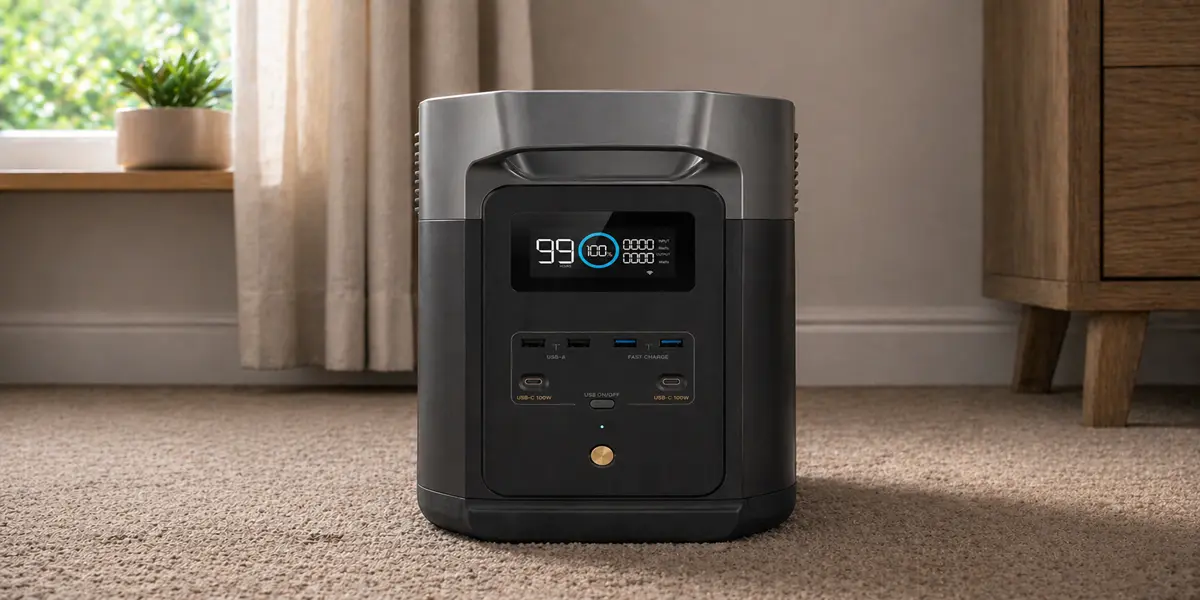
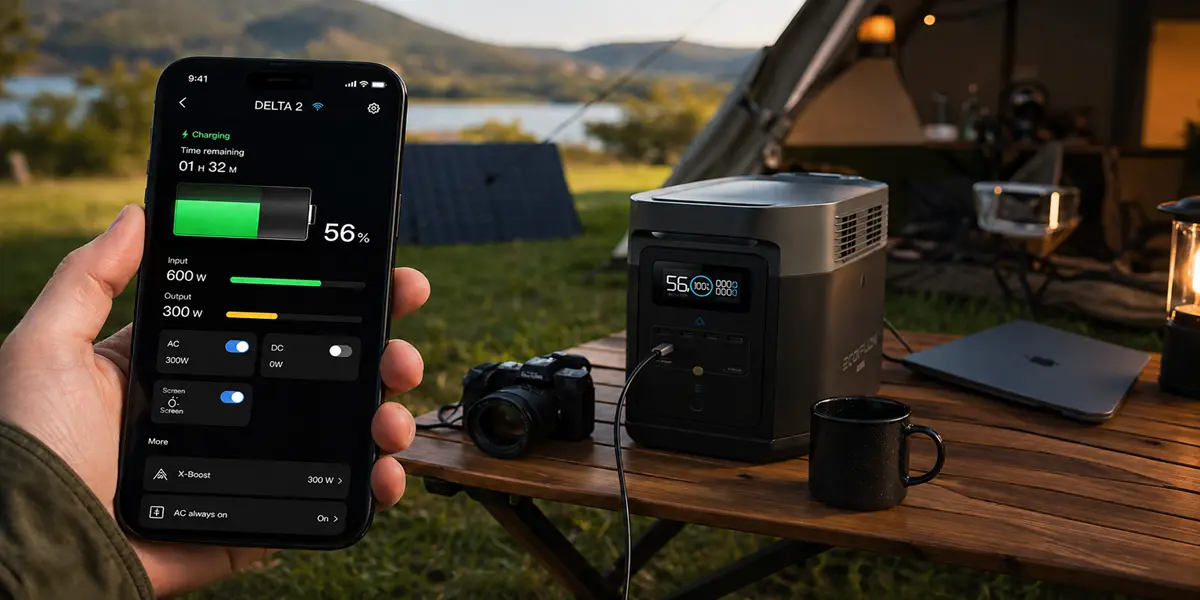
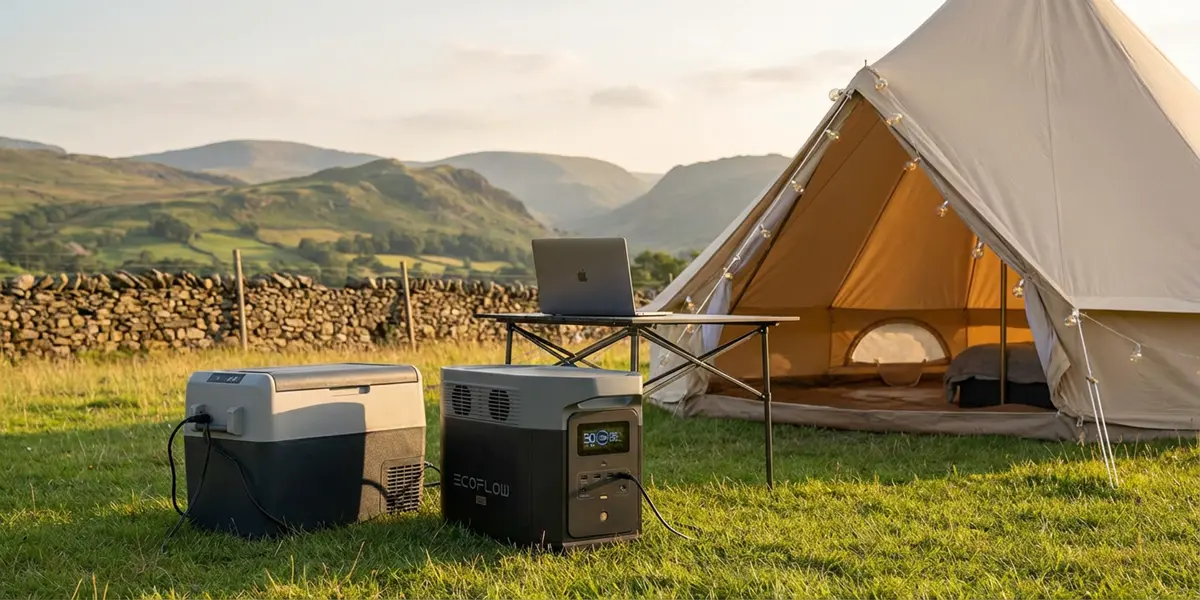
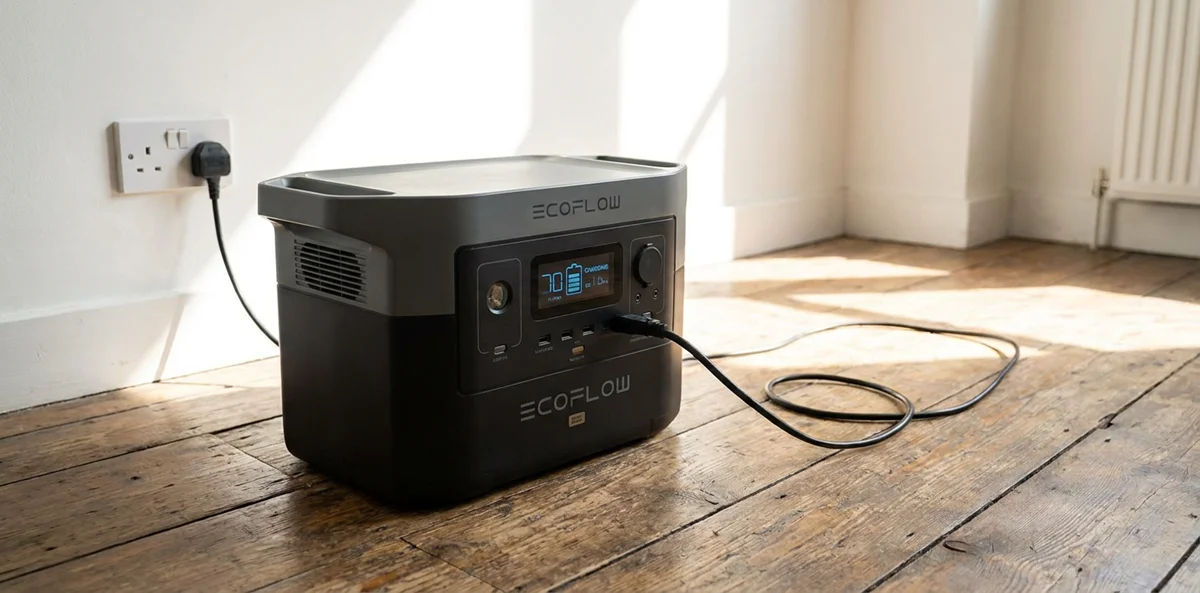
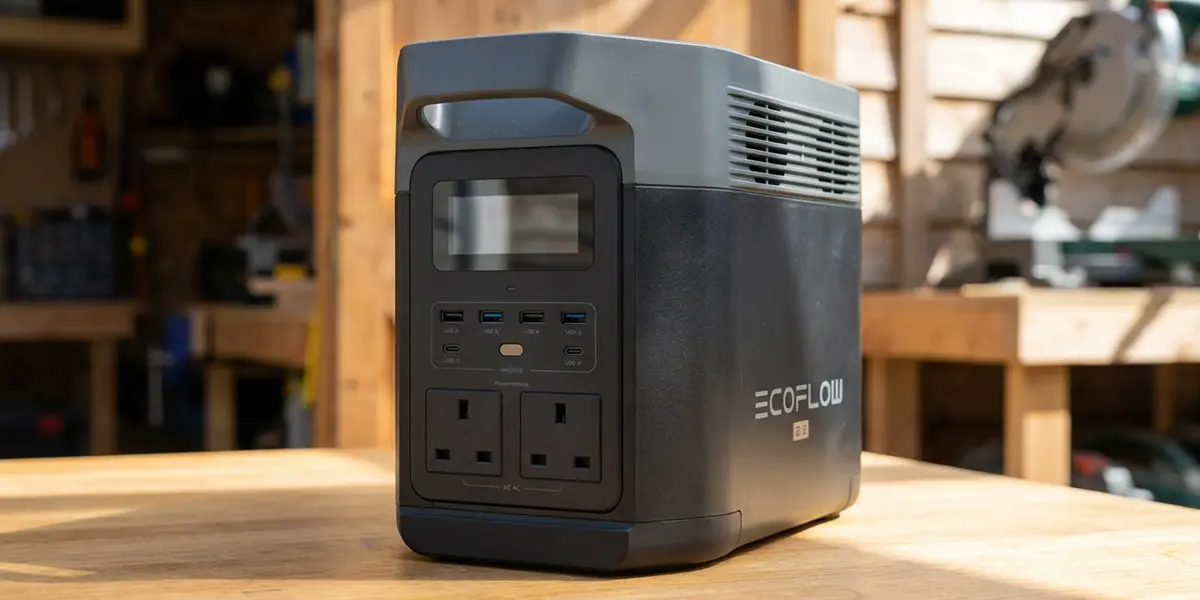
EcoFlow Delta 2: 1,800W and 1,024Wh, backed by a 5-year warranty
| Capacity | 1024Wh |
| AC Output | 1800W |
| Weight | 12 kg |
| Battery | LiFePO4 |
| UK Warranty | 5 years UK |
- Our Best Overall pick, with 13 ports on one unit
- Expandable from 1,024Wh up to 3kWh with extra batteries
- Rated to 3,000 cycles and backed by a 5-year warranty
- 12kg, lighter than the Delta 3 Classic and Delta 3 Plus
- Previous generation, so EcoFlow UK no longer stocks it directly
- 30ms EPS switchover is the slowest of the twelve here
- 500W solar input, half the 1,000W Delta 3 Plus and Max Plus take
Buy it for a proven, well-ported all-rounder, but it’s the previous generation and EcoFlow UK has moved on to the Delta 3 range. You can still find it on Amazon UK, and Trusted Reviews rated it among the best power stations it has covered. Its 30ms switchover is the slowest here, well behind the 10ms models. Its 500W solar input also trails the Delta 3 Plus, so look there for faster solar top-ups.
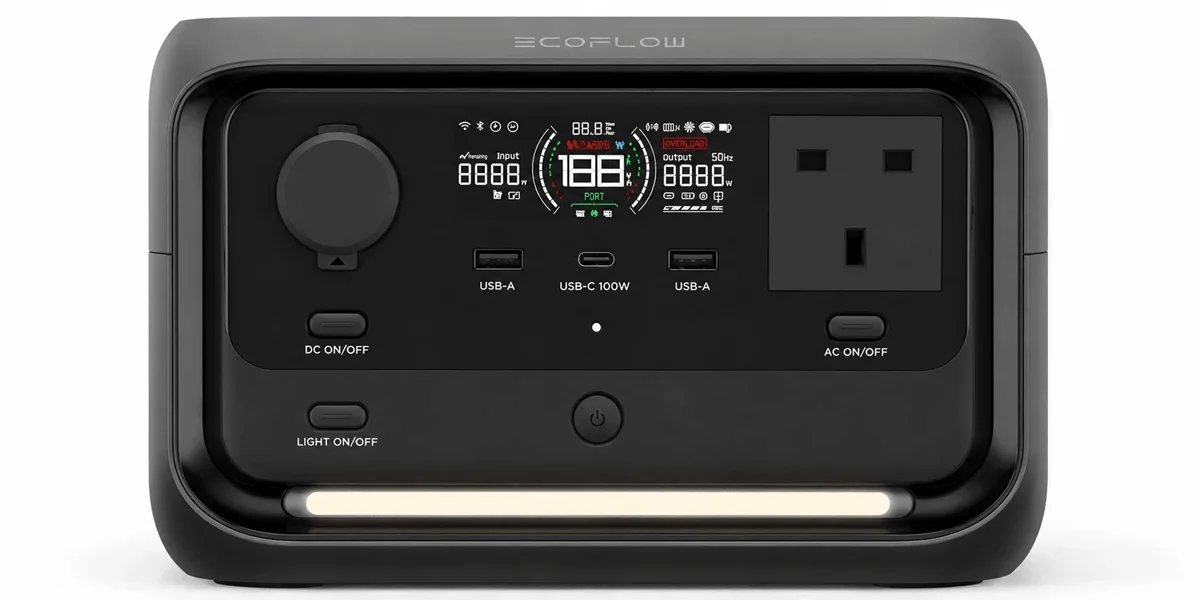
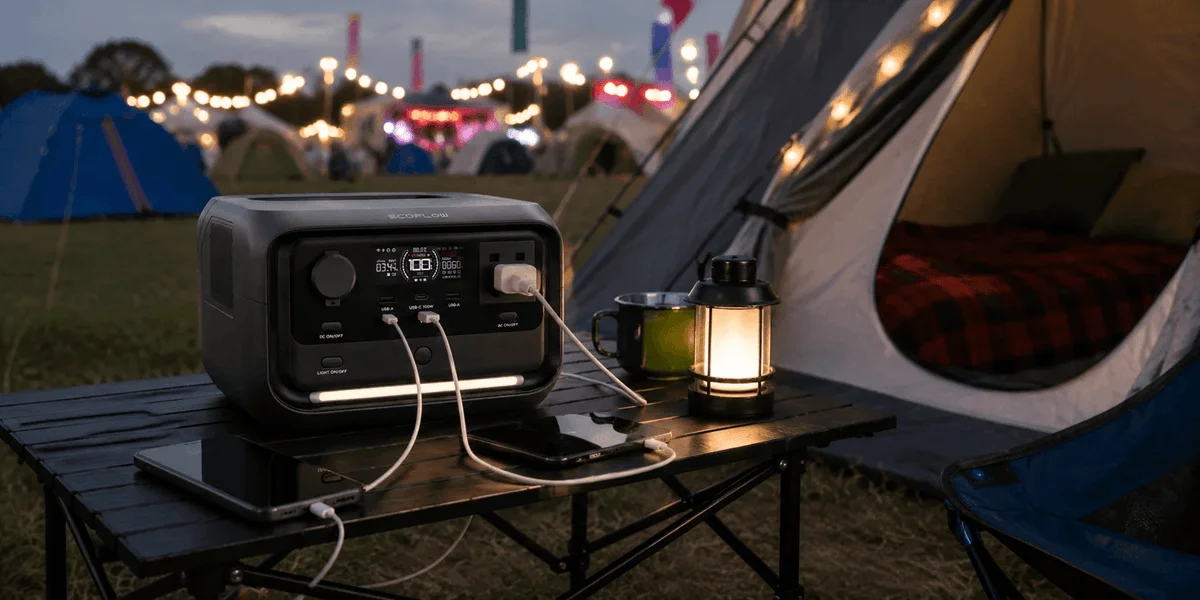
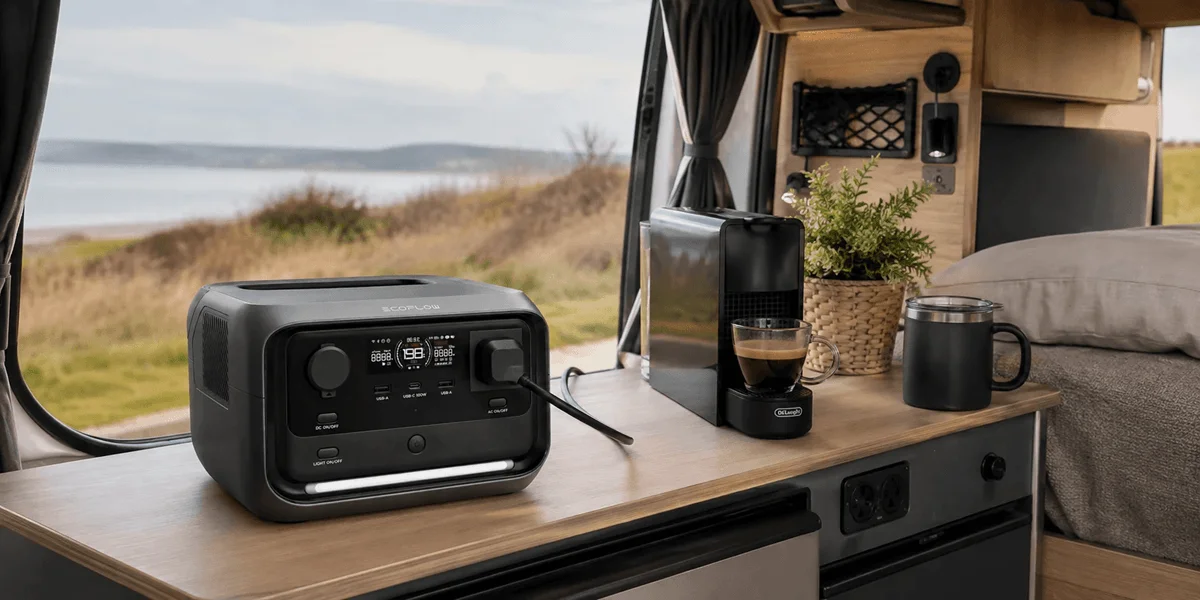
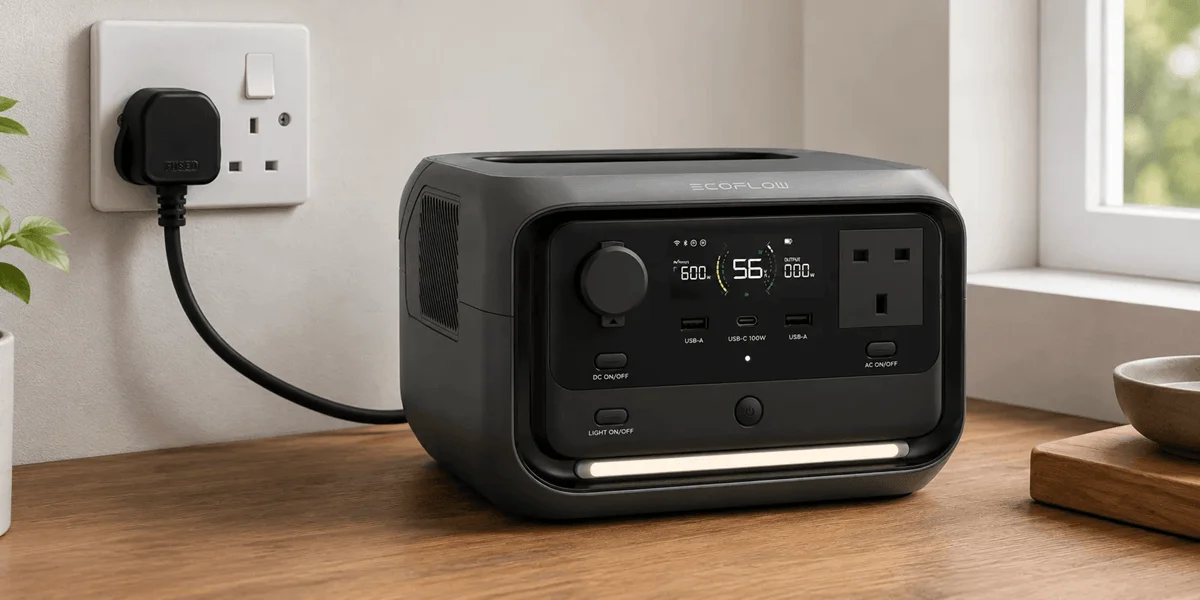
EcoFlow RIVER 3 Plus: sub-10ms UPS switchover, 286Wh at 4.7kg
| Capacity | 286Wh |
| AC Output | 600W |
| Weight | 4.7 kg |
| Battery | LiFePO4 |
| UK Warranty | 5 years UK |
- Our Best Small UPS pick, lightest unit on this list at 4.7kg
- StorageReview measured a 9ms UPS switchover, well under 10ms
- Quiet running, staying under 30dB during normal use
- 286Wh covers small loads: router, CPAP, laptop and lights
- 600W won't run a kettle or heater
- The Amazon UK bundle adds a 110W panel, which suits solar users more than buyers who only recharge from the mains.
Pick the RIVER 3 Plus to keep a router, laptop or CPAP machine running through a power cut, not the whole house. At 4.7kg it’s easy to carry, StorageReview measured a 9ms switchover, and Currys owners give it 4.7 out of 5 from 26 reviews. It holds far less energy than the Delta 3 Plus or Elite 100 V2. The 1,200W X-Boost is a mode for heating devices, not a surge rating.
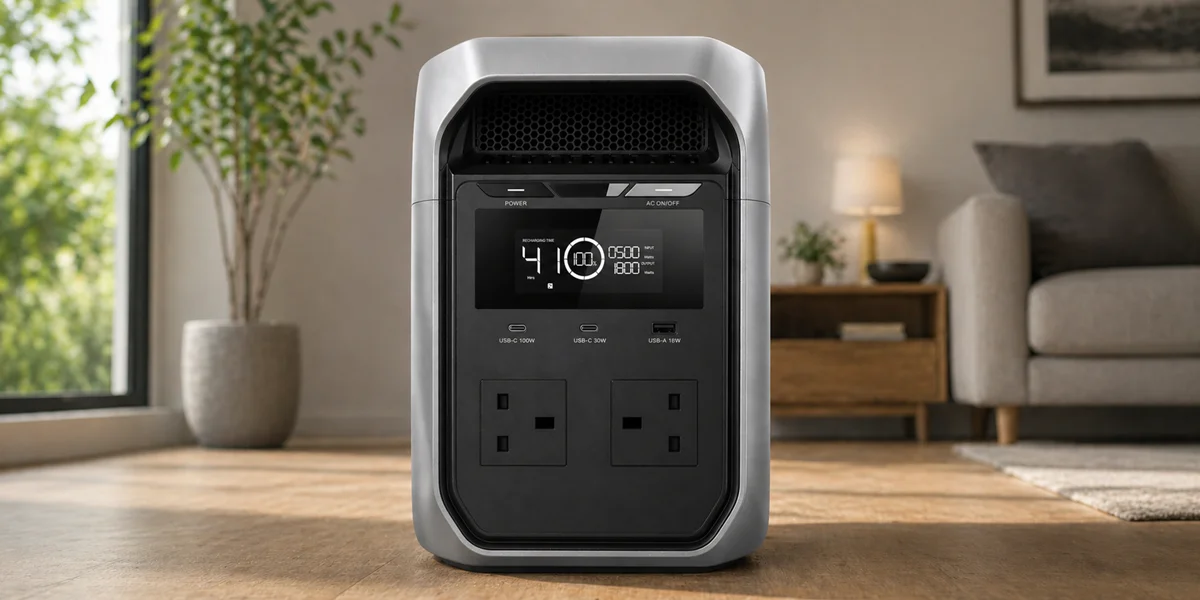
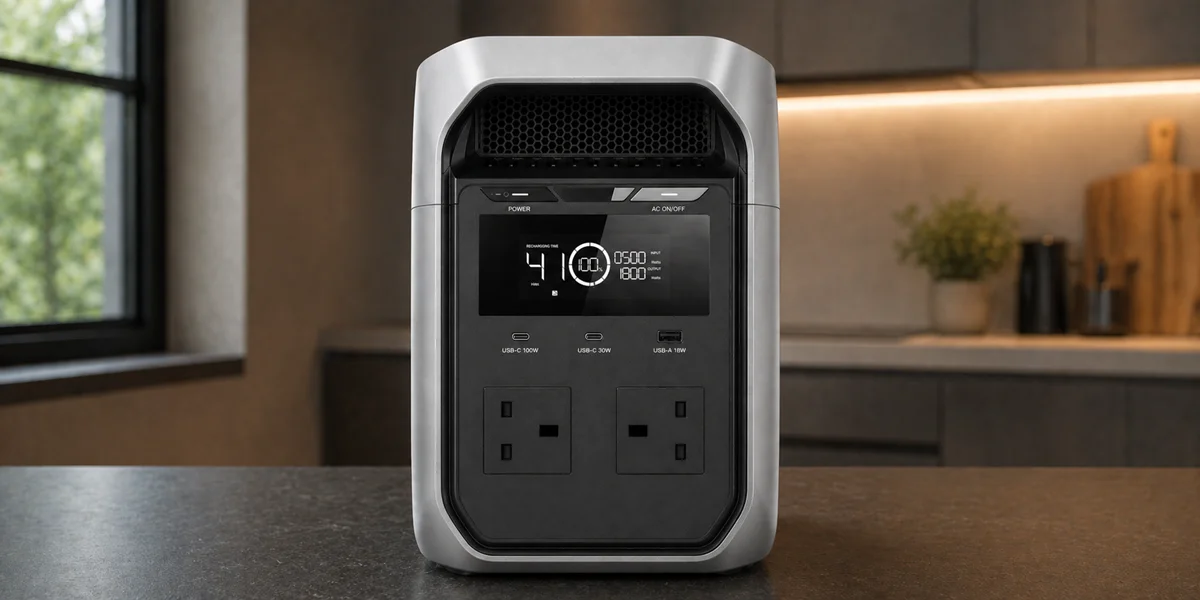
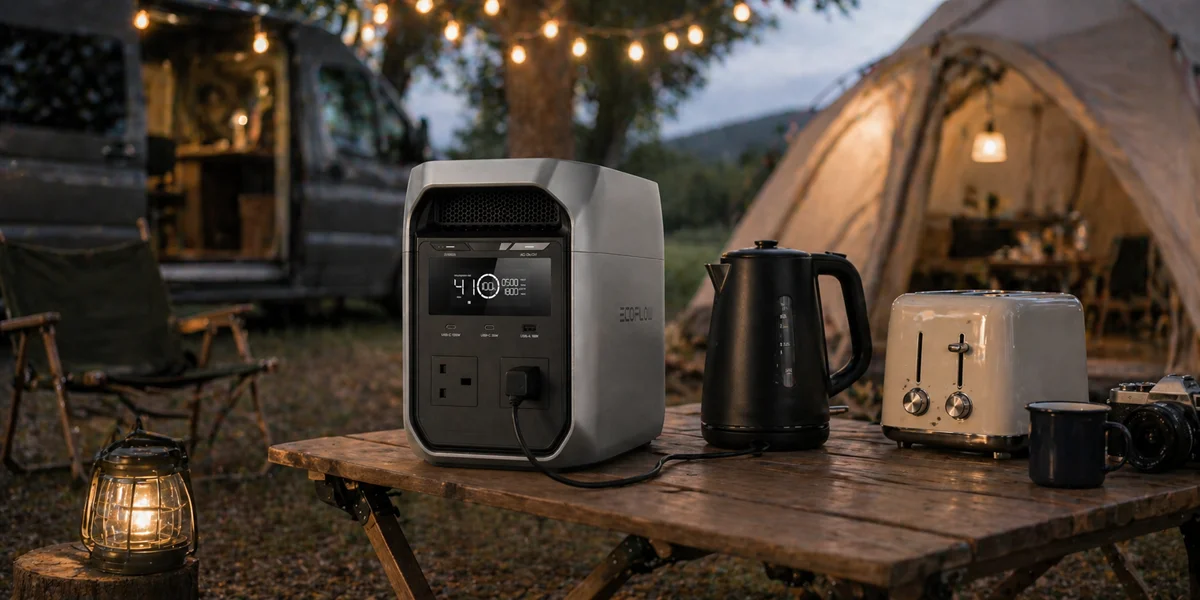
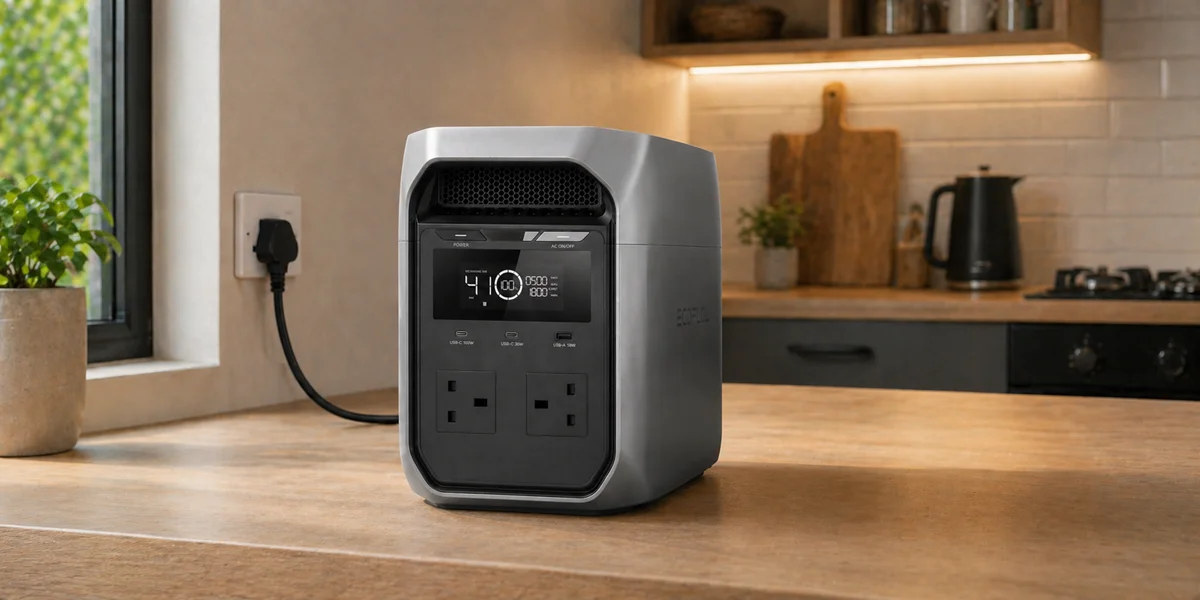
EcoFlow Delta 3 Classic: 0 to 80% in 45 minutes, under 30dB at 600W
| Capacity | 1024Wh |
| AC Output | 1800W |
| Weight | 12.1 kg |
| Battery | Auto-grade LFP |
| UK Warranty | 3+2 years UK |
- Our Best Camping pick, with a 45-minute 0 to 80% charge
- Runs under 30dB at 600W, one of the quieter units here
- 3,600W surge rating covers short start-up spikes from other kit
- Only 2 UK sockets and no 12V car output at all
- Not expandable, unlike the Delta 2 or Delta 3 Plus
- National World noted a slightly noisier fan
This is our camping pick because it charges fast and runs quiet at typical loads. The Mud Life pitches it at camping, overlanding and van life. Its 45-minute 0 to 80% charge beats the older Delta 2’s 50 minutes. Next to the Delta 3 Plus it has no expansion or 12V socket, so pick that one if you’ll want to grow capacity.
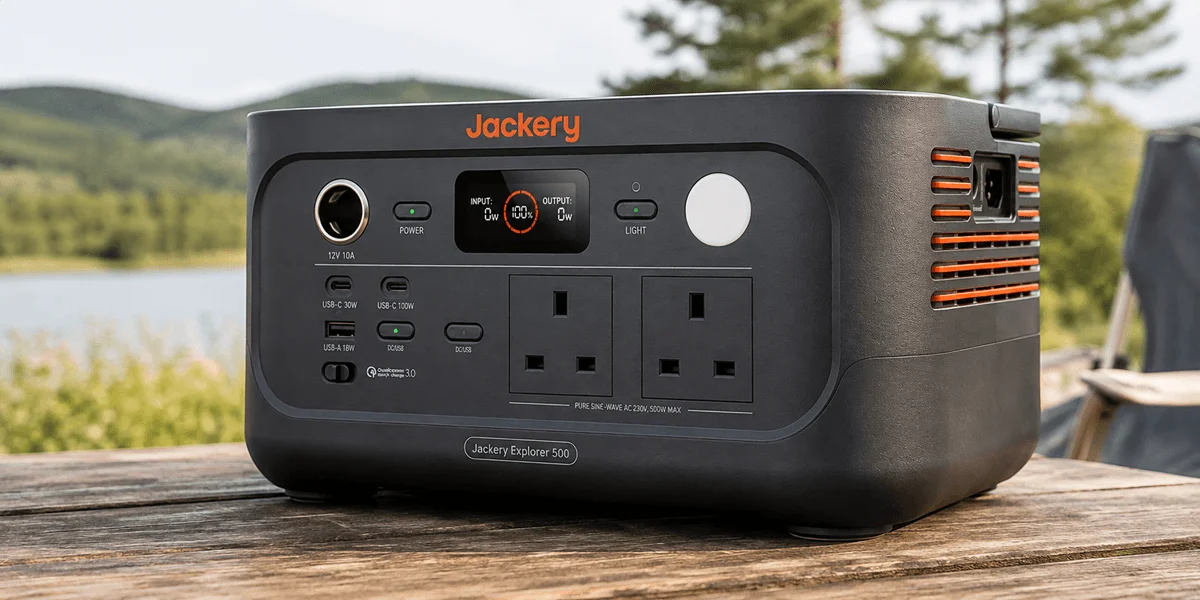
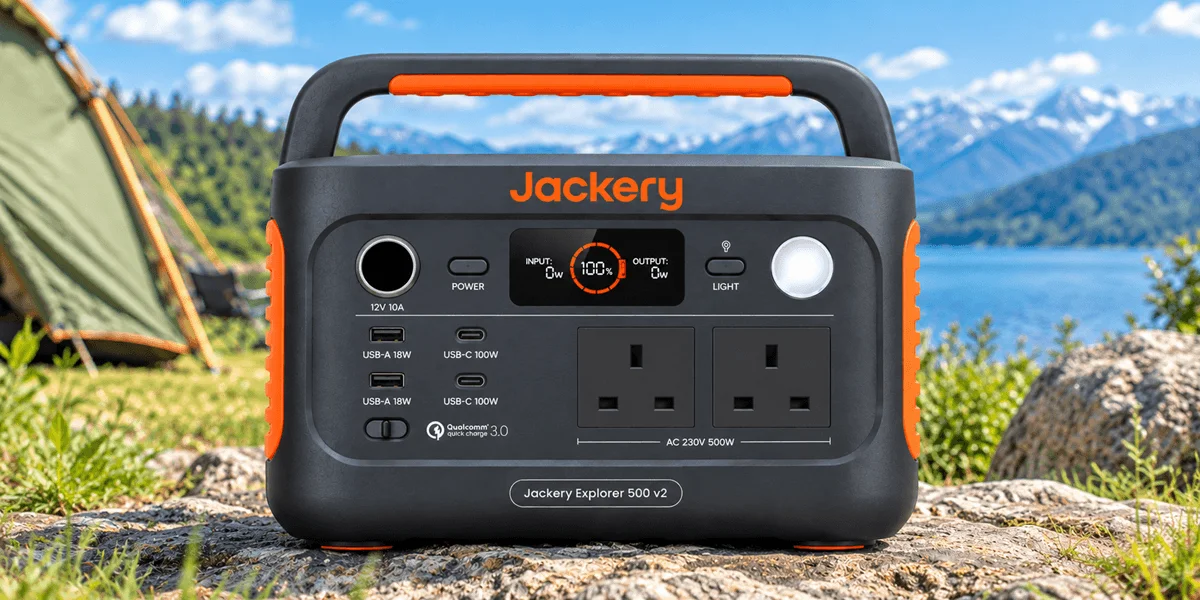
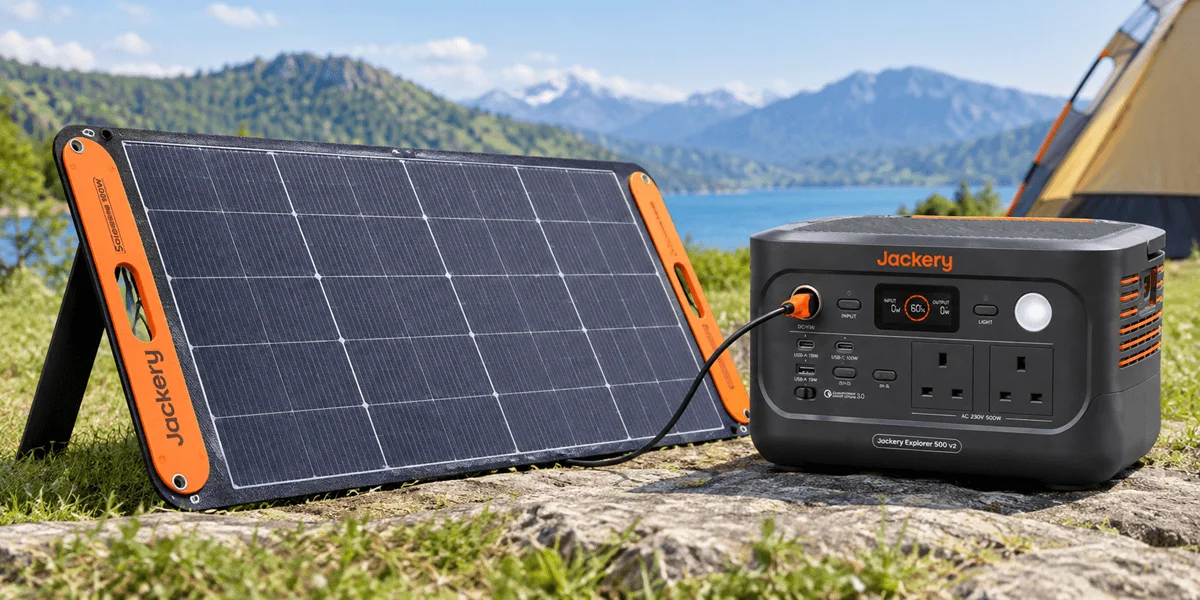
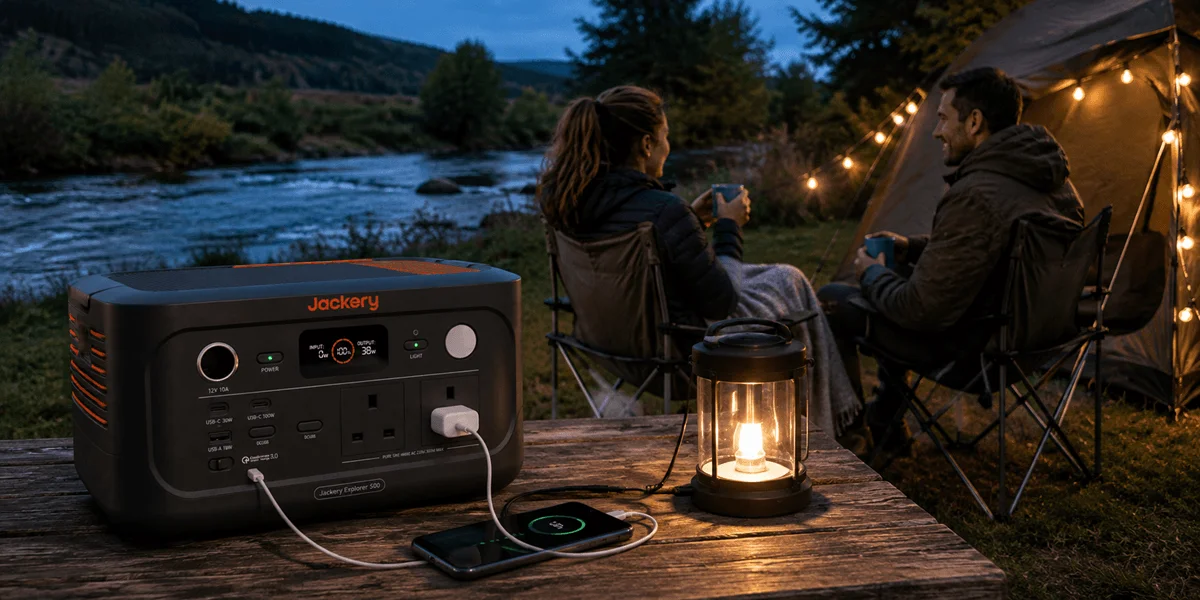
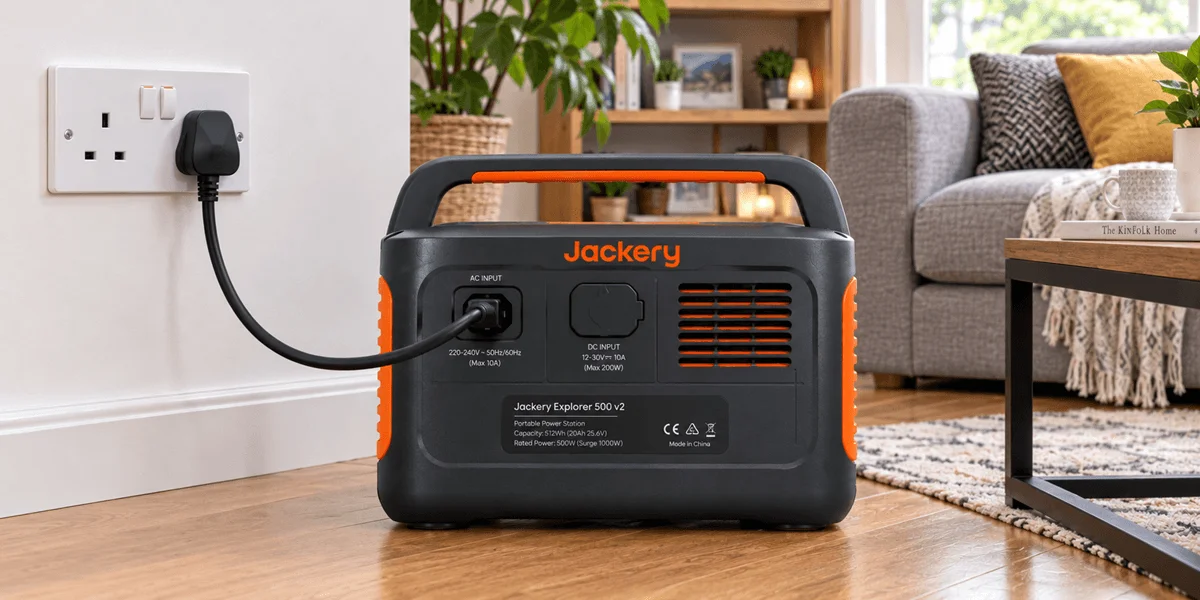
Jackery Explorer 500 v2: 5.7kg with a UPS switchover under 10ms
| Capacity | 512Wh |
| AC Output | 500W |
| Weight | 5.7 kg |
| Battery | LiFePO4 |
| UK Warranty | 5 years UK |
- Our Best Lightweight pick, a genuine one-hand carry at 5.7kg
- Rated to 6,000 cycles to 70%, among the longest lives here
- Quiet at 28dB discharging, so it won't disturb a tent
- 500W continuous output is the lowest on this list
- Only 200W of solar input and no app to monitor it
- No IP rating, so keep it out of the rain
Choose it when weight matters more than raw power: at 5.7kg, only the RIVER 3 Plus on this list is lighter. T3 calls it a fit for localised UPS use and camping, and TechRadar lists camping, van life and backup. It holds nearly double the RIVER 3 Plus’s capacity, but T3 saw an 800W heater trip its 500W limit. Look elsewhere for app control or faster solar.
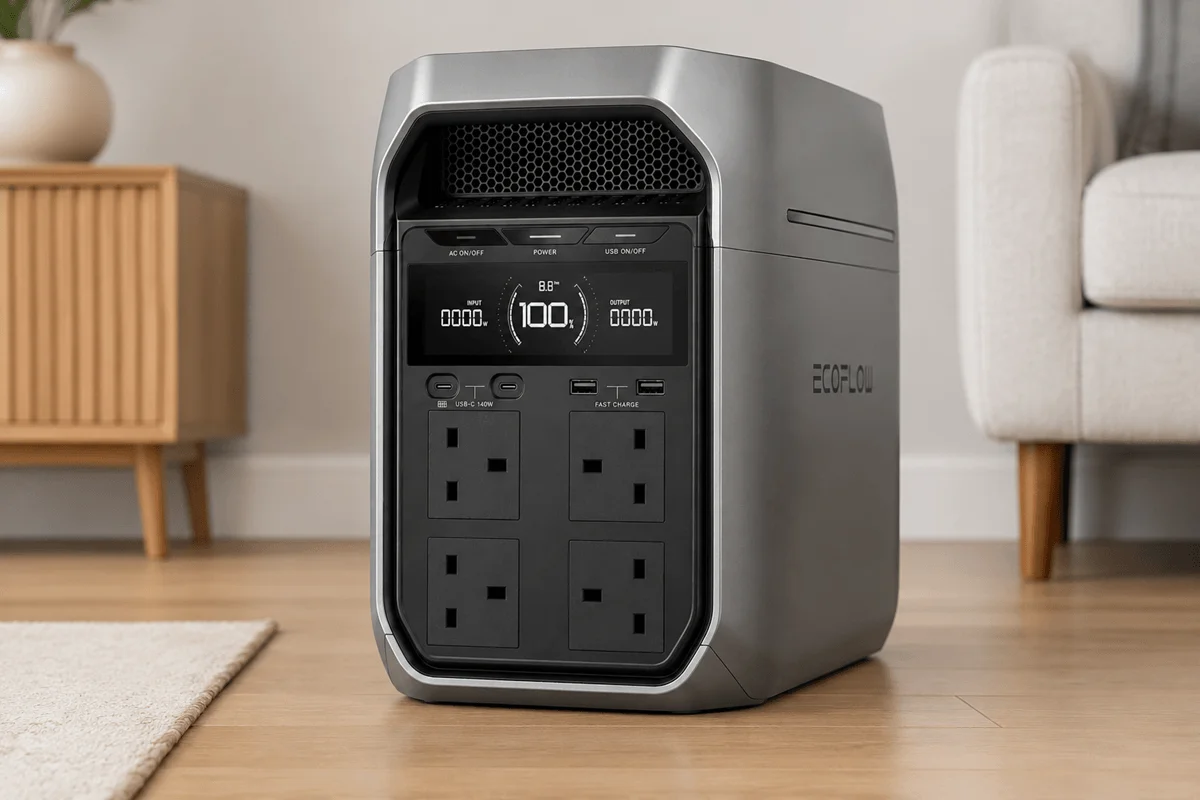
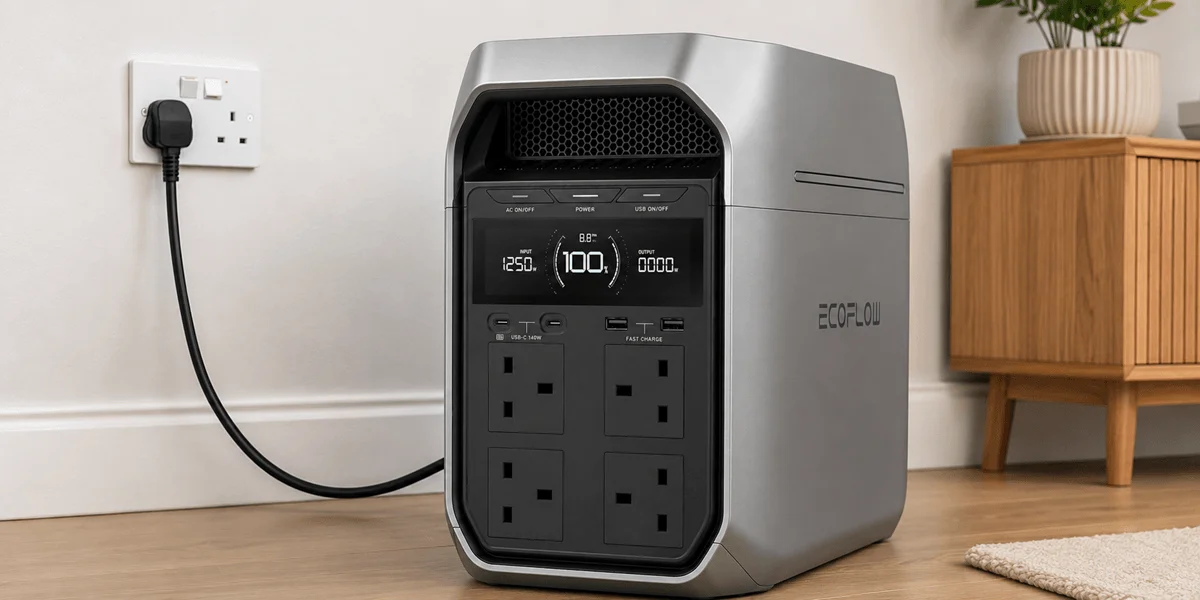
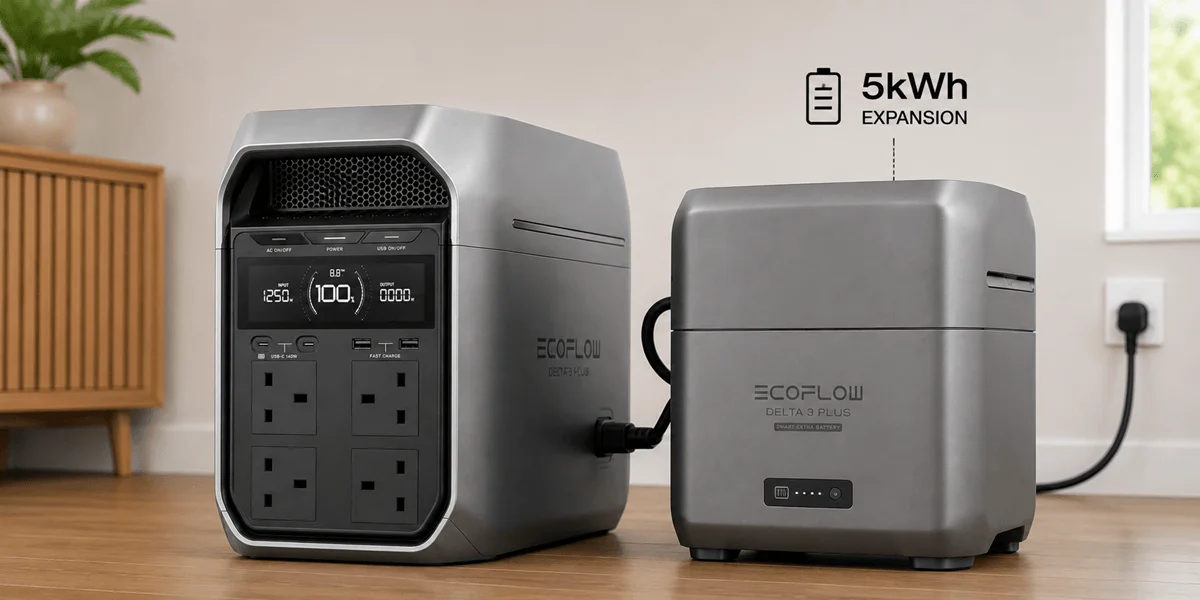
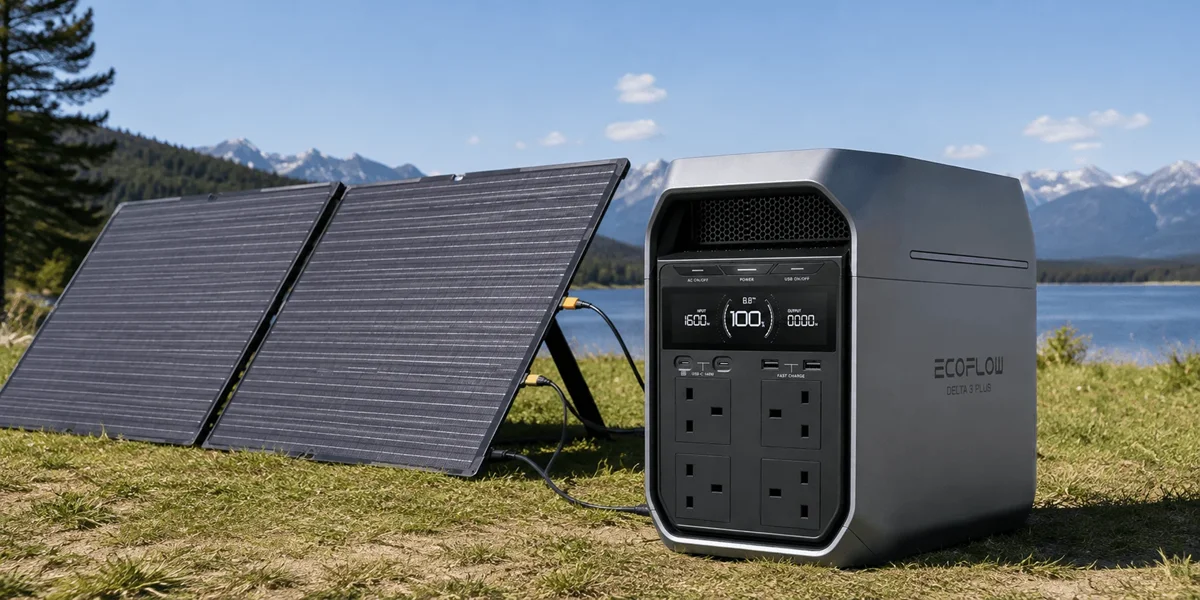
EcoFlow Delta 3 Plus: 1,024Wh that grows to 5kWh, with sub-10ms UPS
| Capacity | 1024Wh |
| AC Output | 1800W |
| Weight | 12.5 kg |
| Battery | LFP |
| UK Warranty | 5 years UK |
- Our Home Backup pick, 0 to 80% in 40 minutes, full in 56
- 800W alternator charging, which tops up the battery while you drive
- Expandable to 5kWh and rated to 4,000 cycles
- UPS switchover under 10ms with NAS and HID shutdown support
- T3 and Trusted Reviews both flagged fan noise at low loads
- 12.5kg, heavier than the camping-focused units on this list
This is the one to buy for proper home backup. TechRadar gave it five stars for camping, RV and home-office UPS use. Trusted Reviews measured a 10ms switchover and a 55-minute full charge, and called it excellent value. Next to the RIVER 3 Plus it holds more energy and adds alternator charging, but T3 and Trusted Reviews flagged fan noise at light loads.
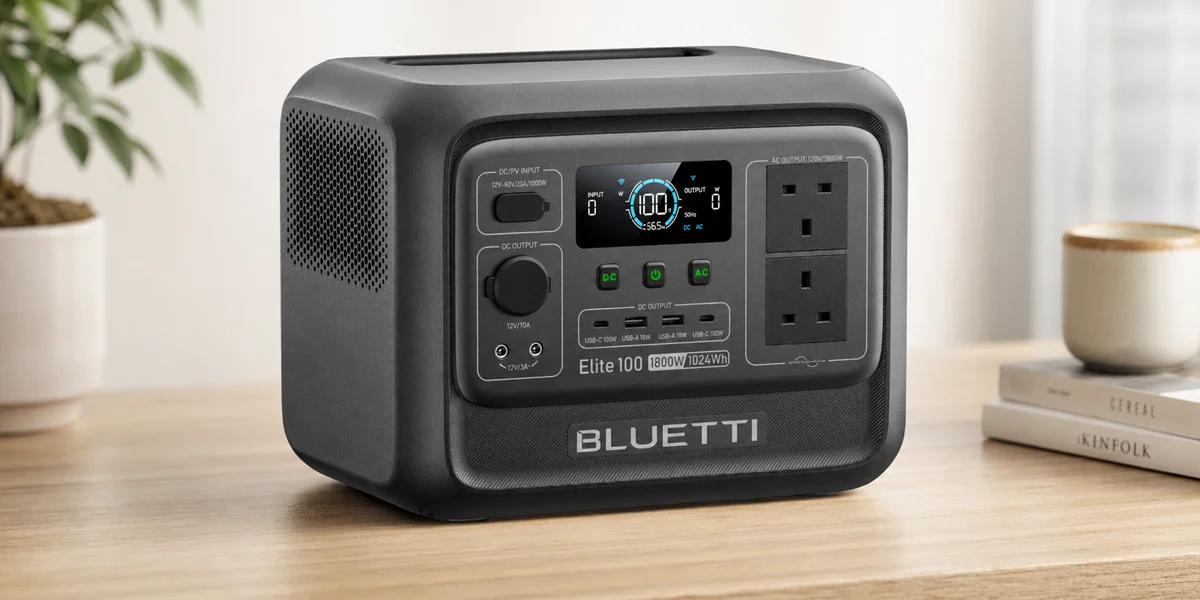
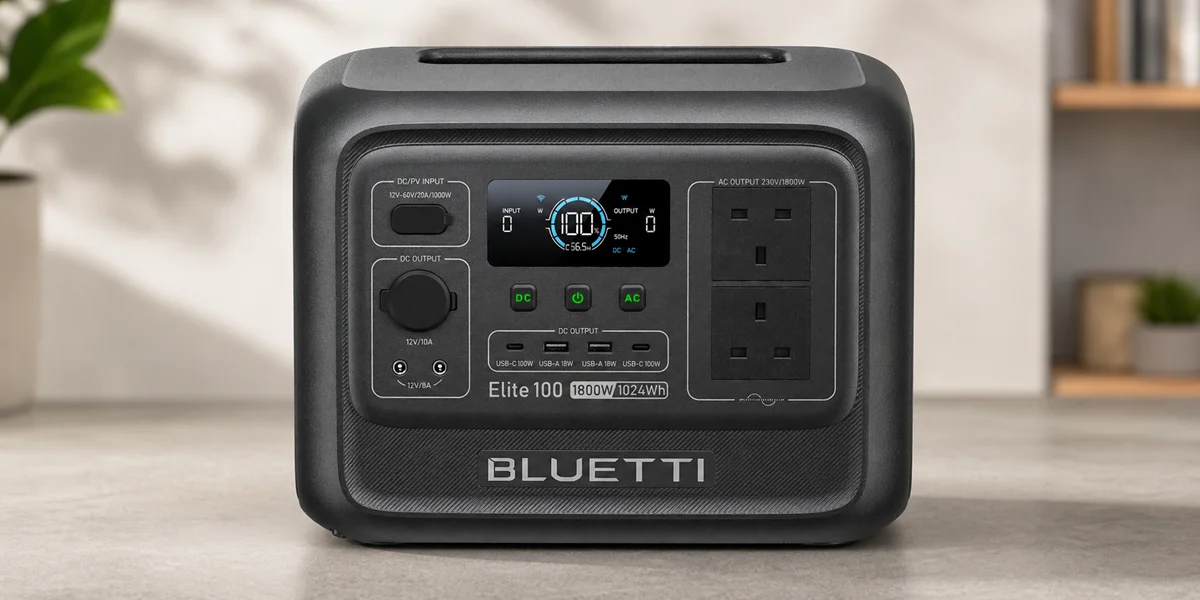
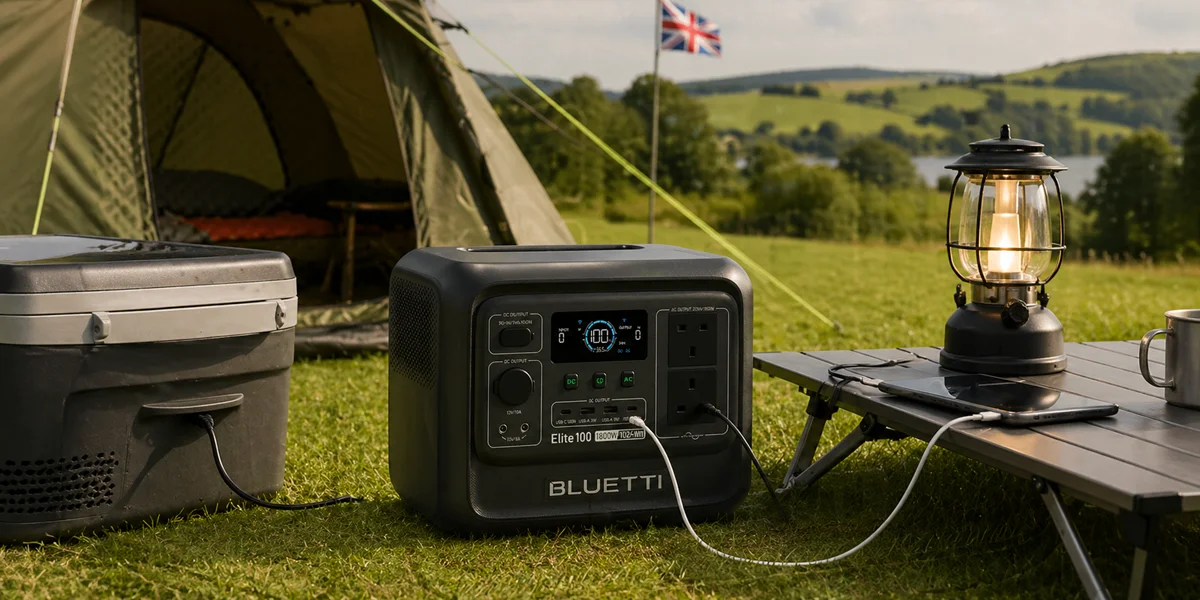
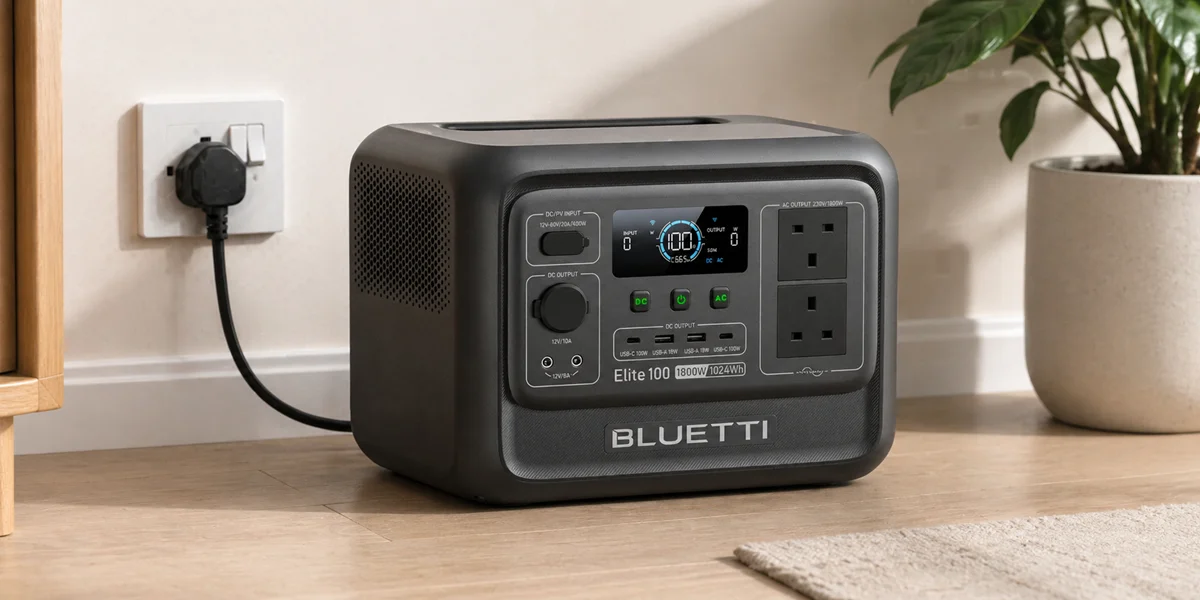
Bluetti Elite 100 V2: a 1,000W solar ceiling, plus 1,024Wh LiFePO4
| Capacity | 1024Wh |
| AC Output | 1800W |
| Weight | 11.5 kg |
| Battery | LFP |
| UK Warranty | 5 years UK |
- Our Best Solar pick, taking 1,000W through a single input
- 4,000+ cycles, matching the Delta 3 Plus, J1000 and C1000
- 11.5kg, lighter than most other 1,024Wh units here
- Only 2 AC sockets and no IP rating, notes TechRadar
- No expansion path, unlike the Delta 2 or Delta 3 Plus
- Notebookcheck found the fans louder during turbo charging
Pick it if solar is your main charging plan: it takes double the Delta 3 Classic’s solar and matches its 45 minutes to 80%. TechRadar called it complete and powerful yet compact. Outdoor Gear Lab pitched it at off-grid travel and short camping trips, but measured only about 890Wh usable. With one XT60 input, two sockets and no expansion, look at the Delta 3 Plus if you want to grow capacity.
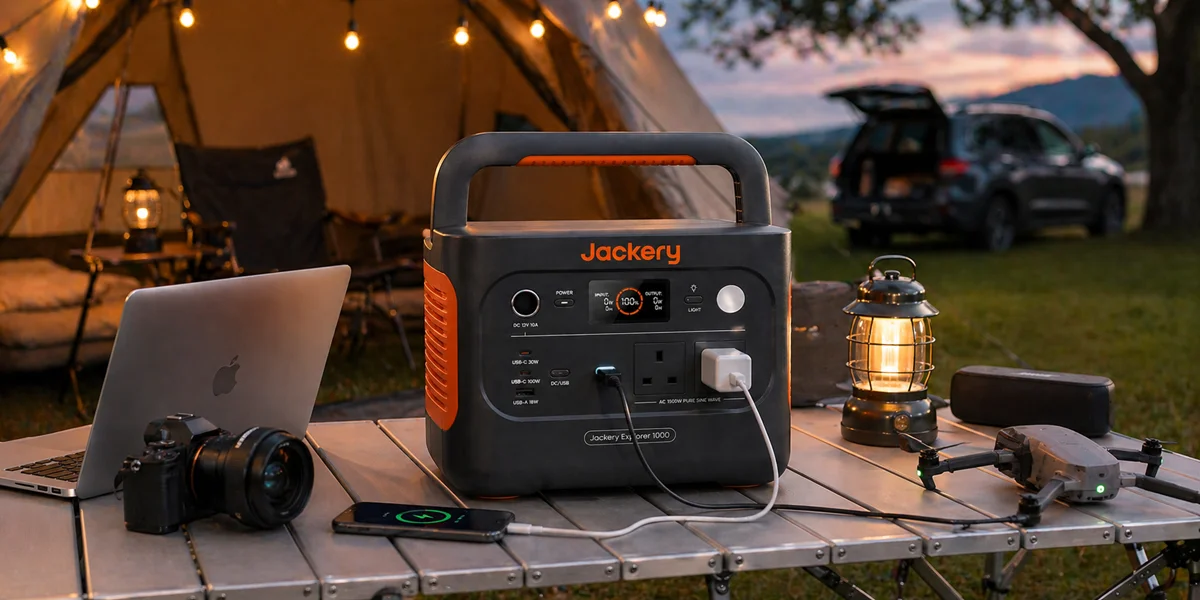
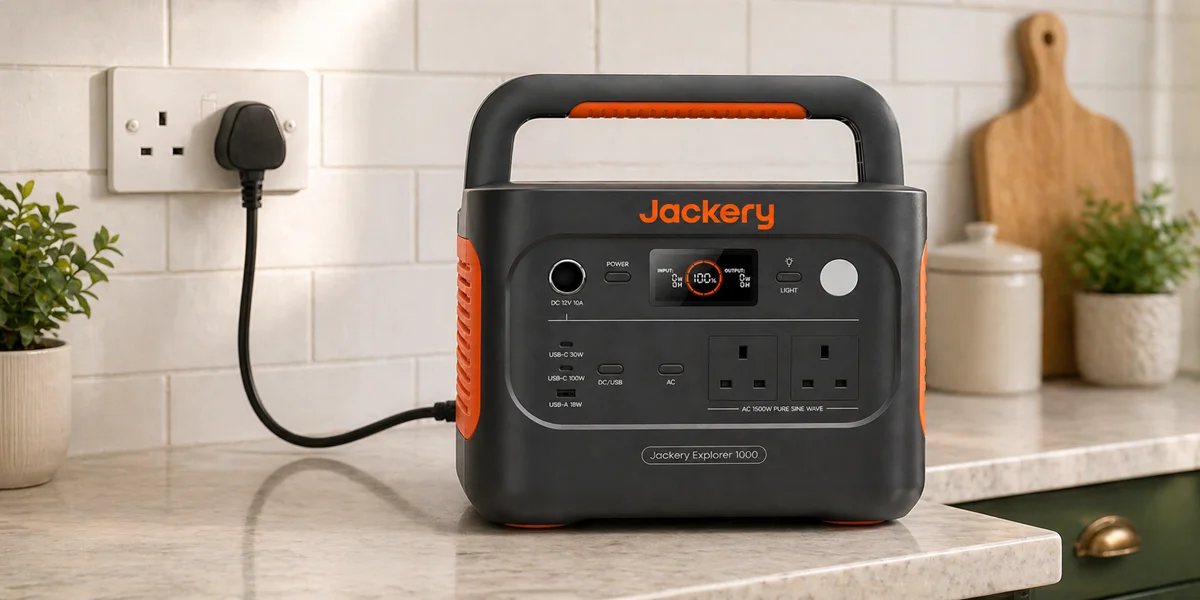
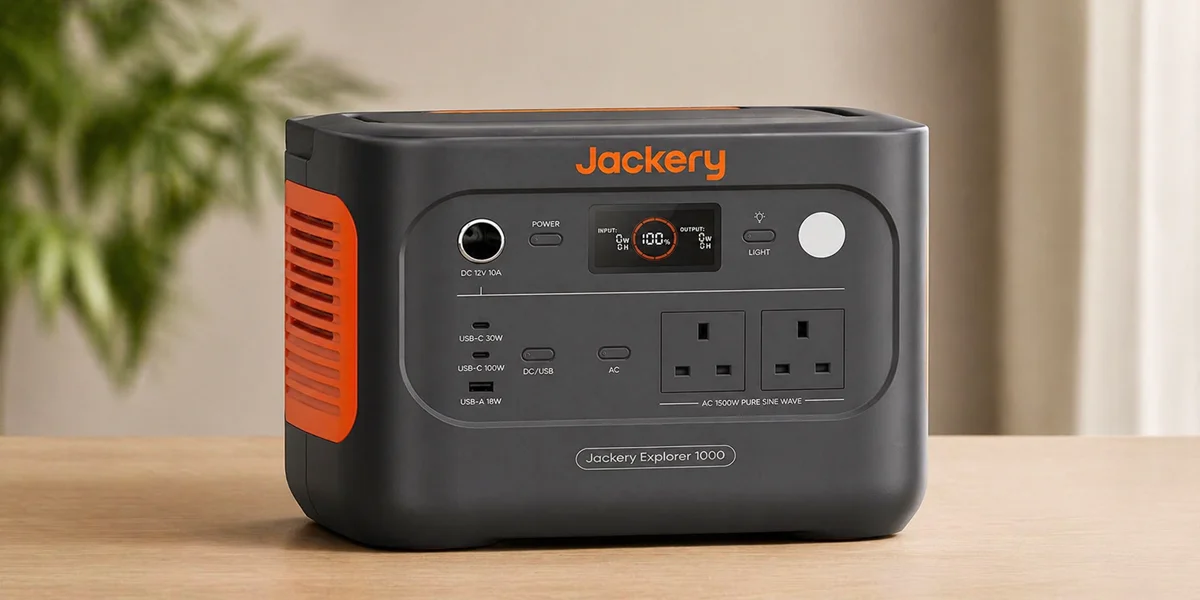
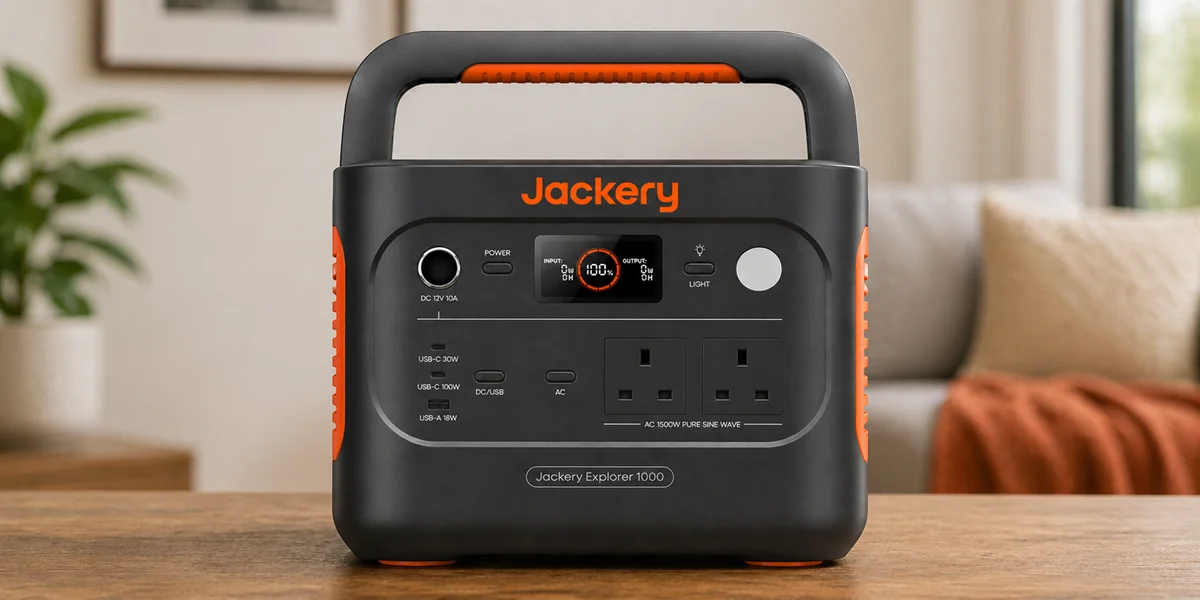
Jackery Explorer 1000 v2: 1,070Wh in a 10.8kg body, UPS in 20ms or less
| Capacity | 1070Wh |
| AC Output | 1500W |
| Weight | 10.8 kg |
| Battery | LFP |
| UK Warranty | 5 years UK |
- Our Best Compact pick, under 22dB in Quiet Charging Mode
- 10.8kg, light for a 1,070Wh battery of this class
- Rated to 4,000 cycles with a built-in LED light
- 1,500W ceiling is modest next to the C1000 Gen 2's 2,000W
- Not expandable, and solar input tops out at 400W
- No weatherproofing rating, according to TechRadar
At 10.8kg, this quiet 1kWh-class unit is lighter than the Delta 2, Delta 3 Classic and C1000 Gen 2. T3 recommends it for campers, caravanners and boaters, and TechRadar called it a superb choice for off-site power and backup. The C1000 Gen 2 gives you 500W more output and faster charging. If you want raw power or expansion, look elsewhere on this list.
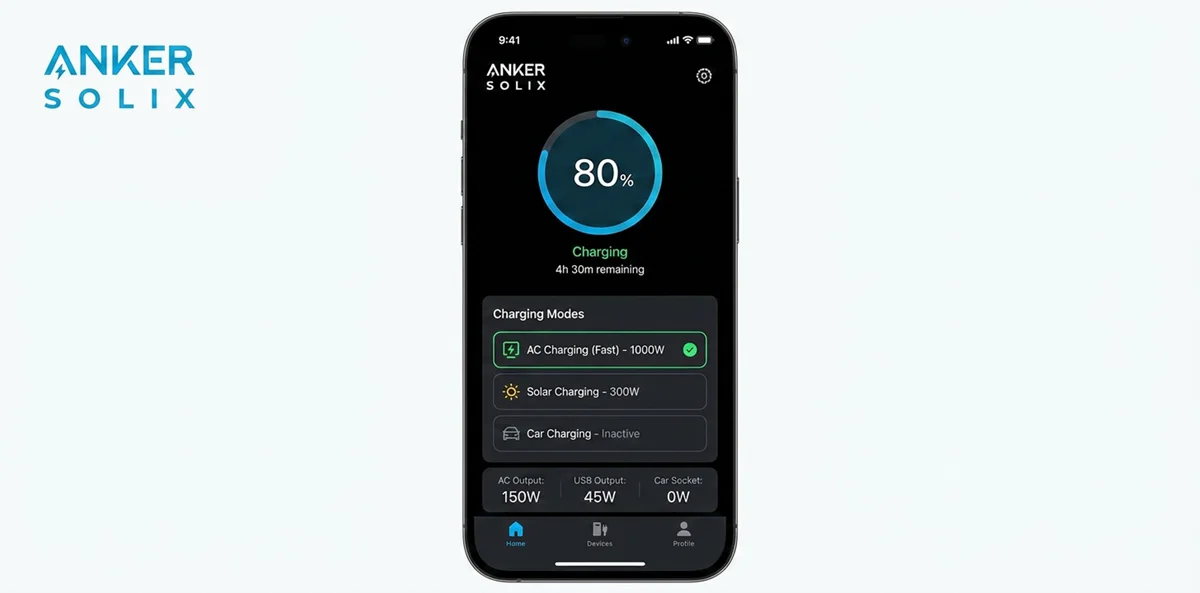
Anker SOLIX C1000 Gen 2: a 49-minute mains recharge with 2,000W output
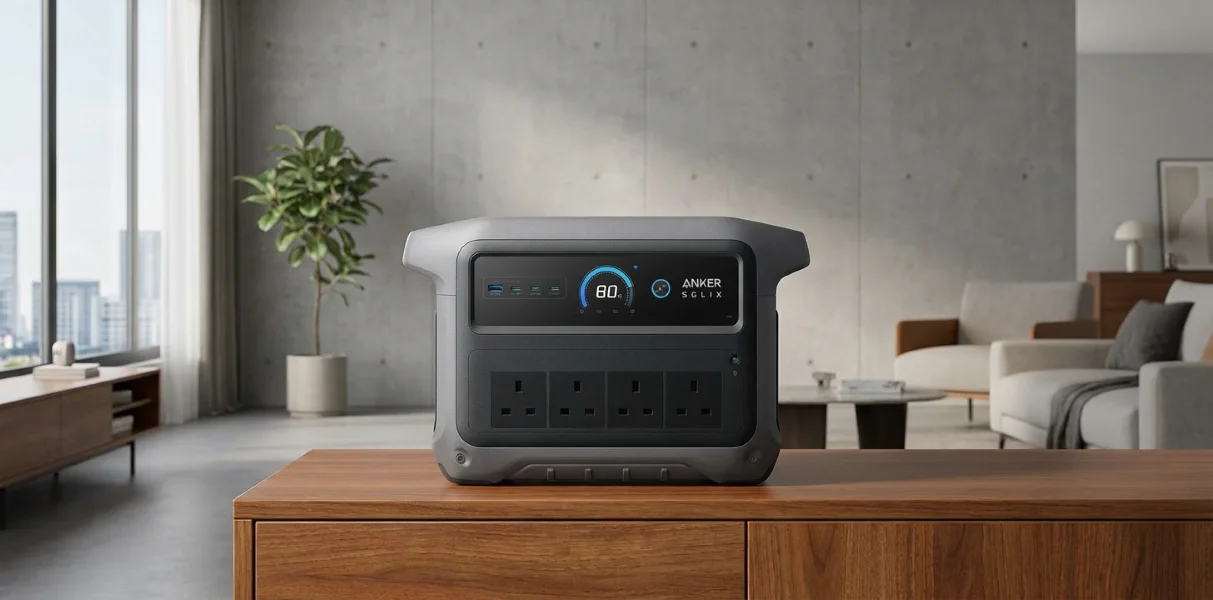
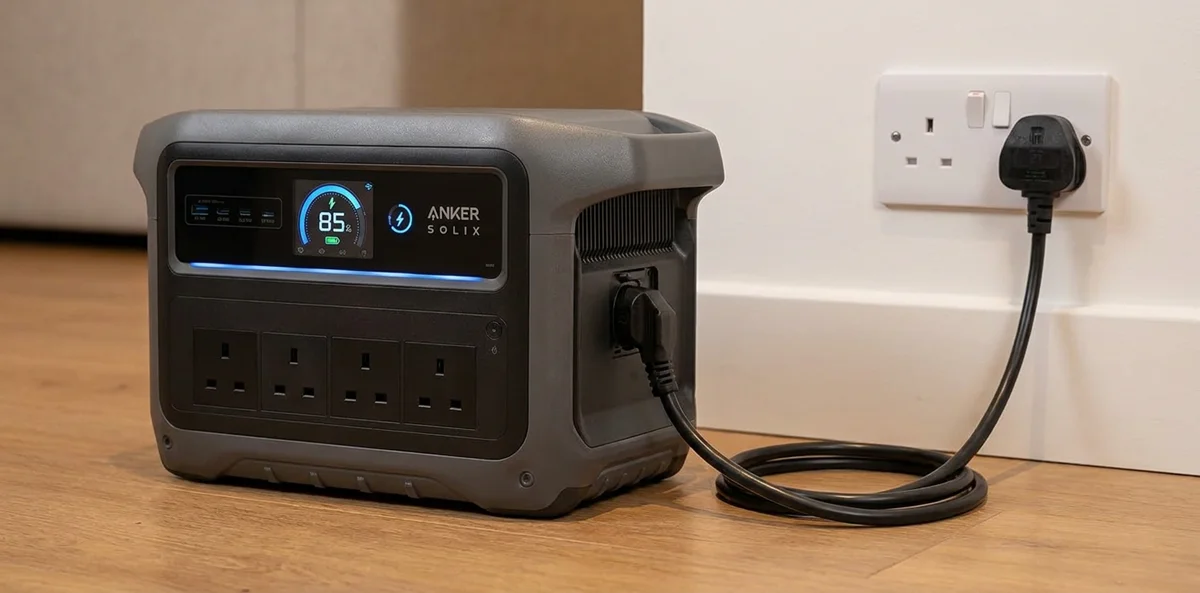
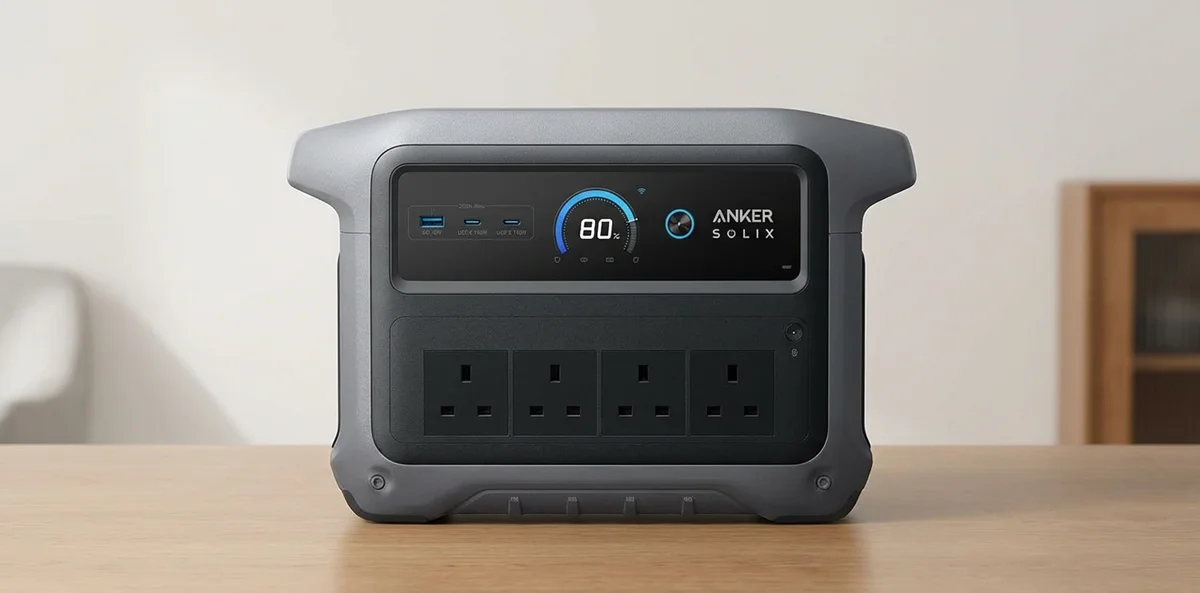
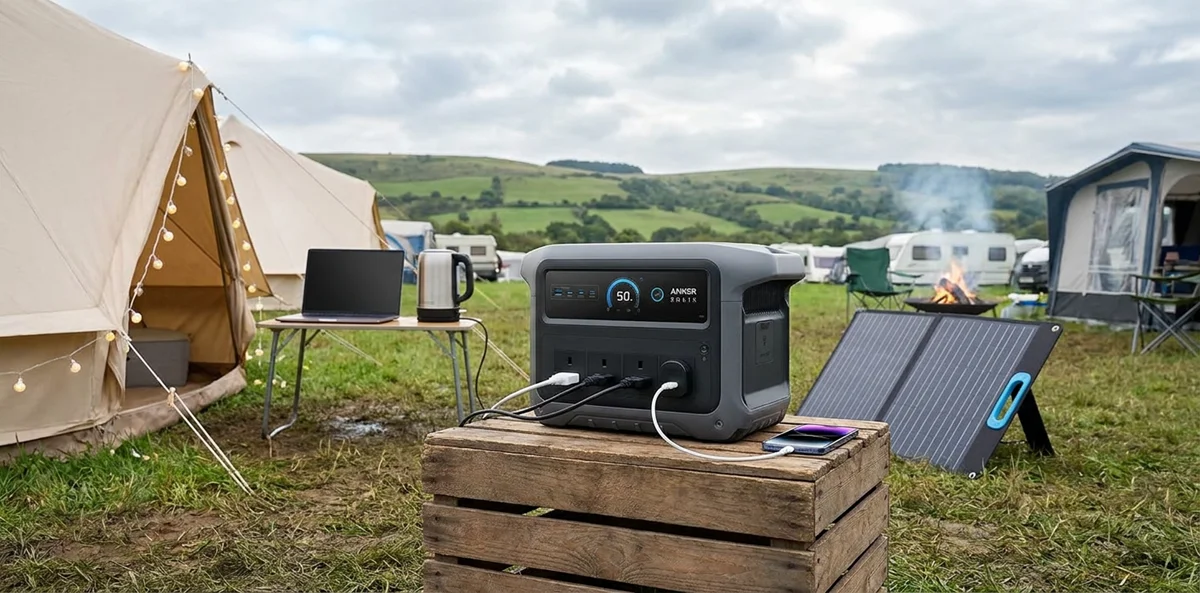
| Capacity | 1024Wh |
| AC Output | 2000W |
| Weight | 11.3 kg |
| Battery | LFP |
| UK Warranty | 5 years UK |
- Our Best Mid-Range pick, highest output of the 1kWh units here at 2,000W
- Anker quotes a 49-minute full mains charge
- 11.3kg with 4,000 rated cycles and a 5-year warranty
- Outdoor Gear Lab called the fan frustratingly loud at full power
- Not expandable, and solar input is a single 600W port
- No built-in light, unlike the Jackery Explorer 1000 v2
Choose the C1000 Gen 2 when output matters most: of the five 1,024Wh units here, it’s the only one pushing 2,000W continuously. Anker’s 49-minute full charge beats every other full-charge time quoted here; Guinness World Records timed one at 43 minutes 48 seconds. Outdoor Gear Lab named it Best Value for Most People, though it found the fan frustratingly loud under full load. Against the Delta 3 Classic or Elite 100 V2 it trades quiet for speed, and there’s no expansion option.
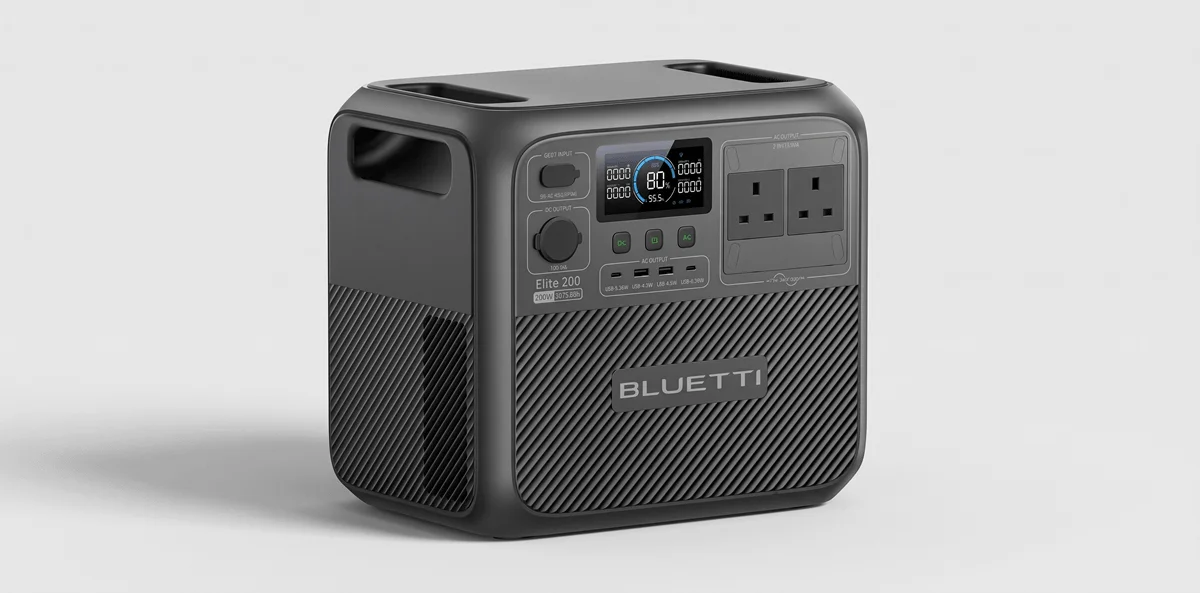
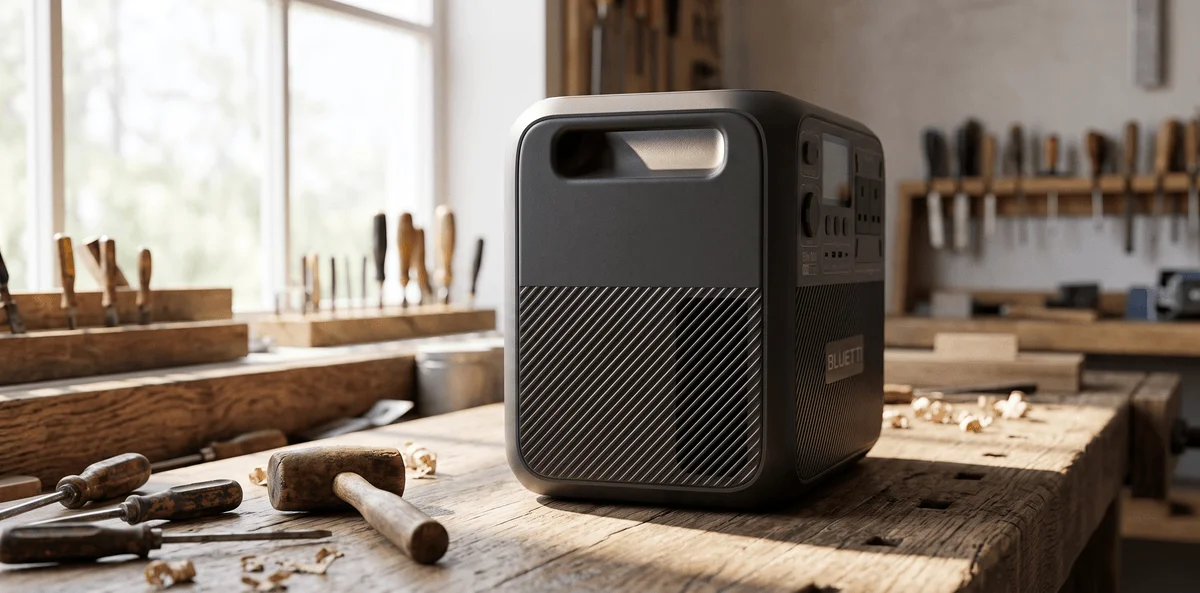
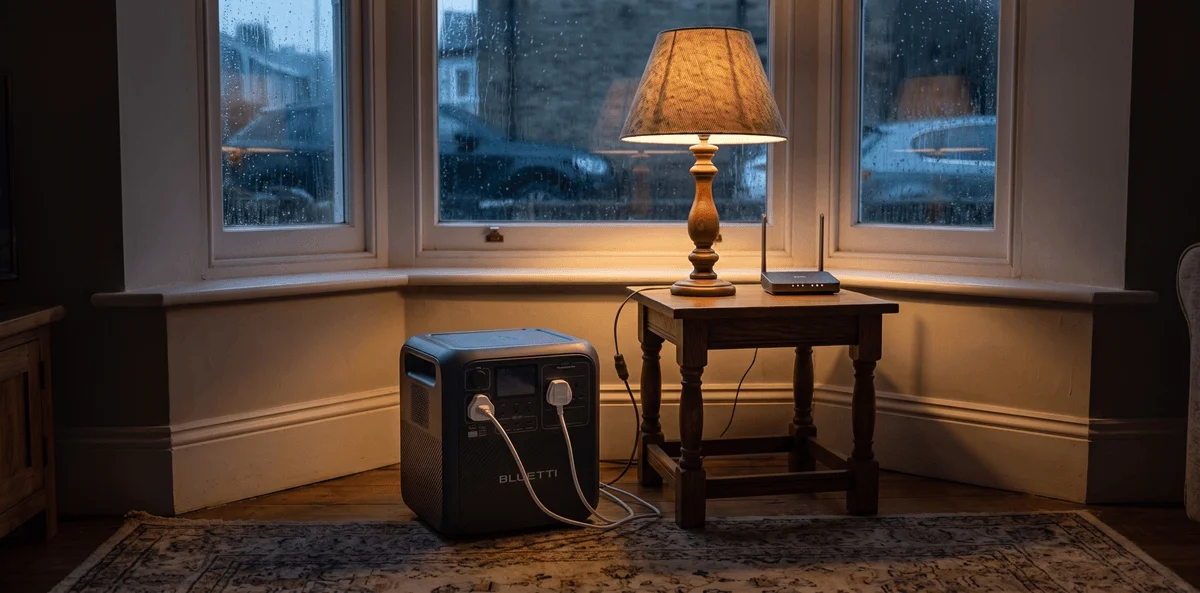
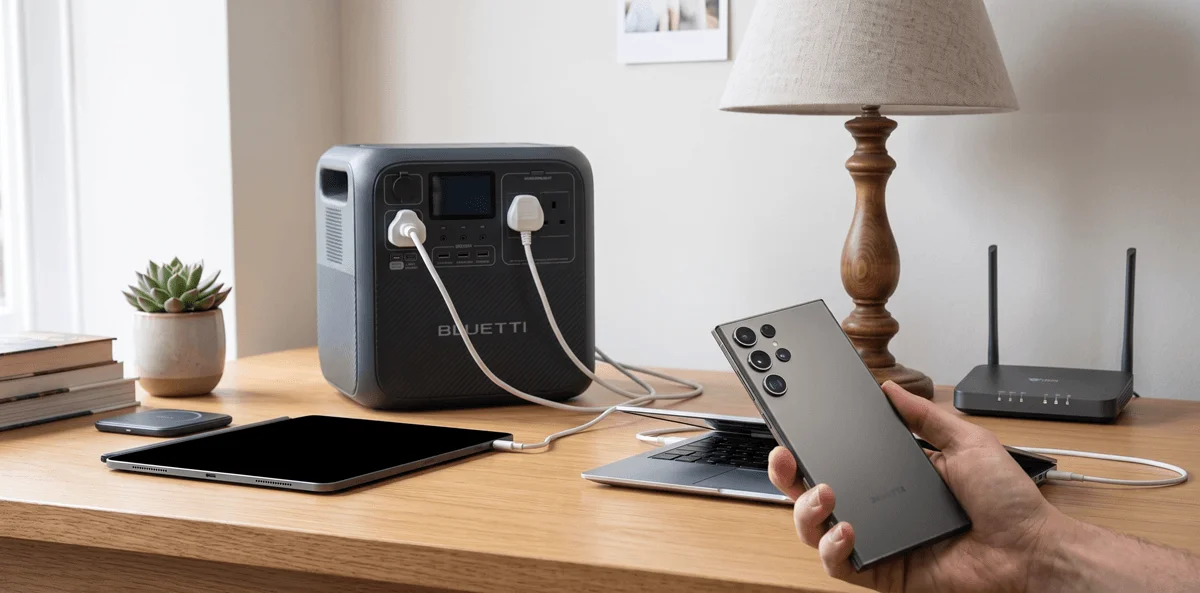
Bluetti Elite 200 V2: 2,073.6Wh and 2,600W, rated for 6,000+ cycles
| Capacity | 2073.6Wh |
| AC Output | 2600W |
| Weight | 24.2 kg |
| Battery | LiFePO4 |
| UK Warranty | 5 years UK |
- 2,073.6Wh of LiFePO4 storage, a touch above the 2,048Wh EcoFlow Delta 3 Max Plus
- Rated for 6,000+ cycles to 80%, in a far lighter body than the 6,000-cycle Bluetti Apex 300
- Matches the Bluetti Elite 100 V2's 1,000W solar ceiling with about twice the storage
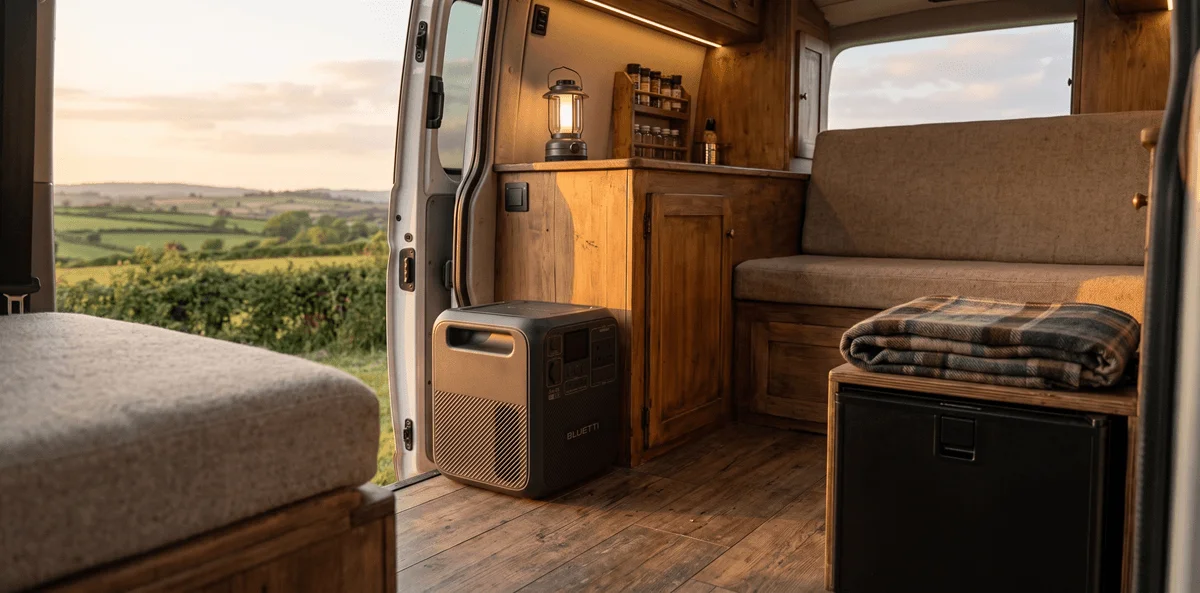
- Suits a van, home backup and fixed off-grid use
- 24.2kg, against 22.1kg for the EcoFlow Delta 3 Max Plus
- Two UK sockets, where the Delta 3 Max Plus has four
- No expansion battery, which both the EcoFlow Delta 3 Max Plus and Bluetti Apex 300 offer
Choose the Elite 200 V2 when a long cycle rating matters more than socket count. It holds a little more than the EcoFlow Delta 3 Max Plus, but gives you 2,600W against 3,000W. It weighs 24.2kg and can’t grow, so it’s one to park and leave.
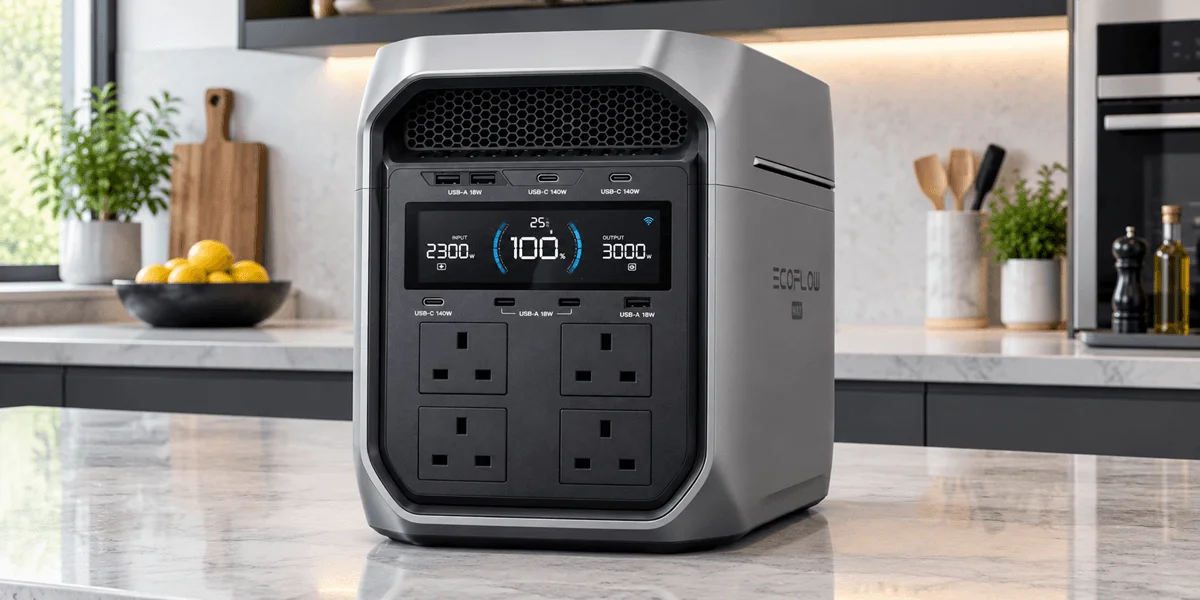
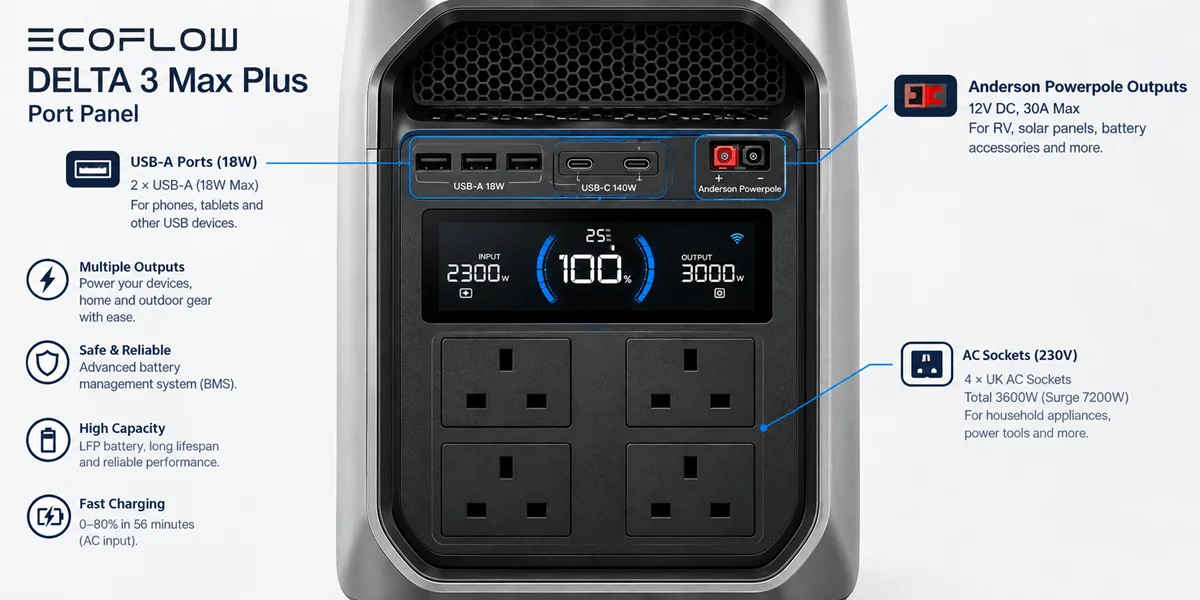
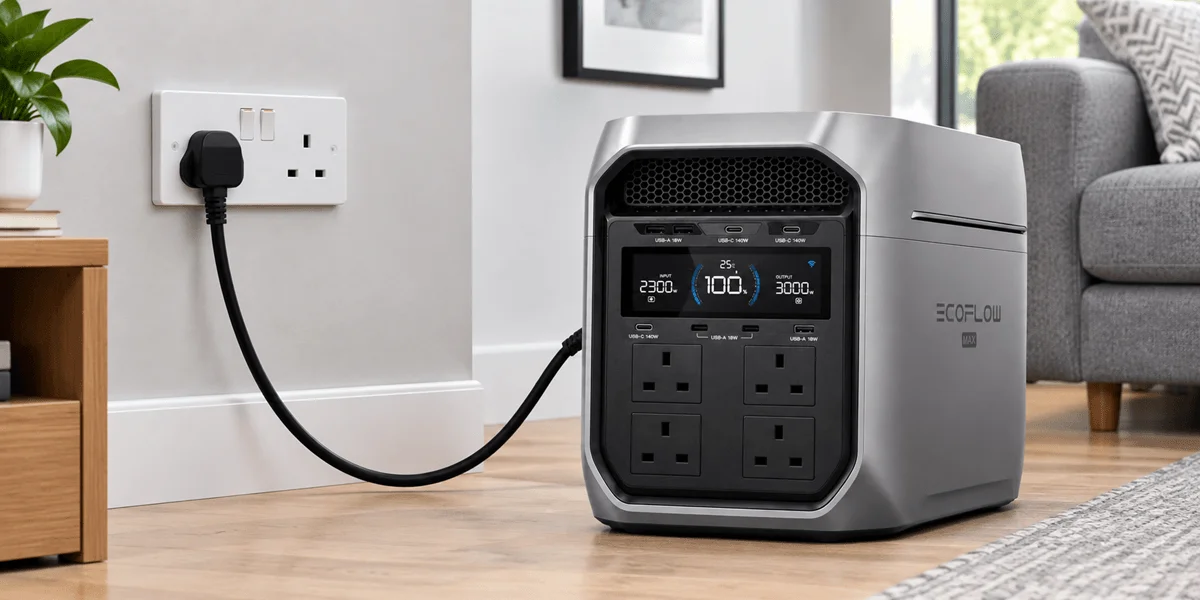
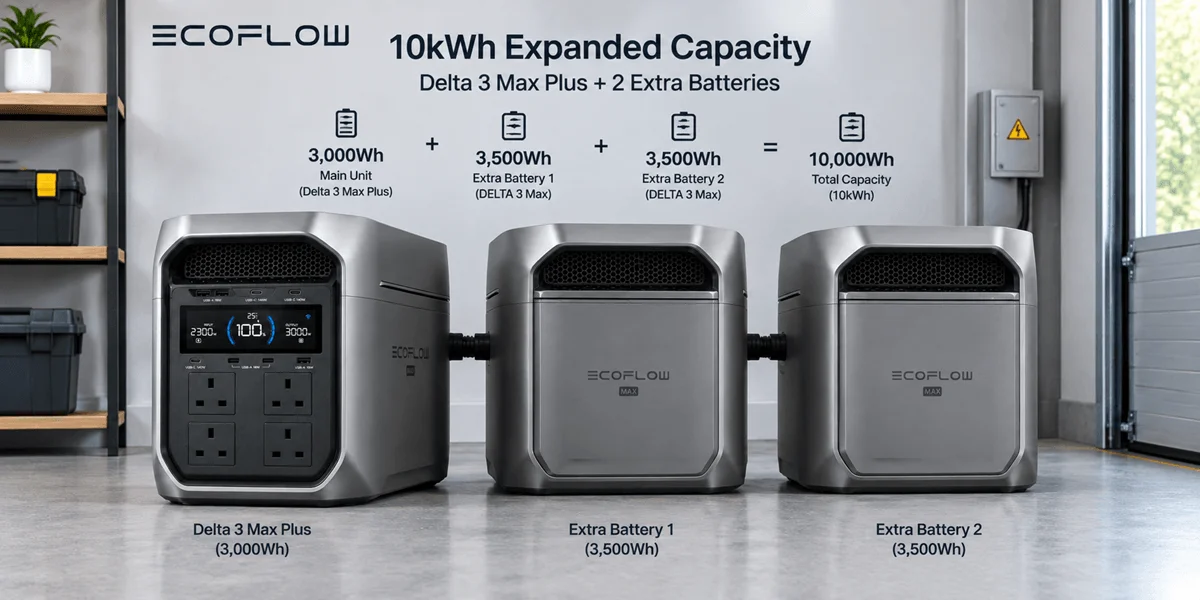
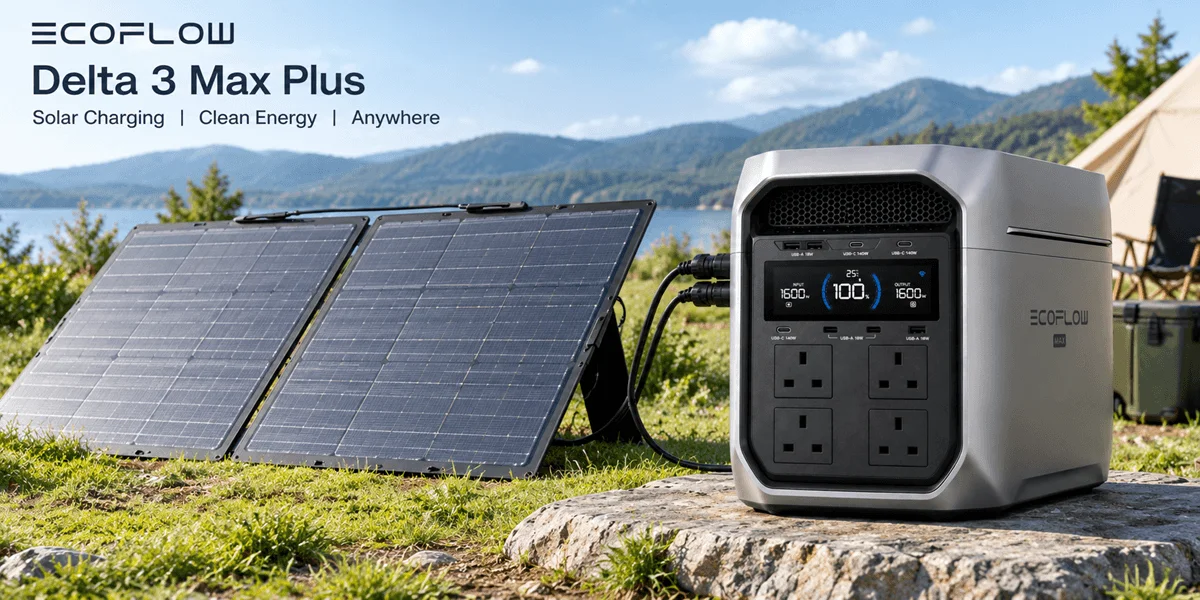
EcoFlow Delta 3 Max Plus: 2,048Wh with 3,000W, expandable to 10kWh
| Capacity | 2048Wh |
| AC Output | 3000W |
| Weight | 22.1 kg |
| Battery | LiFePO4 (LFP) |
| UK Warranty | 5 years UK |
- Our Best High-Power pick: 3,000W of output, third here behind the Delta Pro 3 and Apex 300
- 1,000W alternator charging, the highest figure of the twelve here
- StorageReview measured an 8ms switchover on a US unit
- Expandable to 10kWh with two DELTA Pro 3 extra batteries
- 22.1kg, so it stays in one place once set up
- No built-in light, unlike the Jackery Explorer 1000 v2
This is the pick if you need serious capacity without the Apex 300’s full off-grid scale. At 2,048Wh it holds twice what most 1kWh units here offer, and StorageReview measured an 8ms switchover on a US unit. T3 Platinum called it genuinely easy to live with, and AppleInsider praised how quiet it ran during storm-season backup. Next to the Delta 3 Plus it adds capacity, alternator headroom and expansion, but at 22.1kg it’s a two-handed lift.
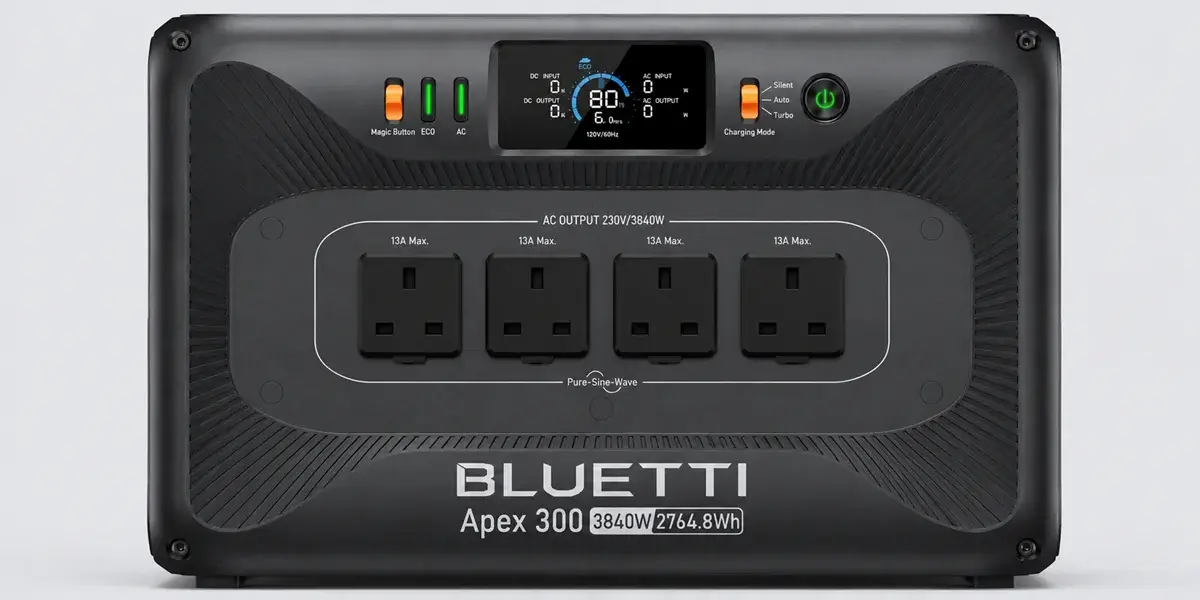
Bluetti Apex 300: 2,400W solar input, 2.76kWh and 6,000 cycles
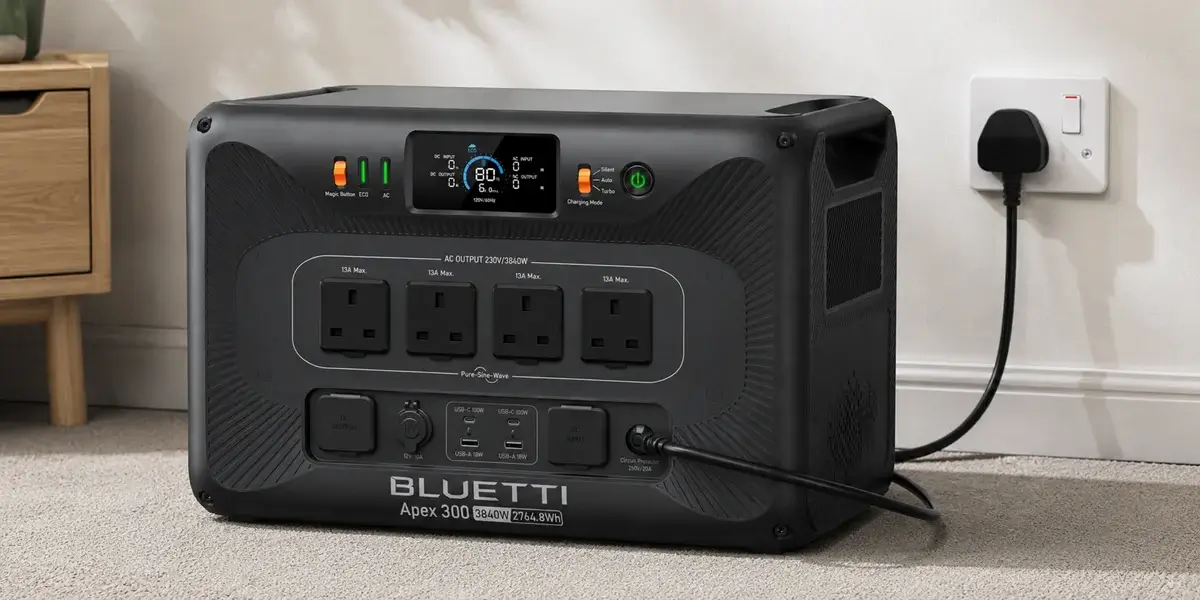
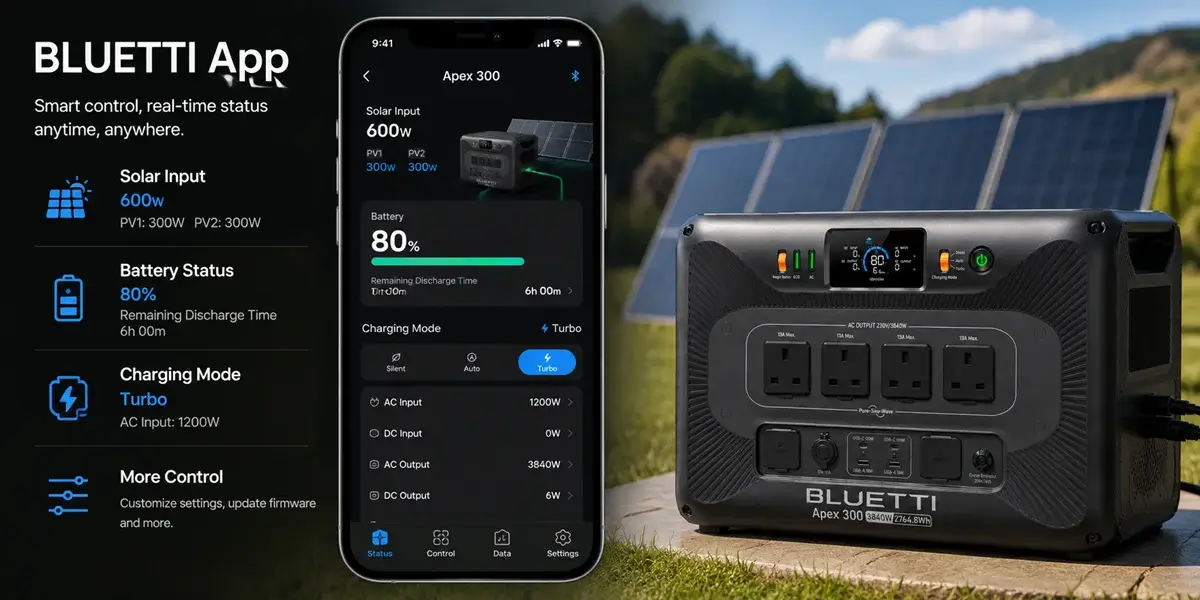
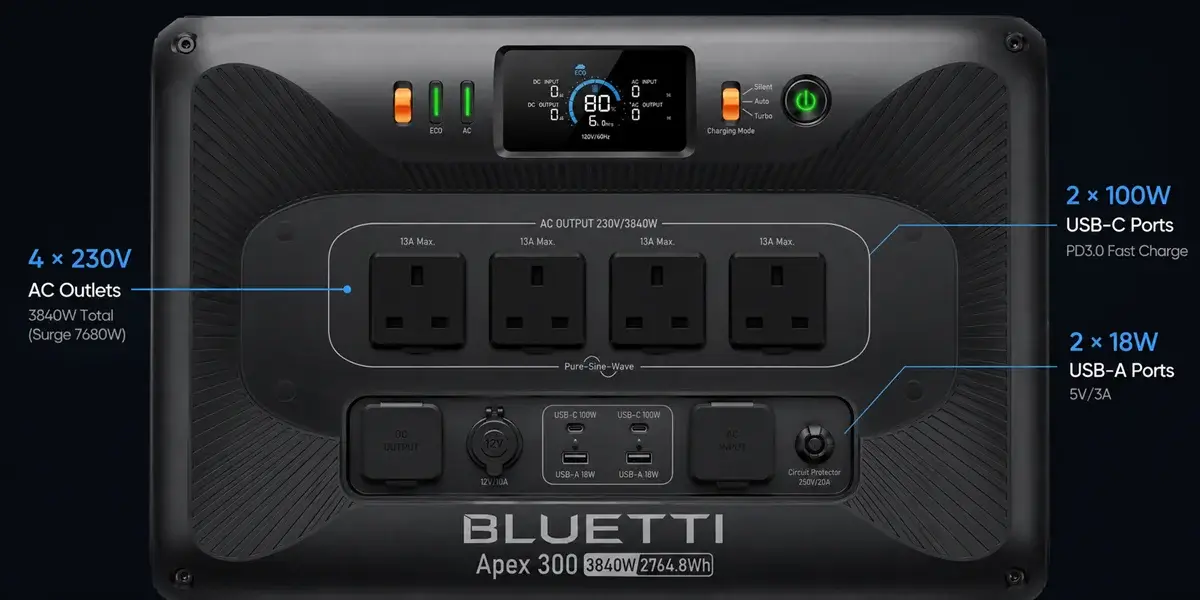
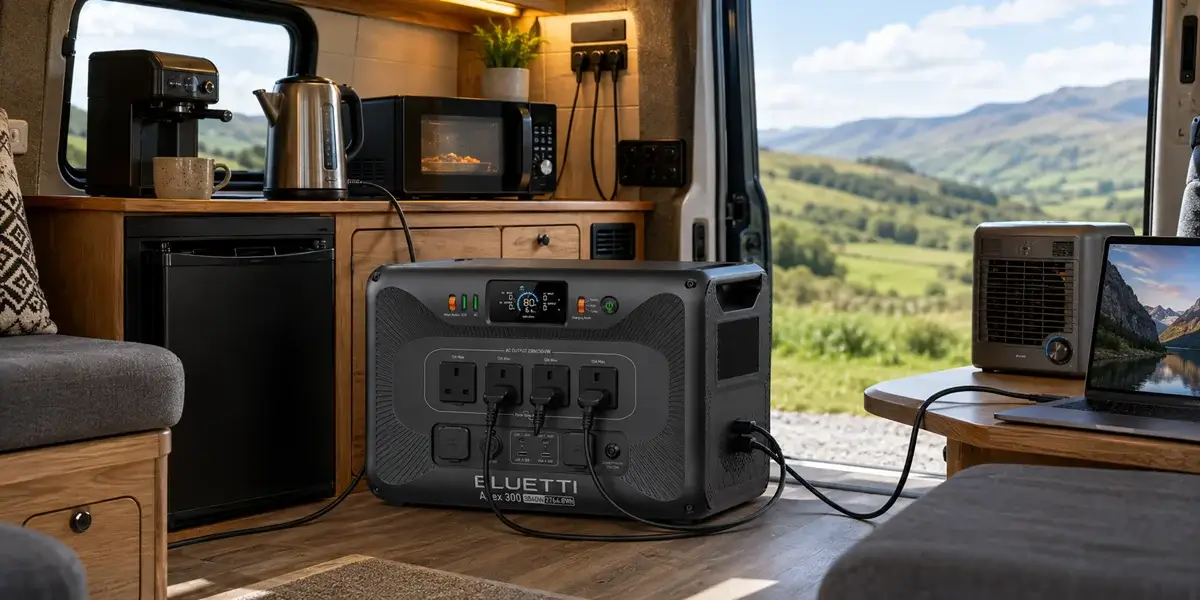
| Capacity | 2765Wh |
| AC Output | 3840W |
| Weight | 38 kg |
| Battery | LFP |
| UK Warranty | 5 years UK |
- Off-Grid Solar Charging pick, with 3,840W of output, second only to the Delta Pro 3
- 2,400W of solar input, 200W short of the Delta Pro 3 and far ahead of the rest
- Rated to 6,000+ cycles, tied for the longest battery life here
- Expands to around 19kWh per unit, most of any product here
- 38kg, second heaviest on this list, and T3 suggests a trolley
- No built-in USB or 12V output without the optional Hub D1
- Notebookcheck found the fans loud during turbo charging
This is the pick for full off-grid setups. Its 3,840W output and 2,400W solar input sit just behind the Delta Pro 3 and well past every other unit here. T3 called it one of the most capable and flexible power stations Bluetti has made, naming campervans, caravans, canal boats and home backup. At 38kg it needs a trolley, T3 notes, and USB and 12V need the Hub D1.
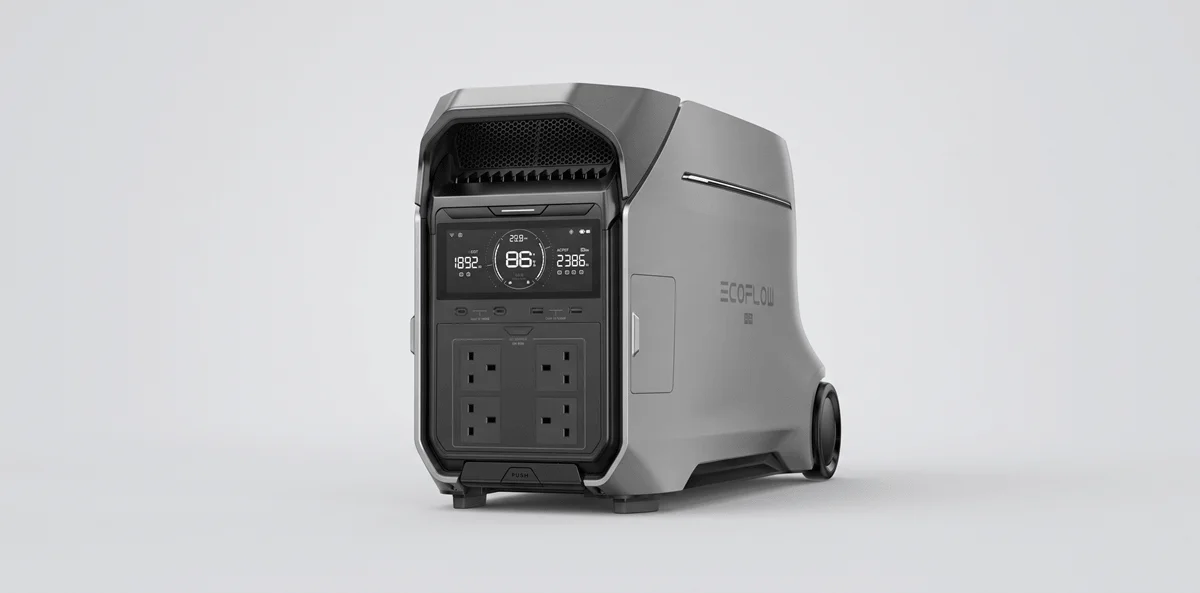
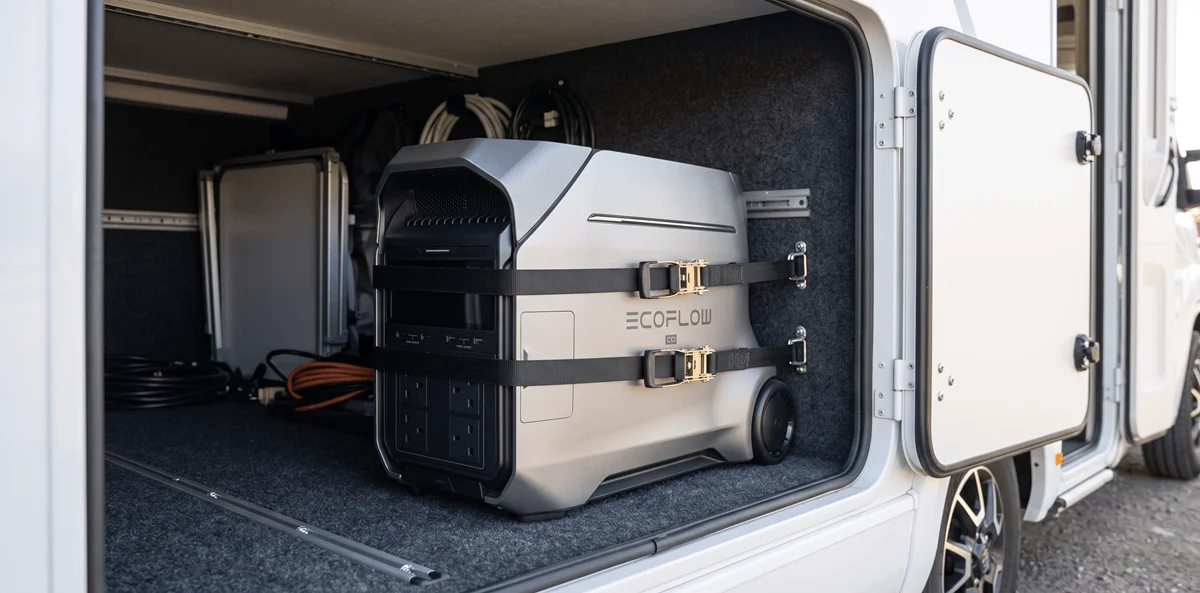
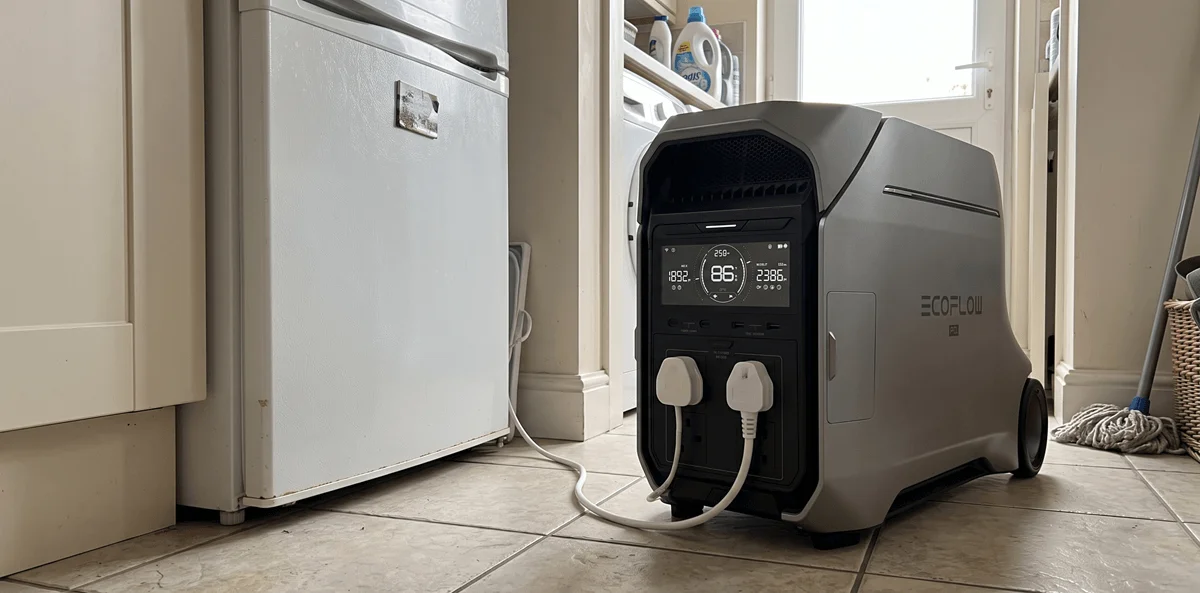
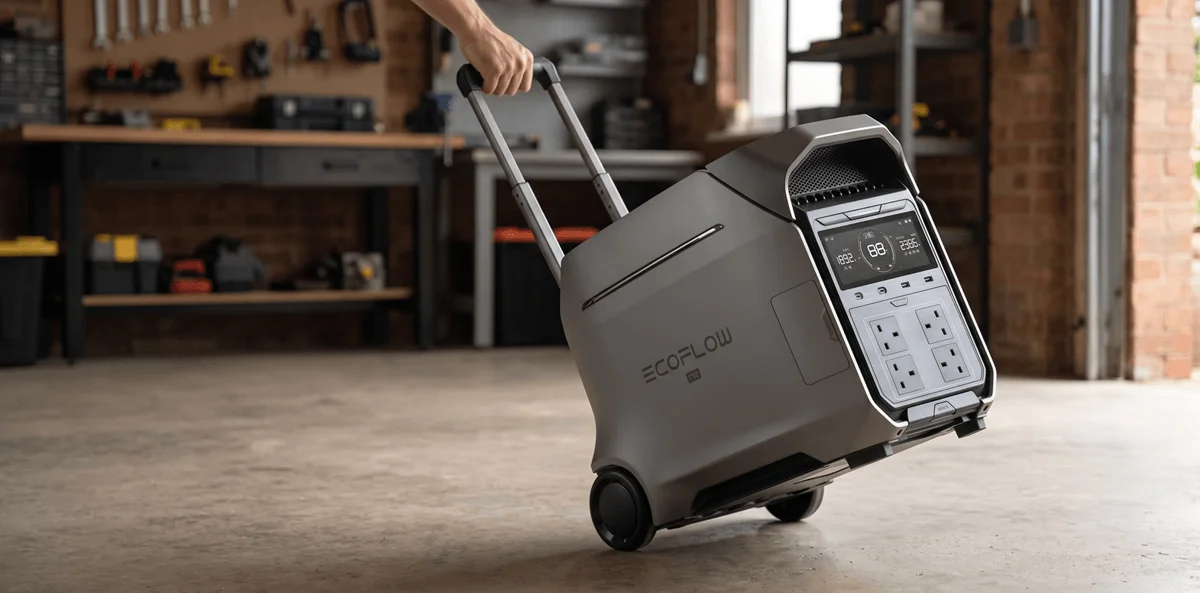
EcoFlow Delta Pro 3: 4,096Wh, 4,000W output and 10ms switchover
| Capacity | 4096Wh |
| AC Output | 4000W |
| Weight | 51.5 kg |
| Battery | LiFePO4 |
| UK Warranty | 5 years |
- Holds 4,096Wh, well ahead of the Bluetti Apex 300 at 2,764.8Wh
- Takes 2,600W over two solar inputs, 200W above the Apex 300's standard 2,400W
- Lists a 10ms standby switchover, where the Apex 300 lists 20ms
- Expands to 12kWh, and also suits fixed home, solar and motorhome set-ups
- At 51.5kg, it is 13.5kg heavier than the Apex 300
- Its 4,000-cycle rating trails the Apex 300's 6,000
- EcoFlow UK support draws complaints, and only two UK buyers have written Amazon reviews
Choose this one for big capacity and power in a fixed spot, with solar as a bonus. It leads the Bluetti Apex 300 on capacity and output, and on solar input in standard form. Skip it if you move your power station often.
Which portable power station is right for you?
Not every buyer needs the same thing. The sections below match each common UK use case to the most suitable model from this guide.
🌳 Camping and caravanning
For camping and caravanning, the EcoFlow Delta 3 Classic and Jackery Explorer 1000 v2 are the strongest choices. The Delta 3 Classic charges to 80% in 45 minutes. The Jackery weighs 10.8kg and operates under 22dB in Quiet Charging Mode. Both handle a mini fridge, phones and a laptop, and pair well with a solar panel for longer trips.
If portability and campsite noise levels are your main concerns, the Jackery is the better pick. It is the lightest of the 1kWh models here and is certified under IEC 62040 for UPS performance. If you want faster recharging from a campsite hook-up, the Delta 3 Classic’s 45-minute 0 to 80% charge time stands out at this size.
If you’re travelling light for a festival weekend or a short camping trip, hauling a 12kg power station around isn’t appealing. At 4.7kg, the EcoFlow RIVER 3 Plus fits in a rucksack and still runs phones, laptops and small camping gear for short trips away. It won’t run a kettle or heater. Full details: EcoFlow RIVER 3 Plus review.
See our dedicated page: best portable power stations for camping.
🏠 Home backup during power cuts
For home backup, the EcoFlow Delta 3 Plus is the pick. At 1,024Wh, it switches to battery power in under 10ms. NAS and HID device support means a connected NAS or PC can see the battery and shut down safely if a cut runs long. It expands to 5kWh with additional batteries, making it a flexible backup option for UK households. The trade-off: its fans can run even at low loads (T3, Trusted Reviews).
If you need more capacity, the EcoFlow Delta 3 Max Plus holds 2,048Wh and puts out 3,000W through four UK sockets. At 22.1kg it’s built to stay in one place. It expands to 10kWh with two DELTA Pro 3 extra batteries for longer cuts.
For the longest cuts, the EcoFlow Delta Pro 3 holds 4,096Wh and puts out 4,000W. At 51.5kg, it needs a fixed spot. If you only need to keep a router, CPAP machine or laptop running, the smaller EcoFlow RIVER 3 Plus is enough. At 4.7kg, it’s also much lighter.
See our dedicated page: best portable power stations for home backup.
🚗 Van life and off-grid living
For van life, how you recharge matters as much as capacity: driving, roof solar and 12V systems all come into play. The EcoFlow Delta 3 Max Plus covers all three. It offers 1,000W of alternator charging while you drive, plus 1,000W of solar across two inputs. It also has a 12V car output, an Anderson 30A output and four UK sockets.
For a smaller van or a lighter setup, the EcoFlow Delta 2 is worth a look. It weighs 12kg, has a 126W 12V car output and four AC sockets, and expands from 1kWh up to 3kWh as your needs grow. Its 30ms switchover is slower than newer models. If solar is your main charging source, the Bluetti Elite 100 V2 takes 1,000W of panels at 11.5kg. See our solar generators page for more on solar-first setups.
For full-time van lifers or off-grid cabins, a 1kWh station often isn’t enough once you’ve got a fridge, water pump and laptop all drawing power. The Bluetti Apex 300 steps up to 2,764.8Wh. Its 3,840W continuous output is strong enough for a kettle or induction hob. The Apex 300 also takes 2,400W of dual solar input to keep it charged on the move. At 38kg, it needs a trolley (T3). See the Bluetti Apex 300 review.
See our dedicated page: best power stations for campervans and motorhomes.
🔧 Tradespeople and job sites
For site use, the EcoFlow Delta 3 Max Plus handles heavier loads. It offers 3,000W of continuous output through four UK 13A sockets for tool charging, site lighting and device charging together. The EcoFlow Delta 2, at 1,800W and 12kg, is the lighter option for one person doing less demanding tool work.
Job site use puts heavier demands on a unit than camping. Running power tools intermittently alongside phone and laptop charging is well within the Delta 2’s capability. The Delta 3 Max Plus’s 3,000W continuous output handles heavier duty scenarios. PCWorld measured the Delta 2’s fans at 57dBA while charging, worth weighing in enclosed spaces.
If speed matters more than anything else, the Anker SOLIX C1000 Gen 2 is worth a look. It charges from flat to full in around 49 minutes, faster than the other 1kWh stations here. Its 2,000W output is the highest in that group. Fast charging plus high output suits tradespeople running tools on site, or anyone who wants home backup ready within the hour. Full details: Anker SOLIX C1000 Gen 2 review.
Portable Power Stations by Output: 500W to 4,000W
Output in watts decides what will start. Capacity in watt-hours decides how long it runs. A 1000W power station delivers up to 1,000 watts at once, but its runtime comes from a completely separate number. Get these the wrong way round and you buy the wrong machine, which is a common mistake.
Most buying guides sort by brand or by price. Buyers shop by the number on the box, and that number is almost always watts. So here is every model we have reviewed, sorted by continuous AC output, with the watt-hour figure alongside it so the two never get confused.
One warning before the bands. Manufacturers lead with whichever figure sounds biggest, and some listings describe a “1000W power station” while pointing at a unit rated 1,800W. Read both numbers, every time.
Portable Power Stations by Price: Entry Level to Top End
Our lowest-priced pick is the EcoFlow RIVER 3 Plus, a 286Wh LiFePO4 unit weighing 4.7kg with 600W of continuous AC output across three UK sockets. It’s compact, covers phones, laptops and small appliances, and comes backed by a 5-year UK warranty.
Wattage tells you what a power station can run, but price decides which ones are actually on your shopping list. Here’s how our twelve picks break down by price tier. Retail prices shift constantly with seasonal sales and stock clearances, so use these tiers as a starting point rather than gospel.
Entry level: one model for essentials on the move
The EcoFlow RIVER 3 Plus is the only model in this tier. At 4.7kg it’s light enough for a rucksack, with three UK three-pin sockets, LiFePO4 cells and a 5-year UK warranty. It suits phones, laptops, camping lights and small appliances kept charged over a weekend away.
It expands to 858Wh with an extra battery pack if you need more later. At 600W continuous output, it won’t run a kettle or heater.
Mid-range: the sweet spot for most homes
Three models sit in this tier. The Jackery Explorer 500 v2 is the lightweight option here at 5.7kg and 512Wh. That’s roughly half the weight and half the capacity of the other two. It’s the pick if you want mains power without carrying a heavier unit.
The EcoFlow Delta 2 and Delta 3 Classic are both 1,024Wh and around 12kg. They suit a genuine power cut or a weekend of van life. The Delta 2 is EcoFlow’s previous generation and is no longer listed on EcoFlow’s own UK site.
It’s still stocked at other UK retailers. The Delta 3 Classic is the current model and charges to 80% faster, in 45 minutes against the Delta 2’s 50.
Upper mid-range: faster charging, solar and UPS features
Four models land in this tier, all in the 1kWh class and between 10.8kg and 12.5kg. The EcoFlow Delta 3 Plus adds NAS and HID support to its UPS switchover. A connected NAS or PC can then shut down safely during a power cut. It also expands to 5kWh with extra batteries.
The Bluetti Elite 100 V2 takes 1,000W of solar on a single input. The Jackery Explorer 1000 v2 is the lightest of the four and runs under 22dB in Quiet Charging Mode. The Anker SOLIX C1000 Gen 2 reaches full in around 49 minutes, ahead of the others in this tier. It also has the highest continuous output of the four, at 2,000W.
Top end: longer backup and serious off-grid living
Three models sit in this tier: the EcoFlow Delta 3 Max Plus, the Bluetti Apex 300 and the EcoFlow Delta Pro 3. The Delta 3 Max Plus holds 2,048Wh and puts out 3,000W continuous through four UK sockets. It expands to 10kWh with two DELTA Pro 3 extra batteries. The Apex 300 steps up further to 2,764.8Wh and 3,840W continuous.
It has 2,400W of dual solar input for off-grid setups. At 38kg, it needs a trolley to move it. The Delta 3 Max Plus and Apex 300 are the picks for tradespeople running power tools through a full working day. They also suit anyone wanting longer backup for several appliances at once.
The Delta Pro 3 holds the most of any unit here, at 4,096Wh, with 4,000W continuous. It takes 2,600W of solar across two inputs and expands to 12kWh with two Smart Extra Batteries. At 51.5kg, it suits a fixed spot at home or in a motorhome, not a job site.
Under 1,000W: device charging and weekend basics
This band charges phones, tablets, laptops, camera batteries and LED lighting, and covers small appliances like a router or fan. It won’t run anything with a heating element, so no kettle, toaster or hair dryer. Those draw well over 1,000W and will trip the unit instantly.
Reviewed: Jackery Explorer 500 v2 , 500W output and 512Wh capacity. Also reviewed: EcoFlow RIVER 3 Plus, 600W output and 286Wh capacity, expandable to 858Wh.
1000W to 2000W: the bracket most UK buyers end up in
A fridge-freezer, a microwave, most power tools, and a full evening of television. Every unit in this band on our site carries roughly 1kWh of storage. That’s where the phrase “1000W power station” usually leads people, even though it describes output rather than capacity.
Reviewed: Jackery Explorer 1000 v2 (1500W, 1070Wh), EcoFlow Delta 2, Delta 3 Classic, Delta 3 Plus and Bluetti Elite 100 V2, all 1800W with 1024Wh.
2000W to 3000W: several appliances at once
Headroom for a workshop bench, or a fridge plus lighting plus a laptop through a long power cut. The extra output matters most for motors and compressors, which spike hard on start-up and need more than their running figure suggests.
Reviewed: Anker SOLIX C1000 Gen 2 (2000W, 1024Wh), Bluetti Elite 200 V2 (2600W, 2073.6Wh) and EcoFlow Delta 3 Max Plus (3000W, 2048Wh).
Above 3000W: kettles, hobs and off-grid living
A standard UK kettle draws around 3,000W, so this is the first band where you can boil one without thinking about it. These units are heavy and built to sit still rather than travel.
Reviewed: Bluetti Apex 300 (3840W, 2765Wh) and EcoFlow Delta Pro 3 (4000W, 4096Wh).
For runtime rather than output, our guide to what a 1000Wh power station will run works through the maths appliance by appliance. To size a unit from your own kit, use the sizing calculator.
What to Look For: UK Buyer's Guide
How much battery capacity (Wh) do I actually need?
For day trips and charging phones or a laptop, 200 to 500Wh is enough. Weekend camping with a small fridge or lights needs 500 to 1,000Wh. For home backup or van life running multiple devices, look for 1,000Wh or more. Match capacity to what you’ll actually run, not the biggest number available.
Measured in watt-hours. The higher the number, the longer the unit runs your devices. A 1,000Wh battery can charge a laptop around 15 times, or run a 60W mini fridge for roughly 14 hours.
| Capacity | Best For | Example Model |
|---|---|---|
| Up to about 500Wh | Day trips, festivals, device charging |
EcoFlow RIVER 3 Plus (286Wh) or Jackery Explorer 500 v2 (512Wh) |
| 1,000 to 2,000Wh | Van life, long weekends, home backup | EcoFlow Delta 2 |
| 2,000Wh+ | Longer home backup, extended off-grid |
Bluetti Elite 200 V2, EcoFlow Delta 3 Max Plus, Bluetti Apex 300, EcoFlow Delta Pro 3 |
Use our free sizing calculator to get a precise recommendation based on your specific devices.
What's the difference between LiFePO4 and Li-ion batteries?
LiFePO4 (lithium iron phosphate) is the battery chemistry used in most modern power stations. It lasts far longer than older lithium-ion cells: independent battery research puts LFP at over 3,000 cycles against roughly 1,000 to 2,300 for NMC lithium-ion. LiFePO4 is also more thermally stable and safer for daily use, so it’s worth prioritising for long-term buyers.
How long is the warranty on a UK portable power station?
UK warranty terms vary by brand and model, typically running from 2 to 5 years. EcoFlow’s Delta 2 carries a 5-year warranty as standard, whilst its Delta 3 Classic carries a 3+2 year warranty. Always register promptly and buy from an authorised UK retailer, since grey imports can void your warranty entirely.
Avoid grey imports. All four brands we recommend, EcoFlow, Jackery, Bluetti, and Anker, have established UK warranty channels. If something goes wrong with a grey import, getting it repaired or replaced can be difficult and expensive.
How much solar power can I actually get in the UK?
UK sunshine is limited, averaging around 1,400 hours a year per Met Office UK climate averages. That means solar panels rarely deliver their full rated wattage in practice. Cloud cover and short winter days mean real-world charging is slower than the headline specs suggest, especially outside summer. Treat solar as a useful top-up on cloudy British days, not your only charging method.
What's the difference between output wattage and surge power?
Output wattage (W) is the continuous power a unit supplies. Surge power is the brief higher spike it can handle when a fridge compressor or power tool starts up. Check both figures against what you plan to run. A kettle needs high continuous wattage, but a fridge needs surge headroom despite its low running wattage.
Units rated 1,500 to 1,800W continuous output handle what most UK campers and home-backup users need. That means a mini fridge, TV, laptop, CPAP machine and small fan heater. They can’t run a kettle (2,200 to 3,000W), an electric shower (7,000W+) or a large oven without additional help from specialist technology.
There is an important difference between continuous output and surge power. Continuous output is the sustained wattage a unit can deliver. Surge power is the short burst of extra wattage needed to start motor-driven appliances. A mini fridge might draw only 60W once running, but it can demand 400 to 600W at start-up. A unit rated 1,800W continuous output will typically handle this without issue.
Ten of the twelve models here hold 1,024Wh or more. All of them handle a mini fridge, a flatscreen TV, a laptop and phone charging without any trouble. The higher-wattage units, like the Anker SOLIX C1000 Gen 2 and Bluetti Apex 300, can even stretch to a small fan heater.
The EcoFlow RIVER 3 Plus and Jackery Explorer 500 v2 do a different job. They’re lighter, more portable units for phones, laptops and small devices, not heaters or kettles. Kettles and hair dryers at 2,200 to 3,000W are outside the continuous rating of the 1kWh units.
Two technologies change this: EcoFlow’s X-Boost (Delta 2 and Delta 3 Classic) and Bluetti’s Lifting Power (Elite 100 V2). Both use intelligent power management to let some appliances run above the rated wattage, at reduced efficiency. Lower-wattage kettles will usually run.
If you need to run heavier UK appliances regularly, look at the EcoFlow Delta 3 Max Plus at 3,000W continuous. The EcoFlow Delta Pro 3 goes further, at 4,000W.
What is pass-through charging and UPS mode on a power station?
Pass-through charging lets you power connected devices while the unit itself charges, handy for keeping a router or freezer running non-stop. UPS mode goes further: it switches to battery within milliseconds if the mains cuts out, so connected electronics don’t lose power. Not every model offers true UPS switchover, so check this if power cuts matter to you.
UPS (Uninterruptible Power Supply) mode means the unit stays plugged into the wall and switches to battery power automatically if the mains fails. For UK power cuts, this protects laptops, routers, NAS drives, and medical devices from sudden shutdown. Switchover happens in milliseconds, fast enough that most devices don’t notice the interruption.
Pass-through charging is the simpler of the two features: the unit charges from the wall whilst simultaneously powering your devices. This is useful for everyday desk use or van set-ups where you want to keep a battery topped up without unplugging anything.
UPS mode goes further. The unit monitors the mains supply continuously and switches to internal battery the moment it detects a drop in mains power. Speed matters: a switchover above 30ms may cause some sensitive electronics to restart. Eleven of the twelve switch in 20ms or less. The Delta 2’s 30ms is too slow for desktop PCs, according to PCWorld.
| UPS switchover speeds: all models | |
|---|---|
| EcoFlow Delta 2 | 30ms |
| EcoFlow RIVER 3 Plus | Under 10ms |
| EcoFlow Delta 3 Classic | 10ms |
| Jackery Explorer 500 v2 | Under 10ms |
| EcoFlow Delta 3 Plus | Under 10ms |
| Bluetti Elite 100 V2 | 10ms |
| Jackery Explorer 1000 v2 | 20ms or less |
| Anker SOLIX C1000 Gen 2 | Under 10ms |
| Bluetti Elite 200 V2 | 15ms or less |
| EcoFlow Delta 3 Max Plus | 10ms |
| Bluetti Apex 300 | 20ms |
| EcoFlow Delta Pro 3 | 10ms |
Can I fly with a portable power station?
No. All twelve models here exceed airline limits for lithium batteries. The UK Civil Aviation Authority’s rules on carrying lithium batteries and power banks permit up to 100Wh unrestricted in cabin baggage. They allow up to 160Wh with airline approval.
Most of the twelve units here sit at 1,024Wh or larger, well over the airline limit for batteries in the cabin. Even the smallest of the bunch, the 286Wh EcoFlow RIVER 3 Plus, is still well over the 100Wh allowance for unrestricted carry-on batteries. That means none of the twelve can fly with you without running into airline battery restrictions. These are road-trip and home-use devices, not travel companions.
Most UK carriers including easyJet and Ryanair prohibit large lithium batteries in both cabin and hold. If you need portable power abroad, a small 100Wh travel power bank is the only practical air-travel option.
For road trips, campervans, and ferry crossings, these units travel without restriction.
EcoFlow vs Jackery vs Bluetti vs Anker: which brand suits UK buyers?
EcoFlow tends to lead on charging speed and app features, and Jackery is known for reliability and simplicity. Bluetti is strong on solar, while Anker SOLIX pairs 2,000W output with a 49-minute full charge. All four have proper UK warranty and support, so the right brand depends on which feature matters most to you.
EcoFlow’s strengths are fast charging and expandability. X-Stream fast charging gets the Delta 2 to 80% in 50 minutes from the wall. The Delta 3 Plus grows to 5kWh with extra batteries. The Delta 3 Max Plus reaches 10kWh with two DELTA Pro 3 extra batteries.
Jackery wins on portability. The Explorer 1000 v2 weighs 10.8kg and, in Quiet Charging Mode, operates below 22dB. With 4,000 rated cycles, it holds up well over years of regular use.
Bluetti is strong on solar at the 1kWh size. The Elite 100 V2 accepts up to 1,000W of solar input, compared to 500W on the EcoFlow Delta 2 and 400W on the Jackery. Bluetti’s Power Lifting technology also allows the Elite 100 V2 to run appliances slightly above its rated output, useful for UK kettles and small microwaves.
Anker leads on charging speed. The SOLIX C1000 Gen 2 charges flat to full in around 49 minutes, faster than the other 1kWh stations here. Its 2,000W output is the highest of any 1kWh unit on this page.
See our full EcoFlow vs Jackery comparison, EcoFlow vs Bluetti, and Jackery vs Bluetti pages for deeper head-to-head analysis.
Frequently Asked Questions
For most UK buyers, the EcoFlow Delta 2 remains our top recommendation, even as EcoFlow’s previous-generation model. It offers 1,024Wh capacity, 1,800W output, charges to 80% in under an hour, and includes a 5-year UK warranty.
For most UK buyers, yes. With power cuts becoming more common and camping or van life growing in popularity, portable power stations offer a quiet, clean alternative to petrol generators. Most buyers get years of regular use from a single unit.
For day trips, 200 to 500Wh is sufficient. For weekend camping, aim for 500 to 1,000Wh. For home backup or van life, 1,000Wh or more. Use our free sizing calculator to get a personalised recommendation.
LiFePO4 (Lithium Iron Phosphate) is a safer, longer-lasting battery chemistry used in most modern portable power stations. Independent battery research puts LFP at over 3,000 cycles against roughly 1,000 to 2,300 for NMC lithium-ion. If you plan to use your power station regularly for years, LiFePO4 is worth prioritising.
Yes. Power stations with UPS (Uninterruptible Power Supply) mode automatically switch to battery during a power cut without interrupting connected devices. The EcoFlow Delta 3 Plus switches in under 10ms and adds NAS and HID support, so a connected NAS or PC can shut down safely. The Delta 2’s older 30ms switchover, by contrast, is too slow for desktop PCs, according to PCWorld.
EcoFlow, Jackery, Bluetti, and Anker all have established UK warranty and support channels. We strongly recommend sticking to these four brands to avoid grey import warranty problems.
EcoFlow leads on charging speed and expandability, and Bluetti is strong on solar input. The EcoFlow Delta 2 charges faster and has a wider accessory range. The Bluetti Elite 100 V2 is the better choice if solar is the priority, accepting 1,000W versus the Delta 2’s 500W. Read our full EcoFlow vs Bluetti comparison.
Jackery leads on portability and quiet operation; EcoFlow leads on output wattage, charging speed, and expandability. The Jackery Explorer 1000 v2 weighs 10.8kg and runs under 22dB in Quiet Charging Mode, making it the better choice for carrying to a pitch. For home backup or heavier loads, EcoFlow is the stronger option. Read our full EcoFlow vs Jackery comparison.
For most UK homes, yes, because they’re quiet, produce no fumes, need no fuel storage and are safe to use indoors. They can’t match a generator for whole-home output. For a fridge, router, laptop and lighting during a power cut, a 1,000 to 2,000Wh unit is enough and far more practical. See our portable power station vs generator guide for a full breakdown.
Yes, though UK sunshine averages 1,400 hours a year and a 400W panel typically gives 150 to 250W, not the headline figure. A 1,024Wh unit fully recharges in 4 to 8 hours under good summer conditions, longer in winter. The Bluetti Elite 100 V2 takes up to 1,000W of solar, behind only the Delta Pro 3’s 2,600W and the Apex 300’s 2,400W. Read our UK solar charging guide for panel sizing advice.
Buyers often confuse 1000W (output, what you can run at once) with 1000Wh (capacity, how long it lasts). Most 1kWh units output 1,500 to 2,000W. On capacity, a fridge runs 6 to 8 hours and a mini-fridge 14 to 18 hours. A laptop runs 12 to 14 hours and a CPAP runs overnight, but a 1kWh unit won’t run a kettle or oven.
Not a whole house, no. It can’t replace the mains or a standby generator, but it covers essentials, a fridge, router, lights and phone charging, for several hours. A 2kWh+ expandable model, like the EcoFlow Delta 3 Max Plus, Bluetti Apex 300 or EcoFlow Delta Pro 3, covers those essentials for longer. It won’t run wired-in circuits like an electric shower or cooker.
The EcoFlow RIVER 3 Plus, the only model in our entry-level tier, is worth it. It’s LiFePO4, holds 286Wh, has three AC sockets and a car socket, and carries a 5-year UK warranty. It expands to 858Wh with an extra battery pack if you need more capacity later. At 600W continuous output, it won’t run a kettle or heater.