Budget Pick
Affiliate Disclosure: We may earn a small commission when you buy through links on this site. This never affects our recommendations. Read our full disclosure →
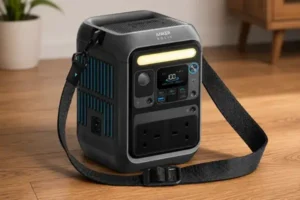
Anker SOLIX is the UK’s fastest-charging power station brand, Guinness-verified at 49 minutes on the C1000 Gen 2. The range runs LFP, spans 288Wh to 26,880Wh expandable and carries a 5-year warranty.
| Brand origin | Founded 2011 by Steven Yang, now Anker Innovations, headquartered in Changsha, China |
| UK models covered | C300, C800 / C800 Plus, C1000 Gen 2, F2000 (PowerHouse 767), F3800 |
| Battery chemistry | LiFePO4 (LFP) across all current SOLIX portable power stations |
| Charging | Fastest-charging 1kWh unit in the UK: the C1000 Gen 2 recharges in around 49 minutes (Guinness World Record verified) |
| UK warranty | 5 years across the current SOLIX portable power station range |
| Signature tech | InfiniPower long-life battery engineering and SurgePad surge-load technology |
| Best for | Fast charging, high-output appliances, camping, caravan power and home backup |
The Anker SOLIX range runs from the compact 288Wh C300 to the 3,840Wh F3800, expandable to 26,880Wh with extra battery packs, all built on LiFePO4 cells with a 5-year UK warranty.
The compact tier suits day trips, backpacking and light camping, where portability matters more than raw output. The high-capacity tier suits caravan and motorhome power, home backup during a cut, and running higher-draw appliances and tools off-grid. If you’re mostly charging phones, cameras and a laptop, the C300 or C800 will cover it. If you need to run a fridge, power tools, or protect home electronics during an outage, look at the C1000 Gen 2, F2000 or F3800.
| Tier | Models | Capacity | Best for |
|---|---|---|---|
| Compact | C300, C800 / C800 Plus | 288Wh to 768Wh | Day trips, backpacking, light camping, device charging |
| High-Capacity | C1000 Gen 2, F2000 (PowerHouse 767), F3800 | 1,024Wh to 3,840Wh (expandable to 26,880Wh) | Camping, caravan and motorhome power, home backup, high-draw appliances |
We’ve fully reviewed two Anker SOLIX models using in-depth research across UK buyer data, manufacturer specifications and independent testing: the Anker SOLIX C1000 Gen 2, currently the fastest-charging 1kWh power station on the UK market, and the compact Anker SOLIX C300. We’re working through the rest of the SOLIX range and will add further reviews as they’re completed. Click through to read the full reviews.

Charge speed is Anker’s clearest advantage. The C1000 Gen 2 recharges from flat to full in around 49 minutes from a UK mains socket in UltraFast mode, backed by a verified Guinness World Record for the fastest-charging 1kWh power station. For comparison, the EcoFlow Delta 2 takes around 80 minutes, the Jackery Explorer 1000 v2 around 60 minutes, and the Bluetti Elite 100 V2 around 70 minutes. If a quick top-up between trips or during a short mains window matters, Anker currently leads this group.
The trade-off is heat and noise. Pushing that much power in quickly makes the fan work harder, and independent testing found it becomes audibly loud, around 45dB, during UltraFast charging or heavy draw. You can cap the charging input in the Anker app if you’d rather charge more slowly and quietly.
SurgePad is Anker’s surge-load technology, similar in concept to EcoFlow’s X-Boost. It reduces the voltage delivered to certain resistive appliances (kettles, toasters, basic heaters), letting some models briefly run devices rated above their continuous output. It isn’t suited to motors, compressors or precision electronics that need a stable voltage. Check this per model rather than assume it applies everywhere: our own review of the C1000 Gen 2 found its 2,000W continuous and 3,000W peak rating isn’t enough to run a standard UK kettle, which typically draws 2,500W to 3,000W. SurgePad helps with smaller resistive loads, but it doesn’t turn every Anker unit into a kettle-capable power station.
For serious home backup, the F3800 is the model built for it. It holds 3,840Wh as standard, delivers 6,000W of continuous AC output, and expands to 26,880Wh with up to six expansion batteries, enough to cover a home’s essential circuits for an extended outage. It also adds a dedicated EV charging port, an RV port, and wheels for moving it around. For lighter backup, such as keeping a router, laptop and a few lights running during a cut, the C1000 Gen 2 or F2000 are more practical and far easier to store. The C1000 Gen 2 includes a UPS mode with a switchover under 10 milliseconds, fast enough to protect a router or laptop from restarting during a mains failure. The C800 includes a similar UPS mode rated at 20 milliseconds.
For a wider look at keeping your home running through a power cut, see our best power stations for UK home backup guide.
All current SOLIX portable power stations use LiFePO4 batteries under Anker’s InfiniPower engineering, which combines the chemistry with durable components and active thermal management, aimed at a roughly 10-year lifespan under everyday use. Confirmed cycle ratings vary by model: the C800 and F3800 are rated to 3,000 cycles retaining at least 80% capacity, while the C1000 Gen 2 is rated to 4,000 cycles. Every model in the current range carries a 5-year UK warranty from authorised sellers. Units bought outside authorised UK channels may not qualify for the full warranty.
Anker leads on charge speed and output power at the 1kWh level. EcoFlow leads on range breadth and UPS-focused home backup. Jackery leads on quiet operation and lighter weight. Bluetti leads on solar input. The right choice depends on which matters most for your setup. If you want the fastest mains turnaround and the highest continuous output in a 1kWh unit, the Anker SOLIX C1000 Gen 2 is currently the strongest option in the UK. If solar harvesting is your priority, the Bluetti Elite 100 V2 accepts up to 1,000W against the C1000 Gen 2’s 600W, so see our solar generator guide. If you want maximum output and expansion for whole-home backup, Anker’s F3800 competes with EcoFlow’s larger Delta units and Bluetti’s AC500. For a detailed breakdown, see our EcoFlow vs Anker comparison or the best portable power stations UK guide.
Not sure which Anker model fits your needs? Use our power station sizing calculator to work out the right capacity, or try our power station finder quiz for a personalised recommendation.
Anker is a consumer electronics company founded in 2011 by Steven Yang, now operating as Anker Innovations and headquartered in Changsha, China. SOLIX is Anker’s dedicated power and solar sub-brand, covering portable power stations, solar panels and home battery storage, sold in the UK through the official Anker SOLIX UK store and Amazon UK.
No. Anker is a Chinese company, founded in 2011 and headquartered in Changsha. It’s neither British nor American. Anker runs a dedicated UK storefront alongside Amazon UK sales, and current SOLIX models include Type G sockets, UK-compliant cables and a UK warranty backed by local support.
Current SOLIX portable power stations use LiFePO4 batteries rated for 3,000 to 4,000 full charge cycles before capacity drops to 80%, depending on the model. That’s engineered under Anker’s InfiniPower system, which combines the chemistry with durable components and thermal management, aimed at a roughly 10-year lifespan. Every current model also carries a 5-year UK warranty from authorised sellers.
Yes, with the right model. For light camping and device charging, the C300 (288Wh) or C800 (768Wh) are compact and easy to carry. For caravan or motorhome power, the C1000 Gen 2 (1,024Wh, 2,000W) or F2000 (2,048Wh) handle a fridge, lights and charging with room to spare. Fan noise rises under fast charging on the higher-output models, so if quiet overnight charging matters, cap the input speed in the Anker app.
Yes. Anker SOLIX products bought through authorised UK channels carry a 5-year warranty, consistent across the C300, C800, C1000 Gen 2, F2000 and F3800. All current UK models include Type G sockets and UK-compliant cables. Units bought outside authorised UK sellers or as grey imports may not qualify for the full warranty.
SurgePad is Anker’s surge-load technology, comparable to EcoFlow’s X-Boost. It reduces the voltage delivered to certain resistive appliances so a unit can briefly power devices rated above its continuous wattage. It works best with heating appliances like kettles and toasters and isn’t designed for motors, compressors or sensitive electronics. Coverage varies by model, so check the specific unit’s ratings against your appliance.
It depends on the model and the kettle. A standard UK kettle draws 2,500W to 3,000W. Our review of the C1000 Gen 2 found its 2,000W continuous and 3,000W peak output isn’t enough to run one reliably. Higher-output models like the F2000 (up to 3,600W via SurgePad) or the F3800 (6,000W continuous) have more headroom for high-draw kitchen appliances. Always check the specific model’s rated and peak output against your kettle before relying on it off-grid.
Anker generally offers faster mains charging and higher continuous output at the 1kWh level, with the C1000 Gen 2 recharging in around 49 minutes against the EcoFlow Delta 2’s roughly 80 minutes. EcoFlow offers a broader range with dedicated UPS home-backup features and expandable batteries across more models. Both use LiFePO4 batteries and offer 5-year warranties on their core UK models. Read our full EcoFlow vs Anker comparison for the detail.
Yes, though solar input varies by model: the C300 accepts up to 100W, the C800 up to 300W, the C1000 Gen 2 up to 600W, the F2000 up to 1,000W, and the F3800 up to 2,400W. As with any UK solar charging, treat manufacturer figures as best-case; overcast conditions and winter light extend real-world charging times considerably. Solar panels are sold separately on all current models.
Yes, especially if fast mains charging matters to you. The SOLIX models we cover use LiFePO4 batteries, and Anker’s UK policy gives LiFePO4 models a 5-year warranty through authorised sellers. The trade-off is fan noise, which rises noticeably during fast charging. Our Anker SOLIX C1000 Gen 2 review covers its 49-minute mains charge in detail.
Use our free tools to get a personalised recommendation in minutes
Enter your devices and usage to calculate exactly what capacity you need
Calculate NowAnswer 5 quick questions and get a personalised power station recommendation
Start Quiz