Plug-In Solar Panels in the UK: What the New Law Allows
Updated October 2026Yes, in most of the UK: plug-in solar panels became legal in Great Britain on 27 August 2026. Only compliant kits of up to 800W qualify, you can have one per household, and you must register yours. Plug-in kits aren’t currently legal in Northern Ireland, and with no battery they stop working in a power cut.
We don’t sell kits and we haven’t tested them. This guide is built from the law itself, the government’s product specification, Ofgem’s decision and Energy Saving Trust advice. It covers plug-in solar panels in the UK, with the rules for Great Britain as at October 2026. That means SI 2026/848, the Plug-in Solar Device Interim Product Specification (version 2) and Ofgem’s G98 change of 11 August 2026.
Below, we cover the law, the rules, how to check a kit, and what one makes and saves. We also cover power cuts, batteries, a safe setup and how it compares with a portable power station. To charge a power station from a panel instead, read our guide to charging a power station with solar panels.
Is plug-in solar legal in the UK now?
Yes, in Great Britain. Plug-in solar has been legal to buy and use since 27 August 2026, under SI 2026/848. Only compliant kits qualify: up to 800W of output, a standard plug and one per household. It isn’t currently legal in Northern Ireland.
The change comes from SI 2026/848, made on 16 July 2026 and in force from 27 August 2026. Its full title is The Plugs and Sockets etc. (Safety) Regulations 1994 and Electricity Safety, Quality and Continuity Regulations 2002 (Amendment) Regulations 2026. The law defines a plug-in microgenerator in plain terms. It makes electricity directly from sunlight, with AC output (the mains-style power it sends to your home) of no more than 800 watts.
It connects through a standard plug and socket and runs in parallel with the network. It isn’t designed to import energy to store it for later. GOV.UK adds that you should check for permissions first, such as a landlord, building owner or freeholder, planning permission or listed building consent.
When did plug-in solar become legal?
Plug-in solar became legal in Great Britain on 27 August 2026. The government announced the plan on 24 March 2026 and ran a public consultation from 16 to 30 June. The table shows each step from the announcement to the day the law took effect.
| Date | What happened |
|---|---|
| 24 March 2026 | The government announced its plan |
| 16 to 30 June 2026 | The public consultation ran |
| 16 July 2026 | The government response and specification version 2 were published |
| 17 July 2026 | SI 2026/848 was laid |
| 11 August 2026 | Ofgem approved the G98 change |
| 27 August 2026 | Plug-in solar became legal in Great Britain |
Is plug-in solar legal in Northern Ireland?
No, not currently. The Energy Saving Trust says plug-in solar isn’t currently legal to use in Northern Ireland, and it may follow once its regulations are updated. The wiring-rules change in SI 2026/848 extends to England, Wales and Scotland only. In Northern Ireland, check the Energy Saving Trust page for updates before you buy.
How do plug-in solar panels work in the UK?
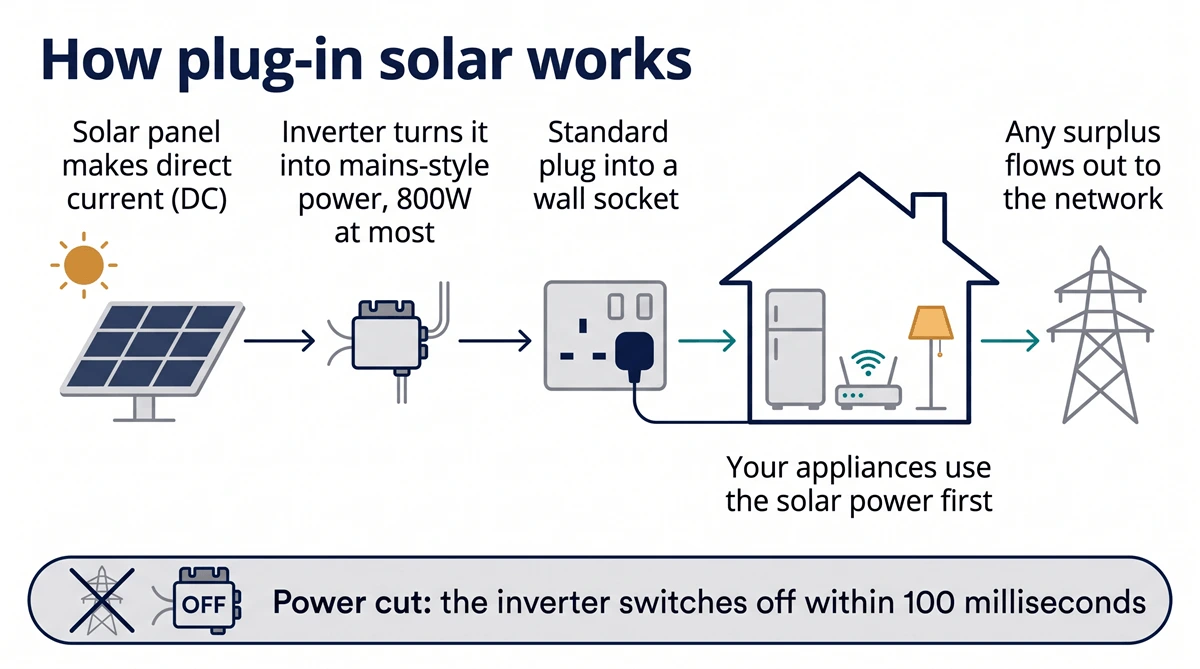
A plug-in solar kit is one or more panels with a small inverter. The inverter turns the panel’s direct current into mains-style power, and a standard plug feeds it into a wall socket. Your home uses that solar power first. Any surplus flows out to the network.
Sunlight hits the panel and makes direct current. The inverter changes it into the power your sockets carry. Whatever is running in your home, such as a fridge or a router, uses that solar power before it draws from the mains. The inverter sits between the panels and the plug, and it caps what reaches your home at 800W.
Can you just plug a solar panel into a socket?
No, not a bare panel. A panel on its own makes direct current, so the kit needs a compliant inverter. The interim product specification asks for a non-rewireable, moulded UK (BS 1363) plug with a fuse of 5A or less. It goes straight into a standard wall socket, with no extension leads, multi-way, travel or plug-in RCD adaptors.
Does plug-in solar send power back to the grid?
Yes, any surplus can flow back to the network. Your home uses the solar power first, so a surplus only appears when the panels make more than the house is drawing. The law describes these devices as running in parallel with the network, and Ofgem’s rules ask you to tell your network operator. You usually won’t be paid for it.
What are the rules for plug-in solar?
The main rules are 800W or less of output, a device on the ENA register, a standard plug and one kit per household. You must also register it and tell your network operator, and your home wiring must meet BS 7671. These rules apply in Great Britain as at October 2026.
| Rule | What it means for you |
|---|---|
| Output limit | Up to 800W of AC output, at 800 VA and 3.5 A at most, single phase |
| Approved device | It must meet the interim product specification and be on the ENA Type Test Register (G98) |
| Plug | A moulded BS 1363 plug with a fuse of 5A or less, in a standard wall socket |
| One per household | Only one plug-in solar kit in your home |
| Registration | Register after you install it and before you use it |
| Network operator | Notify your network operator when you install the kit and when you remove it |
| Home wiring | Your wiring must still meet BS 7671 |
| Power cuts | The inverter must disconnect within 100 milliseconds if the mains fails |
Three documents set these rules. The law sets the 800W limit, the government’s product specification sets what the device must do, and Ofgem’s decision sets the one-per-household and notification rules. The government’s response adds that it doesn’t consider mandatory professional installation or dedicated circuits proportionate.
How many kits can one household have?
You can have one kit per household. Ofgem’s decision allows one plug-in microgenerator per customer installation, and Electrical Safety First also says only one system per home. A second kit in the same home breaks the rules. If you want more output, a rooftop system generates more, but it’s professionally installed and permanent.
Why is the limit 800W if kits come with more panels?
The 800W limit applies to the inverter’s AC output, not to the size of the panels. The product specification allows up to 2,000W of panels (DC), so a kit can have more than 800W of panels and still be legal. The Energy Saving Trust advises seeing an electrician if your panels total over 960W, or if you’re unsure about your wiring.
Do I have to tell my network operator?
Yes. Ofgem’s decision says you notify your network operator when you install the kit and again when you remove it, using simplified forms. The product specification says each kit must carry a link to instructions on how to notify. Registering on myplugin.solar is covered in the setup steps below.
How do you check a kit is compliant?
Check the exact model is on the Energy Networks Association (ENA) Type Test Register, because every compliant device must be listed before sale. Buy from a reputable retailer, not a third-party marketplace seller. Then confirm the kit has a fused BS 1363 plug and no more than 800W of output.
Retailer listings rarely use the words “interim product specification” or “IPS”. That’s why the register is the practical check. The specification itself is the government’s rulebook for these devices, and the register tells you whether a model has passed it. We haven’t checked any specific kit, so we can’t tell you that any product on sale is compliant.
What is the ENA device register?
It’s the ENA Type Test Register for G98, the list of devices cleared for sale. The Energy Saving Trust advises buyers to check a model on the ENA Connect Direct device register. Look up the exact make and model before you pay. If it isn’t listed, don’t buy it, because compliant devices must be listed before they go on sale.
Are plug-in solar kits sold online legal?
Not all of them. Electrical Safety First advises against buying from third-party sellers on online marketplaces, and says to buy from reputable retailers instead. Kits we found listed in October 2026 included ones at Argos, Currys, City Plumbing and Octopus Energy, though stock is patchy. GOV.UK says Amazon, Argos, Currys and Wickes committed to stocking them.
How much electricity do plug-in solar panels make in the UK?
An 800W system makes around 700 kWh a year, according to the Energy Saving Trust. Its savings sums assume a south-facing, unshaded system at a 30° tilt in Manchester. GOV.UK says 800W can cover up to 20% of an average home’s electricity use.
| Scenario | Estimated output a year | What it assumes |
|---|---|---|
| Energy Saving Trust example | Around 700 kWh | Based on Energy Saving Trust research for an 800W system |
| Government headline | Up to 20% of an average home's electricity use | An 800W kit in an average home |
| Shaded or north-facing spot | Less than the example above | The panels get less direct sun, which the Energy Saving Trust advises avoiding |
Treat these as examples, not promises. Output depends on your location, the panels’ direction and tilt, and any shade. We haven’t found a reliable source for cloudy-day output, so we don’t give a figure for it.
How much could plug-in solar save on my bills?
GOV.UK says up to £110 a year, but that’s the top figure, not a typical one. The Energy Saving Trust gives a narrower estimate of around £70 to £100 a year. That’s about £100 if someone is home all day, and about £70 if you’re out. Its sums use an electricity price of 24.7p per kWh and a home that uses 2,500 kWh a year.
Does facing south make a difference?
Yes. The Energy Saving Trust’s checklist says plug-in solar works best unshaded and south-facing, and it advises avoiding north-facing or shaded spots. Because you can’t use extension leads, the spot has to be near a socket too, which can limit where the panels go.
Is plug-in solar worth it for you?
That depends on your home more than on the kit. The savings are modest, and some homes can’t use plug-in solar safely yet.
Who is it good for?
It suits people with a sunny, unshaded spot near a socket who want a simple way to cut some daytime electricity use. Being home during the day helps, because the Energy Saving Trust’s savings estimate is higher for homes with someone in all day. It also suits anyone who’d rather skip a professional install, since none is mandatory.
Who should skip it?
You should skip plug-in solar if any of these apply to you:
- You live in Northern Ireland, where it isn’t currently legal to use.
- Your home has older rewireable fuses, where the Energy Saving Trust says not to install it.
- Your home has Type AC RCDs. Electrical Safety First says to wait until they’re upgraded.
- The only spot you have is shaded or north-facing, which the Energy Saving Trust advises avoiding.
- You want power during a power cut. A plug-in kit switches off when the mains fails.
How much do plug-in solar kits cost?
The seven kits we found on sale in Great Britain on 17 October 2026 cost roughly £340 to £950. That’s a market-wide range, not a price for any one product. Prices and stock change often, so check the retailer’s page on the day you buy.
Do plug-in solar panels work in a power cut?
No. A plug-in kit stops working in a power cut. The product specification says the inverter must disconnect from the mains within 100 milliseconds if the mains supply is lost. So it can’t keep your lights or fridge on when the mains fails.
A plug-in kit has no battery to carry on with, and the law excludes devices designed to import energy to store it for later. So the panels can sit in bright sunshine while your home has no power.
If you want lights, a router or a fridge to keep running during a power cut, you need stored energy. A portable power station does that. See our best portable power stations for home backup. Our power station size guide shows how much capacity you need.
Plug-in solar vs a portable power station with a solar panel
They solve different problems. A plug-in kit cuts your daytime electricity use. A portable power station stores energy and keeps working when the mains fails.
| Feature | Plug-in solar kit | Portable power station with solar panel |
|---|---|---|
| Legal route | A plug-in microgenerator under SI 2026/848 | Not plug-in solar in the legal sense |
| Connects to home wiring | Yes, through a standard wall socket | No, appliances plug into the power station |
| Stores energy | No, it has no battery | Yes, in its own battery |
| Works in a power cut | No, it switches off within 100 milliseconds | Yes, if the battery has charge |
| Portable | No, the panels are secured in one place | Yes, you can carry it and take it away |
| What it powers | It cuts what your home draws from the mains | Whatever you plug into it, within its rating |
| Registration needed | Yes, register it and tell your network operator | Not under the plug-in solar rules, as it doesn't connect to your home wiring |
| Permissions | Check landlord, planning and listed building consent | Not covered by the plug-in solar rules |
For trimming bills, plug-in solar works on its own every sunny day, with nothing to charge or carry. A power station gives you backup and portability instead.
Will a 400W panel run a fridge? With a plug-in kit, no single appliance is powered, because the kit reduces what the whole home draws from the mains. With a power station, you plug the fridge in and it runs within the station’s rating. Our solar charging guide covers that setup.
Which one should you choose?
Choose plug-in solar to trim your daytime bills, and choose a power station for backup or portability. If you want a panel and a battery together for camping or backup, see our solar generators page. To compare power stations on their own, read our best portable power stations guide.
Can you add a battery to plug-in solar?
Not on the plug-in route. Ofgem’s decision says plug-in electricity storage devices remain prohibited from being sold, supplied or used in the UK. Battery balcony systems we found in Great Britain, such as Anker’s, need wiring in by a qualified electrician.
Ofgem says plug-in electricity storage devices “will therefore remain prohibited from being sold, supplied, or used in the UK”. The government’s response adds that battery-integrated products remain outside the scope of the current framework. That’s why a plug-in kit has no battery, and why we don’t call any battery product plug-in solar.
How are battery balcony systems sold in Great Britain?
Battery systems can’t use the plug-in route, so the ones we found need wiring in by an electrician. EcoFlow’s UK blog says the plug-in route “is not available for plug-in batteries or plug-in solar products with built-in batteries”. Anker’s UK page for its Solarbank 4 E5000 Pro says the system “must be hardwired and installed by a qualified electrician” under current UK regulations. We quote both as examples, not recommendations.
How to set up a plug-in solar kit safely
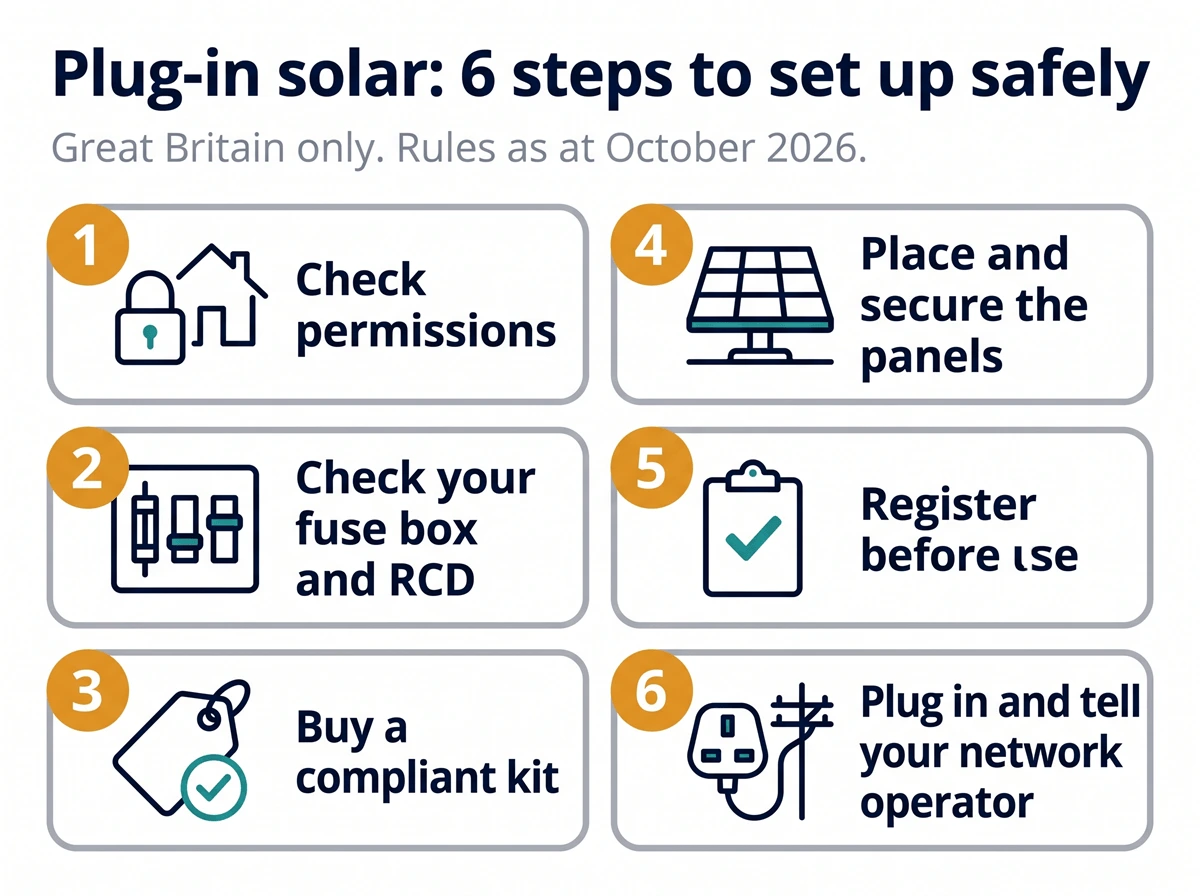
You don’t need an electrician to fit a compliant kit, but you do need to check a few things first. Follow these six steps in order.
- Check you’re allowed. GOV.UK says to check if you need a landlord, building owner or freeholder to agree, or planning permission or listed building consent.
- Check your home. Don’t install it if you have older rewireable fuses. Make sure the circuit has at least a Type A bidirectional RCD, and ask an electrician if you’re unsure.
- Buy a compliant kit. Use a reputable retailer, not a marketplace seller, and check the exact model on the ENA device register.
- Place the panels. Choose an unshaded, south-facing spot near a socket. Secure the panels with a proper frame or anchors so they can’t move or blow over.
- Register before you use it. Register on the UK Plug-In Solar Registration website, myplugin.solar, with your name, postcode and the device make and model.
- Plug in. Use a standard wall socket, with no extension lead or adaptor. Follow the kit’s instructions to tell your network operator, and notify them again if you remove it.
Does my fuse box need a different RCD?
Possibly, because Electrical Safety First says the circuit needs at least a Type A bidirectional RCD. Homes with Type AC RCDs shouldn’t use plug-in solar until they’re upgraded. An RCD is a safety switch in your fuse box that cuts the power when it spots a fault. Ask a competent electrician which type you have, especially in an older home.
How do I register my kit?
Register on the UK Plug-In Solar Registration website, myplugin.solar, after you install the kit and before you use it. The Energy Saving Trust says registering is a legal requirement. You’ll need your name, postcode and the device make and model. Ofgem’s decision also says to notify your network operator when you remove the kit.
The bottom line
Plug-in solar is legal in Great Britain, and it’s a simple way to cut some of your daytime electricity use. It isn’t a power cut solution, it stores nothing, and the savings are modest.
Before you buy, check the ENA register, your RCD suitability and your permissions. Make sure it will be your only kit. If you want backup power or something portable, a portable power station is the better tool. If you’re unsure how much capacity you’d need, try our sizing calculator.
Frequently Asked Questions
It depends on your home, so check before you install. GOV.UK tells buyers to check whether they need planning permission or listed building consent. If you live in a listed building or conservation area, the Energy Saving Trust advises checking with your local authority first.
Possibly, but ask your landlord first. GOV.UK says to check whether a landlord, building owner or freeholder needs to agree before you install. If you live in a flat, the building owner or freeholder may also have a say.
Yes, the rules don’t require a professional installer. The government’s response says mandatory professional installation or dedicated circuits aren’t proportionate for this low-power product. Your home wiring must still meet BS 7671, though. Electrical Safety First suggests a competent electrician assess the installation, especially in older properties.
Possibly, but check with your original installer or a qualified electrician first. The one-per-household rule for plug-in kits still applies.
Not normally. The Energy Saving Trust says that without an MCS certificate, you can’t normally sell electricity under the Smart Export Guarantee. Some suppliers may differ, so check with yours. For most people, the benefit comes from using the power in their own home.
If you take it with you, tell your network operator you’ve removed it. Ofgem’s decision says you notify on removal as well as on installation. At a new home in Great Britain, you would follow the same steps again: check permissions, install, register and notify.
The Energy Saving Trust describes plug-in panels as roughly 400 to 500W each and about 2m by 1m. That’s a large panel, so measure your space before you buy. Allow room for a proper frame or anchors too, because the checklist says panels must be secured so they can’t move or blow over.
Plug-in solar is a small kit that plugs into a wall socket, while rooftop solar is professionally installed and permanent. The Energy Saving Trust says rooftop systems cost more and generate more. A plug-in kit is the smaller, simpler option, limited to 800W of output.

Plug-In Solar Is Only Part of the Picture
Plug-in solar can't keep your lights on in a power cut, but a portable power station can. Work out the capacity you need, or let the quiz narrow the field for you.

Sizing Calculator
Add up your appliances and see how much capacity a power cut or a camping trip really needs.
Sizing Calculator
Power Station Finder
Answer a few quick questions and see which power stations suit how you'll use one.
Finder Quiz