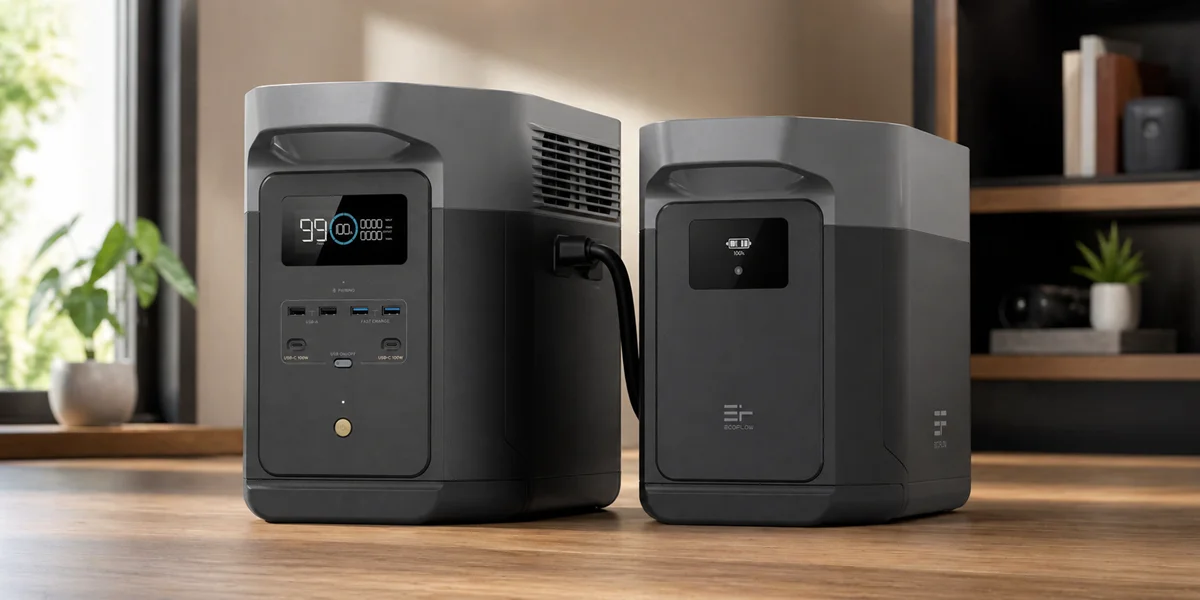
What Is the EcoFlow Delta 2 Max and Who Is It For?
The EcoFlow Delta 2 Max is the step-up model from the Delta 2. It was launched in mid-2023 and sits in the 2kWh class, targeting UK buyers who need more than the typical 1kWh unit can offer. The core pitch is simple: double the capacity of the Delta 2, higher output, dual solar input, and a proven expansion ecosystem that can take you to 6,144Wh if you need it.
It’s aimed at UK homeowners who want reliable backup power during power cuts, motorhome and caravan owners who need to run a fridge and other appliances without a hook-up, and anyone building a solar-charged home energy system. It’s not for backpackers or anyone who needs to carry it any distance. At 23kg, it takes two people to lift comfortably, and EcoFlow themselves describe it as the industry’s lightest 2,400W LFP solar generator.
Not sure if 2kWh is the right capacity for your needs? Our power station sizing calculator can help you work that out before you spend. For more context on the full EcoFlow UK range, see our brand guide. If you want home backup specifically, our best power stations for home backup guide covers all the options.
Key Specifications at a Glance
| Specification | Detail |
|---|---|
| Battery Capacity | 2,048Wh (LiFePO4 / LFP) |
| AC Output | 2,400W continuous |
| Surge | 4,800W |
| X-Boost (UK version) | 3,100W (UK/EU 230V) |
| Weight | 23 kg (two-person carry) |
| Charge 0–80% (AC only) | 53 minutes |
| Solar Input | 1,000W max (dual MPPT, two XT60i ports) |
| AC + Solar Combined | Yes |
| UPS / EPS Mode | Yes – 20ms switchover |
| Noise (low load) | ~30dB under 500W |
| Noise (heavy load) | 48–52dB above 1,500W |
| Ports (UK version) | 4 UK AC sockets, 2 USB-C 100W, 2 USB-A 12W, 2 USB-A 18W fast, 12V car, 2 DC5521 – 15 ports total |
| Battery Cycles | 3,000+ to 80% capacity |
| Expandable | Yes – up to 2 x Smart Extra Batteries = 6,144Wh |
| Alternator Charger | Compatible with 800W EcoFlow Alternator Charger |
| App Control | Yes – EcoFlow app (Wi-Fi + Bluetooth) |
| Warranty | 5 years UK |
How Fast Does the EcoFlow Delta 2 Max Charge?
The EcoFlow Delta 2 Max charges from flat to 80% in 53 minutes on AC. Solar alone, via the 1,000W combined dual MPPT input, takes around 2–4 hours in strong UK summer sun.
That 53-minute charge to 80% is EcoFlow’s X-Stream technology at work. To put it in context: most 2kWh power stations take 3 to 5 hours to charge from mains. The Delta 2 Max does it in 80 minutes. That’s a meaningful difference if you’re preparing for a predicted power cut or filling up before heading off-grid.
The EcoFlow app lets you control AC input speed. You can drop it to 500W, 1,000W, or 1,500W if you’re on a low-power circuit or want to reduce fan noise and heat. A 1,000W charge rate takes about 2 hours for a full charge but runs quietly, which many UK motorhome buyers prefer when connected at a site.
How Does the Dual Solar Input Work?
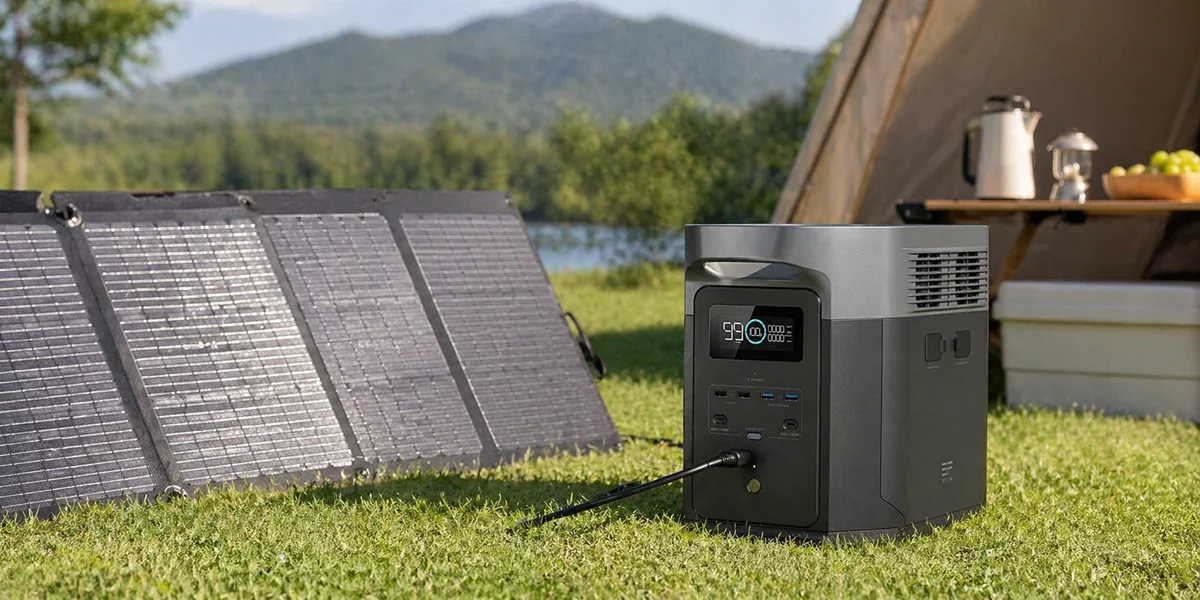
The two XT60i solar input ports accept a combined 1,000W of solar power. That means you can connect two separate solar arrays and charge at twice the rate of the Delta 2 (500W). With two 220W panels per port (four panels total), you’re pulling close to 800W in good summer sun, giving a full charge in about 2.5 to 3 hours. EcoFlow UK confirm the AC and solar inputs can work simultaneously to hit the fastest possible charge time.
You can also charge via the 800W Alternator Charger while driving, which EcoFlow UK buyers have confirmed fully charges the unit in about 2.5 hours of motorway driving.
What Can the EcoFlow Delta 2 Max Actually Power?
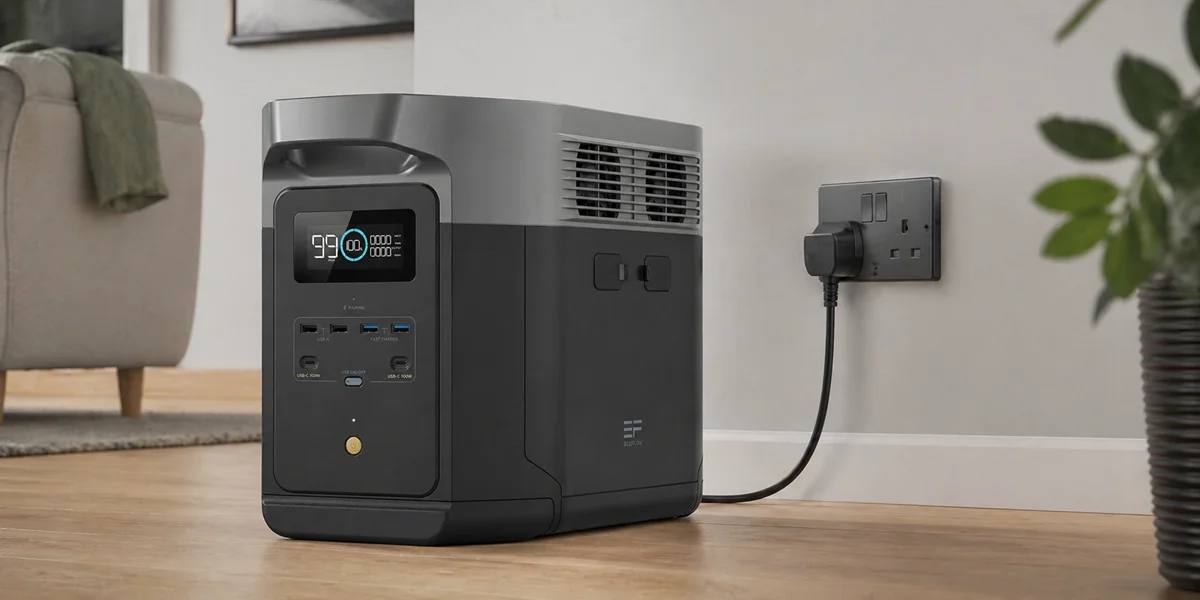
The Delta 2 Max handles virtually every UK household appliance. With 2,400W continuous output and X-Boost reaching 3,100W (UK version), it powers fridges, washing machines under 2,400W, televisions, laptops, CPAP machines, power tools, and standard UK kettles. A real-world test by PowerStationAdvisor recorded a full-size fridge running for 14.2 hours on a single charge.
Here are more UK-specific runtime estimates at around 90% inverter efficiency (EcoFlow rates the inverter at 90% efficiency at medium loads):
- Full size UK fridge (120–150W average): 12–15 hours
- 60W mini fridge: over 28 hours
- Laptop (55W): around 30 full charges
- CPAP machine (30W): over 55 hours
- Drone battery (100W): around 18 charges
- Camera battery: approximately 99 charges (per EcoFlow UK spec)
- LED lighting (20W): multiple days
The X-Boost mode extends the Delta 2 Max to 3,100W for the UK version. This means you can run a standard kettle (2,000–2,500W) with X-Boost enabled. WalkingSolar confirmed in their March 2026 field test that X-Boost successfully ran a 2,800W electric kettle at slightly reduced heating speed, and a 2,500W window AC unit handled the startup surge. Their advice: X-Boost is excellent for short high-draw moments like kettles. Don’t rely on it for sustained multi-hour loads above 2,400W.
Expandable to 6kWh: How the Extra Batteries Work
The Delta 2 Max connects to up to two EcoFlow Delta 2 Max Smart Extra Batteries, each adding 2,048Wh. That takes total capacity from 2,048Wh to 6,144Wh enough to run a full size fridge for over 40 hours, or power essential home circuits through a 2–3 day outage without solar recharging. The batteries connect via the ports on the back of the unit.
Add up to two Smart Extra Batteries via the rear XT60i expansion ports. Capacity scales linearly. Fridge runtime scales proportionally.
The expansion ecosystem is the single strongest reason to choose the Delta 2 Max over alternatives. BackupPowerHub’s April 2026 analysis confirmed that the Delta 2 Max accessory range (extra batteries, 800W alternator charger, EcoFlow Transfer Switch, Smart Generator compatibility) has been on the market and tested long enough to be reliable. Newer models like the Delta 3 Max will build similar ecosystems, but as of 2026 the Delta 2 Max’s expansion options are more proven.
Fridge runtime with one expansion battery was tested by PowerStationAdvisor at 31 hours, enough to cover most multi-day UK power cuts without losing food.
Dual 1,000W Solar Input: What It Means in Practice
The Delta 2 Max accepts 1,000W of solar input across two separate XT60i ports. You can connect two solar arrays independently. With four 220W panels (two per port), you can pull close to 800W in good UK summer sun and achieve a full charge in roughly 2.5 to 3 hours. The EcoFlow FAQ confirms AC and solar can charge simultaneously for the fastest possible top-up.
The dual MPPT controller optimises each solar input independently. That means if one panel array is partially shaded (common on UK motorhome roofs with a TV aerial in the way), the other array charges at full rate without being dragged down. This is a useful real-world advantage that single-MPPT units don’t offer.
UK motorhome buyers on Amazon report successfully running a full van setup (fridge, lighting, device charging) indefinitely during summer through solar alone, without needing to plug in at a hook-up. That’s the practical payoff of 1,000W solar input: a unit that sustains itself in British summer weather rather than just extending battery life.
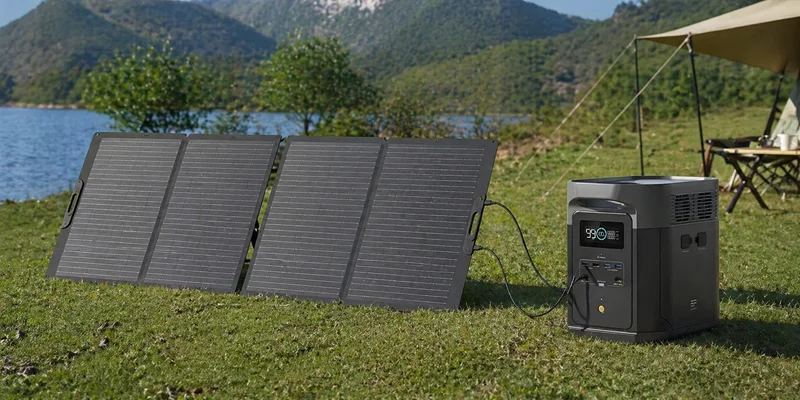
The dual XT60i ports accept up to 1,000W combined, with each port managed independently by its own MPPT controller
Fan Noise: The Most Honest Section of This Review
The EcoFlow Delta 2 Max is one of the noisiest units in this review series under heavy load. At low loads below 500W it’s around 30dB, quiet enough for indoor use. Above 1,500W, fans reach 48–52dB and are clearly audible from across a room. WalkingSolar measured this across multiple test scenarios in March 2026. This is the most common complaint in UK reviews, and it’s real.
The practical fix: use the EcoFlow app to lower the AC charging rate to 1,000W or 1,500W when noise matters. This adds 20 to 40 minutes to the charge time but brings the fans down noticeably. At 1,000W input the unit is much more liveable in an enclosed space like a motorhome.
During discharge (running your devices), noise tracks with load. Running a fridge and a few small devices at around 200W total is quiet. Running a washing machine or electric tools approaches the louder end. The Trusted Reviews UK assessment put it this way: the fans are audible but quieter than older Zendure models they’d tested previously. It’s not a dealbreaker for home backup where the unit sits in a garage or hallway. It’s more relevant for motorhome use where you might hear it overnight.
Ports and Connectivity
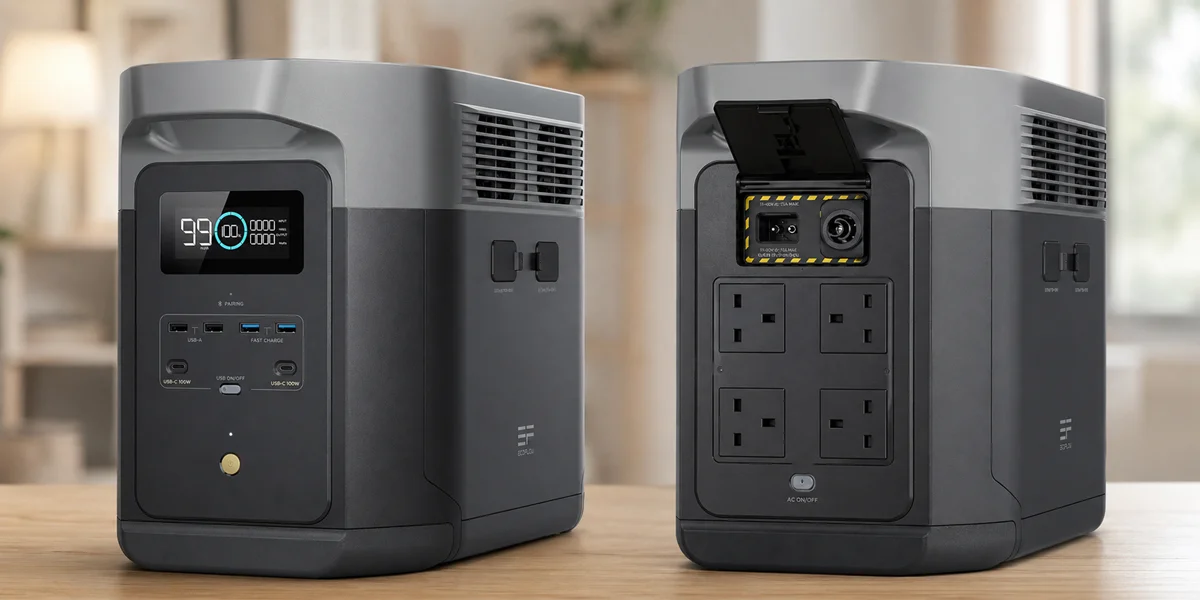
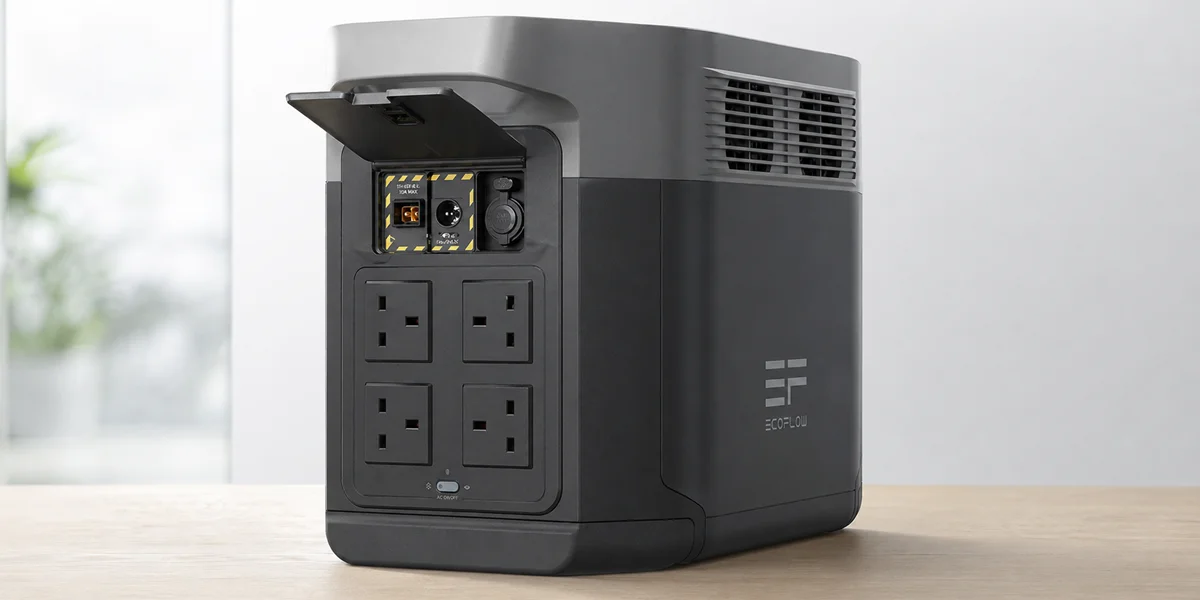
The UK version of the Delta 2 Max has 15 output ports: 4 UK AC sockets, 2 USB-C at 100W each, 2 USB-A at 12W, 2 USB-A at 18W fast-charge, 1 12V car socket, and 2 DC5521 outputs. The AC sockets and DC outputs are on one end of the unit; the USB outputs and main controls are on the other. Trusted Reviews UK confirmed all four UK sockets are spaced well enough to use simultaneously without plugged adaptors blocking each other.
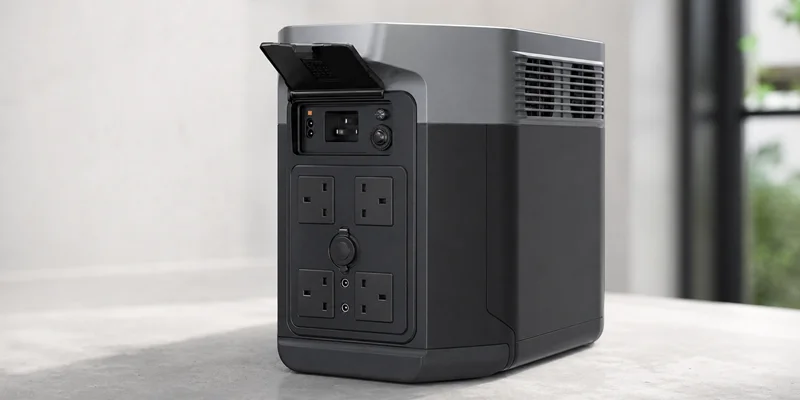
The four UK AC sockets are aligned to avoid plug-on-plug obstruction, a practical detail Trusted Reviews UK highlighted in their hands-on test.
The two 100W USB-C ports handle modern laptop charging at full speed without using an AC socket. That’s useful because it avoids DC-to-AC-to-DC conversion losses, giving you better efficiency for laptop-heavy use cases like remote working from a motorhome.
The EcoFlow app (Wi-Fi and Bluetooth) is consistently praised across UK reviews as the best in class. It gives you real-time input and output monitoring, the ability to switch individual AC outlets on and off remotely, X-Boost toggle, charge speed control, scheduled charging, and firmware updates. StorageReview rated the EcoFlow app as “the best in the industry” across their portable power station testing. The flat top design also gives you a surface to rest a laptop or stack boxes on while the unit is in use.
Battery Life: How Long Will It Last?
The Delta 2 Max uses LFP (lithium iron phosphate) battery cells rated to 3,000+ cycles before dropping to 80% capacity. EcoFlow rates this as 10 years of daily use. ThumbCulture UK’s review confirmed it’s around 30% lighter than comparable 2kWh LFP units from rival brands, which is a design achievement given the capacity. The 5-year warranty covers battery capacity degradation.
ProToolsAdvisor’s testing over 200 charge cycles confirmed capacity measured at 98.7% of original specification after four months of intensive testing. That kind of cycle stability is what LFP chemistry is known for and why EcoFlow’s 10-year claim is credible rather than marketing.
Battery self-discharge is impressively low. ProToolsAdvisor recorded 94% charge retained after 30 days of storage. That matters for home backup use: you can top it up, store it, and rely on it being near-full when you actually need it six months later during a winter power cut.
The charge limit feature in the EcoFlow app lets you cap charging at 80% or 90%. This is worth using if the unit stays plugged in as a permanent UPS. Keeping LFP cells away from 100% during regular storage extends their long-term health.
EcoFlow Delta 2 Max vs Delta 2: Is the Upgrade Worth It?
The Delta 2 Max has double the capacity (2,048Wh vs 1,024Wh), 33% more output (2,400W vs 1,800W), double the solar input (1,000W vs 500W), and expands to 6,144Wh vs 3,040Wh. It weighs 23kg vs 12kg and costs roughly double. For home backup and motorhome use, the upgrade is worth it. For camping where you carry the unit, the Delta 2 makes more sense.
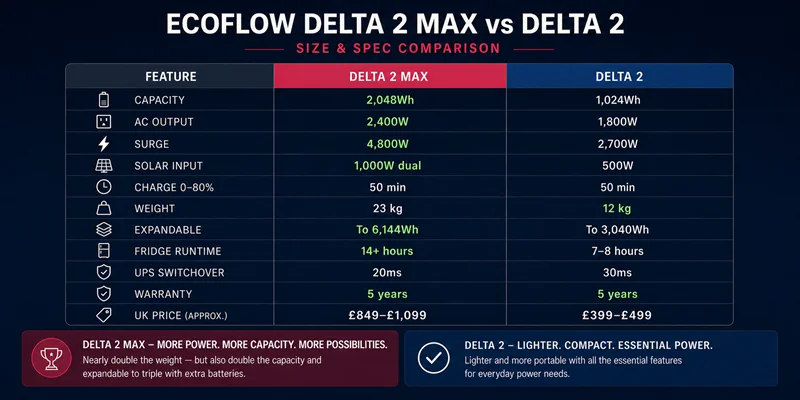
The Delta 2 Max is nearly double the weight of the Delta 2, but also double the capacity and expandable to triple with extra batteries.
The comparison confirms the trade-off clearly. For camping where you physically carry the unit, the Delta 2 wins. For home backup or motorhome use where the unit stays in one place, the Delta 2 Max’s capacity, output, and expansion ceiling make it the stronger choice. For a broader look at how EcoFlow compares to other brands, see our EcoFlow vs Jackery guide.
Campers who need to carry the unit to a pitch: at 23kg it needs two people to lift. It’s a car-boot and garage unit, not something you’ll carry across a field.
Budget-conscious buyers: at £849–£1,099, it costs roughly double the Delta 2. If 1kWh of capacity is enough for your needs, the Delta 2 gives you more value per pound
- Anyone sensitive to fan noise: the fans hit 48–52dB under heavy loads. In a motorhome bedroom or quiet room, this is noticeable. The Jackery Explorer 1000 v2 and Bluetti Elite 100 V2 are quieter options at the 1kWh level
- Buyers who need to run an electric shower, large oven, or air conditioning unit: even at 2,400W, these appliances draw more power than the Delta 2 Max can sustain
- Anyone who only needs occasional small device charging: the cost and weight are not worth it if you just need to charge phones and laptops on a weekend camping trip
Pros and Cons
- 2,048Wh: enough for 14+ hours of fridge runtime
- Expandable to 6,144Wh with two extra batteries
- 2,400W output handles most UK appliances
- X-Boost to 3,100W: runs a UK kettle
- 1,000W combined solar: two MPPT ports
- 0–80% in 53 minutes on AC charging
- Mature accessory ecosystem: alternator charger, transfer switch, extra batteries
- 13 output ports including four UK AC sockets
- Flat top for stacking, side handles for two-person carry
- EcoFlow app: best rated in class by independent reviewers
- 20ms UPS switchover for home office protection
- 5-year warranty, 3,000+ LFP cycles
- 23kg: needs two people to carry, not suitable for carrying to a pitch
- 48–52dB fan noise above 1,500W load
- Expansion batteries are expensive: each adds roughly £500 to £700
- Can't run electric shower, large oven, or air con
- Solar panels not included
- High price vs 1kWh alternatives
Alternatives Worth Considering
The Delta 2 Max is the strongest expandable option in its class, but it’s not right for everyone. Here are the main alternatives:
- EcoFlow Delta 2: Half the capacity, half the weight (12kg), half the price. If you don't need 2kWh and won't be running a fridge for more than 7 or 8 hours, the Delta 2 is a significantly more practical choice for most UK buyers.
- EcoFlow Delta 3 Classic: Newer, 1kWh, faster charge (45 min), 30dB quiet. Better starting point if you want the latest EcoFlow tech at a lower price and don't need 2kWh capacity.
- Jackery Explorer 2000 v2: 2,042Wh, 2,200W output, LFP battery. Lighter than the Delta 2 Max and a strong alternative in the 2kWh class. A solid competitor worth comparing at similar prices.
For the full picture, see our guide to the best portable power stations in the UK.
Final Verdict
The EcoFlow Delta 2 Max is not trying to be the lightest or the cheapest. It’s trying to be the most capable, and it succeeds. The combination of 2,048Wh base capacity, expandability to 6,144Wh, dual 1,000W solar, 2,400W output, and a proven accessory ecosystem puts it in a class of one for UK home backup buyers who want a system that can grow with their needs.
The honest trade-offs are significant: 23kg is a real weight that limits where and how you use it, and the fan noise above 1,500W is the most common complaint in UK reviews. Use the app to dial back the charge rate when noise matters and it becomes much more liveable.
If you’re a homeowner who wants a power station that can run your fridge through a multi-day power cut, power a full motorhome setup, or form the heart of a rooftop solar system, the Delta 2 Max is the unit to build around. If you’re a camper who carries your kit to the pitch, look at the Delta 2 or Delta 3 Classic instead.
Frequently Asked Questions
The EcoFlow Delta 2 Max is worth buying if you need reliable high-capacity power for home backup, a motorhome, or serious off-grid use. Its 2,048Wh base capacity, expandability to 6,144Wh, dual 1,000W solar input, and 5-year warranty make it one of the most complete 2kWh systems in the UK. The main consideration for 2026 buyers is that the newer EcoFlow Delta 3 Max offers similar base capacity at a lower price. The Delta 2 Max wins on expansion ecosystem maturity and the number of ports, but compare current prices carefully before buying.
The EcoFlow Delta 2 Max will run a standard full-size UK fridge for around 10 to 14 hours on a single charge. PowerStationAdvisor ran an 8-month real-world test with a full-size Samsung refrigerator and recorded 14.2 hours from a single charge. With one expansion battery attached (4,096Wh total), that extends to around 31 hours. With two expansion batteries (6,144Wh), you’re looking at over 40 hours of fridge runtime, which is enough to cover most multi-day UK power cuts without food loss.
The EcoFlow Delta 2 Max charges from flat to 80% in 53 minutes on AC. Solar charging via the 1,000W combined dual MPPT input takes 2 to 4 hours in strong UK summer sun. depending on your panel setup. You can combine AC and solar charging simultaneously to hit the fastest possible times. Dropping the AC input to 1,000W via the app extends charge time to about 2 hours but keeps fan noise down significantly.
The EcoFlow Delta 2 Max can run the essential circuits in most UK homes during a power cut: fridge, router, lights, phone and laptop charging, and a television. It won’t run an electric shower, cooker, tumble dryer, or large air conditioning unit, as those draw more than 2,400W. For automatic whole-home coverage, EcoFlow’s Smart Home Panel integrates with the Delta 2 Max for circuit-level load management. With an expansion battery attached, you get around 28 hours of fridge-and-essentials runtime, which covers most UK outage scenarios.
The Delta 2 Max has double the battery capacity (2,048Wh vs 1,024Wh), 33% more output power (2,400W vs 1,800W), double the solar input (1,000W dual MPPT vs 500W single), and expands to 6,144Wh vs 3,040Wh with extra batteries. It weighs 23kg vs 12kg and costs roughly double. Choose the Delta 2 for camping and lighter use where weight and price matter. Choose the Delta 2 Max for home backup, motorhome power, or any setup where you need to run multiple high-draw appliances simultaneously or want to grow capacity over time.
The EcoFlow Delta 2 Max is quiet at low loads, around 30dB when output is below 500W. Above 500W the fans run more continuously, and above 1,500W they reach full speed at roughly 48 to 52dB, which is clearly audible from across a room. This is the most common complaint in UK reviews. The practical fix is to use the EcoFlow app to reduce the AC charging rate to 1,000W, which quiets the fans considerably at the cost of about 40 extra minutes on a full charge.
The Delta 3 Max is newer, slightly lighter, and costs less (around £749 vs £849–£1,099). Both have 2,048Wh and 2,400W output. The Delta 2 Max wins on expansion ecosystem: its extra batteries, alternator charger, transfer switch, and Smart Generator compatibility have been on the market and tested by UK buyers for longer. If you’re building a multi-battery system for home backup and want proven accessories, the Delta 2 Max ecosystem advantage matters. For a first-time buyer who just wants the base unit, the Delta 3 Max at the lower price is worth checking.