What Is the EcoFlow Delta 3 Classic and Who Is It For?
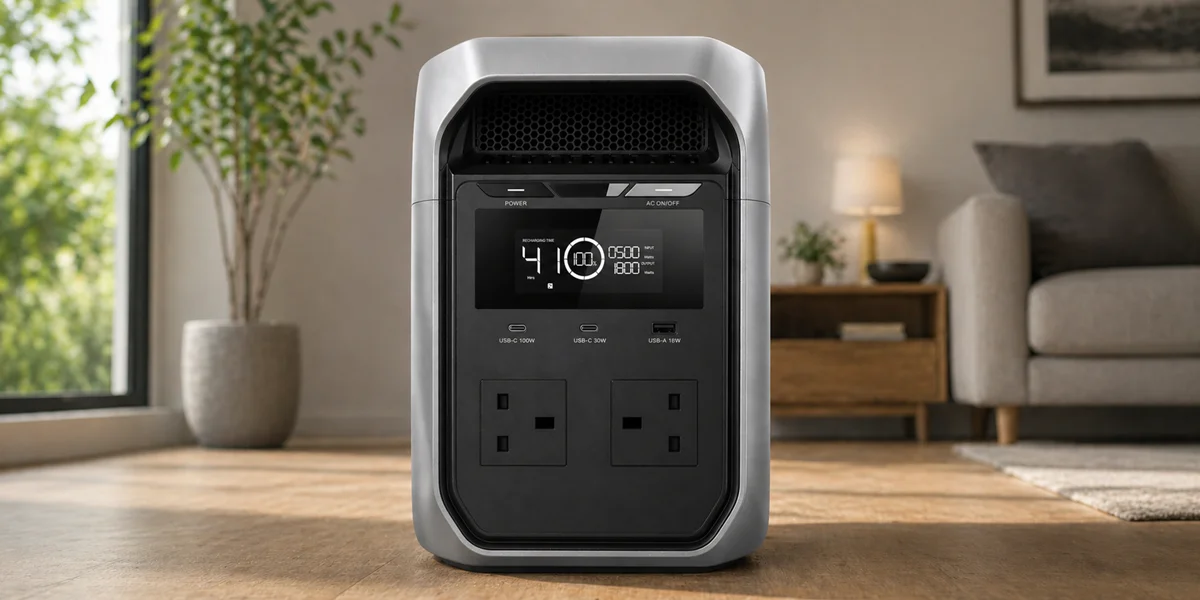
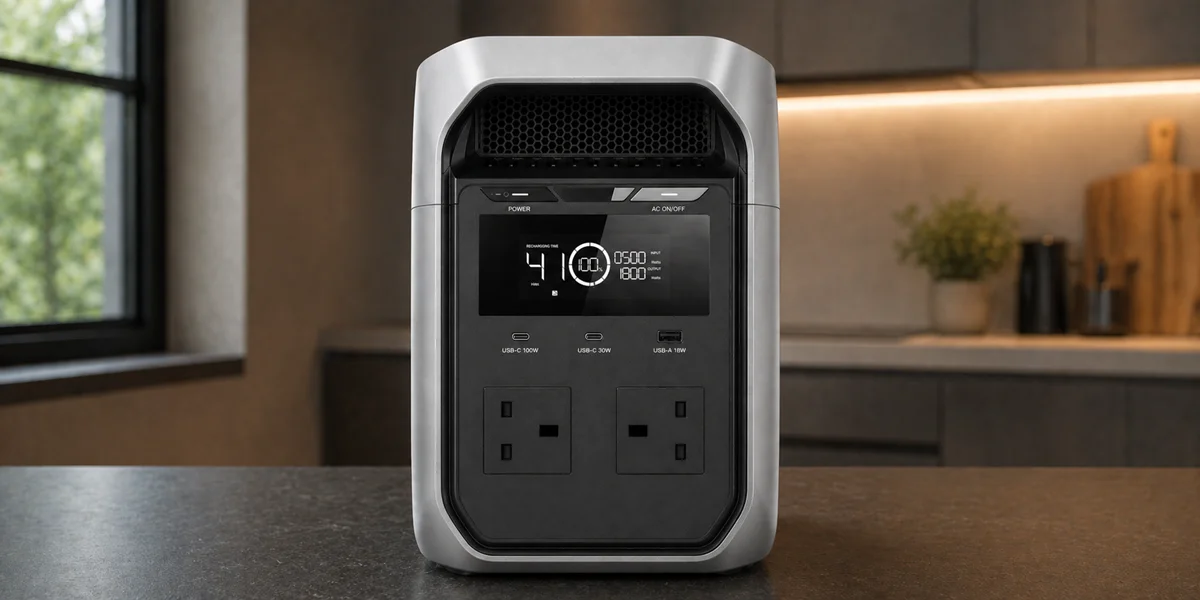
The EcoFlow Delta 3 Classic is the newest entry point into EcoFlow’s Delta 3 range. It launched in the UK on 16 March 2026 and sits below the Delta 3 Plus and Delta 3 Max in the lineup. Think of it as EcoFlow stripping back the extras and focusing on three things: fast charge, quiet operation, and solid power output.
It is aimed at UK buyers who want a reliable 1kWh portable battery without paying for features they will never use. You get 1,800W output, a 3,600W surge rating, 45-minute charge to 80%, and one of the quietest fans in this class. What you do not get is expandability, a 12V car socket, or a long port list.
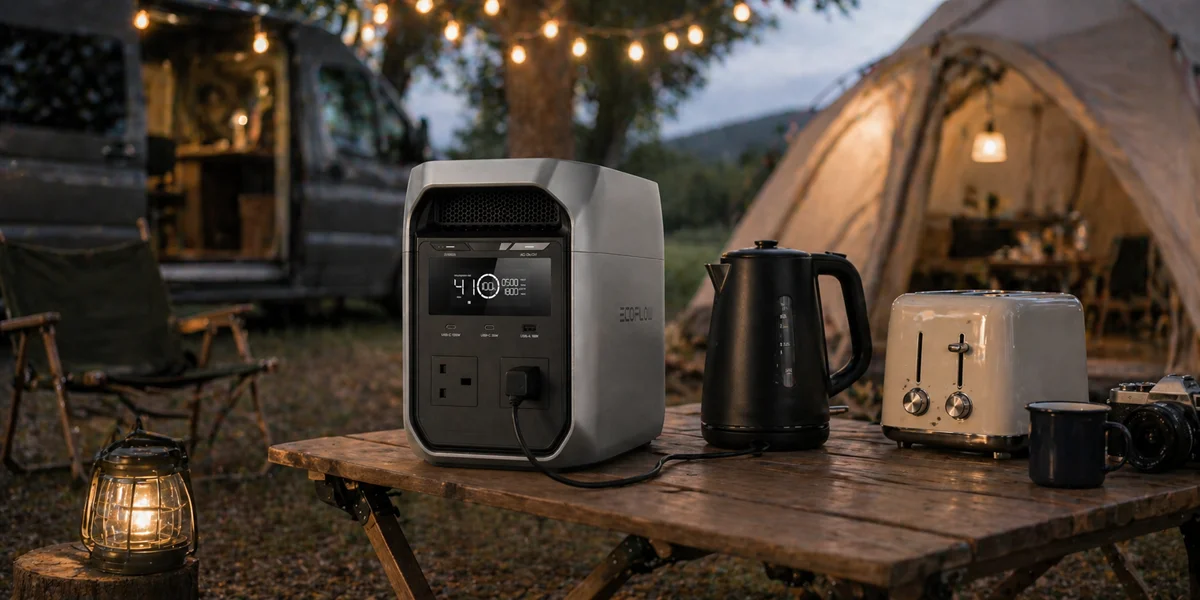
It suits campers, caravan and motorhome owners, van lifers, and homeowners wanting a clean backup for power cuts or a quiet alternative to a petrol generator. If you need off-grid power for weekend trips or want to keep essentials running during a storm, this is a strong choice. Not sure how much power you need? Use our power station sizing calculator before you decide. For solar setup guidance, see our UK solar charging guide. For a look at the full EcoFlow UK range, see our brand guide.
Key Specifications at a Glance
| Specification | Detail |
|---|---|
| Battery Capacity | 1,024Wh (Automotive-grade full-tab LFP) |
| AC Output | 1,800W continuous (3,600W surge), pure sine wave inverter |
| X-Boost Output | Up to 2,400W compatible devices |
| Weight | 12.1 kg |
| Dimensions | 398 x 200 x 283mm |
| Charge 0–80% | 45 minutes (AC, 1,400W X-Stream) |
| Full Charge Time | ~60 minutes from flat |
| Solar Input | 500W max (MPPT), ~2.5 hours in ideal conditions |
| AC Charging Input | 1,400W max |
| Noise Level | 30dB under 600W load (whisper quiet) |
| UPS / EPS Mode | Yes, 10ms switchover |
| Ports (UK version) | 2 UK 230V AC sockets (BS 1363), 1 USB-A, 1 USB-C 100W, 1 USB-C 30W |
| Battery Cycles | 3,000+ to 80% capacity |
| App Control | Yes: EcoFlow OASIS 3.0 (Wi-Fi + Bluetooth) |
| Storm Guard Mode | Yes: auto-charges before severe weather |
| Expandable | No: fixed capacity only |
| 12V Car Socket | No: removed vs Delta 2 |
| Warranty | 3 years UK (5 with app registration) |
How Fast Does the EcoFlow Delta 3 Classic Charge?
The EcoFlow Delta 3 Classic charges from flat to 80% in 45 minutes via a standard UK mains plug, using EcoFlow’s X-Stream technology at 1,400W input. A full charge from flat takes around 60 minutes. Solar charging via 500W input takes about 2.5 hours in strong sunlight. In typical overcast UK conditions, allow 4–5 hours for a full solar charge.
That 45-minute charge to 80% is one of the fastest in this class. To put it in context: the older Delta 2 takes 50 minutes to 80%, and the Jackery Explorer 1000 v2 takes around 62 minutes. The difference is not huge, but it matters when you are trying to top up before leaving for a campsite or filling up before a storm hits.
The real upgrade over the Delta 2 here is the input power. The Delta 3 Classic accepts up to 1,400W from the mains, compared to 1,200W on the Delta 2. That faster input is why it gets to 80% five minutes quicker despite having the same 1,024Wh capacity.
How fast is solar charging in the UK?
The Delta 3 Classic accepts up to 500W of solar input via its MPPT controller. According to T3’s review, full solar recharge in ideal conditions takes about 2.5 hours. In real UK weather, that figure rises considerably. On an overcast day, a 220W solar panel might output just 30–60W, pushing full charge time to 5 hours or more. Pair two 220W panels and you will get much better results on bright days.
One feature worth knowing: you can combine solar and mains charging at the same time, which EcoFlow calls Hybrid Charging. If you are parked up with a solar panel and want to top up faster, plug both in and the unit uses both inputs together.
What Can the EcoFlow Delta 3 Classic Actually Power?
The EcoFlow Delta 3 Classic can power around 90% of UK household appliances. With 1,800W continuous output and X-Boost technology reaching 2,400W for compatible devices, it handles fridges, laptops, CPAP machines, TVs, electric blankets, and most camping appliances. It will not run a standard UK kettle or electric shower because both draw more than 2,400W.
How long does the EcoFlow Delta 3 Classic run common UK devices?
Numbers on a spec sheet do not mean much until you know what they look like in practice. Here are real-world estimates based on typical appliance draws, at 85% inverter efficiency:
What does X-Boost mean at 2,400W?
X-Boost on the Delta 3 Classic is rated to 2,400W, a step up from the Delta 2’s 2,200W ceiling. It lets the unit run appliances rated above 1,800W by managing voltage delivery intelligently. This means microwaves, larger space heaters, and induction hobs come within reach. One thing to be aware of: X-Boost reduces voltage to the appliance, so heating elements may not run at full intensity.
What can the EcoFlow Delta 3 Classic not run?
Be clear on this before you buy. The Delta 3 Classic will not run a standard UK kettle (2,000–3,000W), an electric shower (7,000W+), a standard oven (2,000–5,000W), or an air conditioning unit. If you need to power any of these, look at the EcoFlow Delta 2 Max (2,048Wh, 2,400W output) instead.
How Quiet Is the EcoFlow Delta 3 Classic?
EcoFlow rates the Delta 3 Classic at 30dB under 600W load, which is roughly the volume of a whisper. That makes it one of the quietest units in its class, quiet enough for a tent, a motorhome bedroom, or indoor use during a power cut without disturbing anyone. Under heavier loads the fans do spin up, but UK buyers and reviewers consistently describe the noise as a gentle hum rather than the louder fan noise found in older models.
This is a genuine improvement over the Delta 2. The Delta 2 gets noticeably loud at full 1,200W charging speed, which has been one of the most common complaints in UK reviews. The Delta 3 Classic’s quieter operation comes partly from the new automotive-grade full-tab LFP cells, which generate 25% less heat according to EcoFlow’s data. That means the cooling fans do not need to work as hard.
For anyone who plans to run this overnight as a CPAP backup, or keep it in a motorhome bedroom, the 30dB rating is a meaningful real-world benefit. A March 2026 test confirmed that the fans stay near-silent at low loads under 200W and only become audible under sustained heavy loads.
What Is Storm Guard Mode?
Storm Guard Mode is a feature in the EcoFlow OASIS 3.0 app that monitors local severe weather alerts and automatically starts charging the Delta 3 Classic to 100% before bad weather arrives. You set it up once in the app. If a storm warning is issued for your area, the unit charges itself automatically, even when you are not home. According to T3’s review, this feature was previously only available on EcoFlow’s larger home energy systems. Having it on a portable unit is a genuine step forward for home backup buyers.
Storm Guard Mode requires the EcoFlow app and an active internet connection to work. You preset it once, and it runs in the background. When a severe weather alert is detected for your location, the app triggers automatic charging so your Delta 3 Classic is fully topped up before the power goes down.
For UK buyers who keep the Delta 3 Classic plugged in at home as a standby backup, this is a very useful feature. Rather than scrambling to charge it when you see storm warnings on the news, the unit handles it automatically. The catch: it only works when the unit is connected to Wi-Fi and plugged into a mains socket at the time the alert triggers.
What Ports Does the EcoFlow Delta 3 Classic Have?
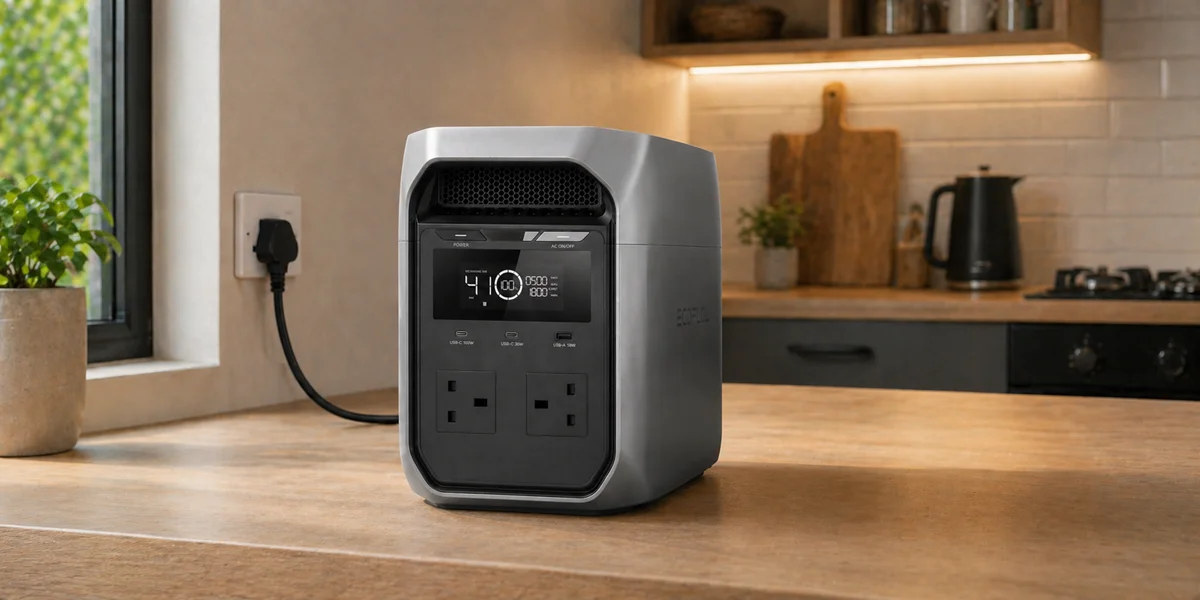
The Delta 3 Classic has five output ports: 2 UK AC sockets (230V, BS 1363 three-pin), 1 USB-A port, 1 USB-C at 100W, and 1 USB-C at 30W. That is fewer than the Delta 2’s 13 ports. There is no 12V car socket, which is a genuine limitation for campers, motorhome and van-life users who rely on 12V accessories such as cool boxes and car fridges. The AC inputs (mains and solar) are on the back, and all outputs are on the front, a cleaner layout than previous Delta models.
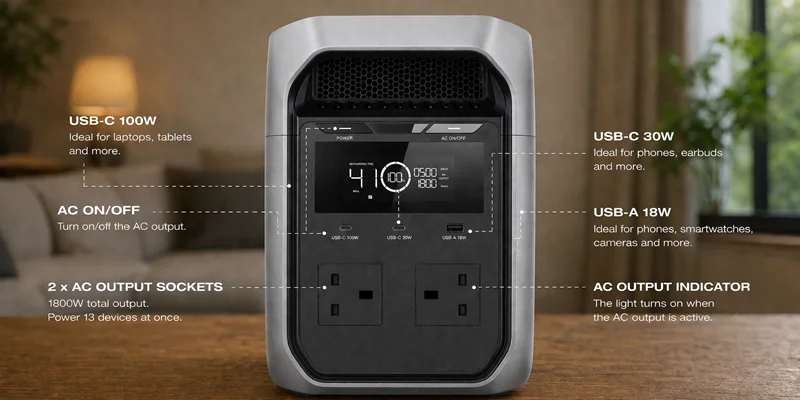
All outputs are on the front panel, a cleaner layout than the older Delta 2 generation.
The 100W USB-C port is the standout here. It charges most modern laptops at full speed without needing to use an AC socket. That is efficient because it bypasses the DC-to-AC-to-DC conversion loss, giving you roughly 15–20% more laptop runtime from the same battery.
The missing 12V car socket is worth flagging clearly. Motorhome test noted this as a disappointment, particularly for users who run 12V accessories like fans, lights, and fridges. If a 12V output is important to your setup, the Delta 2 or the Delta 3 Plus both include one.
App connectivity via the EcoFlow OASIS 3.0 app works over Wi-Fi and Bluetooth. The dashboard shows battery percentage, input and output wattage, and estimated runtime. You can switch ports on and off remotely and set timed charge schedules for off-peak electricity rates.
Battery Life: How Long Will It Last Over the Years?
The Delta 3 Classic uses automotive-grade full-tab LFP battery cells, rated to 3,000+ charge cycles before dropping to 80% capacity. EcoFlow rates it for around 10 years of reliable use under normal conditions. Used once a week for camping, that is well over a decade of service before any meaningful degradation.
The cell technology here is worth understanding. EcoFlow used the same automotive-grade full-tab LFP cells as those found in the Delta 3 Max Plus, which costs three times as much. According to EcoFlow’s technical data, the full-tab design reduces internal resistance by 25% compared to previous EcoFlow cells. Less resistance means less heat, and less heat means longer cell life.
LFP (lithium iron phosphate) chemistry is also inherently safer and more stable than older NMC lithium-ion cells. That matters if you are running the unit inside a tent, a motorhome, or a home. UK forum feedback confirms that LFP power stations from EcoFlow’s Delta range have held up well after several years of regular use.
One note worth flagging: some independent reviewers cite the cycle count as 4,000, while EcoFlow’s official UK specification page lists 3,000+. The 3,000+ figure is the confirmed manufacturer specification for the Classic model, so that is the number we use here.
EcoFlow Delta 3 Classic vs Delta 2: What Actually Changed?
The Delta 3 Classic charges 5 minutes faster (45 min vs 50 min to 80%), runs significantly quieter (30dB vs louder fan noise at full charge), and has a higher 3,600W surge (vs 2,700W). The Delta 2 wins on ports (13 vs five), a 12V socket and expandability (up to 3,040Wh vs not expandable at all). Warranty is level at five years once you register the Classic in the EcoFlow app.
The comparison table tells the full story clearly. If you need a 12V socket, more than 5 ports or the ability to expand capacity, the Delta 3 Plus covers all three. The Delta 3 Classic wins on surge power, charge speed, and noise. For a full head-to-head brand comparison, see our EcoFlow vs Jackery guide.
Who This Is NOT For
Anyone who needs to expand capacity later: there is no expansion battery support at all. If you think you will want more capacity in future, start with the Delta 2 or the Delta 3 Plus instead
- Van lifers and motorhome owners who rely on a 12V socket for accessories: the Delta 3 Classic does not have one
- Anyone needing more than 5 ports: the Delta 2 has 13. If you are powering multiple devices at once from a variety of port types, the Classic will frustrate you
Buyers who do not want to register the unit: the standard cover is 3 years, and the extra 2 years need EcoFlow app registration. The Anker SOLIX C1000 Gen 2 lists 5 years under Anker’s LiFePO4 policy
Anyone needing whole-home backup for more than a few hours: at 1,024Wh with no expandability, look at the EcoFlow Delta 2 Max (2,048Wh, expandable to 6kWh)
- Anyone wanting to run a standard UK kettle, electric shower, or oven: all draw more than 2,400W
Pros and Cons
The Delta 3 Classic’s biggest strengths are its 45-minute fast charge, 30dB whisper-quiet operation, and 3,600W surge rating. Its main weaknesses are no expandability, no 12V socket, fewer ports than the Delta 2, and a 3-year warranty unless you register for 5. It is a simplified, pared-back unit. It is excellent at what it does, but deliberately limited in scope.
- 0–80% in 45 minutes: fast enough for a lunch-break top-up
- 30dB whisper quiet: tent, bedroom and indoor friendly
- 3,600W surge: handles fridge and compressor startup
- X-Boost up to 2,400W: higher ceiling than Delta 2
- Automotive-grade full-tab LFP cells: 10-year rated lifespan
- Storm Guard Mode: auto-charges before severe weather
- 10ms UPS switchover: protects computers and NAS drives
- 100W USB-C port: charges most laptops at full speed
- Cleaner front-facing port layout than older Delta models
- Solar ready: 500W MPPT input
- Not expandable: 1,024Wh is the limit, full stop
- No 12V car socket: a step back from Delta 2
- Only 5 ports: significantly fewer than the Delta 2's 13
- 3-year warranty: 5 years only with EcoFlow app registration
- will not run a kettle, shower, or oven
- Solar panels sold separately
- Storm Guard requires Wi-Fi to work
Alternatives Worth Considering
The Delta 3 Classic is a strong unit for what it is, but it is deliberately simple. Here are the main alternatives depending on what matters most to you:
- EcoFlow Delta 2: More ports (13), 12V socket, expandable to 3,040Wh, 5-year warranty. Slightly slower charge (50 min to 80%) and louder fans. A better fit if you need more versatility or future expandability.
- Jackery Explorer 1000 v2: The quietest unit in this class at under 22dB, 4,000 battery cycles, 10.8kg. Lower 1,500W output and no Storm Guard feature. Best choice if weight and noise are your top priorities.
- Anker Solix C1000 Gen 2: Higher 2,000W output, 49-minute charge and a 5-year warranty, but no expansion. Good if you want more output power.
For a wider view of everything available in the UK, see our guide to the best portable power stations in the UK.
Final Verdict
The EcoFlow Delta 3 Classic is a well-thought-out, no-nonsense power station that does exactly what it sets out to do. It charges faster than almost anything at this price, runs quietly enough for a tent or bedroom, and has the surge power to handle any fridge or compressor appliance you’d realistically take camping.
The limitations are real and worth repeating: no expansion, no 12V socket, only 5 ports, and a 3-year warranty unless you register for 5. These aren’t hidden. EcoFlow is open about them. This is a unit built for simplicity, not flexibility.
If you want a capable, no-fuss power station for camping, short campervan trips, or home backup during a power cut, and you do not have plans to expand your system, the Delta 3 Classic is one of the best options in its class right now. If you think you will want more capacity later, start with the Delta 2 or the Delta 3 Plus. Getting the right starting point matters more than saving a little upfront.
Frequently Asked Questions
Yes, if you want a fast-charging, quiet 1kWh power station for camping, campervans or power cut backup. It charges to 80% in 45 minutes, handles a 3,600W surge and runs at 30dB under a 600W load. It has no 12V socket and cannot be expanded, so look at the EcoFlow Delta 3 Plus if you need 5kWh later. Cover is 3 years, or 5 if you register the unit in the EcoFlow app.
The Delta 3 Classic charges faster (45 minutes to 80% vs 50 minutes) and has a higher surge rating (3,600W vs 2,700W). It also runs quieter, at 30dB under a 600W load. The Delta 2 wins on ports (13 vs 5), 12V car socket (included vs missing) and expandability (up to 3,040Wh with an extra battery). Warranty is level at 5 years if you register the Classic in the EcoFlow app, and 3 years if you do not.
The EcoFlow Delta 3 Classic reaches 80% charge in 45 minutes from a standard UK mains plug using its 1,400W X-Stream fast charging. A full charge from flat takes around 60 minutes. Solar charging via 500W input takes about 2.5 hours in strong direct sunlight. In typical overcast UK conditions, plan for 4 to 5 hours or longer for a full solar charge. You can combine mains and solar charging at the same time using EcoFlow’s Hybrid Charging feature to speed things up.
Storm Guard Mode is a feature in the EcoFlow OASIS 3.0 app that monitors local severe weather alerts and automatically starts charging the Delta 3 Classic to 100% before bad weather arrives. You enable it once in the app, and it runs in the background. When a storm warning is triggered for your location, the unit charges automatically even if you are not home. It requires a Wi-Fi connection to work. T3 confirmed in their March 2026 coverage that this feature was previously only available on EcoFlow’s larger, more expensive energy systems.
Yes. The EcoFlow Delta 3 Classic can run a standard UK fridge. A fridge averaging 120W will run for roughly 7 to 14 hours on a full charge, depending on its size, the room temperature, and how often you open the door. A compact mini-fridge averaging 60W can run for around 14 hours. The 3,600W surge rating handles the startup spike of most compressor-based fridges comfortably, which is one of the genuine strengths of this unit at its price point.
Yes. The Delta 3 Classic switches to battery power within 10 milliseconds of a mains failure, which is fast enough to keep computers, routers, NAS drives, and other sensitive electronics running without any interruption. This is the same UPS response speed found on units costing considerably more, and it is a useful feature for anyone running a home office setup or wanting to protect networking equipment during a power cut. The 10ms switchover will not cause a computer to reboot or a NAS drive to lose data.
The EcoFlow Delta 3 Classic is often listed as a solar generator, and that is a fair description when you pair it with solar panels. It accepts up to 500W of solar input via its MPPT controller, letting you recharge off-grid from one or two solar panels. The solar panels are sold separately, so the unit alone is the power station. When combined with an EcoFlow 220W or similar solar panel, it becomes a complete off-grid power setup suitable for camping, overlanding, and outdoor use across the UK.
No, the EcoFlow Delta 3 Classic cannot be expanded and stays at 1,024Wh. The standard Delta 3 and the Delta 3 Plus are different models. Both expand to 5kWh with EcoFlow extra batteries. If you may want more capacity later, read our EcoFlow Delta 3 Plus review before you choose.