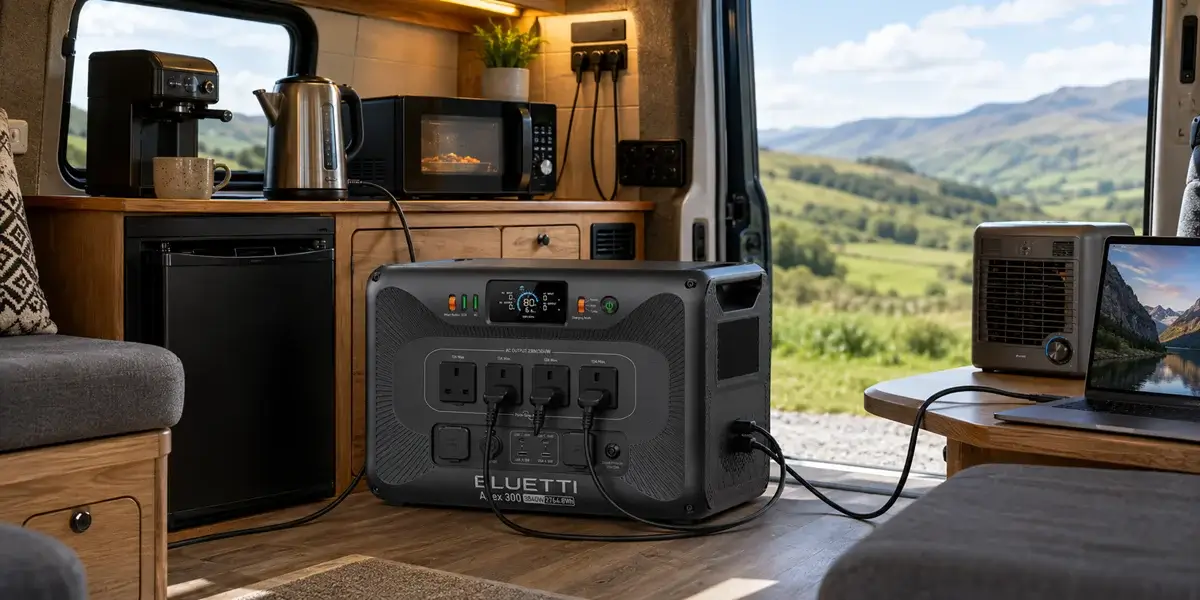
What Is the Bluetti Apex 300 and Who Is It For?
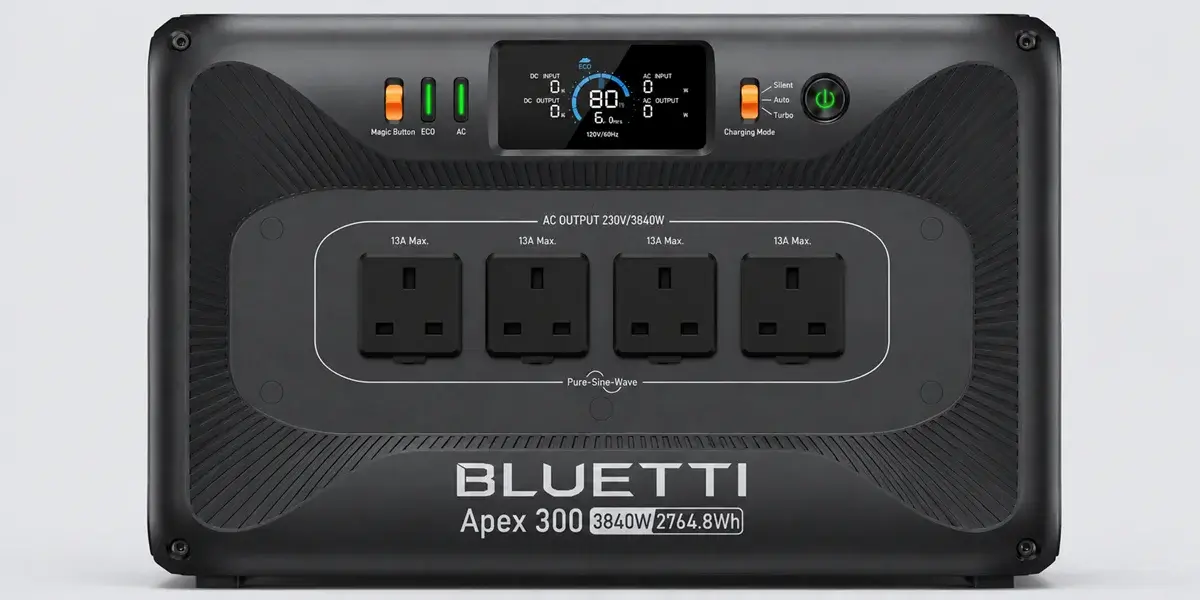
The Bluetti Apex 300 is a large-capacity portable power station built for off-grid living. It holds 2,764.8Wh of LiFePO4 (LFP) capacity and pushes out 3,840W of continuous AC power, with a 7,680W surge for start-up loads. With 2,400W of dual solar input and four native UK sockets, it is designed to run real household appliances on solar alone.
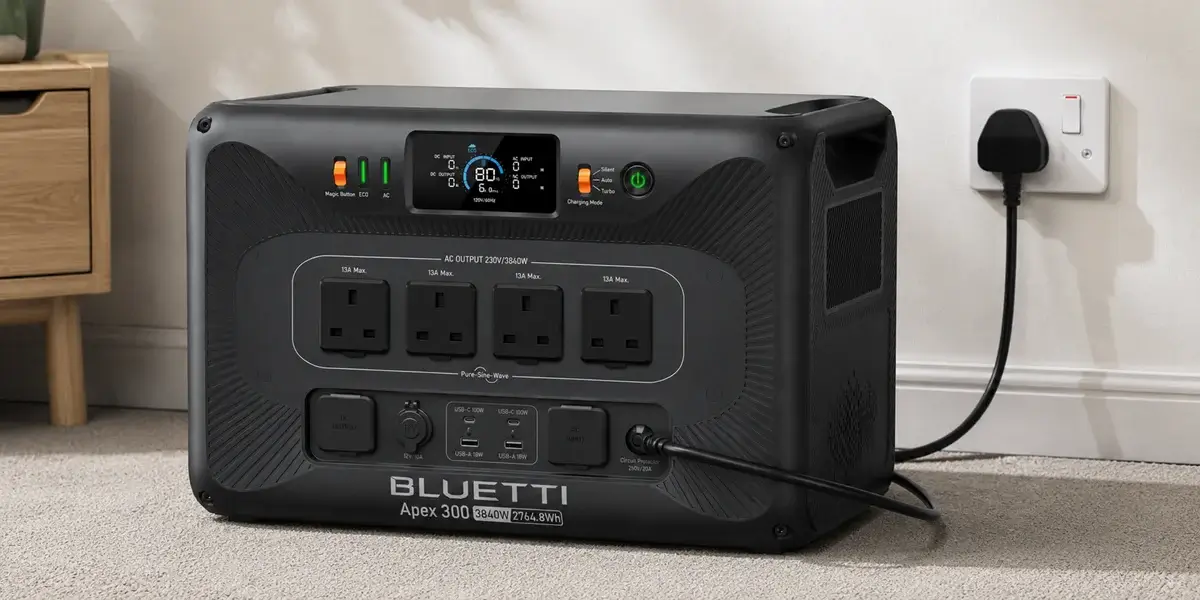
It suits three jobs in particular: van life and caravanning, off-grid cabins and workshops, and serious home backup during a power cut. At 38kg and 525 x 327 x 320mm, it is a two-person lift rather than a grab bag, so it tends to live in a fixed spot. The Apex 300 also expands: connect up to six B300K modules and the system grows to roughly 19kWh.
Not sure how much capacity you actually need? Our power station size guide walks you through matching a unit to your real-world load before you commit, and our best power stations for campervans guide covers van-life picks.
Key Specifications at a Glance
| Specification | Detail |
|---|---|
| Battery Capacity | 2,764.8Wh (LiFePO4 / LFP) |
| AC Output | 3,840W continuous, pure sine wave |
| Surge / Peak Power | 7,680W |
| Max AC Charging Input | ~3,000W (mains) |
| Full Charge Time | ~70 minutes from flat (mains) |
| Solar Input | 2,400W max (2x XT60, 1,200W / 60V / 20A each) |
| Full Solar Charge | ~70 minutes in ideal sun |
| Weight | 38 kg |
| Dimensions | 525 x 327 x 320 mm |
| UPS / EPS Mode | Yes, 20ms switchover |
| Ports (UK version) | 4x BS 1363 UK sockets (230V), 2x USB-C 100W, 4x USB-A; 12V DC via optional Hub D1 |
| Battery Cycles | 6,000 cycles (around 17 years of weekly use) |
| App Control | Yes: BLUETTI App |
| Expandable | Yes, to ~19kWh with up to 6x B300K (2,764.8Wh each); B500K (5,120Wh) compatible |
| Warranty | 5 years UK |
How Fast Does It Charge?
The Bluetti Apex 300 charges from flat to full in around 70 minutes from a UK mains socket, drawing up to roughly 3,000W of AC input. Solar charging at the full 2,400W input also reaches full in around 70 minutes in strong sun. You can blend mains and solar at the same time to keep the battery topped up through the day, which is handy for off-grid use.
For a 2,764.8Wh battery, a 70-minute mains recharge is genuinely fast. It means you can fill the unit on a short hook-up stop, then run off-grid for the rest of the day. Bluetti lets you manage charge speed in the BLUETTI App, so you can cap the input if you would rather charge gently and reduce wear on the cells.
The dual solar input is the headline for off-grid buyers. Feeding both XT60 ports at the full 2,400W can match the mains time in ideal summer light. In typical overcast UK conditions, treat that figure as a best case and allow longer, but even partial sun keeps the battery topped up while you draw from it.
Does the Fast Charge Make the Fan Loud?
Yes, and it is worth flagging. The Apex 300 runs near-silent at light load, but the fan becomes audible when charging at full power or under heavy draw. If you want a quiet overnight charge in a van or bedroom, cap the input in the app rather than pulling the full 3,000W.
How Much Solar Can It Take in the UK?
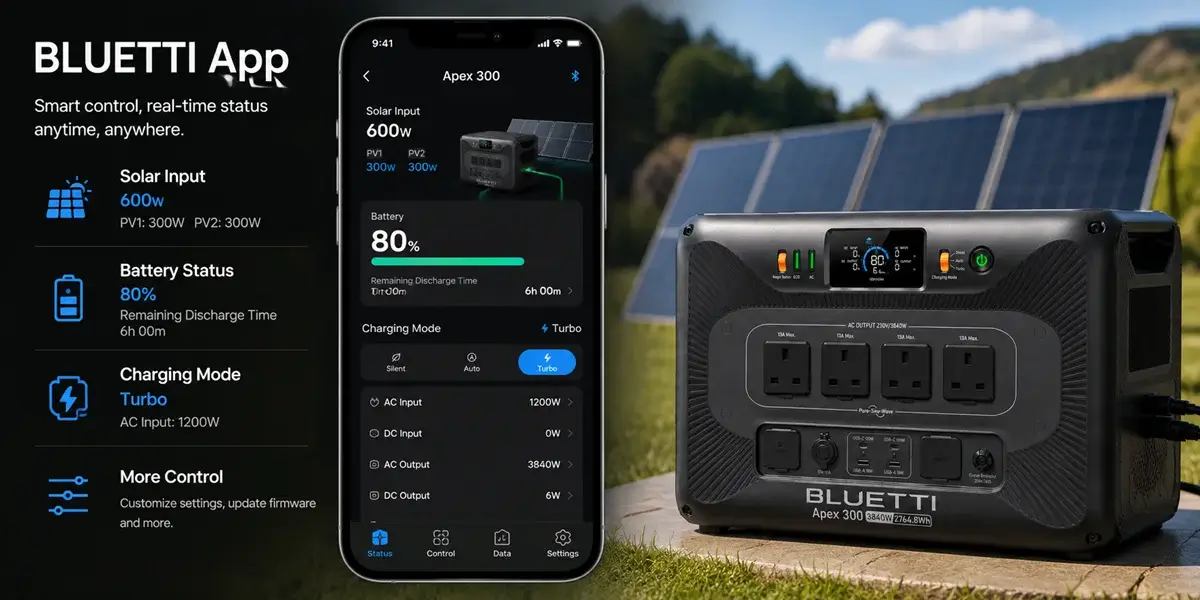
The Apex 300 accepts up to 2,400W of solar across two inputs, with each XT60 port taking 1,200W at 60V and 20A. That dual setup lets you split panels across two strings, which helps in changing UK light. In ideal sun a full solar recharge takes around 70 minutes. In typical UK conditions, with weaker winter light and cloud, plan for longer, but the headroom is generous.
This is one of the strongest solar inputs you can buy on a unit this size. The 2,400W ceiling and dual MPPT inputs mean you can run a large panel array and still feed the battery faster than you draw from it on a sunny day. For permanent off-grid setups on a cabin or a fixed van install, that headroom is the difference between topping up and falling behind.
For most UK off-grid users, a 1,000W to 1,600W panel array makes the most of a typical day, with the full 2,400W reserved for big arrays in strong summer sun. For a wider look at panel setups, see our guide to the best solar generators in the UK, and our best power stations for home backup guide if backup is your main use.
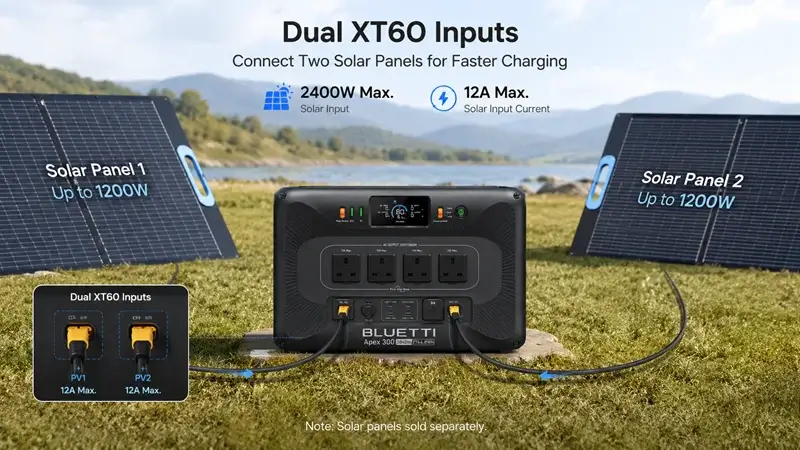
The 2,400W dual solar input can recharge the Apex 300 in about 70 minutes of strong sun, split across two XT60 ports.
What Can It Actually Power?
With 3,840W of continuous output and a 7,680W surge, the Apex 300 runs almost anything a UK home or van plugs in: a kettle, an induction hob, a microwave, a fridge-freezer, power tools, and a full off-grid setup at once. The 2,764.8Wh battery means it keeps a fridge, lights and devices going for a day or more before you need to recharge.
Here are indicative runtimes based on the battery capacity and typical device draw:
Other useful estimates: a 1,000W microwave runs for roughly 2.5 hours of cumulative use, and a CPAP machine without a humidifier for two to three nights on a single charge. Because the inverter is rated to 3,840W, you can run several of these at once without tripping out.
What Can It Not Run?
It cannot run the very highest-draw appliances continuously. An electric shower (7,000W and up) and some large ovens exceed the 3,840W continuous limit, so they are off the table. A kettle and a single induction ring are fine on their own, but running both flat out together will push close to the ceiling. Use our size guide to check your appliances before buying.
How Does the Modular Expansion Work?
You can grow the Apex 300 from its 2,764.8Wh base to roughly 19kWh by connecting up to six B300K battery modules, each adding 2,764.8Wh. The larger B500K module (5,120Wh) is also compatible. Each module connects directly to the main unit and the whole system is monitored through the BLUETTI App, so capacity grows with your needs rather than forcing you to buy big up front.
This is what makes the Apex 300 a long-term off-grid platform rather than a one-off purchase. You can start with the base unit for van life or backup, then add modules later as your power needs grow, for example when you move from weekend trips to full-time van living or kit out a cabin. Fully expanded, around 19kWh is enough to run a low-consumption home for a day or two.
The trade-off is weight and cost. Each B300K module is heavy in its own right, so a large system is a fixed install rather than something you move around. If you only ever need the base capacity, you are not paying for expansion you will not use, which is a fairer model than sealed-in batteries.
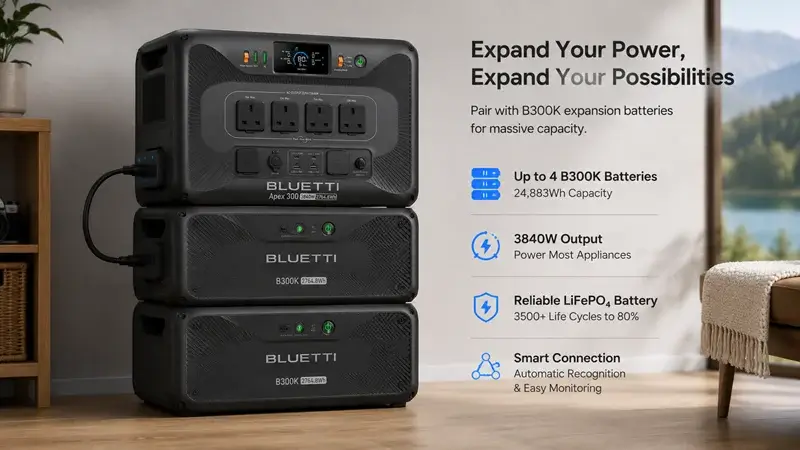
Up to six B300K modules take the Apex 300 from 2,764.8Wh to roughly 19kWh, all managed in the BLUETTI App.
Does the 20ms UPS Switchover Work for UK Homes?
Yes. The Apex 300 switches to battery in 20ms when the mains drops, fast enough to keep a fridge, router, lights and most desktop computers running without a reboot. Plug your essential circuit through the unit and it acts as a whole-room UPS, holding power through a cut until the grid returns or you switch to solar.
A 20ms switchover sits comfortably inside the gap most home electronics tolerate, so in practice you will not notice the changeover. That makes the Apex 300 a sensible backup for a home office, a home network, or a fridge-freezer full of food during a UK winter outage. It is not a substitute for a wired-in home battery, but for an unplanned power cut it does the job.
For a deeper look at sizing a unit for outages, our best power stations for home backup guide covers how long different capacities last on essential loads.
What Ports Does the Bluetti Apex 300 Have?
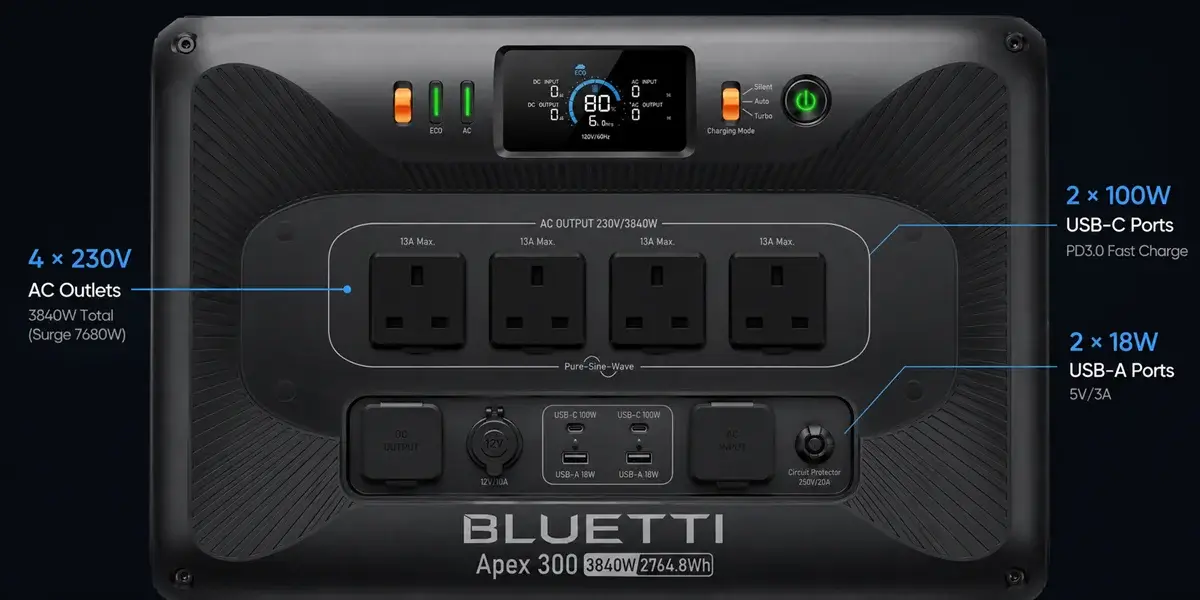
The UK Apex 300 has four BS 1363 UK three-pin sockets (230V), two USB-C ports at 100W, and four USB-A ports. The four native UK sockets mean no travel adapter is needed. There is no built-in 12V DC output on the unit itself; for car-socket and DC loads you add the optional Bluetti Hub D1.
Four full UK sockets is generous and lets you run several mains appliances at once, which is exactly what an off-grid kitchen or workshop needs. The two 100W USB-C ports fast-charge laptops and phones, and the four USB-A ports cover everything smaller. Everything connects through the BLUETTI App for real-time input and output monitoring.
The one thing to plan for is DC. If you run 12V fridges, water pumps or lighting common in van builds, you will need the optional Hub D1 to add those DC outputs. Factor that into your budget if DC is central to your setup, rather than assuming it is built in.
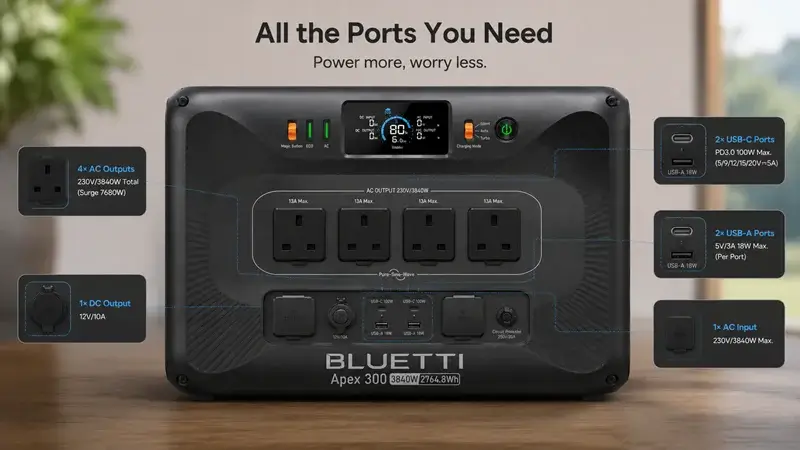
Four native BS 1363 UK sockets and two 100W USB-C ports cover mains and device charging; DC needs the optional Hub D1.
How Quiet Is It?
At light load the Apex 300 is near-silent, which makes it fine for overnight use in a van or a bedroom. Under fast charging or heavy draw, the fan becomes audible as it clears heat from the inverter and battery. The fix is simple: cap the charging input in the BLUETTI App to keep the fan calm when you need quiet.
This is the honest trade-off for fast charging and a high-output inverter. Pushing 3,000W into the battery generates heat, and the fan has to work to clear it. For day-to-day running of a fridge or laptop, you will barely hear it. It is the rapid charge and the heaviest loads that spin the fan up.
If you plan to charge overnight near where people sleep, set a lower input in the app before bed. You lose some of the headline speed, but you keep the peace, which is a fair swap a couple of nights a week.
Bluetti Apex 300 vs EcoFlow Delta 2 Max vs Anker SOLIX F3800
Here is how the Apex 300 compares with two other large-capacity options on the UK market:
The Apex 300 sits in the middle on raw capacity but leads on solar input and matches the F3800 on cycle life and UPS speed, all at a much lower weight than the 60kg F3800. The EcoFlow Delta 2 Max is lighter and cheaper but tops out at 2,400W output and 1,000W solar, so it suits camping and mid-range backup more than full off-grid living. The F3800 is the whole-home choice with 240V, but it is heavy and expensive. For flexible, transportable off-grid solar power, the Apex 300 is the balanced pick. For a wider view, see our EcoFlow vs Bluetti comparison.
Who This Is NOT For
Weekend campers who only need occasional power: at 38kg and a premium price, a smaller unit like the Bluetti Elite 100 V2 will suit you far better
Anyone who needs a light, grab-and-go unit: this is a two-person lift that lives in a fixed spot, not something you carry to a picnic
Buyers on a tight budget: the Apex 300 sits at the premium end, so if cost is the priority, look at the EcoFlow Delta 3 Classic
People who rely heavily on 12V DC outputs: the unit has no built-in car socket, so you must budget for the optional Hub D1
Anyone wanting near-silent fast charging: the fan is audible under full charging, so cap the input in the app when you need quiet
Pros and Cons
The Apex 300’s standout strengths are its 3,840W output, 2,400W dual solar input, 70-minute recharge, 6,000-cycle LFP battery, modular expansion to ~19kWh, and 5-year warranty. Its main weaknesses are its 38kg weight, premium price, audible fan under fast charging, and the need for the Hub D1 to add DC outputs.
- 3,840W continuous output runs a kettle, induction hob and power tools
- 2,400W dual solar input, one of the strongest in its class
- Roughly 70 to 75 minutes to full on mains, about 80 minutes on full 2,400W solar
- Expandable to roughly 19kWh with up to six B300K modules
- 20ms UPS switchover for home backup
- Four native BS 1363 UK sockets, no adapter needed
- 6,000-cycle LFP battery, around 17 years of weekly use
- BLUETTI App for charge control and monitoring
- 5-year UK warranty
- Heavy at 38kg, a two-person lift
- Premium price
- Fan audible under fast or heavy charging
- DC outputs need the optional Hub D1
- Too large and costly for occasional camping
- Will not run an electric shower or large oven
Alternatives Worth Considering
The Apex 300 is the balanced choice for transportable off-grid solar power, but it is not right for everyone. Here are the main alternatives:
- EcoFlow Delta 2 Max: Lighter at 23kg and cheaper, with 2,048Wh and 2,400W output. The better pick for camping and mid-range backup if you do not need the Apex's solar headroom or full expansion.
- Bluetti Elite 100 V2: A 1,024Wh, 1,800W unit that is far lighter and more portable. The sensible choice if you only need power for camping and short trips rather than full off-grid living.
- EcoFlow Delta 3 Classic: A lower-cost mid-range option for buyers on a tighter budget who still want fast charging and a solid output for weekend use.
For the full picture across the UK market, including the wider Bluetti range, see our guide to the best portable power stations in the UK, or compare the C1000 in our Anker SOLIX C1000 Gen 2 review.
Final Verdict
The Bluetti Apex 300 is built for people who want to live off solar, not just top up a phone at a campsite. The 2,764.8Wh battery, 3,840W output and 2,400W dual solar input let it run a real off-grid setup, kettle, fridge, tools and all, then refill in around 70 minutes on mains or full sun.
It expands to roughly 19kWh with up to six B300K modules, so the system grows with you, and the 20ms UPS switchover makes it a sensible whole-room backup during a power cut. Four native UK sockets and a 6,000-cycle LFP battery with a 5-year UK warranty round out a genuinely long-term platform.
The honest limitations: it weighs 38kg, it sits at a premium price, the fan is audible under fast charging, and DC outputs need the optional Hub D1. For occasional camping it is overkill. For van life, caravans, cabins and serious home backup, it is one of the best you can buy.
Frequently Asked Questions
For off-grid use, van life and caravanning, the Apex 300 is one of the most capable power stations you can buy in the UK. Its 2,764.8Wh LFP battery, 3,840W output and 6,000-cycle lifespan represent genuine long-term value. It is heavy at 38kg and sits at a premium price, so if you only need power for occasional camping, a smaller unit such as the Bluetti Elite 100 V2 will suit you better.
Via the fast charge mode, the Apex 300 charges from flat to full in approximately 70 minutes. Solar charging at the full 2,400W input also reaches full in around 70 minutes in strong sunlight. You can blend both sources at the same time to keep the battery topped up during the day, which is ideal for off-grid living.
Yes. A standard UK kettle draws around 2,200 to 3,000W, well within the Apex 300’s 3,840W continuous output. A single-ring induction hob at 1,800 to 2,000W will also run comfortably. The 7,680W surge rating means motor-start appliances such as fridges and power tools are handled without issue. Running a kettle and a hob flat out together will push close to the limit, so do one at a time for heavy loads.
The Elite 100 V2 has a 1,024Wh capacity and 1,800W output, making it a portable, lighter unit suited to camping and short trips. The Apex 300 nearly triples the capacity at 2,764.8Wh, more than doubles the output at 3,840W, and is designed for off-grid cabins, caravans and serious home backup rather than day trips. You can read our full Bluetti Elite 100 V2 review for the smaller unit.
You can connect up to six B300K battery modules (each 2,764.8Wh) to the Apex 300, bringing the total system to approximately 19kWh. Each module connects directly and the BLUETTI App monitors the whole system. The larger B500K module (5,120Wh) is also compatible, so you can mix modules to reach the capacity you need.
Not indefinitely, but it can cover essential circuits for an extended period. With its 2,764.8Wh base capacity and 20ms UPS switchover, it will keep lights, a fridge, phone charging and a router running for many hours. Fully expanded to approximately 19kWh, it could sustain a low-consumption home for one to two days. See our best power stations for home backup guide for sizing help.