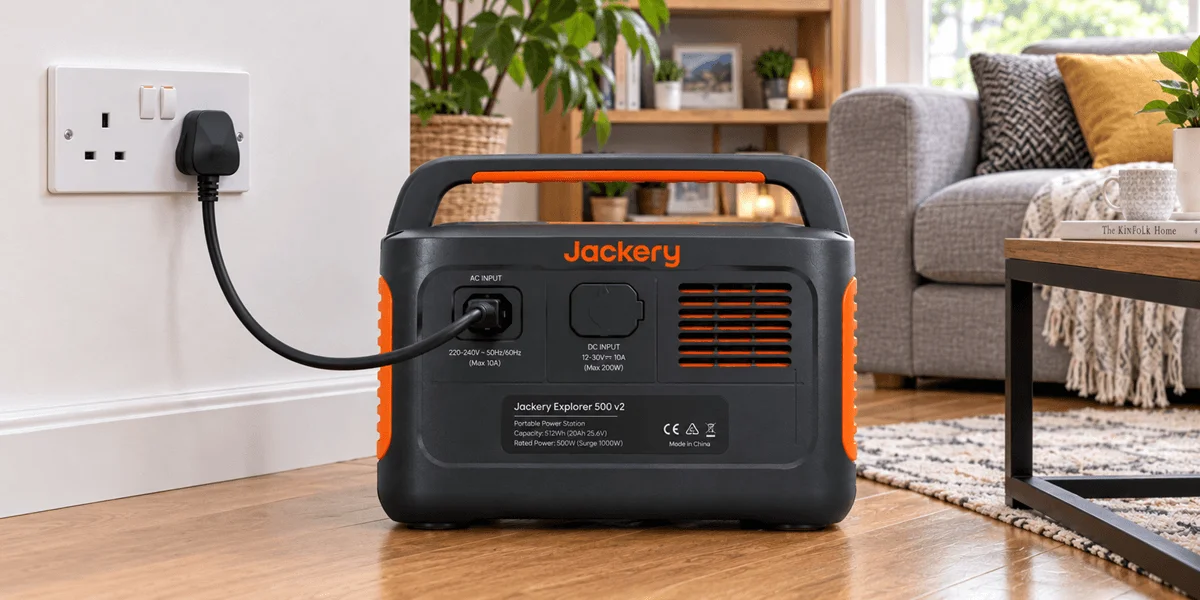
What Is the Jackery Explorer 500 v2?
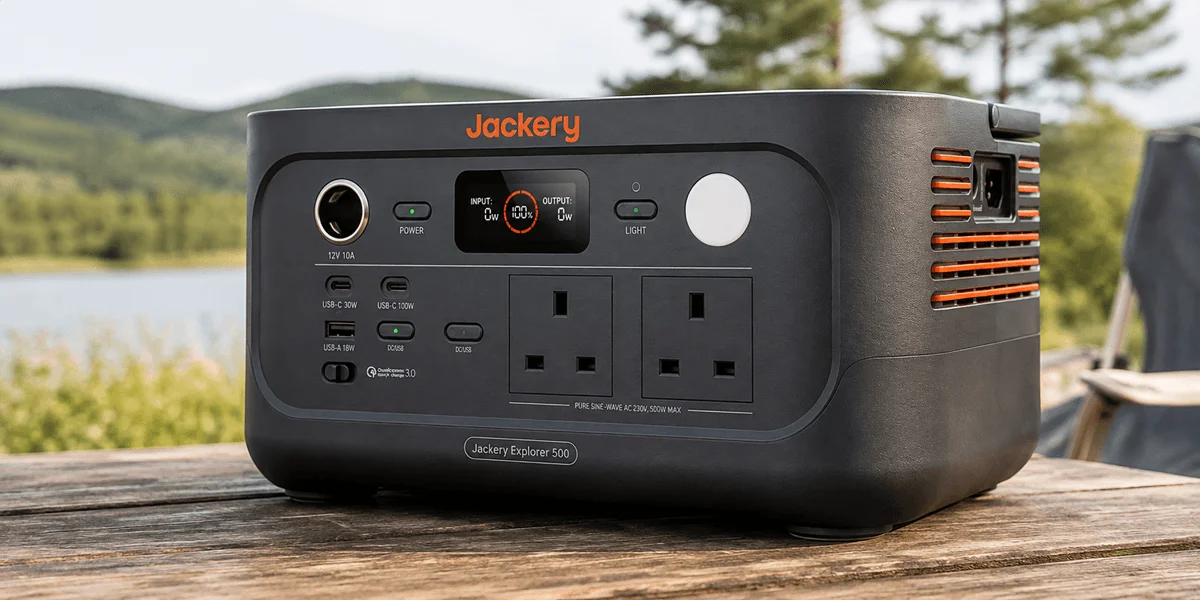
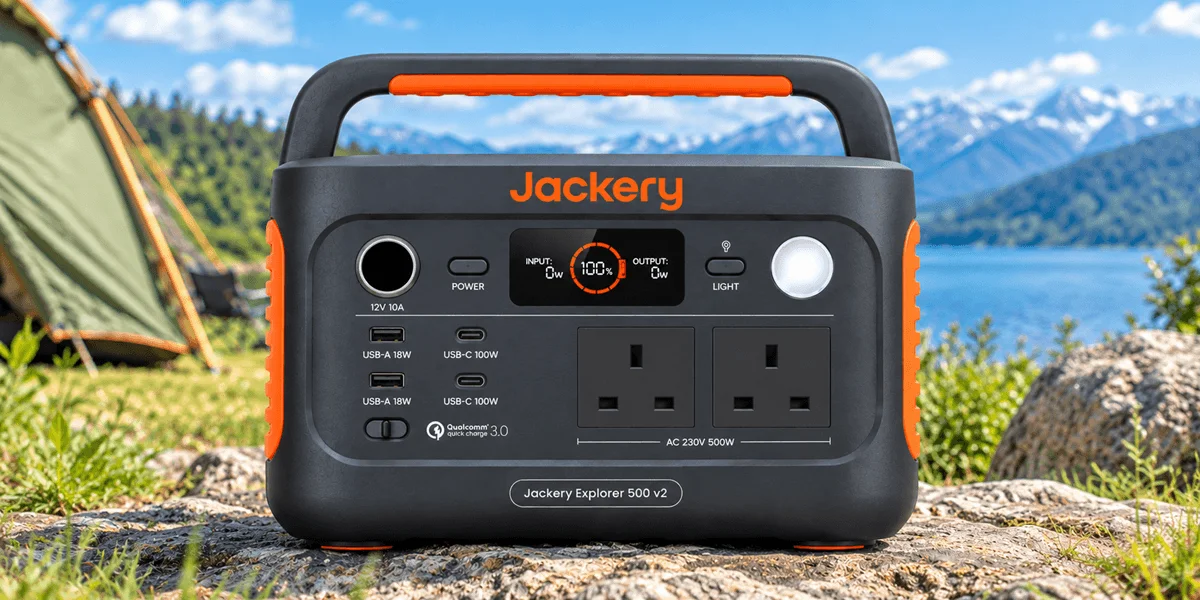
The Jackery Explorer 500 v2 is a 512Wh LiFePO4 power station outputting 500W continuously (1,000W surge) and weighing 5.7kg. It replaces the discontinued Explorer 500 with a different battery chemistry, not a simple refresh, and typically sells for around £300 to £350 in the UK.
If you’ve found listings for the original Explorer 500, that unit is now discontinued. It used older NMC lithium-ion cells rated for around 800 cycles and took roughly 7.5 hours to charge. The v2 is a genuinely different battery in a similar case, as Jackery’s own Explorer 500 v2 product page and its own comparison of the Explorer 500 and 500 v2 set out. The Scotsman’s write-up frames it as part of a wider shift towards LiFePO4; our guide to why LiFePO4 outlasts the NMC cells in the original 500 covers the chemistry. See Jackery’s UK range and warranty terms for where this sits in the wider line-up.
How it differs from the original Explorer 500
Every figure that changed, changed for the better.
| Spec | Explorer 500 (discontinued) | Explorer 500 v2 |
|---|---|---|
| Battery chemistry | NMC lithium-ion | LiFePO4 |
| Cycle life | ~800 cycles to 80% | ~6,000 cycles to 70% |
| Weight | 6.4kg | 5.7kg |
| AC charge time | ~7.5 hours | 1.3 hours (AC alone) |
| Ports | 1 AC, 3 USB-A, 2 DC, 1 car | 2 AC, 2 USB-C, 1 USB-A, 1 car |
Key Specifications at a Glance
Figures come from Jackery’s own spec sheet, cross-checked against T3 and TechRadar. Anything unpublished is marked as such.
| Specification | Detail |
|---|---|
| Battery Capacity | 512Wh (LiFePO4 / LFP) |
| AC Output | 500W continuous, pure sine wave (T3's 800W heater test tripped it in 41 seconds) |
| Surge / Peak Power | 1,000W |
| Full AC Charge Time | 1.3 hours AC alone; the "1 hour" headline is hybrid AC-plus-DC only (see below) |
| Weight | 5.7kg |
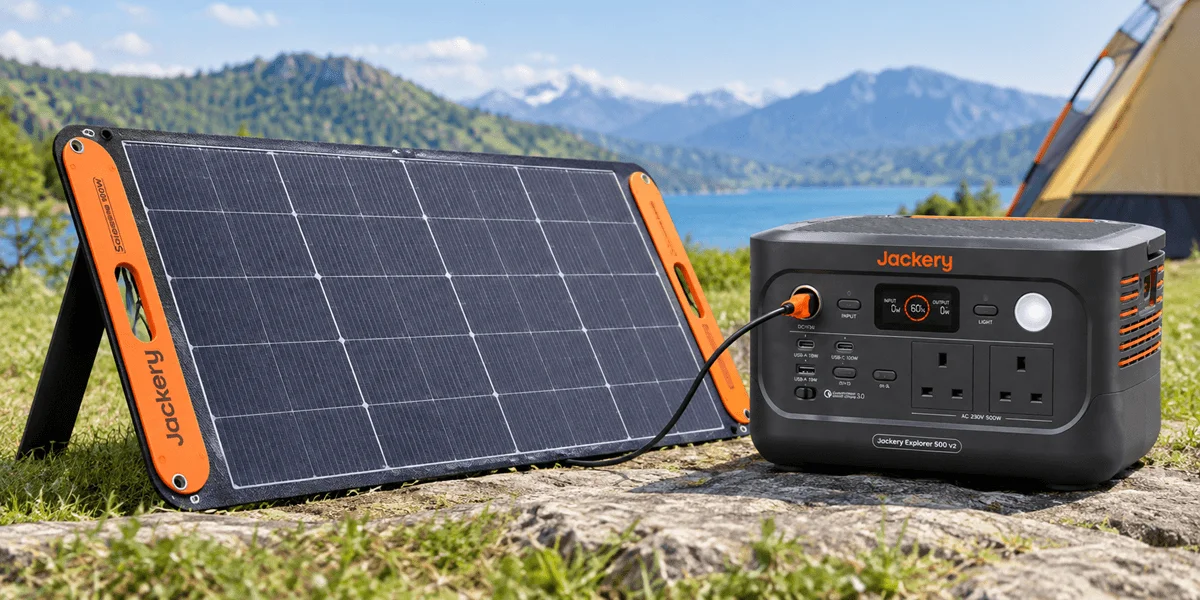
| Max Solar Input | 200W (2 x 100W panels) |
| Ports | 2x BS 1363 AC, 2x USB-C PD 100W (in/out), 1x USB-A, 1x 12V car (6 total) |
| Backup / Switchover | Marketed as "UPS under 10ms", technically EPS rather than a true UPS |
| Noise | Jackery's own pages disagree (28 to 36dB range quoted); no independent measurement published |
| App Control | None. Jackery states it was designed without app control |
| UK Warranty | 3 years base, 5 years only if you register (see below) |
That warranty row needs explaining: Jackery’s own messaging contradicts itself in three places. The product page advertises “3+2 Years Warranty”: three years automatic, a further two only once you register. Registering means visiting Jackery’s warranty registration form, which asks for your order ID, serial number and proof of purchase if you didn’t buy direct, Amazon included; no deadline is stated. Its own warranty and returns page instead states a flat 24 months. Its policy page says “up to five years, depending on the model.”
UK retailers don’t help: Currys states a flat five-year guarantee on a related unit with no mention of registration, whilst Argos lists only a two-year guarantee on another. Amazon mixes a “5 Years Customer Support” bullet with a spec field that simply reads “2.” Register on unboxing, keep your receipt, and confirm the term at checkout. Regardless, the Consumer Rights Act 2015 already gives you a 30-day right to reject faulty goods and then a right to a free repair or replacement, both against the retailer, not Jackery.
Explorer 240 v2, 500 v2 or 1000 v2: Which One Are You Actually Buying?
The 500 v2 sits in the middle of Jackery’s v2 range: bigger than the 256Wh Explorer 240 v2, smaller than the 1,070Wh Explorer 1000 v2. If 512Wh and a 500W ceiling cover your devices, it’s the sensible pick. If you’re already picturing a fridge running all day, size up instead.
Jackery’s UK v2 line-up runs from the pocketable 240 v2 up to the larger 2000 v2 and 3000 v2, which move into home-backup territory. Here’s how the closest models compare, plus one value trap.
The 300 Plus is the one to watch. It sells for almost the same money as the 500 v2, per Jackery’s own listing for the Explorer 300 Plus. Yet it offers roughly half the capacity and a quarter of the cycle life: an older-generation unit priced like a current one. If 512Wh isn’t enough, don’t downgrade to save a little; step up instead to the Explorer 1000 v2, if 512Wh is not enough. We found no evidence of the Explorer 600 Plus being sold in the UK.
How Long Does the Explorer 500 v2 Take to Charge?
On a UK mains socket alone, the Explorer 500 v2 charges fully in about 70 to 90 minutes, which lines up with Jackery’s own stated 1.3-hour AC figure. That’s the honest number to plan around, not the “1 hour” claim you’ll see in some marketing, which only applies under a specific combined charging mode.
A lunchtime top-up from flat to full is genuinely realistic here, one of the clearest improvements over the original’s 7.5-hour charge time. You’re not limited to the mains either: the 100W USB-C PD input can top it up from a laptop charger or power bank if a socket isn’t nearby.
Why does Jackery quote two different charge times?
Because two charging modes exist, and the faster one only fires under specific conditions. The headline “1 hour” figure is a hybrid mode combining AC and DC input simultaneously, something most buyers won’t set up on a normal trip. Charging from AC alone, how most owners actually use it, takes 1.3 hours by Jackery’s own numbers. Treat 70 to 90 minutes as the figure that matters day to day.
Does It Really Charge in One Hour?
Not on a standard mains-only charge, no. The “1 hour” claim from Jackery’s launch announcement is a hybrid AC-plus-DC figure. Charging from a UK wall socket alone, the realistic time is 60 to 90 minutes, with T3 measuring around 75 minutes from completely empty.
This is the gap between marketing and reality that no competitor reviewing this unit has spelled out clearly. Jackery’s product page states 1.3 hours for AC charging, its blog separately mentions 80 minutes, and Amazon rounds to around 70. None is dishonest alone, but stacked next to a headline “1 hour” claim, it reads faster than the everyday reality.
UK owners’ own timings back the independent testing rather than the headline. Multiple Amazon UK reviewers report 60 to 90 minutes from a standard wall socket. That’s roughly five to seven times quicker than the original’s 7.5-hour charge. It’s just not literally one hour unless you’re running two charging inputs at once, which most people won’t be set up to do.
Is a Solar Panel Worth It for the Explorer 500 v2 in Britain?
Yes, as a top-up method rather than your main charging plan. The 500 v2 accepts up to 200W of solar across two 100W panels, but TechRadar’s own measurement of a 100W panel found it delivering closer to 88W in practice. UK weather will usually push that lower still.
What Can 512Wh Actually Run?
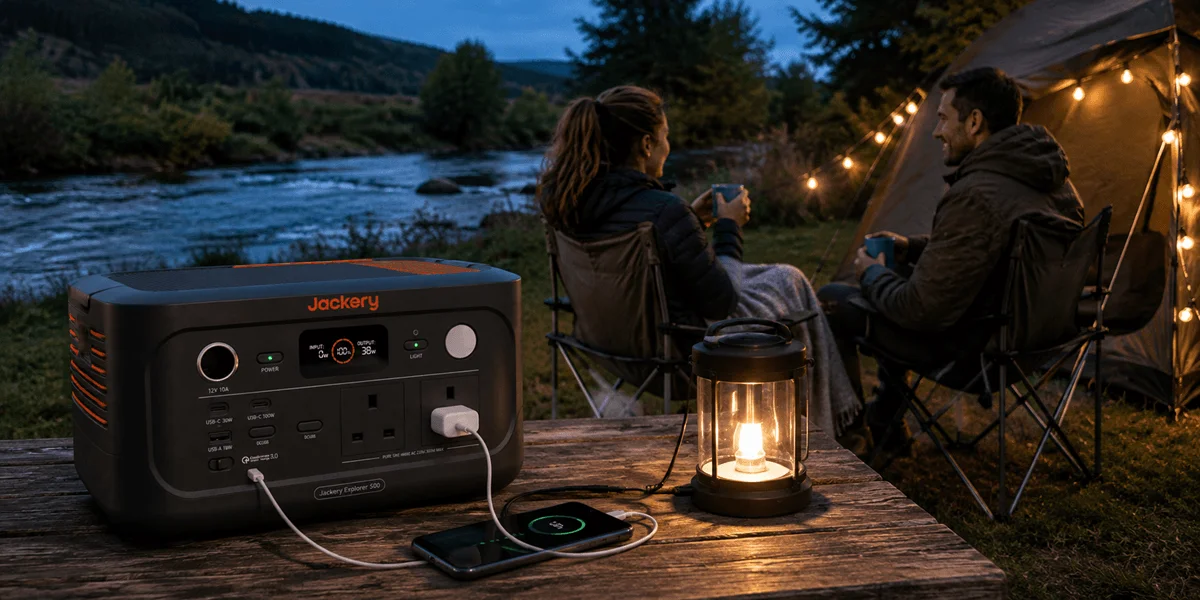
Applying the standard 15% inverter-loss allowance, the Explorer 500 v2’s 512Wh rated capacity gives roughly 435Wh usable. That’s enough for phones, a laptop, camp lighting, a CPAP machine overnight, or a small camping fridge for a decent stretch of the day. It’s not enough for a kettle, a heater or anything else needing a high, sustained draw.
These are estimates built from typical device draw against that 435Wh usable figure, not our own bench testing. Real results shift with device efficiency and ambient temperature, but they’re a fair planning benchmark.
| Device | Estimated Runtime |
|---|---|
| Camping fridge or cool box (~50W) | Roughly 8 to 9 hours |
| LED camp lantern (~5W) | Well over 80 hours |
| Laptop for remote working (~40W, screen and router included) | Around 10 to 11 hours |
| Small greenhouse heater or pump (~150W, per owner reports) | Roughly 2.5 to 3 hours |
What it cannot run
Anything needing sustained high wattage is off the table. A standard UK kettle draws around 2,500 to 3,000W, several times the 500W continuous ceiling, and the same goes for heaters, hairdryers and most microwaves. It’s not theoretical: T3’s hands-on review found an 800W heater tripped the inverter’s protection in just 41 seconds.
What Ports Does the Explorer 500 v2 Have?
Six ports in total: 2x BS 1363 UK three-pin AC sockets sharing the 500W output, plus 2x USB-C PD ports rated at 100W (in and out), 1x USB-A, and 1x 12V car socket. It’s a sensible, if unglamorous, spread for camping and desk-backup use.
The two 100W USB-C ports are the biggest upgrade over the original’s USB-A and older DC ports. Either can charge a laptop at close to native speed, and being bidirectional, either can recharge the unit.
Two owner complaints worth flagging: some wanted a third USB-C port over a second USB-A, and several noted the 12V car socket has no protective cover.
Quiet Enough for a Tent, and the App That Isn't There
Jackery’s own pages quote noise figures that don’t agree with each other, and no independent measurement has been published anywhere we could find. There’s also no companion app at all, Bluetooth or WiFi, a genuine gap against other models in Jackery’s own v2 line-up.
The noise claims are a genuine mess. Jackery’s product page states 28dB discharging and 36dB charging. A blog post claims “under 28dB at 200W”. Amazon rounds to “less than 36dB” with no stated load. A third party claims a much wider 28 to 46dB range with no methodology. Nobody has published an independent test, so treat any single figure with scepticism.
App control is clear-cut: there isn’t any. Jackery states plainly it was “designed without app control”, and one Amazon UK owner reported it took support two days to confirm that in writing. It’s a genuine step down from the Explorer 240 v2 and 1000 v2, both of which do offer app monitoring.
Amazon UK sentiment on this exact unit sits at 4.4 stars from 41 ratings, 79% five-star, praising fast recharging and stable 230V output on light loads like greenhouse heaters and pumps. Ten per cent are one-star, including one report of two units failing after around four hours, leaving only the USB-C ports working. It’s one report out of 41, but honest to mention rather than bury it.
Is the 10ms Switchover a Real UPS?
Not technically, no. Jackery markets a switchover “under 10ms”, but what’s actually inside is EPS (emergency power supply), a switched backup system, rather than a true double-conversion UPS. In practice that means a very brief interruption during switchover rather than none at all.
The distinction matters more than it sounds. A true double-conversion UPS runs devices from the battery permanently, so mains failure causes zero interruption. An EPS like this one detects the drop and then switches, which is why Jackery quotes a time at all: there’s a genuine, tiny gap. For phones and laptops that’s imperceptible, but it’s worth knowing the correct term.
T3’s testing backs this up: during a four-hour simulated outage, the display reported zero output at one point whilst still powering a connected MacBook, a display quirk rather than a real failure. If you need genuinely gapless backup, look at the EcoFlow RIVER 3 Plus and its faster switchover instead.
Explorer 500 v2 Against the Anker SOLIX C300, EcoFlow RIVER 3 Plus and Jackery Explorer 1000 v2
Specs and fit only, not a full verdict; our dedicated Jackery vs Anker comparison covers that ground.
At 5.7kg it sits between the lighter Anker and EcoFlow units and the much heavier Explorer 1000 v2. It holds nearly twice the capacity of either smaller unit, which is the reason to pick it. Note that it does not win on output: the EcoFlow RIVER 3 Plus runs 600W continuous against this Jackery’s 500W, from a smaller battery. If app control matters more, the Anker SOLIX C300 at 288Wh offers full app, Bluetooth and WiFi monitoring that this Jackery simply doesn’t.
Who Should Not Buy the Explorer 500 v2?
- Anyone boiling a kettle or running a heater off-grid: the 500W ceiling falls well short, and T3 tripped the inverter with an 800W heater in 41 seconds
- Anyone wanting app, Bluetooth or WiFi monitoring: none exists on this unit, unlike the 240 v2 and 1000 v2 in the same range
- Anyone planning serious off-grid solar: the 200W ceiling delivers closer to 150 to 175W, and Jackery hasn’t confirmed a voltage window or MPPT
- Anyone running a fridge alongside other loads through a full overnight power cut: 435Wh usable simply won’t stretch that far
- Buyers assuming the “5-year warranty” is automatic: it needs registration, and Jackery, Currys and Argos all quote different terms
Pros and Cons
- LiFePO4, 6,000 cycles against the original's roughly 800
- Fast mains charging: 1.3 hours by spec, 60 to 90 minutes per owners
- Genuinely compact at 5.7kg, an easy one-hand carry
- Two 100W USB-C PD ports, fast enough for a laptop and phone together
- Pure sine wave output with a 1,000W surge
- Two built-in UK three-pin sockets, no adapter needed
- Strong sentiment: 79% five-star from 41 Amazon UK ratings
- No app, Bluetooth or WiFi control at all
- 200W solar ceiling delivers closer to 150 to 175W in real conditions
- 500W limit rules out kettles, heaters and hairdryers entirely
- 5-year warranty needs active registration; Jackery's own pages disagree on the base term
- One owner reported two units failing after around four hours, with a difficult support experience
- Noise figures conflict across Jackery's own marketing, with no independent measurement
- 12V car socket has no protective cover
Alternatives Worth Considering
- Anker SOLIX C300: Lighter at 4.13kg with full app, Bluetooth and WiFi control, for less capacity (288Wh) and a 300W ceiling.
- EcoFlow RIVER 3 Plus: At 4.7kg with a measured 9ms switchover, it's the faster backup unit, and it runs 600W continuous against this Jackery's 500W. You give up nearly half the capacity for it, at 286Wh.
- Jackery Explorer 1000 v2: Roughly double the capacity and triple the output, in a body that's noticeably heavier at 10.8kg.
- Jackery Explorer 300 Plus: Avoid unless meaningfully discounted; nearly the same money for roughly half the capacity and a quarter of the cycle life.
For the wider UK market beyond Jackery’s own range, see our guide to the full UK buying guide.
Final Verdict: Is the Jackery Explorer 500 v2 Worth It in the UK?
The Explorer 500 v2 earns its place with a real generational leap over the unit it replaces. LiFePO4 rated for 6,000 cycles, a mains charge owners consistently time at 60 to 90 minutes, and a 5.7kg one-hand carry add up to a dependable camping and desk-backup companion. It typically costs around £300 to £350 in the UK.
The honest catches: the “1 hour” claim only applies in a hybrid mode most owners won’t use, and the widely quoted 5-year warranty needs active registration, with Jackery’s own pages disagreeing on the base term. Neither’s a dealbreaker once you know, which is why we’ve spelled both out above rather than repeat the marketing.
Buy it for dependable, fast-charging power for phones, laptops, camp lighting and short power cuts, not for app control, serious solar recovery or an off-grid kettle. If those matter more, weigh it against the Explorer 1000 v2 or check our shortlist of power stations for camping.
Frequently Asked Questions
For its intended job, yes. The Explorer 500 v2’s LiFePO4 battery, fast mains charging and 5.7kg weight make it a solid weekend camping and desk-backup unit. It’s let down by the missing app control, the 500W ceiling and a genuinely confusing UK warranty, so check those limits match your needs first.
Yes. The Explorer 500 v2 has a built-in pure sine wave inverter rated at 500W continuous with a 1,000W surge for appliances that need a brief higher draw at start-up. Pure sine wave output means it’s safe for sensitive electronics like laptops, CPAP machines and camera equipment.
Yes, that’s how it’s designed to be used. ChargeShield 2.0 and an energy-saving mode manage trickle charge automatically once full, so it shouldn’t shorten the 500 v2’s 6,000-cycle lifespan. For the general answer that applies across brands, see our homepage FAQ.
No. Jackery publishes no IP water or dust rating for the Explorer 500 v2, so treat it as sheltered-use only: inside a tent, awning, van or porch. Its stated operating range of -20°C to 45°C covers British cold, but temperature tolerance is not weatherproofing.
Yes. The Explorer 500 v2 has a one-touch energy-saving mode that automatically shuts off inactive outputs rather than leaving them drawing power. That matters on a 512Wh battery, where a forgotten USB port left live overnight is a meaningful share of your capacity.