What is the EcoFlow RIVER 3 Plus?
The EcoFlow RIVER 3 Plus is a 286Wh LiFePO4 power station weighing 4.7kg, built for van life, festivals and home network backup. It outputs 600W continuously (1,200W claimed via X-Boost) and switches to UPS mode in a measured 9ms. It’s compact and genuinely quick as backup power, but it isn’t a kettle-running home generator.
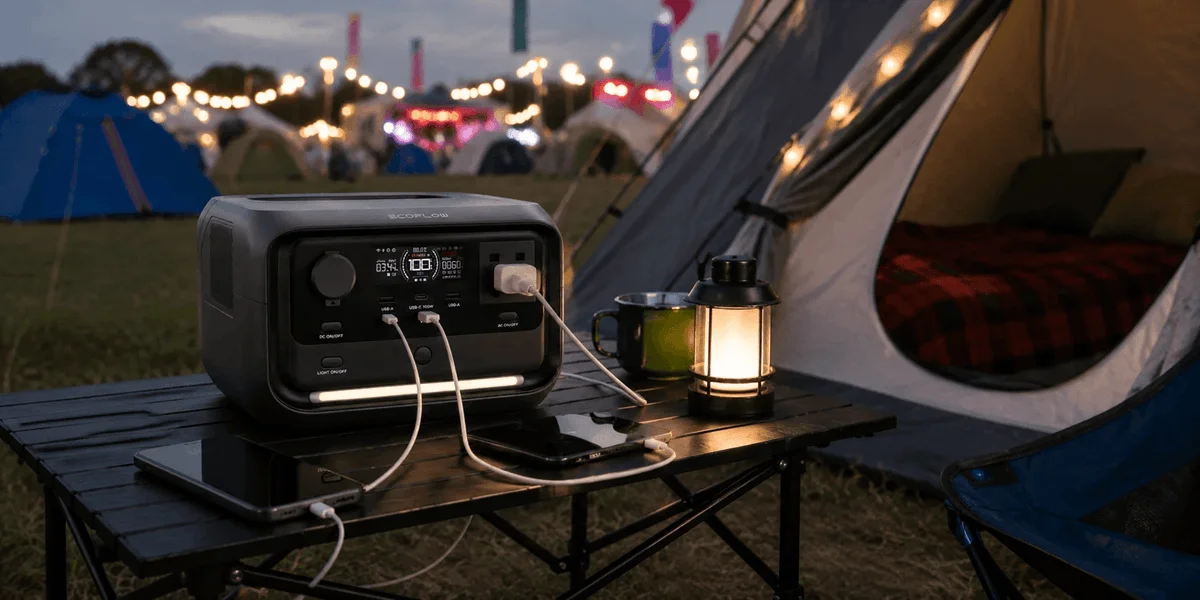
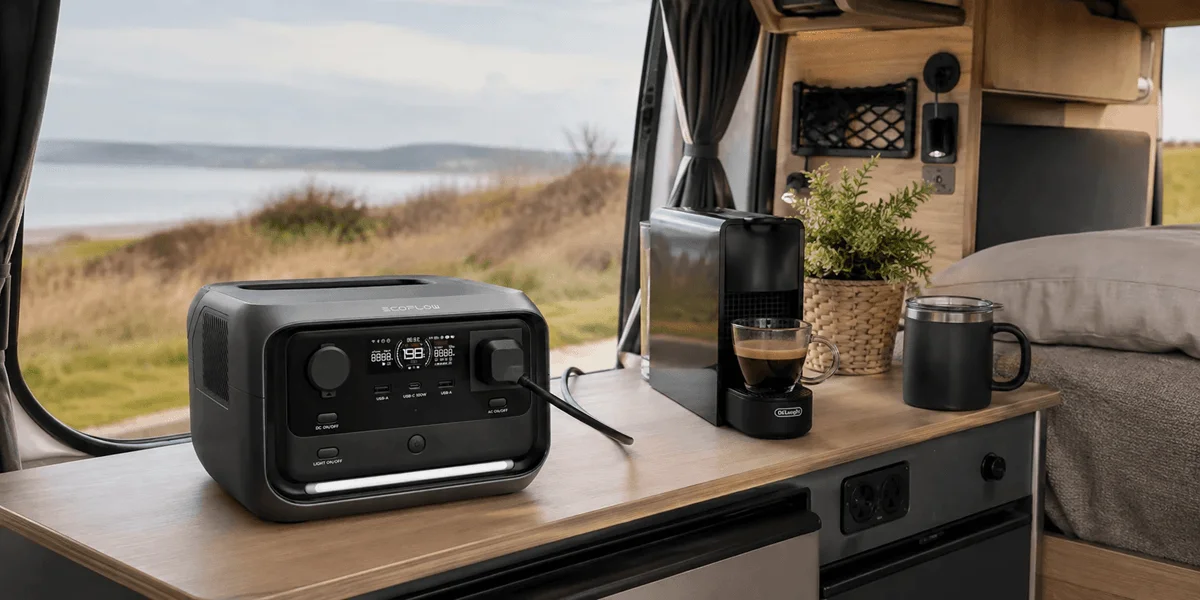
EcoFlow pitches it as the mid-tier option in its cheapest line, between the base RIVER 3 and the larger RIVER 3 Max. The one figure to distrust is the X-Boost claim, which doesn’t survive independent testing; more on that further down. EcoFlow’s full UK range covers the rest of the line-up, but the appeal here is narrower: a router alive through a cut, a fridge running for a festival afternoon, or a rucksack-sized backup for the van.
How it differs from the RIVER 2 generation
EcoFlow’s own comparison flags three real changes. The RIVER 3 line is markedly lighter than RIVER 2 equivalents, IP54 dust and splash resistance is new, and UPS switching didn’t exist on RIVER 2 at all. If you’ve used an older EcoFlow unit as backup power, you were improvising; this one does the job properly, per EcoFlow’s blog comparing the RIVER 2 and RIVER 3 generations.
Key Specifications at a Glance
Every figure below comes from EcoFlow’s own RIVER 3 Plus product page, with the operating temperature confirmed on EcoFlow’s separate spec sheet for the model. The warranty row is deliberately vague; see why below.
| Specification | Detail |
|---|---|
| Capacity | 286Wh |
| Battery chemistry | LiFePO4 (lithium iron phosphate) |
| Cycle life | 3,000 cycles to 80% capacity retained |
| AC output, continuous | 600W |
| AC output, surge (X-Boost claimed) | 1,200W |
| AC sockets | Three 230V UK three-pin sockets, one front, two rear |
| USB-A | 2 x 12W (24W total) |
| USB-C | 1 x 100W |
| Car port | 12V, 126W |
| Solar input | 220W max (11 to 55V, 13A) |
| AC charge input | 360W max |
| Charge time, mains | About 60 minutes, 0 to 100% |
| Charge time, car | About 3.3 hours, 0 to 100% |
| UPS switchover | Rated under 10ms; measured 9ms |
| Weight | 4.7kg |
| Noise | Under 30dB |
| Ingress protection | IP54 |
| Operating temp, discharge | -10°C to 45°C |
| Operating temp, charge | 0°C to 45°C |
| Warranty | Listed inconsistently across UK retailers; check at the point of sale |
That’s not laziness: UK sellers genuinely disagree on the term, so we’re flagging it rather than guessing. More in the section on who shouldn’t buy this.
RIVER 3, Plus, Max or Max Plus: which one are you actually buying?
EcoFlow sells four RIVER 3 models. The RIVER 3 is the 245Wh entry point, and the Plus reviewed here is 286Wh with UPS and IP54. The Max is a Plus with an EB300 battery clipped on for 572Wh, and the Max Plus adds an EB600 for 858Wh. Output stays at 600W continuous once you’re at Plus level or above.
That’s genuinely the whole story on the Max and Max Plus: not separate engineering efforts, just the Plus with an extra battery pack pogo-pinned on, so buying the Max later spreads the cost. For context, TechRadar’s review of the standard RIVER 3 confirmed a roughly 60-minute AC charge and about 3 hours on solar in full sun, on the base model rather than the Plus.
How fast does the RIVER 3 Plus charge?
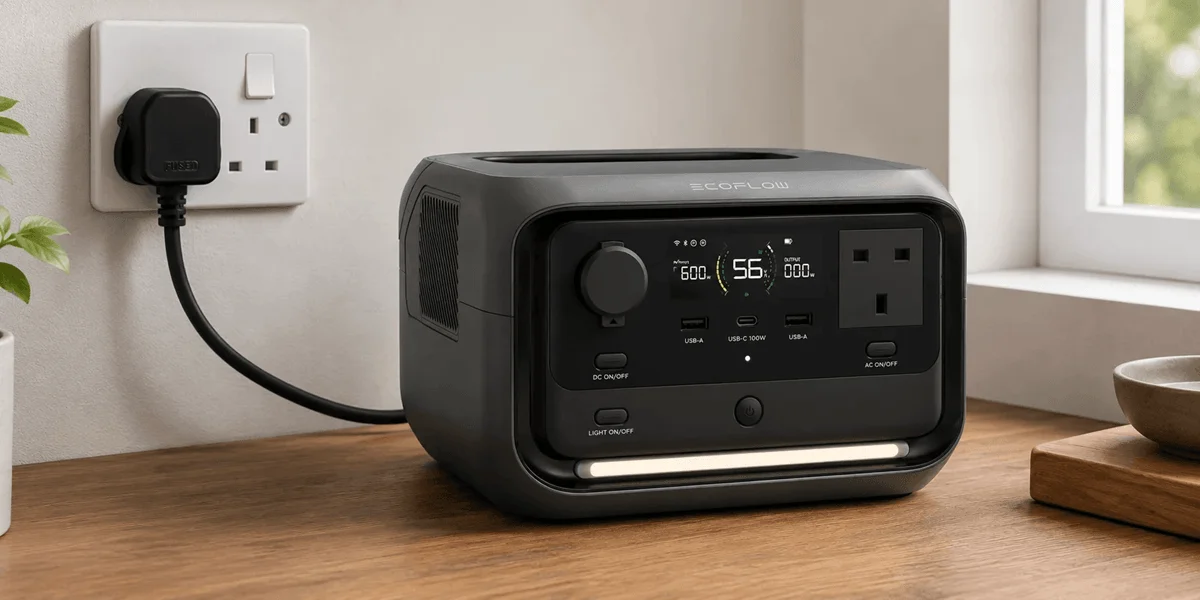
The RIVER 3 Plus charges from flat to full in around 60 minutes on the mains, or about 3.3 hours from a 12V car socket, per EcoFlow’s own charge specifications for the RIVER 3 Plus. Mains charging draws up to 360W, well ahead of most rivals this size.
That’s useful for a lunch-stop top-up rather than an overnight charge. The figures line up with what independent reviewers have measured on the smaller RIVER 3.
What the 9ms UPS switchover actually means during a power cut
StorageReview measured the switchover at 9ms against EcoFlow’s rated sub-10ms figure. Nine milliseconds is quick enough that a desktop PC won’t reboot and a router won’t drop its connection.
That lines up with what owners report. Several reviewers among Amazon UK’s customer ratings for the RIVER 3 Plus describe using it to protect routers, NAS boxes and PoE switches during outages. They cite 4 to 6.5 hours of runtime on light loads, and one even runs a Starlink Mini from it.
Is a solar panel worth it for the RIVER 3 Plus in Britain?
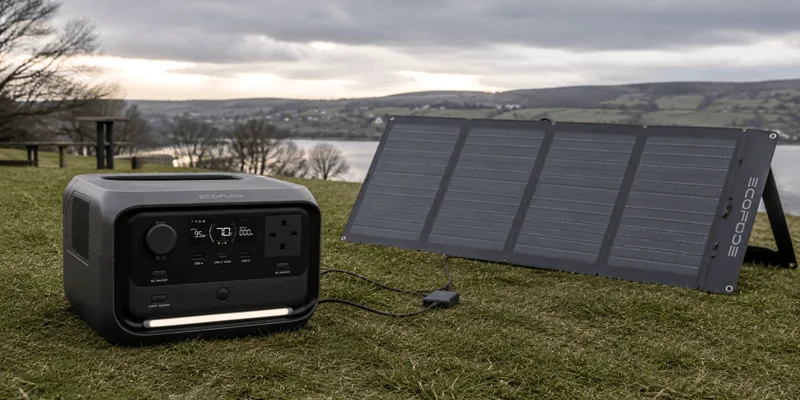
Yes in summer, less so in winter. The RIVER 3 Plus takes up to 220W of solar. A 100W panel can fill it in a good day of summer sun, but the same panel in a British December might add only 35 to 50Wh a day. Treat winter solar as a top-up, not a charging method.
British sunshine swings hard by season and latitude, per NASA POWER’s UK solar hours data and roamwired’s PVGIS-sourced peak sun hour figures.
| Region | Summer (June/July) | Winter (December) |
|---|---|---|
| Southern England | 4.8 to 5.2 peak sun hours a day | As low as 0.7 peak sun hours a day |
| Scotland | About 4.2 peak sun hours a day | About 0.4 peak sun hours a day |
That’s roughly a sevenfold drop from summer to winter. Applying a realistic panel efficiency factor against the 220W ceiling gives the figures below.
| Panel | UK summer | UK winter |
|---|---|---|
| 100W | About 290 to 365Wh a day; roughly one full charge on a good day | About 35 to 50Wh a day; several days for one charge |
| 220W | Near the input ceiling; roughly half a day of intermittent generation for a full top-up | About 77 to 110Wh a day; a full charge may take three days or more, if it happens at all |
EcoFlow’s “0 to 100% in as fast as 1.5 hours” figure assumes ideal sun and angle, achievable on a clear midsummer afternoon but not typical UK weather. How solar charging really performs in the UK covers the maths in more detail.
What can 286Wh actually run?
286Wh is the rated capacity, but you won’t get all of it through the AC socket. Inverter losses take around 15%, leaving roughly 243Wh usable. That’s still enough for around 16 phone charges, a full night on CPAP, or about 4 hours running a 60W laptop.
| Load | Assumption | Result |
|---|---|---|
| 40W camping fridge | 40W flat out; about 16W average with normal cycling | About 6 hours flat out; closer to 15 hours with normal compressor cycling |
| 4W LED lantern | 4W | About 60 hours |
| Drone batteries | Roughly 13Wh plus charger loss | About 15 charges, varies by model |
| Starlink Mini | 20 to 25W | About 9 to 10 hours |
On the smaller base RIVER 3, The Mud Life’s UK hands-on test got 17 hours from a 9W light and 30 hours running a 3W router. Useful context, even with less capacity than the Plus. Working it out for your own kit beats guessing: working out what capacity you actually need is a good starting point if you’re unsure.
What it cannot run
Anything with a heating element or a sizeable motor is where this falls down. A 2,000W kettle is well beyond both the 600W continuous and 1,200W surge ratings, so it can’t run one. A microwave rated at 700W often draws 1,000W to 1,100W at the wall, which puts that out of reach too; hair dryers and electric heaters are the same story. Run your own kit through the sizing calculator rather than guess.
Does X-Boost really run 1,200W appliances?
No, not reliably. EcoFlow’s X-Boost mode claims 1,200W of AC surge from a unit rated at 600W continuous, by reducing voltage to resistive loads. Two independent reviewers tested it against real appliances and found it overloads on anything with a motor, a compressor or a heating element. Treat the RIVER 3 Plus as a 600W unit, full stop.
X-Boost works by cutting the output voltage to resistive loads so they draw less current than rated. That helps on some resistive appliances. It fails on anything with a motor, a compressor, or a heating element sized above what the inverter can sustain, which covers most of what a camper reaches for first.
Australian Photography tested it directly against everyday appliances and didn’t have much luck: “I had fun testing it with various devices around my home, but didn’t have a huge success. Most small appliances like a jug, microwave, sandwich press, and vacuum cleaner pushed it into overload mode.” Those are exactly the appliances a UK buyer would expect X-Boost to handle.
The Solar Lab is blunter still, calling the claim “totally fake” and adding: “EcoFlow continues to advertise X-Boost, which we think is a huge exaggeration.” Neither reviewer is testing a different unit or firmware version; both describe the same feature covered here.
The practical rule is simple: buy this for what it reliably does (600W continuous, a fast UPS switchover, light everyday loads). Don’t buy it to run a 2,000W to 3,000W kettle, usually the first thing a UK camper reaches for. X-Boost is a bonus, not a spec worth buying on.
What ports does the RIVER 3 Plus have?
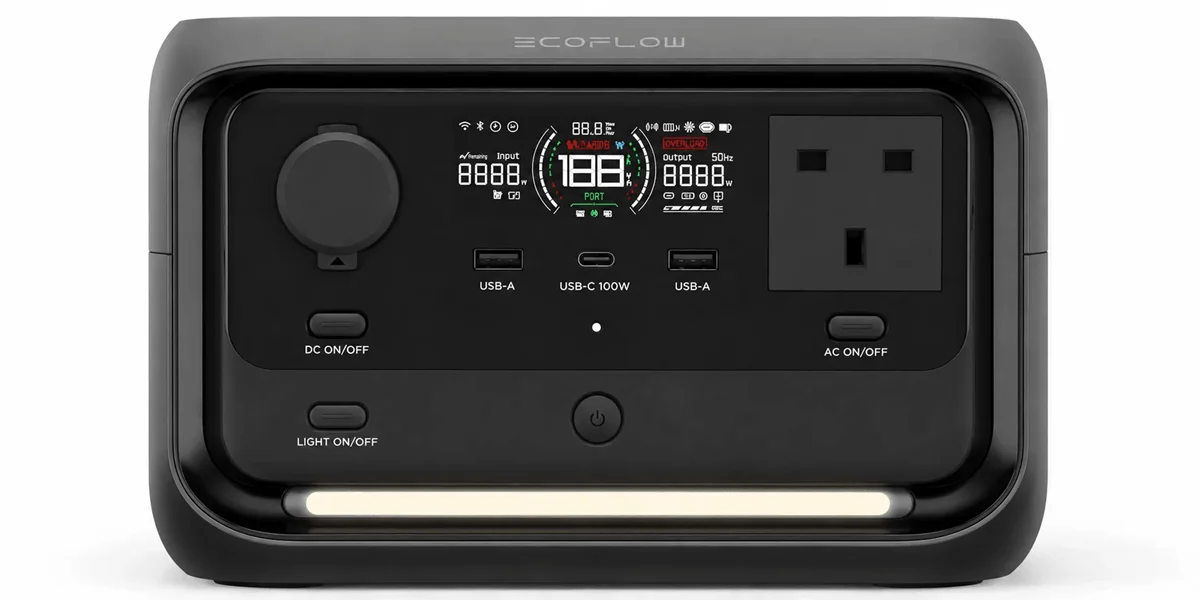
Seven outlets in total: three 230V UK three-pin sockets, two USB-A ports at 12W each, one 100W USB-C port and a 12V, 126W car port. EcoFlow’s UK spec sheet lists it as “3 outlets, 600W total”. One socket sits on the front, two on the rear.
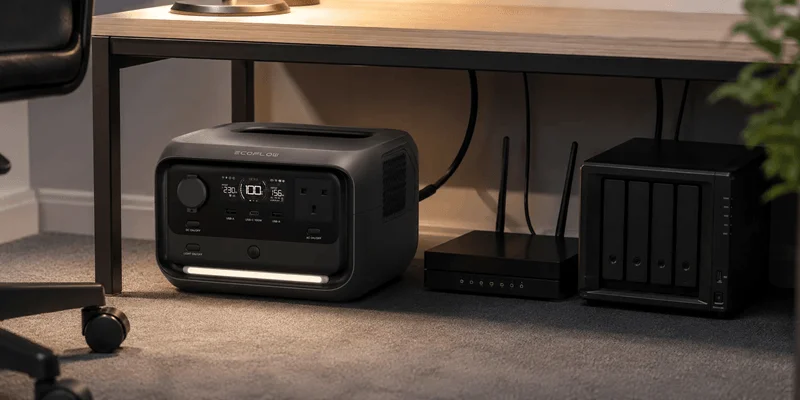
The split placement matters more than the count. EcoFlow intends the two rear sockets for kit you leave plugged in permanently, cables tucked out of sight, and the front one for short stints. For a router and a NAS under a desk, that’s the right layout. All three share the same 600W budget though, so it’s convenience rather than extra headroom.
One thing to watch whilst shopping. Two UK retailer spec fields, Hampshire Generators and Currys, both list a single AC socket. Currys’ own photographs contradict its own spec table. If that figure put you off, it’s a retailer error.
The USB-C port covers most laptops but falls short of higher-draw ultrabooks. The car port suits 12V gear run directly, bypassing the inverter.
The Wireless variant and its detachable RAPID power bank
There’s also a “RIVER 3 Plus (Wireless)” variant, adding a detachable 5,000mAh power bank that clips on via pogo pins for 15W Qi2 wireless charging. It’s a magnetic add-on rather than a built-in charging pad. Its contacts aren’t backwards compatible with older EcoFlow power banks, according to The Solar Lab’s review of the Wireless variant.
Quiet enough for a tent, and cool enough for a cupboard
At under 30dB rated, it’s quiet by power station standards. That matters more than it sounds: a noisy unit in a small tent or campervan bunk is genuinely annoying at 2am.
Australian Photography noted it runs “noticeably cooler and quieter” than the older RIVER 2 Plus, which “would kick on its fans fairly often.” The Mud Life described the noise level on the base RIVER 3 as “about the sound level of a whisper.”
The IP54 rating and the -10°C to 45°C discharge range translate well to UK terms. A cold campsite in March, dipping close to freezing overnight, is fine for use. Charging in sub-zero conditions isn’t recommended, since EcoFlow’s charge range starts at 0°C, so bring it somewhere warmer first.
RIVER 3 Plus against the Anker SOLIX C300, Jackery Explorer 300 Plus and Bluetti EB3A
At 286Wh, the RIVER 3 Plus sits in the same capacity class as the Anker SOLIX C300 and Jackery Explorer 300 Plus (both around 288Wh) and the slightly smaller Bluetti EB3A (268.8Wh).
It wins on the numbers that matter for backup use: 600W continuous against 300W for the Anker and Jackery, a 220W solar ceiling well ahead of the Anker’s 100W, and a measured 9ms UPS switchover none of the three publishes on their own. It loses on USB-C, where a single 100W port trails the Anker’s two ports totalling 280W, and on warranty clarity, covered below.
To be fair to the Anker, Trusted Reviews measured the SOLIX C300 cutting out under its rated 300W, entering a restart loop, and sustaining closer to 255W, with round-trip efficiency of 86.5% on DC but only 71.5% on AC. Our Anker SOLIX C300 review covers it properly.
Who should not buy the RIVER 3 Plus?
- Anyone who wants to boil a kettle, run a space heater or heat anything with an element: 600W is the real ceiling, whatever the box says
- Anyone buying on the strength of the 1,200W figure in Amazon’s spec table: 600W is the continuous rating, and X-Boost does not reliably bridge the gap
- Anyone running a fridge for a full weekend without a solar panel to top it back up
- Anyone wanting a plug-and-leave home backup unit: the EcoFlow Delta 3 Plus is the better fit
The warranty situation is the other honest caveat: Hampshire Generators and The Mud Life state five years, while Currys’ listing states two. We can’t reconcile that, so check the exact term with your retailer before you pay.
Alongside that, one detailed account among Amazon UK’s 158 ratings for the RIVER 3 Plus describes a difficult RMA: an “error 411” fault at around five months, four failed courier collections, FedEx drop-off points refusing the unit as a dangerous good, and trouble reaching the decision-making team in China. Their summary: “If you purchase a unit and it works well then that is marvellous but if you have an issue be prepared for a long drawn out, unsuccessful and stressful experience.”
That’s one account out of 158 ratings, and 7% of those are one star; we won’t turn it into a pattern it isn’t, though it’s a real risk nobody else covering this product mentions. If it gives you pause, our best power stations for camping covers units with more forgiving return processes.
- 600W continuous output, roughly double most rivals at this capacity
- 9ms measured UPS switchover, genuinely fast enough for router and desktop backup
- 220W solar ceiling, well ahead of similarly sized competitors
- Expandable to 572Wh or 858Wh via the EB300 or EB600
- IP54 dust and splash resistance, plus a light 4.7kg build
- Under 30dB, quiet enough for a tent or a bunk
- Three UK three-pin sockets, two rear-mounted for kit you leave plugged in
- The 1,200W X-Boost claim doesn't hold up against real appliances in independent testing
- Amazon's own spec table lists 1,200W as the running wattage, which will mislead anyone who doesn't read the bullets
- A single 100W USB-C port, against two at 140W on the Anker SOLIX C300
- UK warranty term is contradicted between retailers rather than stated clearly
Alternatives worth considering
- Anker SOLIX C300: If USB-C speed matters more than AC output, the Anker SOLIX C300's two 140W ports outclass this unit's one 100W port. That comes at the cost of a lower 300W continuous output and a smaller solar ceiling.
- RIVER 3 Max: If 286Wh feels tight, the RIVER 3 Max is the same unit with an EB300 battery attached, taking you to 572Wh without switching families or learning a new app.
- EcoFlow Delta 3 Classic: For campers wanting more headroom in one box rather than an add-on battery, the EcoFlow Delta 3 Classic, one step up for camping, is worth a look at the next capacity tier up.
Final verdict: is the EcoFlow RIVER 3 Plus worth it in the UK?
Yes, if you want quick, genuinely capable backup power in a small package: 600W continuous, a 9ms measured UPS switchover, and IP54 protection for under £250. Just don’t buy it for the 1,200W X-Boost claim, which independent testing doesn’t support. For router, NAS, festival and van-life use, it earns its price.
Worth noting: idealo’s UK price comparison shows it sitting close to the £250 to £300 mark at RRP, with a “was, now” discount at nearly every retailer checked, including EcoFlow’s own site. That’s a near-permanent pattern, not a one-off, so don’t rush a discount.
Frequently Asked Questions
The RIVER 3 is the 245Wh entry point: 300W continuous (600W via X-Boost) and a UPS switchover under 20ms. The Plus steps up to 286Wh and 600W continuous (1,200W claimed via X-Boost), with a faster sub-10ms UPS and expandable capacity, though it’s heavier at 4.7kg against 3.55kg.
For most buyers wanting compact backup power, yes. Its 600W continuous output and measured 9ms UPS switchover beat similarly sized rivals for under £250. The caveat is the X-Boost surge claim, which doesn’t hold up in independent testing, so treat it as a 600W unit.
Not for a full night unattended without solar help. A 40W fridge flat out drains the usable capacity in around 6 hours, though normal compressor cycling stretches that closer to 15 hours. Pair it with solar, or expect it dry before morning.
No. Australian Photography’s testing found a jug, microwave, sandwich press and vacuum cleaner all pushed it into overload mode. The Solar Lab calls the claim “totally fake.” Treat X-Boost as an occasional bonus, not a spec to buy on.
Yes, that’s what it’s built for: EcoFlow markets it as a UPS device you leave connected. StorageReview reported no bugs or build defects during testing, and its LiFePO4 chemistry, rated for 3,000 cycles to 80%, is the same forgiving type used across most modern power stations.
Depends on whether 286Wh covers your trips. The Max is simply a Plus with EcoFlow’s EB300 battery attached, taking capacity to 572Wh rather than being a separate unit. If you need more than one night off-grid, the extra capacity is worth it; for fast backup power alone, the Plus does the job.
StorageReview measured the switchover at 9 milliseconds, comfortably inside EcoFlow’s rated under-10ms figure. That’s fast enough that a desktop PC won’t reboot and a router won’t drop its connection.