A solar generator is a portable power station with a LiFePO4 battery, an inverter and an MPPT charge controller. It recharges from solar panels as well as the mains. It delivers proper 230V AC with no fumes and little noise. For most UK buyers focused on solar, the Bluetti Elite 100 V2 is our top pick. It pairs a single 1,000W solar input with steady 1,800W output. This guide uses manufacturer specifications, UK Amazon and Trustpilot reviews, and independent field-test data, not paid testing.
At a glance: our top picks
For most UK buyers, the Bluetti Elite 100 V2 is our top pick. The Bluetti Apex 300 is our top pick for serious off-grid solar charging. Both are UK-spec, with genuine BS 1363 sockets and full UK warranty cover. Between them they cover compact single-input units and large-capacity, dual-input models.
Solar is slower in British weather than the marketing suggests. Treat the panels below as a strong top-up to mains charging, not a replacement for it. To weigh these against non-solar options too, see our best portable power stations UK guide.
UK Solar Quick Facts
- Real-world panel output: A 200W solar panel typically delivers only 100 to 140W once you account for UK daylight conditions, not its rated figure.
- Sunshine hours: The UK gets around 1,400 hours a year, based on the Met Office UK sunshine time series for 1991 to 2020. That’s well short of the sun behind most US-based solar generator reviews.
- MPPT vs PWM: In Victron’s PWM vs MPPT whitepaper, a PWM controller harvested 19% less than MPPT at 25°C. The gap narrows as panels warm up, which matters when you’re picking panels.
- Set expectations: Treat solar charging as a strong summer top-up, not a year-round replacement for mains power, especially through UK winters.
Best solar generators UK 2026: comparison table
| Model | Capacity | Solar Input | MPPT | Cycles | Warranty |
|---|---|---|---|---|---|
| Bluetti Elite 100 V2: | 1024 Wh | 1000 W | Single | 4000+ | 5 years UK |
| Bluetti Apex 300 : | 2765 Wh | 2400 W | Dual | 6000 | 5 years UK |
Both output pure sine wave AC at 230V through genuine BS 1363 sockets, and both are UK-spec versions with full UK warranty support. Prices shift across platforms, so each model below carries a live “Check Price on Amazon UK” button rather than a fixed figure.
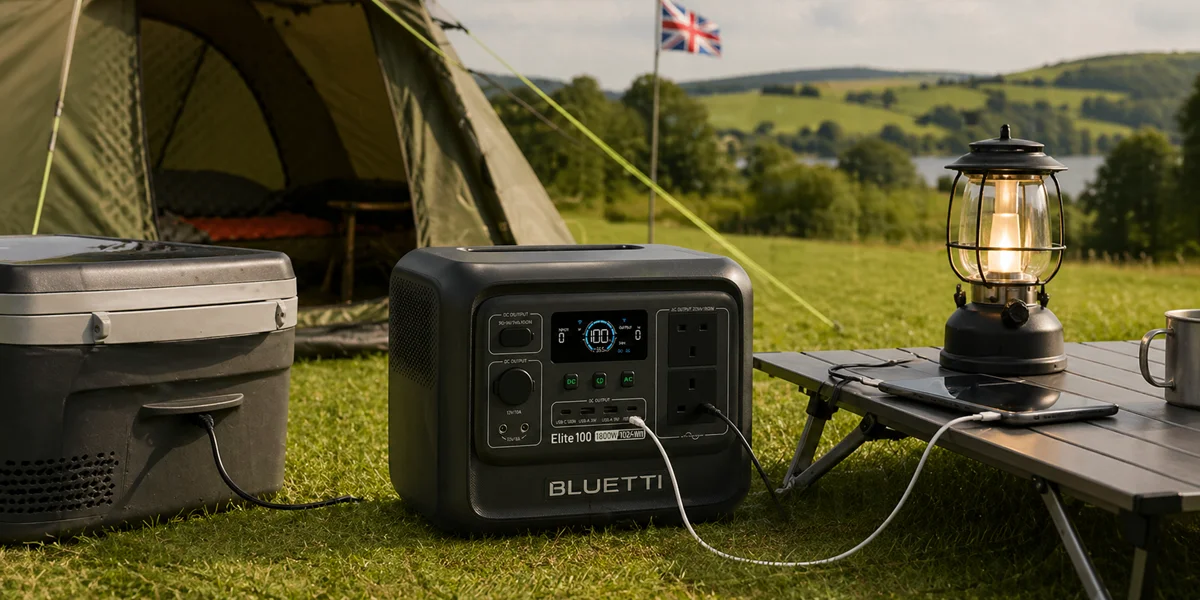
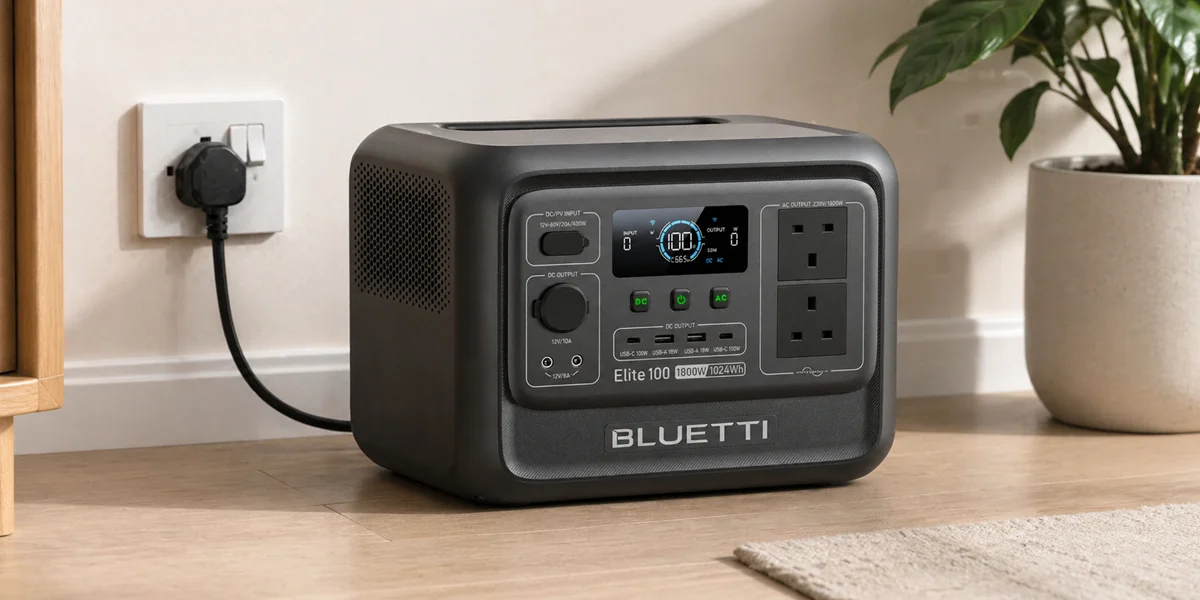
Bluetti Elite 100 V2: a 1,000W solar ceiling, plus 1,024Wh LiFePO4
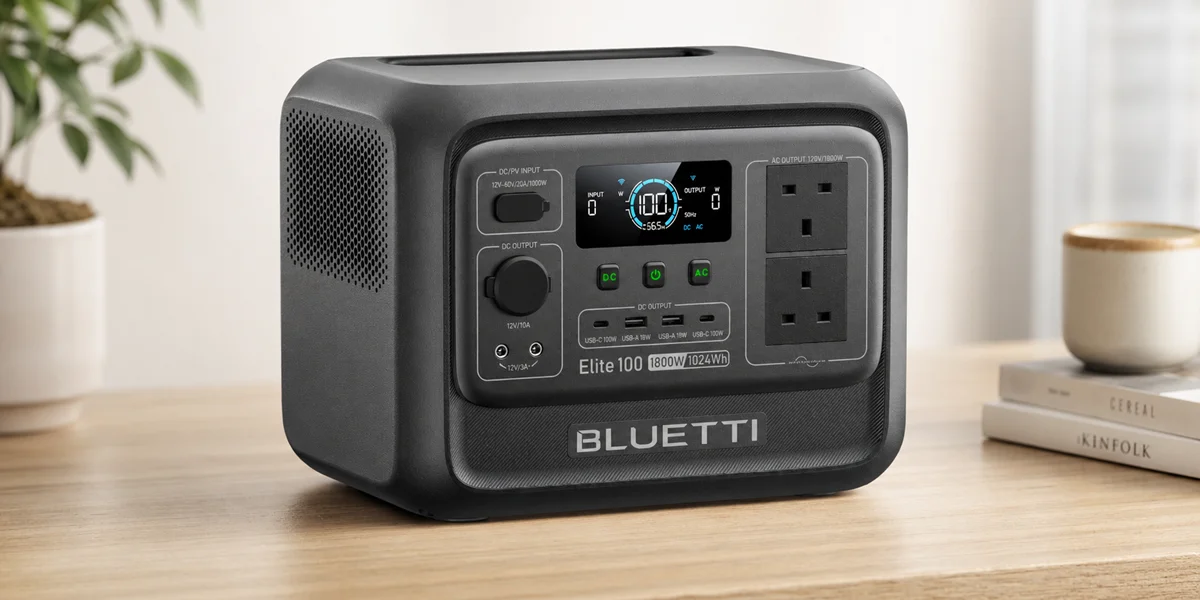
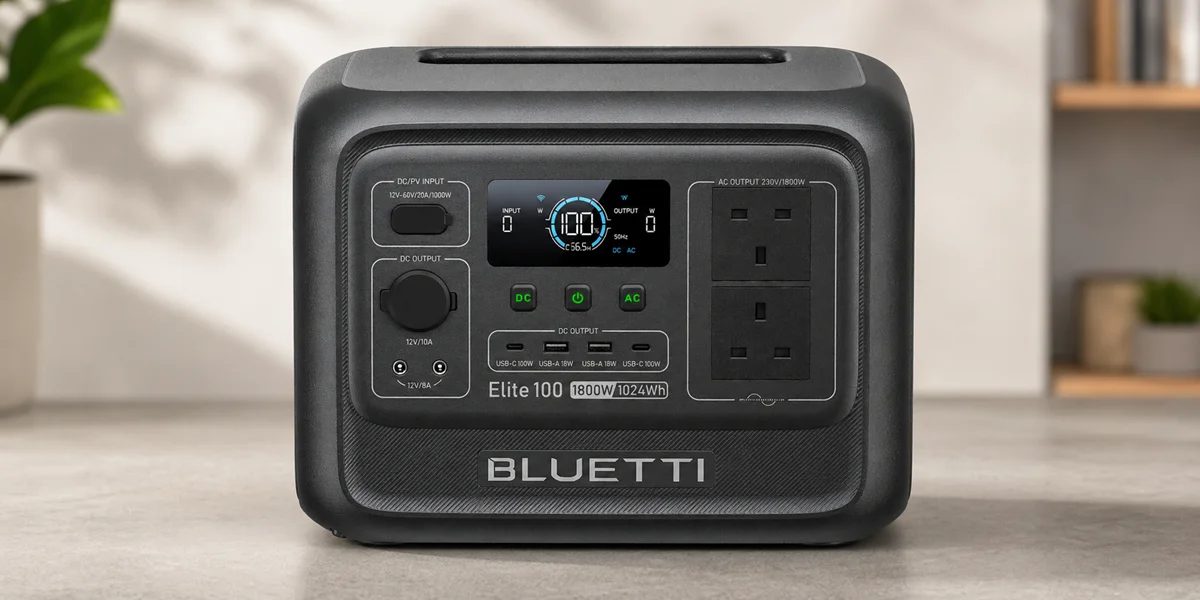
| Capacity | 1024Wh |
| AC Output | 1800W |
| Solar Input | 1000W max |
| MPPT Ports | Single |
| Battery | LFP |
| UK Warranty | 5 years UK |
- 1,000W solar input on a single XT60 socket, simple to wire up
- Accepts panels from 12V to 60V on that one input
- 11.5kg stays portable enough to move between a shed and the garden
- Doubles as light home backup or camping power when the sun's out
- Only one solar input, unlike the Apex 300's two
- Only 2 AC sockets limit what you can run at once
- No IP rating, so keep it under cover outdoors
The Elite 100 V2 is our solar pick because its single XT60 input accepts panels from 12V to 60V. On mains, TurboBoost takes it to 80% in 45 minutes, and Outdoor Gear Lab measured about 890Wh of its 1,024Wh as usable. It also covers light home backup and camping power between sunny spells. If you want two separate solar inputs and more than double the solar wattage, look at the Apex 300 instead.
Bluetti Apex 300: 2,400W solar input, 2.76kWh and 6,000 cycles
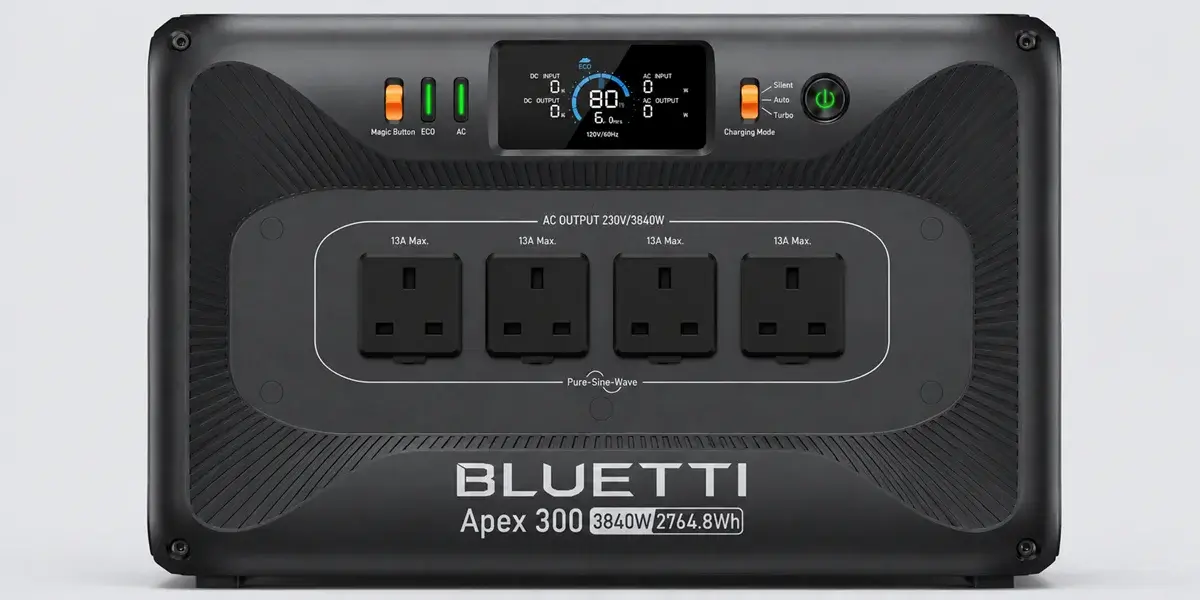
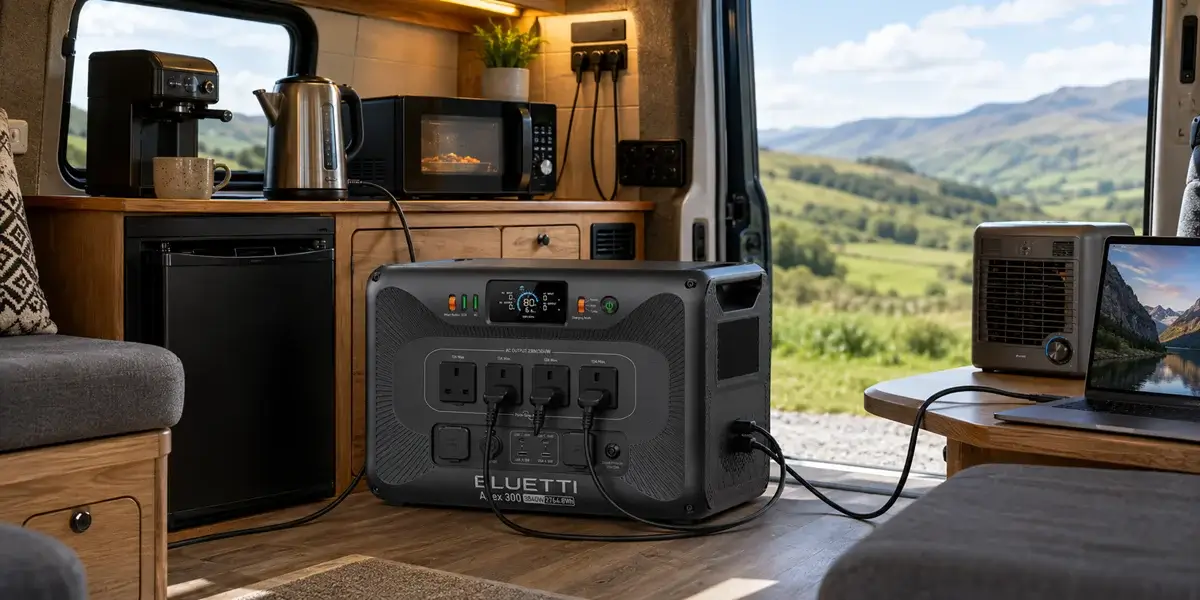
| Capacity | 2765Wh |
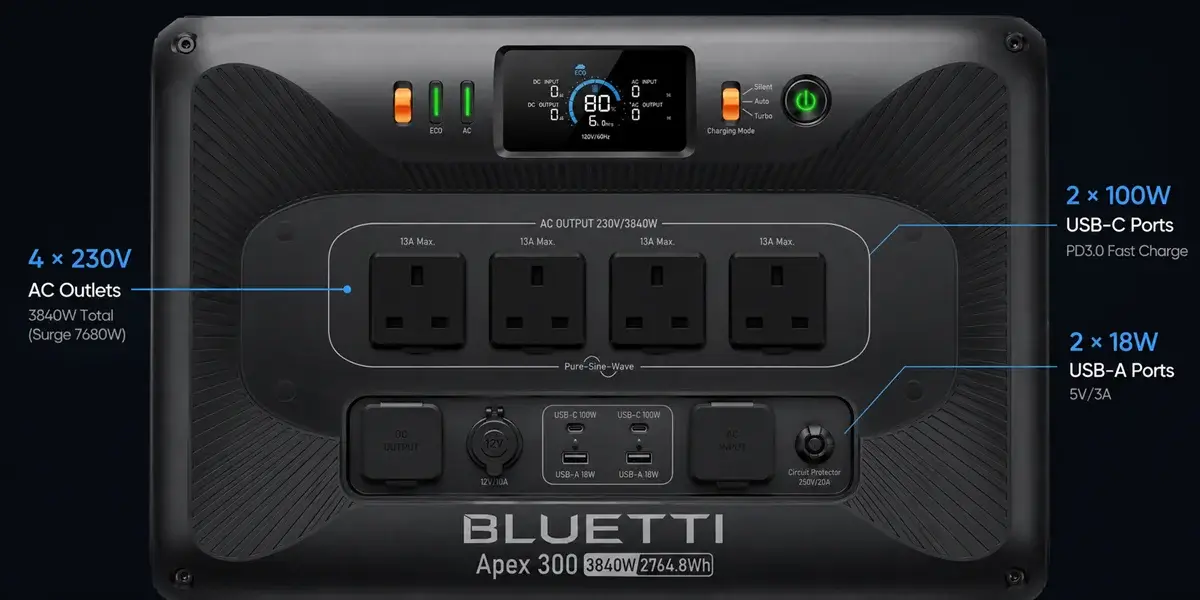
| AC Output | 3840W |
| Solar Input | 2400W max |
| MPPT Ports | Dual |
| Battery | LFP |
| UK Warranty | 5 years UK |
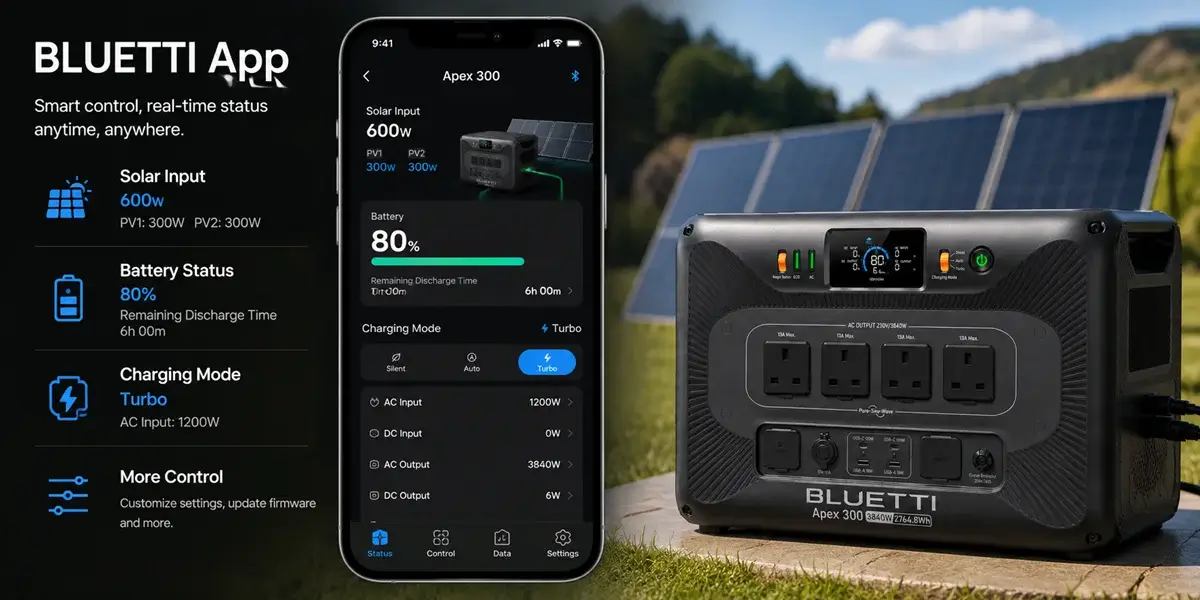
- 2,400W solar across two 1,200W inputs charges faster in full sun
- 2,764.8Wh capacity, more than double the Elite 100 V2's 1,024Wh
- Expandable with B300K battery packs for a larger off-grid system
- Suits fixed installs in a van, boat or cabin as well as solar setups
- 38kg needs a trolley to move it, according to T3
- USB and 12V output need the optional Hub D1 accessory
- Fans get loud during fast turbo charging, according to Notebookcheck
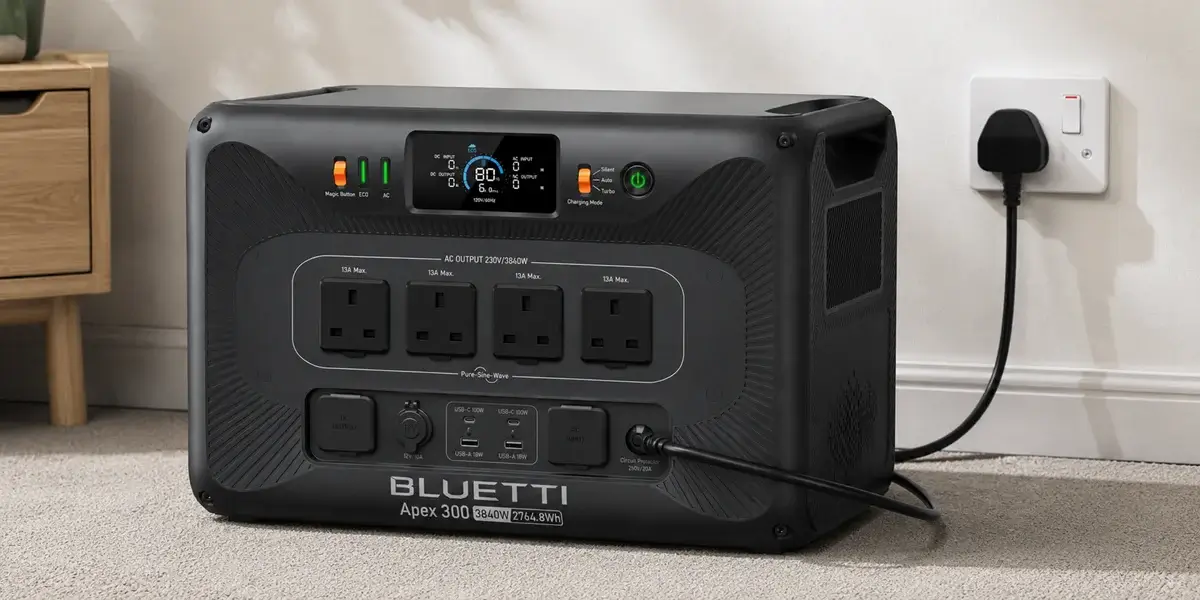
The Apex 300 is for serious off-grid solar setups, not for carrying about. Two 1,200W inputs take up to 2,400W in good sun, and B300K battery packs let you expand the system. It suits fixed installs in a van, boat or cabin, and it doubles as home backup. USB and 12V need the optional Hub D1, and T3 says it needs a trolley at 38kg, so choose the Elite 100 V2 for portability.
Also worth considering for solar charging
If neither pick above fits, these four are worth a look. The EcoFlow Delta 3 Plus and Delta 3 Max Plus split 1,000W of solar across two inputs, and they also charge faster from the mains.
| Model | Why consider it | The catch | Link |
|---|---|---|---|
| EcoFlow Delta 3 Plus | 1,000W solar across two 500W inputs, plus 800W alternator charging for van life and a full recharge in under an hour | Fans can run even at low loads | EcoFlow Delta 3 Plus review |
| EcoFlow Delta 3 Max Plus | 1,000W solar across two 500W inputs, 2,048Wh capacity and expandable to 10kWh with two DELTA Pro 3 extra batteries for longer off-grid stints | At 22.1kg it's not something you'll want to move often | EcoFlow Delta 3 Max Plus review |
| Bluetti Elite 200 V2 | Accepts as much as 1,000W from panels, across a 12V to 60V range. Bluetti claims a full solar charge in about 2.4 hours. | UK light means far longer, no solar cable is listed in the box, and the 60V ceiling limits panel wiring | Bluetti Elite 200 V2 review |
| EcoFlow RIVER 3 Plus | 286Wh with 220W of solar input, and Amazon UK currently sells it with a 110W panel to get you started. | 286Wh covers small loads only, and the 110W panel can’t use the full 220W input. | EcoFlow RIVER 3 Plus review |
What does a small solar setup get you?
- A small, single-battery solar setup gets you enough for phones, laptops and lighting, with modest solar input alongside it. It won’t run a kettle or a hairdryer on a unit this size. Treat it as a top-up tool, not a home backup unit.
That is not automatically a bad buy for light use, such as charging phones and running LED lights, but check three things first:
- Battery chemistry claims. Some cheap listings claim “LiFePO4” with no way to verify it. If the listing does not name a recognised cell supplier or show cycle-life data, treat the claim with caution.
- Sine wave type. Cheaper units sometimes ship with a modified sine wave inverter. This suits basic lights and phone chargers, but can hum or upset sensitive electronics like laptop chargers and CPAP machines.
- Warranty and returns. A UK-registered seller with a real returns address matters most at this end of the market. Smaller units are the ones most likely to develop a fault in year one.
If a compact single-input unit doesn’t cover what you need, our reviews hub covers every model in more detail. Our best portable power stations guide is the better starting point if you need more capacity or output.
Can a solar generator work for home backup power?
- Yes, within limits: it can run lighting, a fridge and a few small essentials during a power cut. It won’t replace mains power for a whole house. For a model-by-model breakdown, see our best solar generators for home backup guide.
Can a solar generator run a house?
No, not the way a mains connection or a standby generator can. A 1,000Wh to 2,000Wh unit will comfortably run a fridge, lights, a router and phone charging through a typical cut. It won’t run high-draw circuits such as an electric shower, an oven or a central heating pump. Those draw more than a portable unit can output.
What size do you need for home backup?
For anything beyond a few hours of light use, aim for 2kWh or more. Capacity across the models on this page spans 1,024Wh (Bluetti Elite 100 V2 and EcoFlow Delta 3 Plus) up to 2,764.8Wh (Bluetti Apex 300). The two 1,024Wh picks suit short cuts and weekend use. Anyone running a fridge plus lights plus a router overnight should look at an expandable option. The EcoFlow Delta 3 Max Plus starts around 2,048Wh. The Bluetti Apex 300 starts around 2,765Wh and expands to about 19kWh with B300K battery packs. Our home backup buying guide covers sizing for longer power cuts.
What does a 3,000W solar generator actually do?
Some solar generators are marketed by output wattage, such as a “3,000W solar generator.” That figure describes how much it can power at once, not how long it will run for; runtime comes down to the battery capacity paired with it, typically 2,000Wh to 3,000Wh in that class, so check the Wh figure separately from the W rating.
The genuine advantage for home backup is the UPS switchover, typically under 30ms on the models above, which keeps routers and small electronics running without a flicker during a cut, something a petrol generator cannot do.
Solar generators by capacity: which class do you need?
- UK solar generators fall into capacity classes rather than fixed price points. There are compact single or dual-input units around 1,024Wh, mid-capacity expandable units around 2,048Wh, and large off-grid systems from around 2,765Wh. Capacity, continuous output and solar input watts are what separate them, not the brand name on the case.
Solar generator capacity, solar input and battery chemistry vary enormously across the UK market. Rather than compare by price, here is what each capacity class on this page typically covers:
- Around 1,024Wh: the Bluetti Elite 100 V2 takes 1,000W of solar on a single input. The EcoFlow Delta 3 Plus takes 1,000W across two inputs and expands to 5kWh. Both suit weekend camping and light home backup.
- Around 2,048Wh: the EcoFlow Delta 3 Max Plus takes 1,000W of solar across two inputs. It expands to 10kWh with two DELTA Pro 3 extra batteries, for longer stints off-grid.
- 2,765Wh and up: the Bluetti Apex 300, with 2,400W solar across two inputs and expandable capacity built for off-grid living or longer home backup.
Prices move often enough that a fixed number goes stale within weeks, which is why every model here links through to a live “Check Price on Amazon UK” button rather than a printed figure.
Solar generator kits: panels included or separate?
Most solar generators, including all six models here, are sold as the power station only, with panels as a separate purchase. A small number of brands sell bundled kits with a matched panel. That’s simpler if you don’t want to research compatibility, though it usually locks you into the kit’s wattage.
If you buy panels separately, check two things:
- Connector type. Most units use the standard MC4 connector, so most third-party panels physically fit. Confirm this first, since a small number of models use a proprietary connector instead.
- VOC compatibility. VOC is the panel’s open-circuit voltage, and it must fall inside the unit’s rated input range, commonly 11V to 60V. Wiring panels in series or parallel changes the combined VOC, so check the maths before connecting more than one.
Each manufacturer also sells own-brand panels, such as EcoFlow’s 220W and 400W panels, which guarantee plug-and-play compatibility.
How much solar charging can you actually expect in the UK?
Solar charging works in the UK, but slower than the marketing suggests. A panel rated at 200W realistically delivers 100 to 140W here, not its full figure, and winter days are marginal. Treat solar as a strong summer top-up and rely on the mains the rest of the year.
A higher solar ceiling only helps if you have the panels and daylight to feed it. That goes for the Bluetti Elite 100 V2’s 1,000W and the Apex 300’s 2,400W. The UK recorded 1,648.5 hours of sunshine in 2025, which the Met Office puts at 118% of the 1991 to 2020 average. Call it roughly 1,400 hours in a normal year, spread very unevenly between June and December. A full home solar system also saves around one tonne of carbon a year on average, on the Energy Saving Trust’s figures. A portable panel saves far less, because it’s much smaller. Our solar charging guide covers the full seasonal breakdown.
What will a solar generator actually run?
A 1,000Wh solar generator runs low and medium-draw kit well. Think a fridge for 6 to 8 hours, a CPAP machine overnight, a laptop for 12 to 14 hours, or phones and lights for days. It won’t run a kettle, electric shower or oven, which all draw 2,000W or more.
Capacity is only half the question. The other half is how much each device draws. Here is what a 1,000Wh unit handles in practice.
| Device | Typical wattage | Approx runtime on 1,000Wh |
|---|---|---|
| LED lights | 10W | 80+ hours |
| Phone charge | 10W | 70+ full charges |
| CPAP machine | 40W | 18 to 20 hours |
| Laptop | 60W | 12 to 14 hours |
| TV (40 inch LED) | 80W | 9 to 10 hours |
| Mini-fridge | 60W (cycling) | 14 to 18 hours |
| Full fridge | 120W (cycling) | 6 to 8 hours |
| Kettle | 2,000W+ | exceeds most 1,000W units |
Running costs matter as much as wattage when you’re deciding what’s worth backing up. An F-rated 424-litre fridge-freezer costs roughly £80 a year to run. A full-size A-rated dishwasher costs around £35. Both figures come from the Energy Saving Trust’s home appliance running costs.
Kettles, electric showers and ovens draw 2,000W or more, so they exceed most 1,000Wh units on output, runtime or both. Check the output rating, not just the capacity.
The simple formula: usable Wh divided by device watts, multiplied by 0.85 (to allow for conversion losses), gives approximate runtime in hours. Worked example: a 60W laptop from a 1,000Wh battery: 1,000 / 60 = 16.7, then x 0.85 = roughly 14 hours.
To size a unit to your own kit, use our sizing calculator or read the full size guide.
Solar generators by wattage: what will yours actually run?
- Short answer: 1,000W to 2,000W covers a microwave, a slow cooker or a small hair dryer. Around 3,000W and up adds a full-size kettle and power tools, with the highest-output model here able to run several heavy appliances at once.
Capacity in watt-hours tells you how long a charge lasts. What actually switches an appliance on is the continuous AC wattage rating. The bands below use each product’s own AC output figure from this page’s spec boxes, grouped at the nearest round-number breakpoint.
1,000W to 2,000W solar generators: what they actually run
The Bluetti Elite 100 V2 and the EcoFlow Delta 3 Plus both sit in this band. Both are rated at 1,800W continuous (3,600W surge). That covers a microwave, a slow cooker and a small hair dryer without drama. A UK kettle draws 2,000W to 3,000W, so this band sits right at the edge. A low-draw kettle will run here, but a typical one won’t. Check the wattage on the base of your own kettle to be sure.See our best solar generators for campervans guide for models picked for van life.
3,000W solar generators: what they actually run
Two products sit in this band and above. The EcoFlow Delta 3 Max Plus is rated 3,000W continuous with a 6,000W surge. That’s enough for a full-size kettle, a microwave and power tools, usually one at a time. The Bluetti Apex 300 goes further, at 3,840W continuous with a 7,680W surge. That’s enough headroom to run a full-power kettle alongside smaller loads. If full kitchen backup during a power cut is the goal, the Apex 300’s extra headroom is worth planning for.
How do you choose a solar generator?
- Match capacity in Wh to what you need to run. Match continuous AC wattage to your heaviest appliance. Match solar input watts to how fast you want to recharge off-grid. LiFePO4 batteries and pure sine wave output are worth insisting on; everything else is a secondary spec.
What is MPPT and why does it matter?
In Victron’s own worked example, a 100W panel at 25°C harvests 81W through a PWM controller against 100W through MPPT. So PWM loses about 19%. That gap narrows as panels heat up, and Victron calls it negligible at 75°C cell temperature. That’s quietly good news for UK buyers: panels here rarely run hot enough to close it.
When you compare units, ask two questions. How high is the solar input ceiling? Does the unit have a single or dual MPPT input?
How much solar input do you actually need?
Match solar input to how fast you want to refill the battery. 400W to 500W is plenty for weekend camping. Solar-only off-grid living needs 600W to 1,000W to charge faster on a good day.
| Situation | Recommended solar input | Estimated UK charge time per 1,000Wh |
|---|---|---|
| Day tripper, top-up charging | 100W panel | 10 to 14 hours |
| Weekend camper | 200W panel | 8 to 12 hours |
| Extended van life | 400W panels | 4 to 7 hours |
| Off-grid base camp | 600W+ | 2 to 4 hours |
For scale, a typical UK home solar installation runs to around 4.5kWp of panels, according to the Energy Saving Trust. That dwarfs the 1,000W to 2,400W panel inputs on the units compared on this page. Don’t expect a portable panel to behave like a roof system.
Which solar panels are compatible with a solar generator?
Most units use the standard MC4 connector, so third-party panels often work without adapters. The panel’s open-circuit voltage (VOC) must fall inside the unit’s rated input range, commonly 11V to 60V. See the kits section above for how to check this before buying.
Each manufacturer also sells own-brand panels, such as EcoFlow’s 220W and 400W panels, which guarantee plug-and-play compatibility.
Pure sine wave or modified sine wave, which do you need?
Pure sine wave delivers clean, mains-quality power that suits laptops, CPAP machines and anything with a motor. Modified sine wave is cheaper but can hum or upset sensitive electronics; every unit recommended here uses pure sine wave.
Do UK solar generators use proper UK plugs?
Yes, on every model recommended here. A solar generator needs genuine BS 1363 three-pin sockets at 230V, not a US or EU socket with an adapter. Both brands here sell UK-spec models with proper sockets and warranty support.
Three rectangular pins built to the BS 1363 dimensions make a genuine UK plug. The law calls it the “standard plug” in regulation 3 of the Plugs and Sockets etc. (Safety) Regulations 1994.
How we research these picks
We do not make hands-on testing claims. Our picks come from manufacturer specifications, UK Amazon owner reviews, and measurements published by T3, TechRadar, Notebookcheck and Outdoor Gear Lab. We focus on UK realities: 230V sockets, British weather, warranty support, and the practical differences between models.
Final Recommendation
For most UK buyers, the Bluetti Elite 100 V2 is our top pick. It pairs a single 1,000W solar input with steady 1,800W output and a 5-year warranty. The catch: it has just 2 AC sockets and isn’t expandable. Pick the Bluetti Apex 300 for serious off-grid solar charging. The Apex 300 takes 2,400W across two inputs, and its capacity expands for longer stints away from the mains. It weighs 38kg and needs the optional Hub D1 for USB and 12V. The EcoFlow Delta 3 Plus and Delta 3 Max Plus are worth a look for faster mains charging and alternator support for van life. Whichever you choose, buy the UK-spec version from an authorised seller so the warranty applies.
Frequently Asked Questions
A solar generator is a portable power station with a built-in MPPT charge controller, so it recharges from solar panels as well as the mains. It pairs a LiFePO4 battery with an inverter that delivers 230V AC and runs quietly with no fumes, unlike a petrol generator.
For most UK buyers focused on solar, it’s the Bluetti Elite 100 V2. It has 1,024Wh of capacity, 1,800W output and up to 1,000W of solar input on a single input, balancing power and portability. If you need serious off-grid solar charging, the Bluetti Apex 300 takes up to 2,400W across two inputs instead.
A typical fridge draws around 120W while cycling, so a 1,000Wh solar generator runs one for roughly 6 to 8 hours. For a fridge plus lights on a longer cut, step up to a 2,000Wh unit or bigger, such as the EcoFlow Delta 3 Max Plus.
The 3,000W figure describes output, how much it can power at once, not runtime. Runtime depends on the battery capacity paired with that output, typically 2,000Wh to 3,000Wh. A 2,500Wh battery running a 300W load would last roughly 7 hours on the standard capacity-divided-by-load formula.
For many UK buyers, yes. They are quiet, fume-free and safe to use indoors, which makes them practical for power cuts, camping and remote work. Solar charging is slower here than the marketing suggests, so treat the panels as a summer top-up.
From the mains, most 1,000Wh solar generators charge in roughly 1 to 2 hours. The EcoFlow Delta 3 Plus reaches 80% in about 40 minutes. From solar it’s far slower. A 200W panel needs around 8 to 12 hours of usable UK sun to refill a 1,000Wh battery, and longer in winter.
For most campervan use, yes. On a good summer day, a 400W array delivers roughly 200W to 280W in UK conditions. That’s enough to keep a 1,000Wh battery topped up for lights and a compressor fridge. Winter will likely still need mains charging.
There is no single best brand: EcoFlow leads on fast mains charging and expandable capacity, while Bluetti leads on solar input and cycle life. Both offer UK-spec models with proper BS 1363 sockets and warranty support.
For camping, van life and power cuts, a solar generator is usually the better UK choice. It’s quieter, produces no fumes, and can run safely indoors, which a petrol generator can’t do. Petrol runs for as long as you keep adding fuel, while a solar unit is limited by its Wh capacity.
Many solar generators support charging from the mains and solar at the same time; check the spec sheet for your exact model. This is genuinely useful in UK autumn and winter, when solar alone often will not refill the battery in a single day.
It depends mainly on capacity and solar input. Compact units around 1,024Wh with a single solar input, like the Bluetti Elite 100 V2, suit weekend trips and light backup. Larger expandable units with dual solar inputs and higher continuous output, like the Bluetti Apex 300, suit off-grid living and longer home backup.
It depends on whether solar input or mains speed matters more to you. The Apex 300 takes the most solar here, at 2,400W across two inputs; the Elite 100 V2 takes 1,000W on a single input. EcoFlow’s Delta 3 Plus and Delta 3 Max Plus take 1,000W too, charge faster from the mains and add alternator charging for van life.
It depends on how much capacity you used and your panel’s wattage, not on how long the fridge ran. Divide the Wh drawn by your solar wattage, then add extra for UK sun rather than lab conditions. A 1,024Wh unit with a 500W panel can refill a fair chunk in a few hours of good sun, though a grey day gives less. For how long a given capacity runs a fridge, see our guide to what 1,024Wh will run.
The main one is weather and speed: UK solar charging is slower and less predictable than mains power, especially from November to February. Capacity is fixed on some models, such as the Elite 100 V2, so under-sizing strands you until you buy a bigger unit. A portable model with strong output and low weight costs more than an equivalent mains-only battery. None of that rules a solar generator out, which is why most owners treat solar as a top-up, not their only charging method.
Use our free Power Station Finder Quiz for a personalised recommendation. Or run your appliances through the Sizing Calculator to see exactly what capacity and solar input you need.