What Is the EcoFlow Delta Pro 3 and Who Is It For?
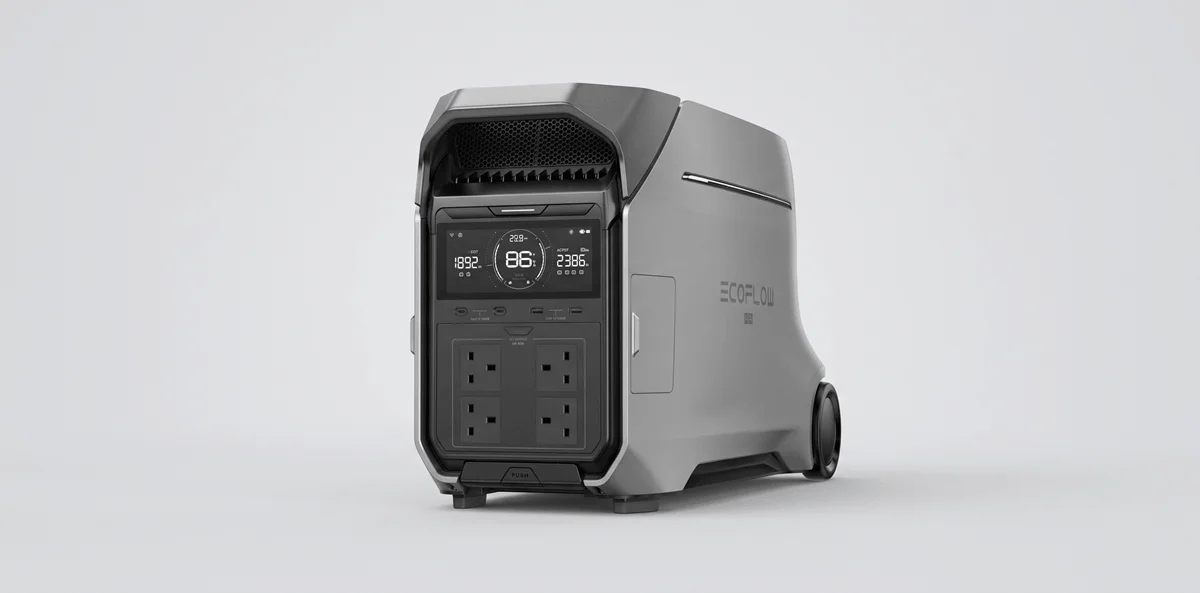
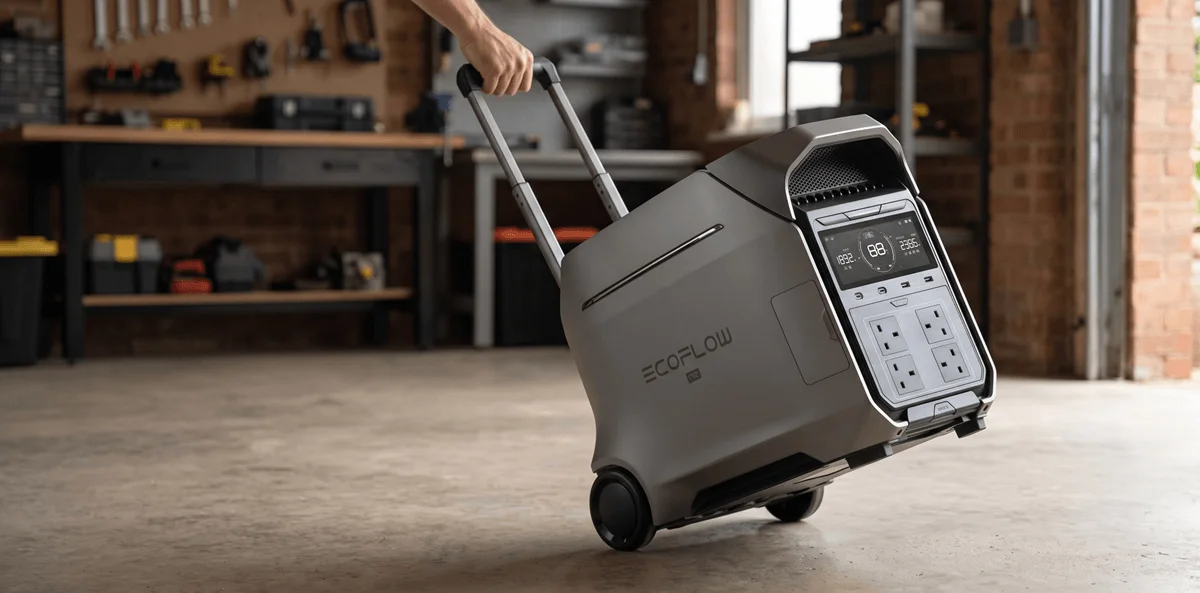
The EcoFlow Delta Pro 3 is a 4,096Wh LiFePO4 power station sold in the UK, with 4,000W of output and four UK three-pin sockets. It suits long power cuts, fixed solar set-ups and motorhome installs. At 51.5kg, it rolls on wheels but isn’t one to carry.
This review covers the UK model, which EcoFlow’s manual lists as EFD521. It runs at 230V and 50Hz. It has four Type G sockets, the UK three-pin type, plus one CEE 16A socket. US sockets and voltages don’t apply here, so we leave them out.
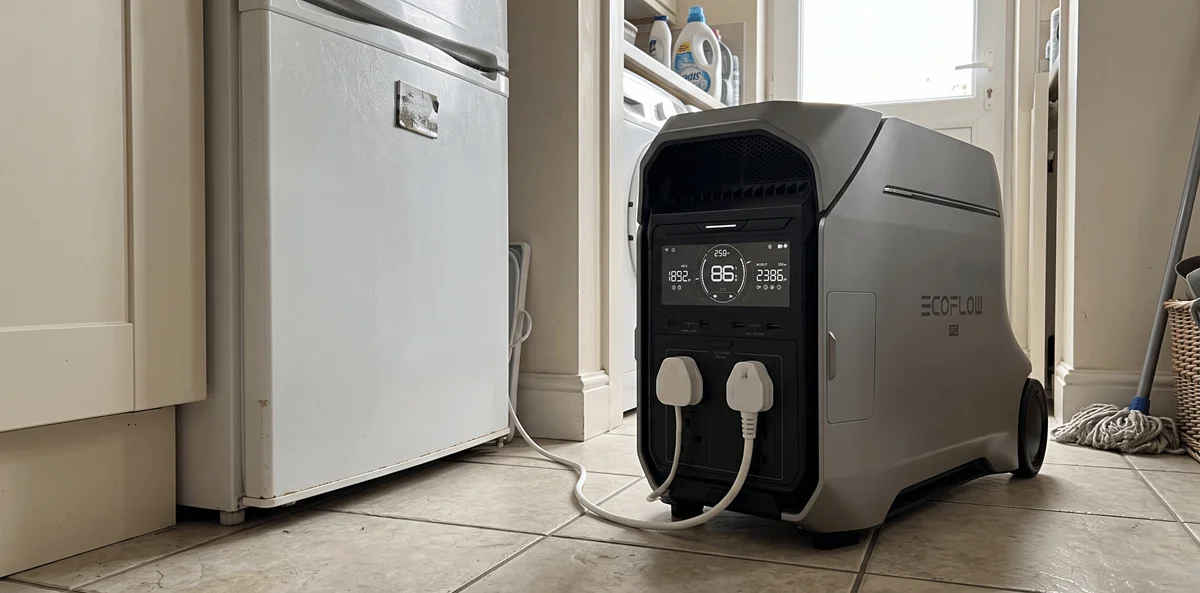
Home backup is the main job. Outdoor Gear Lab, testing a US unit, names it best for home backup. A Polish reviewer on Amazon UK rates it for power cuts and as a UPS.
The catch is the wiring. Connecting it to a house needs an electrician and an isolation switch. Our guide to the best power stations for home backup shows other options.
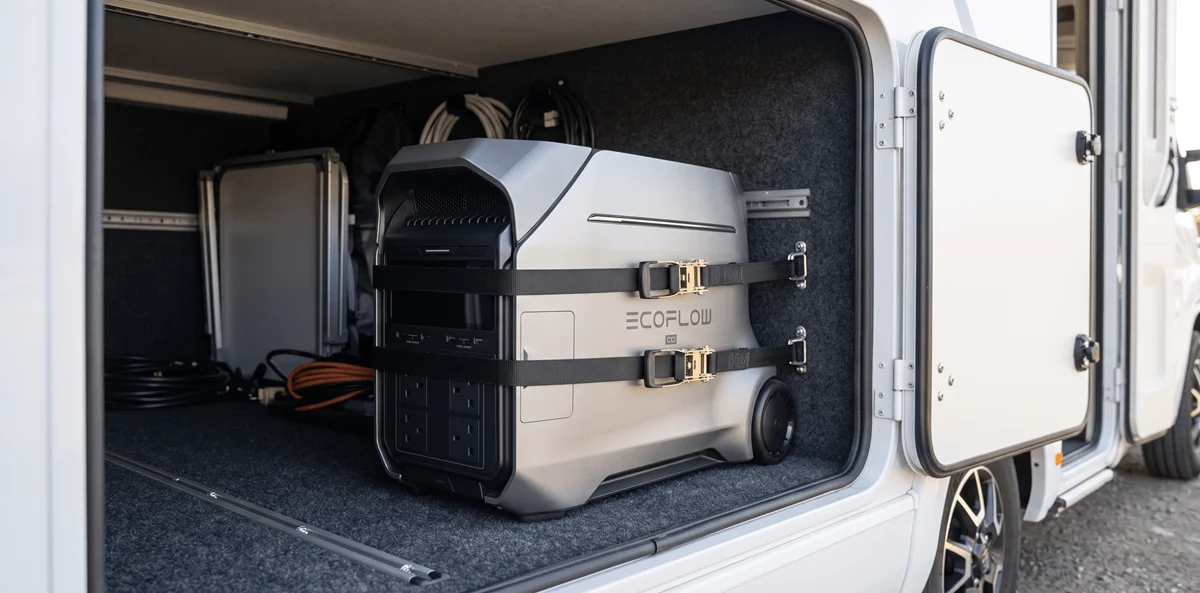
Solar and off-grid use come second. It takes up to 2,600W across two inputs, and an Italian reviewer reports charging it from three panels. Motorhomes come third, and a French reviewer reports a week away with a 1,000W plancha grill.
Solar and motorhome use both need a fixed install, because the main unit has no waterproof rating and weighs 51.5kg. It isn’t a camping unit. You’d need two people just to lift it into the car. For lighter vans, see our best power stations for campervans.
Key Specifications at a Glance
Figures below come from EcoFlow’s online manual and the EcoFlow UK product page, unless we say otherwise. Two numbers matter most. The 4,096Wh figure is the tank: how much energy it holds. The 4,000W figure is the tap: how much it can deliver at once.
How many amp hours is that? The battery is rated at 80Ah and 51.2V, which multiplies out to 4,096Wh.
| Specification | Detail |
|---|---|
| Model | EFD521 (UK) |
| Capacity | 4,096Wh (51.2V, 80Ah) |
| Battery type | LFP (LiFePO4) |
| Cycle life | 80%+ health after 4,000 cycles, at 0.5C and 25°C |
| AC output | 4,000W total, 230V, 50Hz, surge 8,000W |
| X-Boost | 6,000W mode for appliances above 4,000W, off by default |
| UK AC sockets | 4 x Type G (13A) and 1 x CEE 16A |
| AC POWER IN/OUT port | EcoFlow proprietary; disables all AC sockets and the AC input while in use |
| USB-C | 2 x 100W maximum (200W total), PD3.0 |
| USB-A | 2 x 18W maximum (36W total), QC3.0 |
| 12V DC | 12.6V, 30A, 378W total, via DC5521 and Anderson ports |
| Output ports | 11 by our count (5 AC, 2 USB-A, 2 USB-C, 2 DC) |
| AC input (UK) | 220 to 240V, 12.5A, 2,900W maximum, C20 inlet |
| Solar input | 2,600W total across two inputs |
| High-PV input | 30 to 150V, 15A, 1,600W maximum |
| Low-PV input | 11 to 60V, 20A, 1,000W maximum, shared with the car input |
| Car input | 12V at 8A maximum, or 48V at 20A maximum |
| UPS switchover | 10ms, standby type |
| Expansion | Up to 2 Smart Extra Batteries, 4,096Wh and 33kg each |
| Noise | As low as 30dB under 2,000W (EcoFlow's claim) |
| Weight | About 51.5kg, with telescopic handle and wheels |
| Dimensions | About 410.4 x 341 x 693mm |
| Water protection | Battery pack IP65; main unit has no waterproof rating (EcoFlow UK gives IP20) |
| Temperatures | Charge 0 to 45°C; discharge and storage -10 to 45°C |
| Connectivity | Wi-Fi 4 (2.4GHz), Bluetooth 5.0, CAN (RJ45) |
| Warranty | 5 years |
| In the box | Delta Pro 3, AC charging cable, 2 grip protectors, documents |
Delta Pro vs Delta Pro 3: What Actually Changed?
The Delta Pro 3 holds 4,096Wh, up from 3,600Wh on the original Delta Pro. It takes 2,600W of solar across two inputs, where the older unit took 1,600W through one. It also weighs about 6.5kg more, and EcoFlow lists less expansion for it.
The original Delta Pro is out of stock at EcoFlow UK, which now points buyers to the Delta Pro 3. Figures come from EcoFlow UK and EcoFlow’s manuals.
| Feature | Delta Pro | Delta Pro 3 (UK) |
|---|---|---|
| UK stock, 11 October 2026 | Out of stock | In stock |
| Capacity | 3,600Wh | 4,096Wh |
| AC output | 3,600W (UK 230V figure not confirmed) | 4,000W, surge 8,000W |
| Weight | About 45kg | About 51.5kg |
| Solar input | One input, 1,600W | Two inputs, 2,600W |
| Cycle life | 3,500 cycles to 80%+ | 4,000 cycles to 80%+ |
| UPS switchover | Within 30ms | 10ms |
| Expansion | Up to 25kWh (EcoFlow's claim) | 4 to 12kWh |
So what changed? You get 496Wh more capacity and 1,000W more solar input (our sums). Switchover drops from within 30ms to 10ms. The cycle rating rises by 500.
The trade-offs are weight and expansion. The Delta Pro 3 is about 6.5kg heavier by our sum. EcoFlow also claims up to 25kWh for the original, against 4 to 12kWh here.
How Fast Does the EcoFlow Delta Pro 3 Charge?
The Delta Pro 3 takes up to 2,900W from a UK socket, which is 220 to 240V at 12.5A through a C20 inlet. EcoFlow claims 0 to 80% in one hour but gives no condition for it. We found no UK test, so we publish no UK full-charge time.
Here’s why we don’t read the one-hour claim as a wall-socket figure. 80% of 4,096Wh is about 3,277Wh (our sum). A 2,900W input supplies only 2,900Wh in an hour. EcoFlow UK doesn’t say which inputs the claim assumes.
Reviews that quote mains charge times used US 120V units, so those times don’t apply here. A charge speed switch offers ADJUST, where you set a level in the app, or FAST. It works on AC input only.
EcoFlow also advertises up to 7,000W with multi-charge combinations, but it doesn’t name the combination. Treat that as a ceiling, not a mains figure.
On the road, the XT60i port accepts 12V at 8A, about 96W by our sum, or 48V at 20A. EcoFlow’s 800W Alternator Charger connects through the Extra Battery port with an adapter. Its UK bundle was out of stock on 11 October 2026.
How Much Solar Can It Take in the UK?
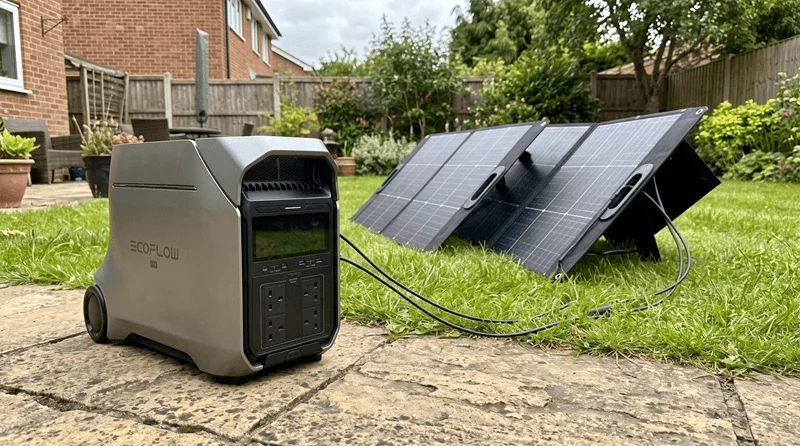
The Delta Pro 3 takes up to 2,600W of solar across two inputs, but UK light will deliver far less. One input suits higher-voltage panel strings and the other lower-voltage ones. EcoFlow doesn’t list a solar cable in the box.
The two ports have different limits. High-PV takes up to 1,600W and Low-PV up to 1,000W. Low-PV is also the car input, so it serves one source at a time.
Independent solar tests used US units. Bob Vila saw 320 to 335W from one panel on a clear day. CleanTechnica saw 1,200 to 1,500W at peak from 1,800W of panels.
A British winter will do worse, and we found no UK-measured figure. Plan for a long charge, not the headline number.
Budget for a cable. The manual’s box list shows none, and an Italian reviewer on Amazon UK complains that none came with the unit. Our UK solar charging guide explains how to match panels to a power station, and our best solar generators page compares other units.
What Can the EcoFlow Delta Pro 3 Actually Power?
By our sums, the Delta Pro 3 should run a 10W router for about 14 days and a 60W laptop for about 58 hours. A 250W desktop PC gets nearly 14 hours. Those figures use 85% of the 4,096Wh rated capacity. A 3,000W kettle works but drains the battery fast.
Our method is capacity times 0.85 for inverter losses, divided by the load in watts. That leaves about 3,480Wh to spend. The 85% figure is cautious. Outdoor Gear Lab measured 3,790Wh usable on a US unit, and nextpit got 3,997Wh out of an EU unit for 4,885Wh in.
The kettle card shows the trade-off. A 3,000W kettle sits inside the 4,000W output. The same sum gives only about 69 minutes of total heating before the battery is flat. The radiator card drains it the same way.
Real loads go higher than our cards. An Italian reviewer on Amazon UK reports running a washing machine and oven at 3,850W. A French reviewer reports a year powering four commercial fridges. We work out a fridge runtime in the FAQ below.
Motors start with a surge, and EcoFlow rates the surge at 8,000W. The Solar Lab ran a US unit at 5,100W for nearly a minute before it shut down. In the same test it ran 3,650W for an hour, which works out at about 89% efficiency.
Appliances rated above 4,000W need X-Boost, a 6,000W mode. It’s off by default and you switch it on in the app. It isn’t a surge figure. EcoFlow’s manual says it suits heating devices better, doesn’t support devices with voltage protection, and isn’t available while charging from AC.
How Does Expansion to 12kWh Work?
You expand the Delta Pro 3 by plugging in one or two Smart Extra Batteries. One takes the total to 8,192Wh and two take it to 12,288Wh. Each battery weighs 33kg, so an expanded set-up tends to stay where you put it.
EcoFlow UK lists the range as 4 to 12kWh. The Smart Extra Battery was in stock there on 11 October 2026.
The manual says the Delta Pro 3 is backwards compatible with the original Delta Pro’s Smart Extra Battery. That helps anyone who already owns one.
Capacity is only part of the story, because weight climbs fast. One extra battery takes the stack to about 84.5kg, and two take it to about 117.5kg (our sums). Treat any expanded set-up as a permanent install.
Runtimes use 85% of capacity and an assumed 250W load, such as a desktop PC and monitor. Weights are our sums.
Can the Delta Pro 3 Back Up a UK Home?
The Delta Pro 3 can power essentials in a power cut, but you can’t simply plug a house into it. EcoFlow’s manual says it acts as a standby UPS with a 10ms transfer time. Connecting it to a building needs a properly installed isolation switch, fitted by a certified electrician.
A standby UPS passes mains power straight through and switches to battery when the mains drops. That’s different from an online UPS, which always runs from the battery. EcoFlow’s manual also says the unit needs more mains input than the connected load, or it can’t act as a UPS.
Powering a house is a bigger job than powering a PC. The manual warns against hooking a power station to a building’s wiring without a properly installed isolation switch. EcoFlow UK lists a Manual Transfer Switch that needs a certified electrician and carries a one-year warranty. On 11 October 2026, both bundles that include it were out of stock.
The manual also describes a Smart Home Panel 2 that switches over automatically. We couldn’t confirm it’s sold in the UK.
One setting catches people out. The AC output switches itself off after an idle period. Before you rely on it for a fridge or medicine storage, change the AC timeout to never in the EcoFlow app. EcoFlow also says the unit isn’t intended for life-sustaining medical equipment.
One long-term reviewer stays cautious. CleanTechnica wouldn’t rely on it for critical, unattended power backup. For comparison, see our home backup shortlist.
What Ports Does the EcoFlow Delta Pro 3 Have?
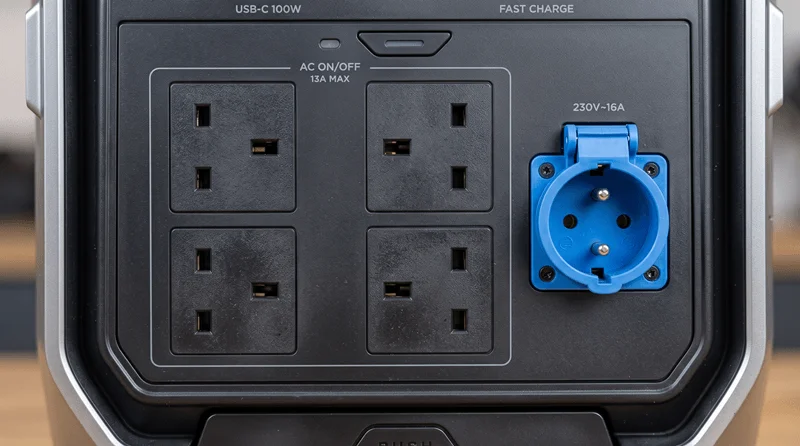
By our count, the Delta Pro 3 has 11 output ports. Five are AC: four UK three-pin sockets and one CEE 16A. The rest are two USB-C ports at 100W each, two USB-A ports at 18W each, a DC5521 port and an Anderson connector. There’s no cigarette-lighter output.
- 4 x UK three-pin (Type G) 230V, 13A each, sharing the 4,000W total AC output
- 1 x CEE 16A 230V, 16A, for kit with a CEE plug
- 2 x USB-C 100W maximum each, 200W total, PD3.0
- 2 x USB-A 18W maximum each, 36W total, QC3.0
- DC outputs 12.6V at 30A (378W total) over DC5521 (5A maximum) and Anderson (30A maximum)
- AC POWER IN/OUT EcoFlow's own port; while it's in use, all AC sockets and the AC input socket are disabled
The unit connects over Wi-Fi 4 (2.4GHz) and Bluetooth 5.0, and it has a CAN (RJ45) port. Each three-pin socket is rated 13A, but together they share 4,000W. Check your total load before you plug everything in. To switch the unit off, press and hold the main power button for two seconds, as EcoFlow’s manual describes.
How Quiet Is the EcoFlow Delta Pro 3?
EcoFlow says the Delta Pro 3 runs as low as 30dB under a 2,000W load. That’s the maker’s best-case claim, and we found no trustworthy measured figure. US reviewers describe it as quiet at moderate loads and louder near full power.
The 30dB figure is from EcoFlow UK, and “as low as” describes the best case. We’d treat it as a floor, not a typical reading.
We found no reliable decibel reading above 2,000W, so we can’t put a number on it. The Solar Lab found its US unit quiet at 2,000W and more noticeable beyond that. If it will sit in a living space, read recent owner comments first.
Battery Life: How Long Will It Last?
EcoFlow rates the battery to keep at least 80% of its health after 4,000 cycles, tested at 0.5C and 25°C. Used once a day, that’s just under 11 years by our sum. The warranty runs for 5 years, and long spells unused can void it.
A cycle is one full charge and discharge. The 4,000-cycle figure comes from EcoFlow’s manual. It’s a rating, not a track record.
Care matters. The manual says to charge and discharge the unit every three months and store it at 60%. It also says leaving it uncharged or unused for more than six months voids the warranty. That’s a trap for a backup unit that sits in a cupboard.
Charging is rated for 0 to 45°C, and discharge and storage for -10 to 45°C. In a frozen garage, warm the unit before you recharge it. EcoFlow UK and the Amazon UK listing both give a 5-year warranty, but we couldn’t check the full policy terms.
Owner evidence is thin and mixed. A UK reviewer on Amazon reported the unit switching off above about 100W. A slow drain and battery recalibration fixed it. The same reviewer noted a strong smell when new.
Another UK reviewer called the kit good but EcoFlow UK support very poor. A Spanish reviewer said the product works but customer service is poor.
On Trustpilot, we found three UK buyers who name the Delta Pro 3. Two describe a unit that stopped working, one of them twice. The third is a recent buyer who is happy so far.
CleanTechnica’s long-term US reviewer needed three resets in about five weeks, two of them after false short-circuit warnings. A firmware update has stopped the warning so far. One forum post describes smoke and arcing from an idle US unit bought at launch, refunded within two days. That’s a single report, so we can’t tell how typical it is.
EcoFlow Delta Pro 3 vs Bluetti Apex 300 vs Jackery Explorer 3000 v2
Figures come from the UK pages of EcoFlow, Bluetti and Jackery. Two of the weights come from elsewhere. The Apex 300’s comes from our Bluetti Apex 300 review, and the Jackery’s from a Jackery UK news post.
The Delta Pro 3 holds more energy and delivers more power than either rival. It also weighs 13.5kg more than the Apex 300 and 24.5kg more than the Jackery. Its cycle rating sits below the Apex 300’s.
We’ve left out warranty and mains charge times, because we couldn’t verify them for all three. Bluetti also quotes higher solar input for the Apex 300 with add-on hardware.
Who This Is NOT For
- Anyone who carries a power station to a pitch or up steps. At 51.5kg it’s a two-person lift, even with wheels. The Jackery Explorer 3000 v2 is listed at 27kg.
- Anyone who needs it outside in the rain. The main unit carries no waterproof rating, and IP65 covers the battery pack alone.
- Anyone who needs to power life-sustaining medical equipment. EcoFlow states the unit isn’t intended for it.
- Anyone who wants hands-off backup in a cupboard for months. The warranty is void if the unit sits uncharged or unused for over six months.
- Anyone planning to link two units in the UK. The FAQ below explains why extra batteries are the practical route.
Pros and Cons
- A big LiFePO4 battery with a 4,000-cycle rating, plus 4,000W of AC output
- Four UK three-pin sockets, a CEE 16A socket and a quick standby switchover
- Two solar ports that accept 2,600W between them
- Two Smart Extra Batteries can lift storage to 12kWh
- 51.5kg, so it suits a fixed install, not carrying
- Owner reports of faults and weak support, from a small UK sample
- No UK full-charge time, no solar cable listed and no measured noise figure
Alternatives Worth Considering
Figures for the first two come from Bluetti UK and EcoFlow UK’s Delta 3 Max page. The Apex 300 and Delta 3 Max Plus weights are as published in our own reviews.
- Bluetti Apex 300: longer cycle life, less weight Pick it if cycle life or weight matters more than capacity. It lists 6,000 cycles to 80% and weighs 38kg. The catch is less storage, at 2,764.8Wh, and a slower 20ms switchover.
- EcoFlow Delta 3 Max Plus: a lighter EcoFlow Pick it for an easier carry. It weighs 22.1kg, outputs 3,000W and switches over in under 10ms. The catch is 2,048Wh of capacity, half the Delta Pro 3's, and expansion that stops at 10kWh.
- Bluetti Elite 200 V2: a smaller Bluetti for a fixed spot Pick it if you want a Bluetti for a van or the house and don't need the Delta Pro 3's size. Our review has its figures. The catch is that it can't match the Delta Pro 3 on capacity or output.
Final Verdict: Is the EcoFlow Delta Pro 3 Worth It in the UK?
The EcoFlow Delta Pro 3 suits a UK home or motorhome that needs several kilowatt-hours and 4,000W of output. UK sockets, a 10ms standby switchover and expansion to 12kWh back that case. The weight, the owner-reported faults and the unexplained one-hour charge claim are real reasons to hesitate. Check the live listing and returns terms before you buy.
Frequently Asked Questions
It should run a large fridge-freezer for about a day and a half. We assume a 100W average draw: 4,096Wh x 0.85 divided by 100W is nearly 35 hours. A smaller fridge lasts longer. Also switch the app’s AC timeout to never, or an idle output can shut itself off.
Most buyers who rate it are satisfied, but a minority report faults or failures in the first year. The UK sample is small, with only two written UK reviews on Amazon UK. A 5-year warranty helps, and UK claims tend to end in a refund, though they can be slow.
Yes, you can run appliances from the AC sockets while it charges from AC. EcoFlow calls this bypass mode, and a feature named X-Fusion keeps the sockets at up to 4,000W. X-Boost, the mode for appliances rated above 4,000W, is unavailable during that charge.
Not easily in the UK. EcoFlow’s manual describes linking units only through EcoFlow hubs sold for the US market, and we can’t confirm their UK availability. UK buyers who want more capacity should add Smart Extra Batteries instead, because they are the route EcoFlow UK lists.
Not in any dedicated way, because EcoFlow documents no feature for charging an electric car from the Delta Pro 3. A car’s own three-pin charger would be an ordinary load on a 13A socket. Even with 4,096Wh to spend, that adds only a modest range per charge, so we give no mileage figure.
No. The battery pack alone has an IP65 rating. EcoFlow UK’s FAQ lists the main unit as IP20, with no waterproof rating, so keep it indoors or sheltered. For wet places, the manual suggests a waterproof bag, which is a workaround, not a rating.
There’s no single number, because voltage limits your wiring as much as watts do. Keep the combined open-circuit voltage of panels wired in series under 150V for the High-PV port and under 60V for Low-PV. Your panel’s datasheet lists that voltage. Then check the total watts against each port’s cap.