For most UK campers, the best portable power station for camping is the EcoFlow Delta 3 Classic, our all-round pick. It recharges to 80% in 45 minutes and runs at under 30dB at 600W. If you’re carrying it from the car boot to your pitch, look at the Jackery Explorer 500 v2 instead. At 5.7kg it’s the lightest of our four camping picks. The EcoFlow RIVER 3 Plus (4.7kg) isn’t one of the four, but it’s lighter still. Which one’s right depends on how far you carry it and what you need to run.
EcoFlow Delta 3 Classic
It’s our best all-round pick for UK camping: quiet enough for campsite quiet hours and fast to recharge before you set off. It also has enough surge power to start a camping fridge or cool box. The trade-off: only 2 AC sockets, no 12V car socket, and it’s not expandable. See the full review for full specs and details.
What Makes a Good Camping Power Station?
Four things decide whether a power station earns its place in your boot: weight, noise, cold-weather performance, and how it charges off-grid. Get those four right and the rest is detail.
There’s a lightweight tier below for anyone walking gear in. There’s also a 1kWh “base camp” tier for anyone driving up or carrying it a short distance from the car.
Noise matters more at a campsite than almost anywhere else you’d use one of these. Most UK sites don’t publish a decibel limit. The unwritten rule among fellow campers is simpler: if you can hear the fan over a conversation at your own pitch, it’s too loud.
Cold-weather performance comes down to battery chemistry. Every product on this page uses LiFePO4 (lithium iron phosphate). It holds its charge better below freezing and lasts far longer over repeated cycles than the older lithium-ion cells still found in cheaper power banks. We cover the practical side of camping in the cold further down.
Solar input capability is the last piece, and it’s the one most affected by British weather rather than the spec sheet. We’ve built a solar sizing table further down this page that uses realistic UK charging hours, not the manufacturer’s lab figures.
Weight
Aim for under 10kg if you're carrying it to a pitch. Most 1kWh units weigh between 10kg and 13kg.
Noise
Aim for 30dB or lower to stay within campsite quiet-hours rules. Petrol generators are restricted at many UK sites, so a power station is the quiet, fume-free alternative.
Cold Weather
LiFePO4 batteries hold their charge better than older lithium-ion on cold UK nights, useful for autumn and winter trips.
Solar Input
Check it pairs with a portable solar panel. In typical UK sun, a 100W panel delivers roughly 40 to 60W of real input, enough to stretch a weekend off-grid.
How We Researched These Picks
We don’t run lab tests on these units, and we’re not going to pretend we do. What’s here comes from published manufacturer specifications, cross-checked against UK owner reviews on Amazon and Trustpilot, plus independent reviews and teardowns.
For camping we check three things harder. Weight is the manufacturer’s net figure, not the shipping weight retailers often list, because those can differ by over a kilogram. Noise ratings are quoted with the load they were measured at, since 30dB usually means 30dB at low draw, not under a fridge. And we favour LiFePO4 for anything you’ll take out in autumn or winter.
Where a figure couldn’t be confirmed, we’ve said so rather than guessed.
Written and researched by Valerie Wei, Editorial Contributor.
Full Comparison Table
| Model | Capacity | Solar Input | MPPT | Cycles | Warranty |
|---|---|---|---|---|---|
| EcoFlow Delta 3 Classic Portable Power Station: | 1024 Wh | 500 W | Single | 3,000+ | 3+2 years UK |
| Jackery Explorer 1000 v2: | 1070 Wh | 400 W | Single | 4,000+ | 5 years UK |
| Jackery Explorer 500 v2: | 512 Wh | 200 W | Single | 6000 | 5 years UK |
| Anker SOLIX C1000 Gen 2 Portable Power Station: | 1024 Wh | 600 W | Single | 4000 | 5 years UK |
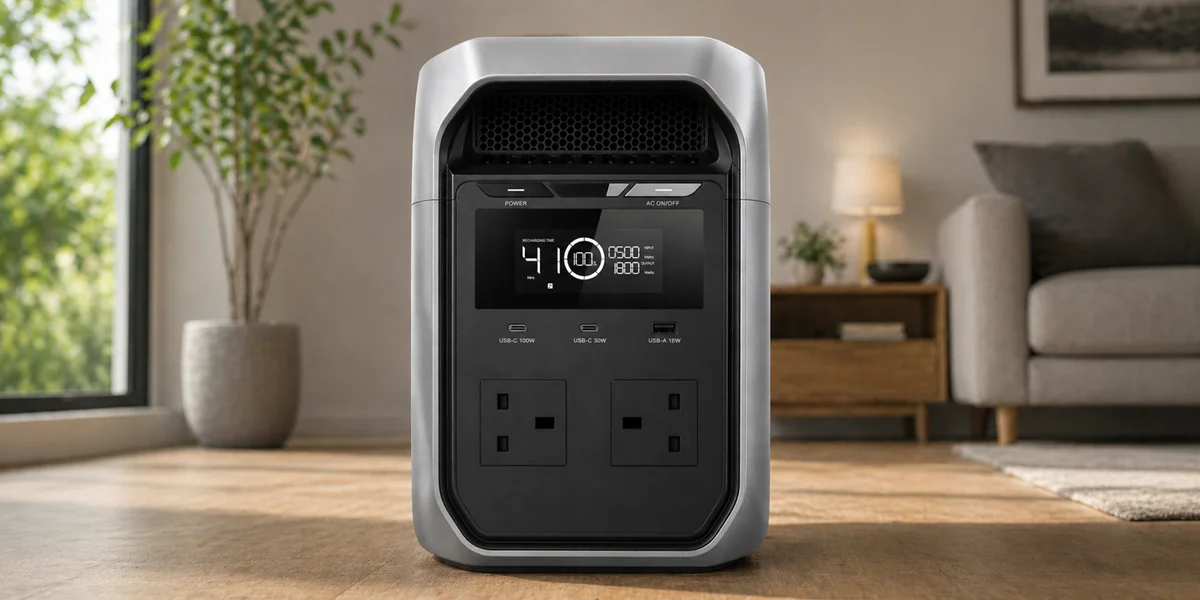
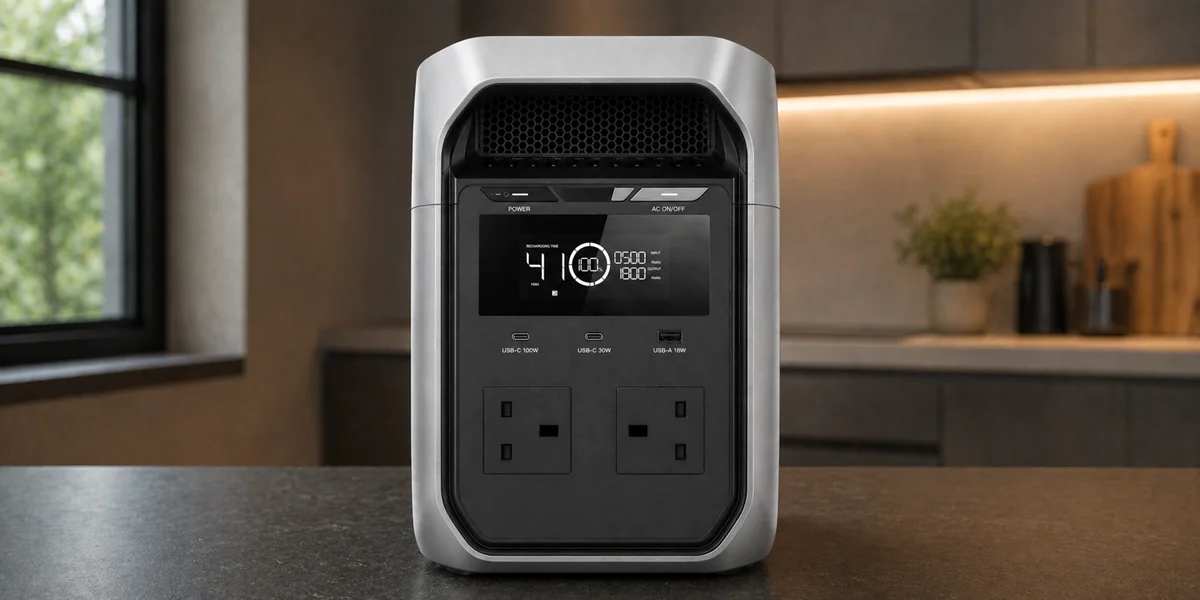
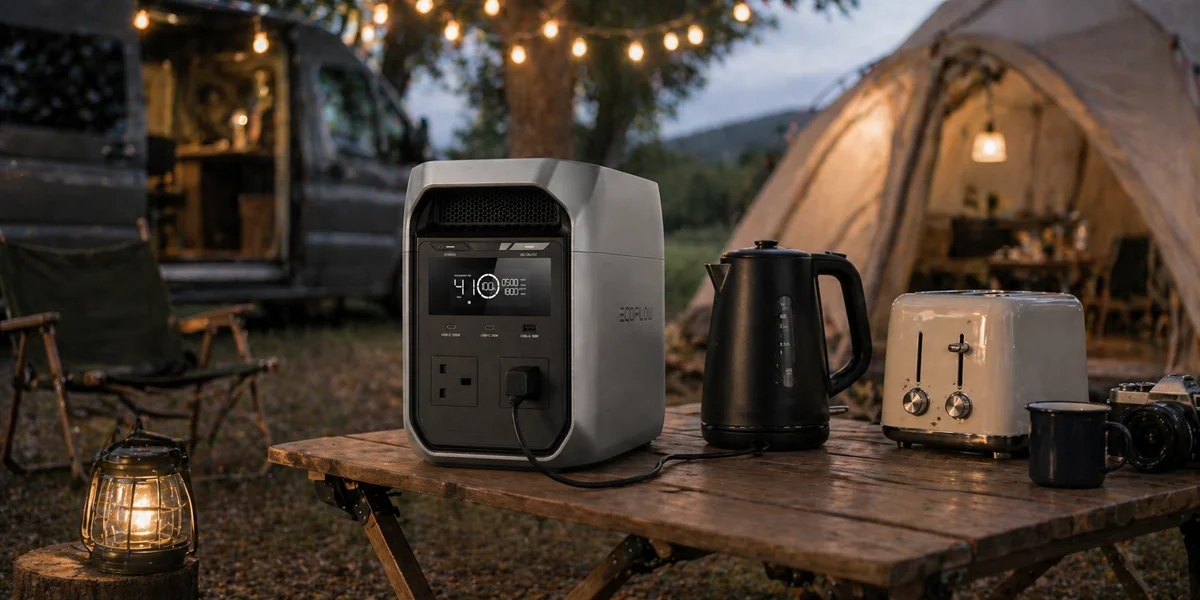
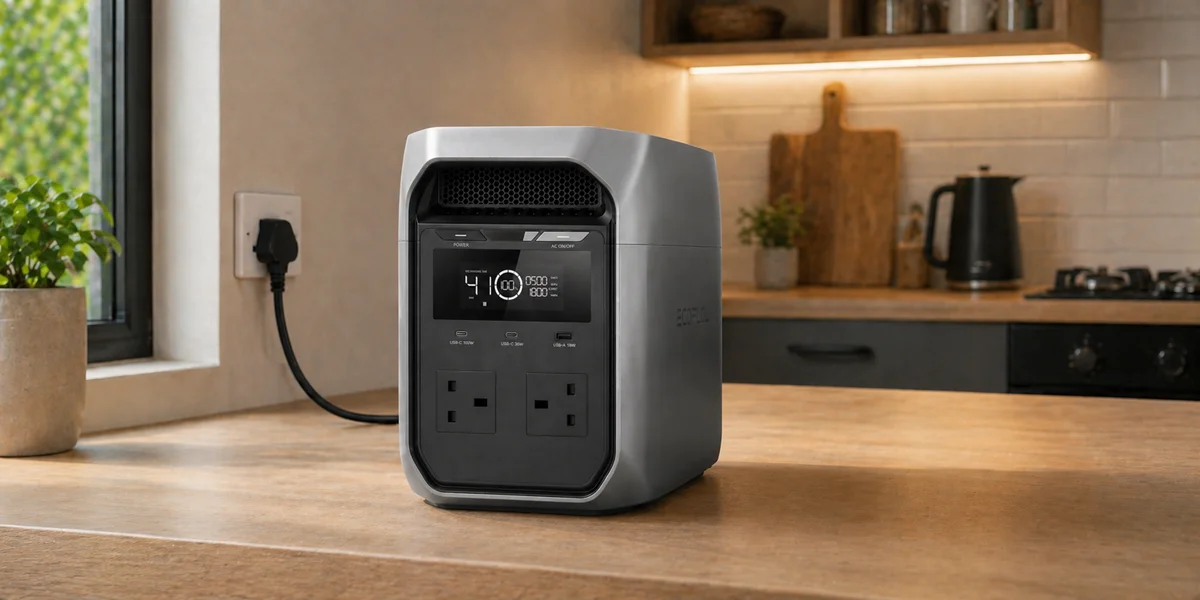
EcoFlow Delta 3 Classic: 0 to 80% in 45 minutes, under 30dB at 600W
| Capacity | 1024Wh |
| AC Output | 1800W |
| Solar Input | 500 max |
| MPPT Ports | Single |
| Battery | Auto-grade LFP |
| UK Warranty | 3+2 years UK |
- 12.1kg body is light enough for one person to carry to a pitch
- Charges 0 to 80% in 45 minutes at a hook-up point
- Stays under 30dB at 600W, so it won't disturb neighbouring pitches
- Doubles as light home backup for lamps, routers and a laptop
- Only two UK sockets, so plan your plug order in advance
- No 12V car output socket for running 12V gear on the go
- Fixed capacity, with no expansion battery if you need more
The Delta 3 Classic is our top camping pick. It’s easy to carry to a pitch and reaches 80% in 45 minutes on a hook-up. The fan stays under 30dB at 600W, and it covers light home backup like lamps and a router. There’s no 12V car output socket, so if you want to run 12V gear in a van, look at the Delta 2 instead.
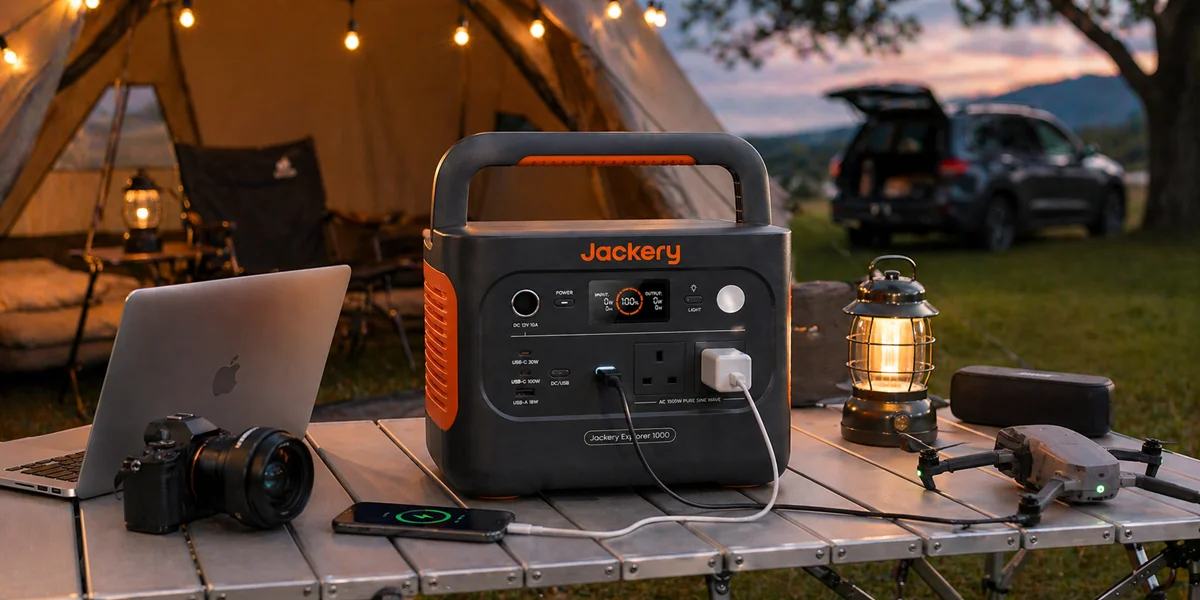
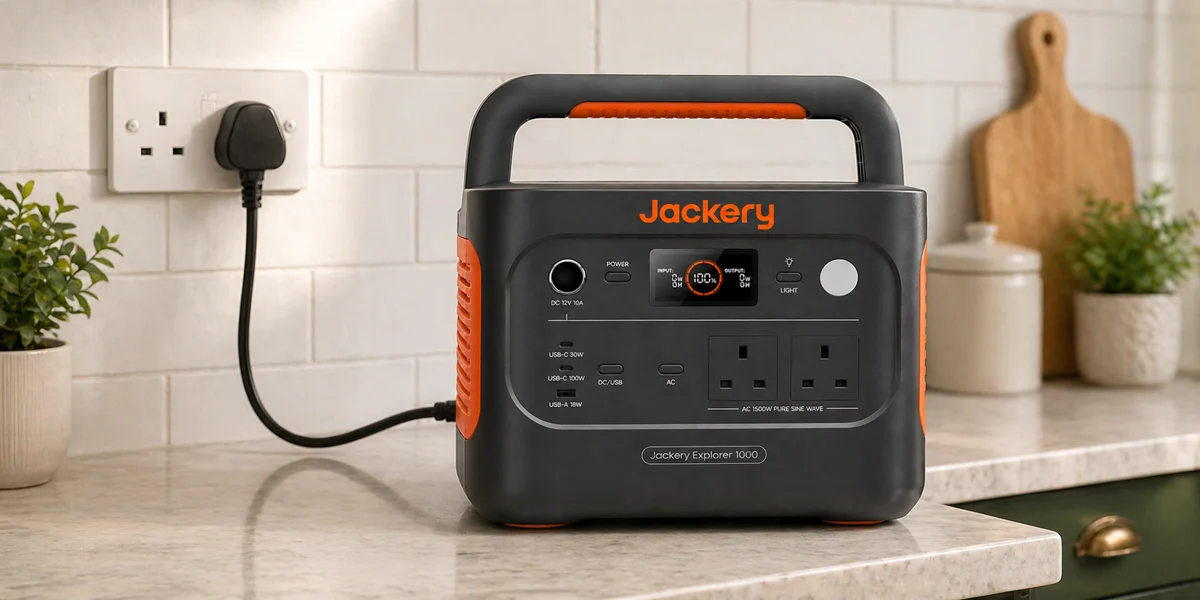
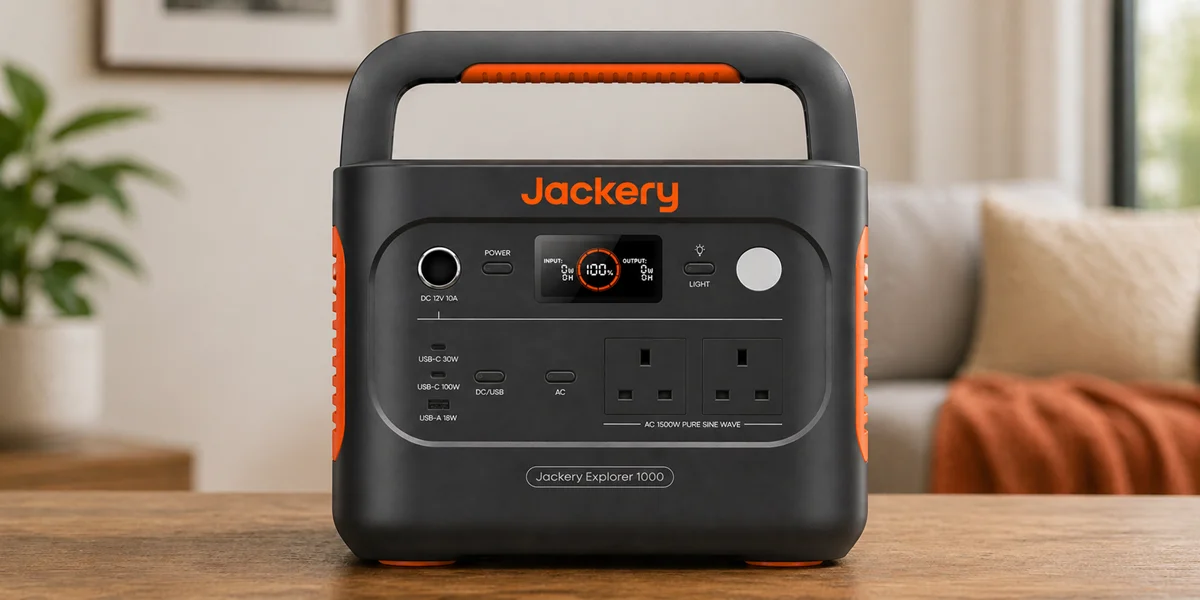
Jackery Explorer 1000 v2: 1,070Wh in a 10.8kg body, UPS in 20ms or less
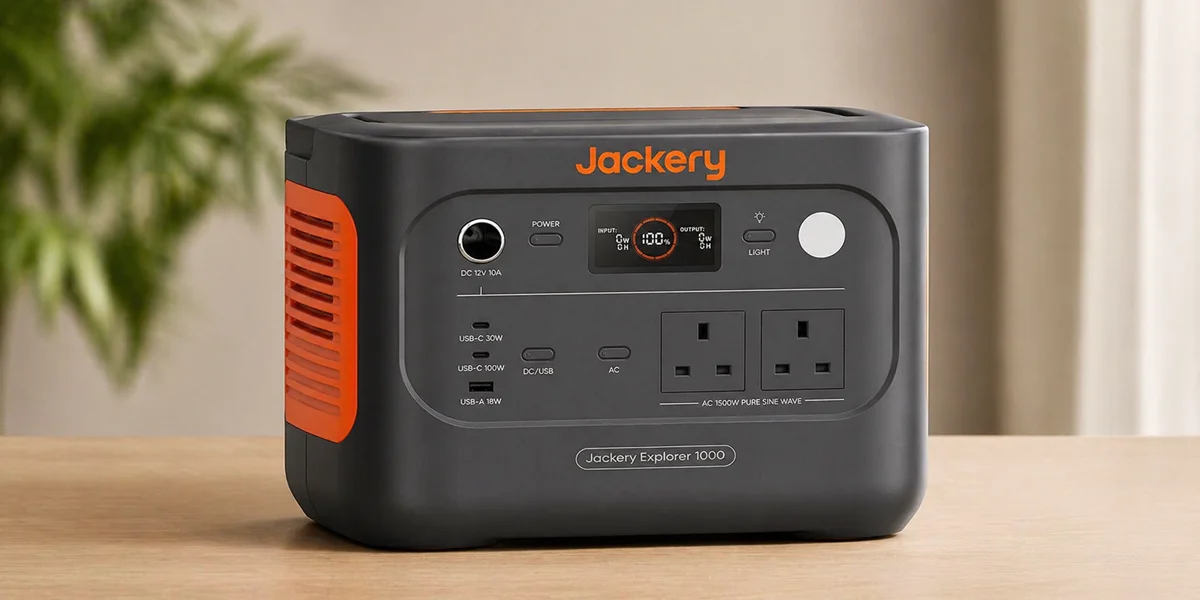
| Capacity | 1070Wh |
| AC Output | 1500W |
| Solar Input | 400 max |
| MPPT Ports | Single |
| Battery | LFP |
| UK Warranty | 5 years UK |
- 10.8kg with a built-in LED light, handy for after-dark pitches
- Emergency Mode gives a full charge in about an hour
- Quiet Charging Mode keeps noise under 22dB near the tent
- 12V car port powers 12V gear in a caravan or van
- 1,500W ceiling limits which higher-draw appliances it can run
- Not expandable, so capacity is fixed at 1,070Wh
- No weatherproofing, so keep it under cover in wet weather
The Jackery 1000 v2 suits campers who want compact power, and at 10.8kg it’s manageable solo. The app’s Emergency Mode gives a full charge in about an hour, against 1.7 hours on the standard setting. The built-in light and 12V car port help at a pitch, and it can back up a router or lights at home. If you regularly run appliances above 1,500W, the Delta 3 Classic is the better choice.
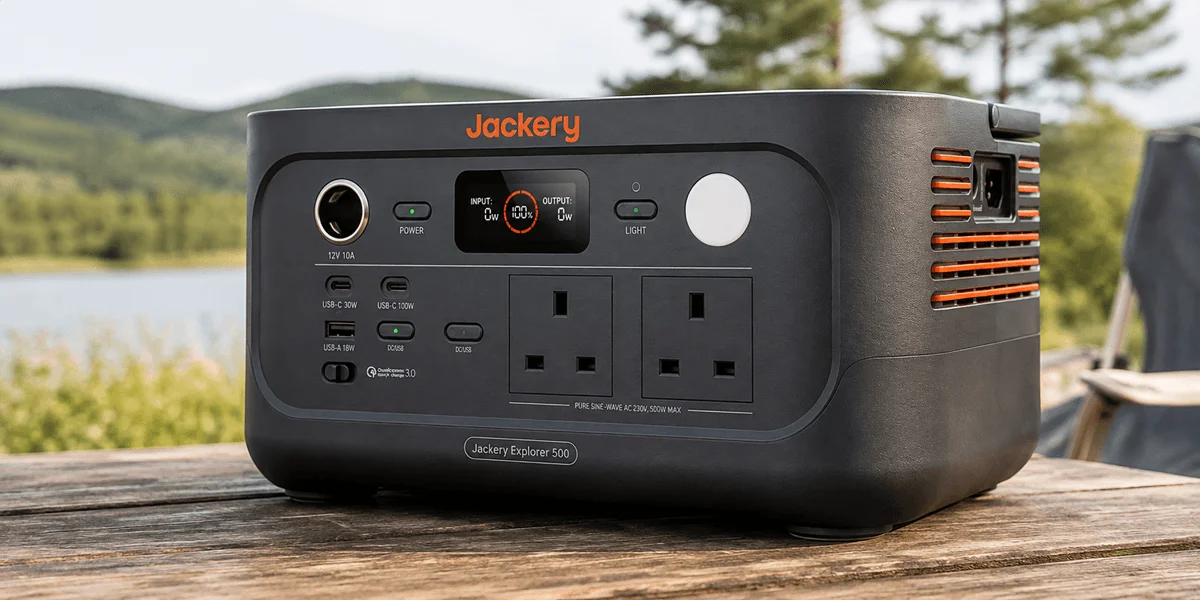
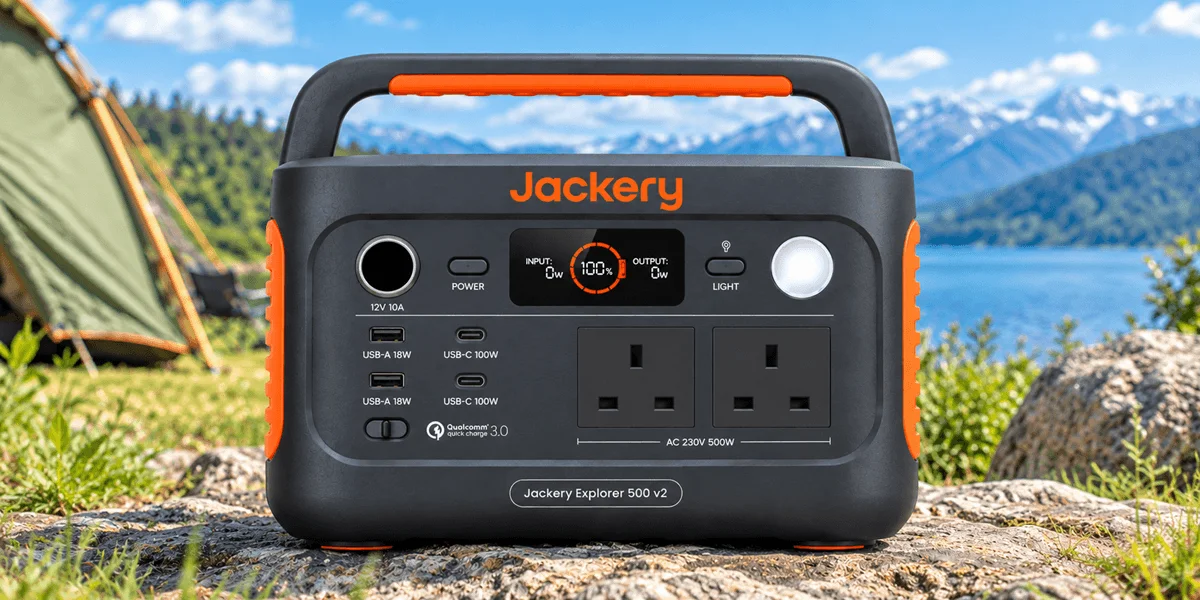
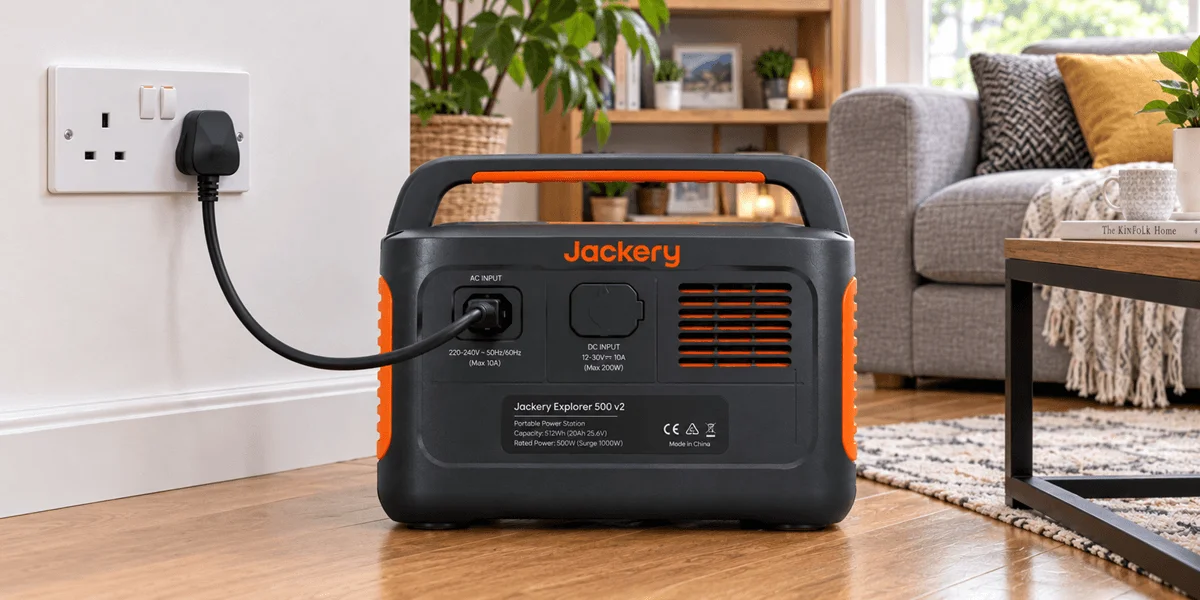
Jackery Explorer 500 v2: 5.7kg with a UPS switchover under 10ms
| Capacity | 512Wh |
| AC Output | 500W |
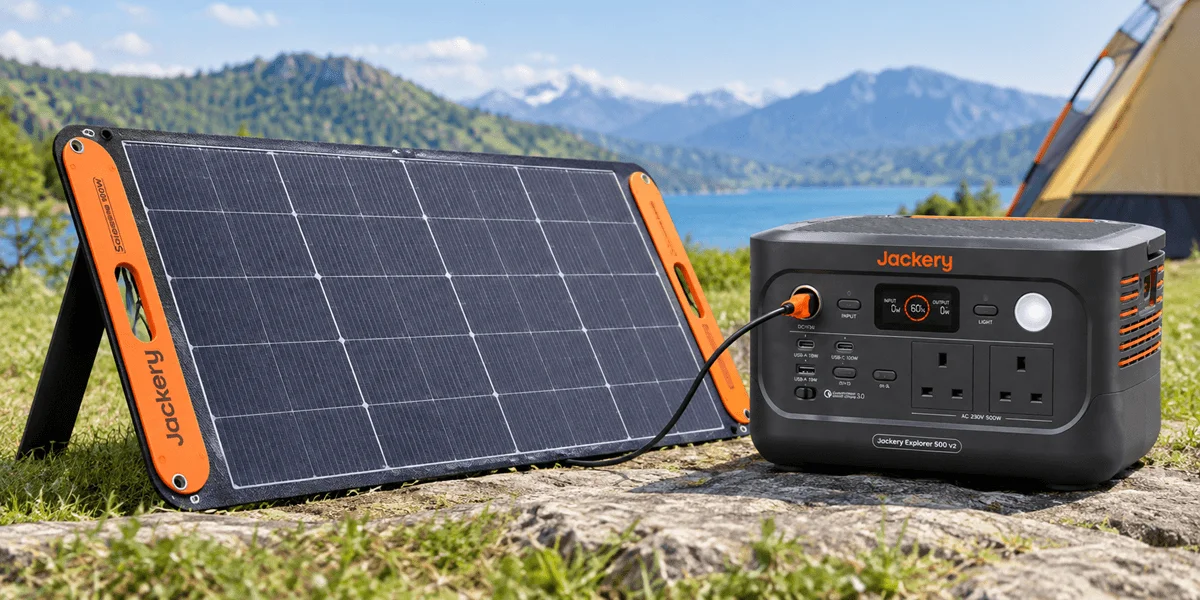
| Solar Input | 200 max |
| MPPT Ports | Single |
| Battery | LiFePO4 |
| UK Warranty | 5 years UK |
- 5.7kg is light enough to carry one-handed to a pitch
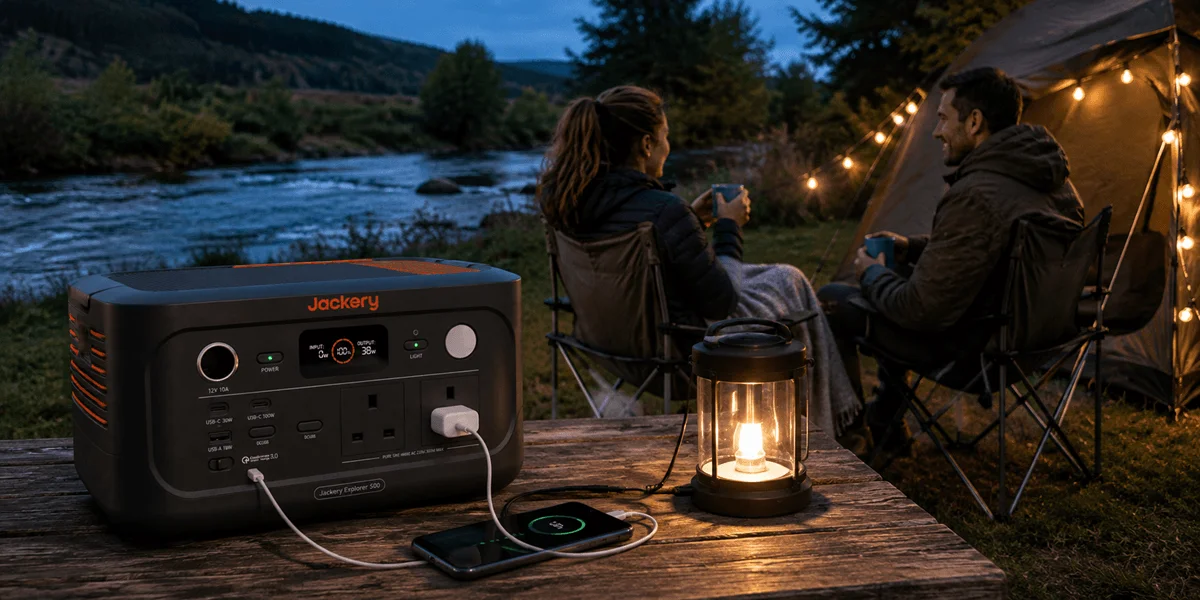
- Runs quietly at 28dB when discharging near the tent
- Works from -20°C to 45°C, so cold nights aren't a problem
- Car socket output also suits weekend van trips
- 500W ceiling trips on heavier appliances like a camping heater
- No app, so status checks happen on the unit itself
- No IP rating, so keep it away from rain
The Jackery 500 v2 is the pick for weight-conscious campers who don’t need much power. At 5.7kg it’s noticeably lighter than the other full cards here, and 200W of solar tops it up slowly. It also works as a small desk or router backup at home, and the car socket output helps on weekend van trips. If you run a camping heater or other heavy appliance, size up to the Delta 3 Classic, as 500W trips on heavier loads.
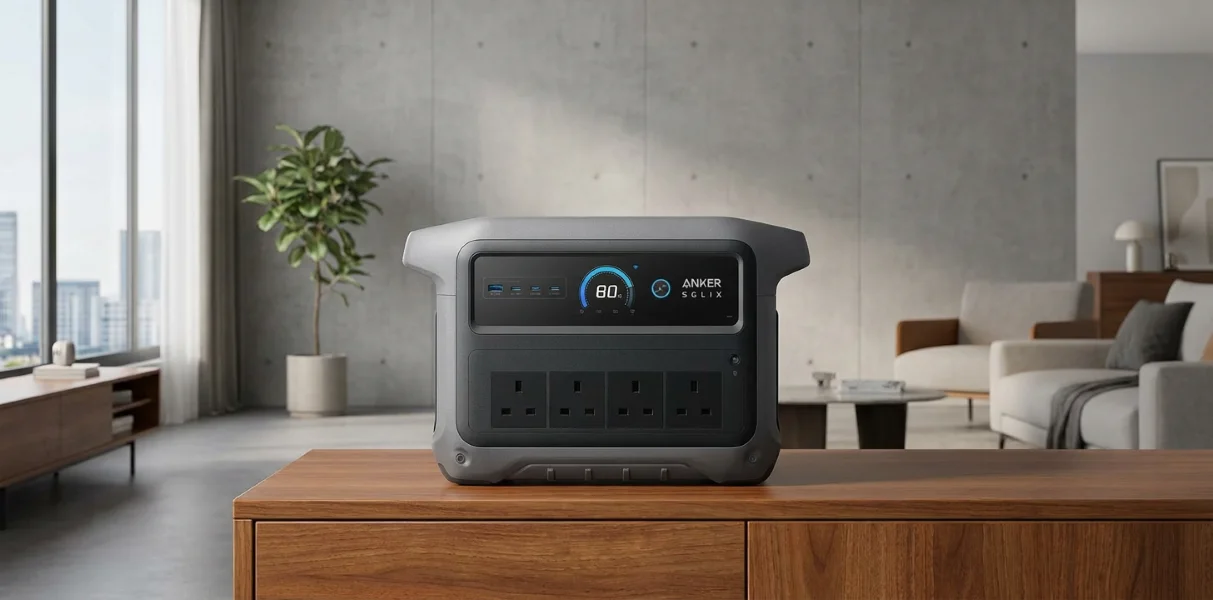
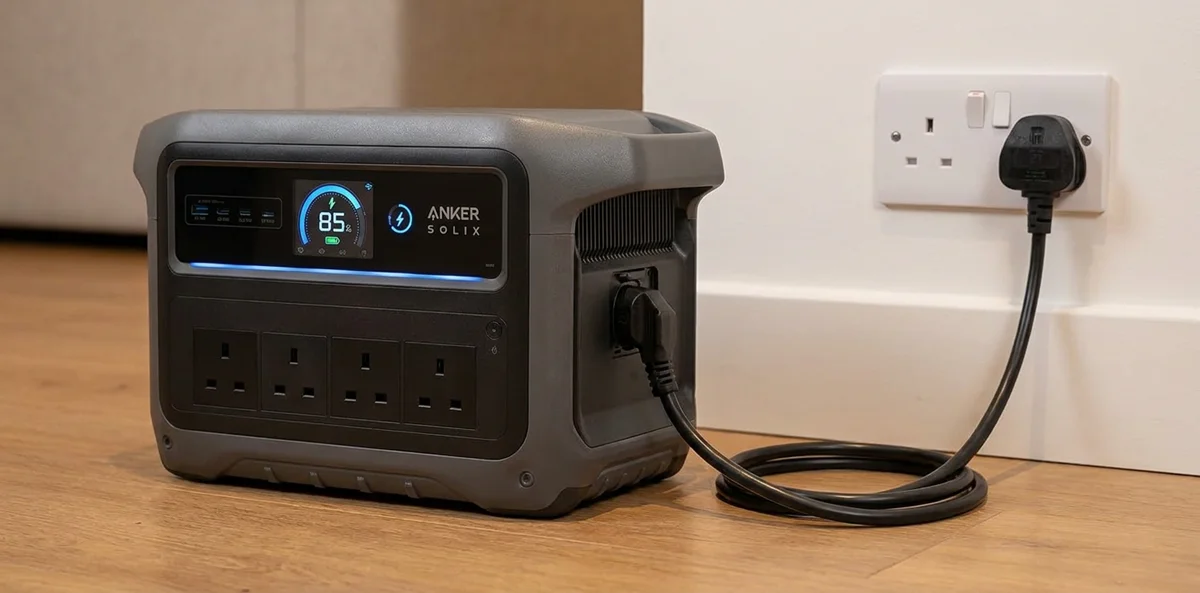
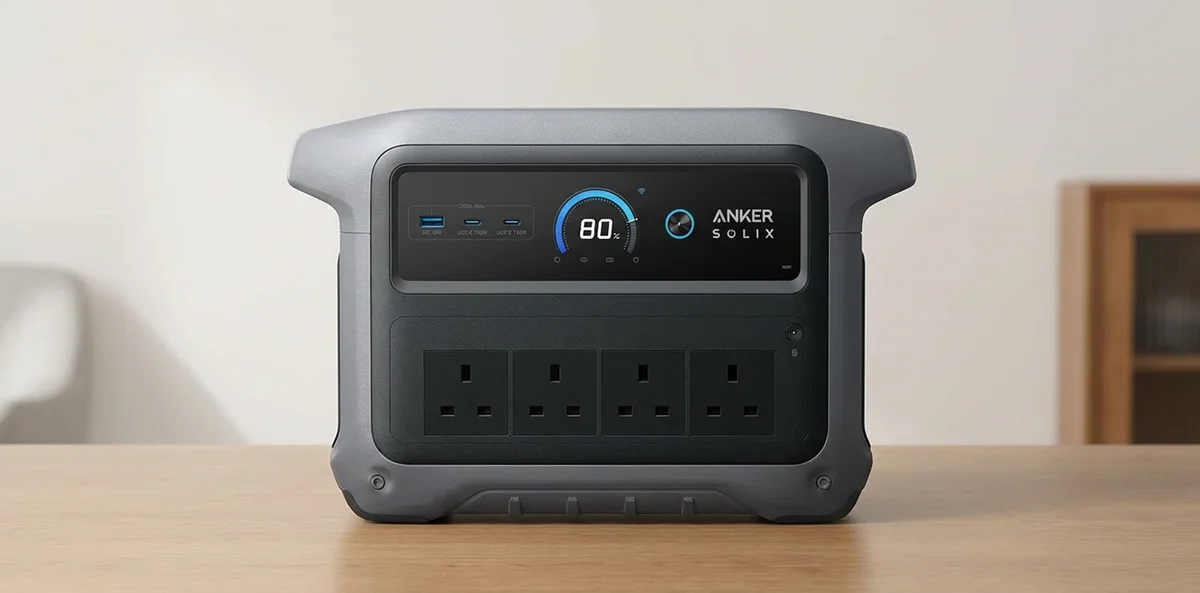
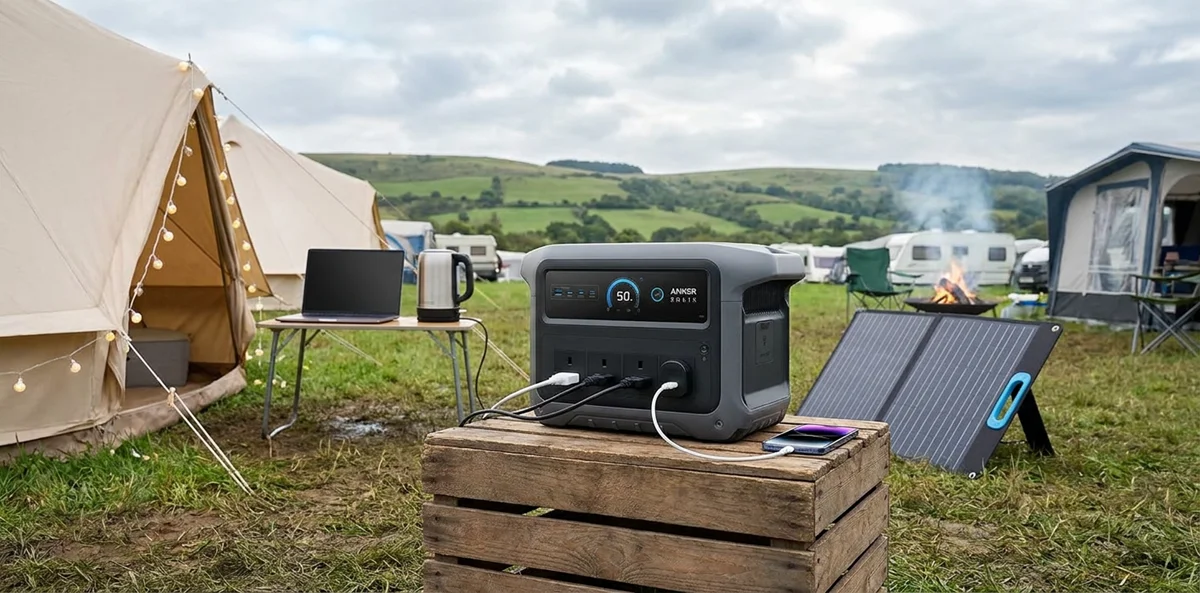
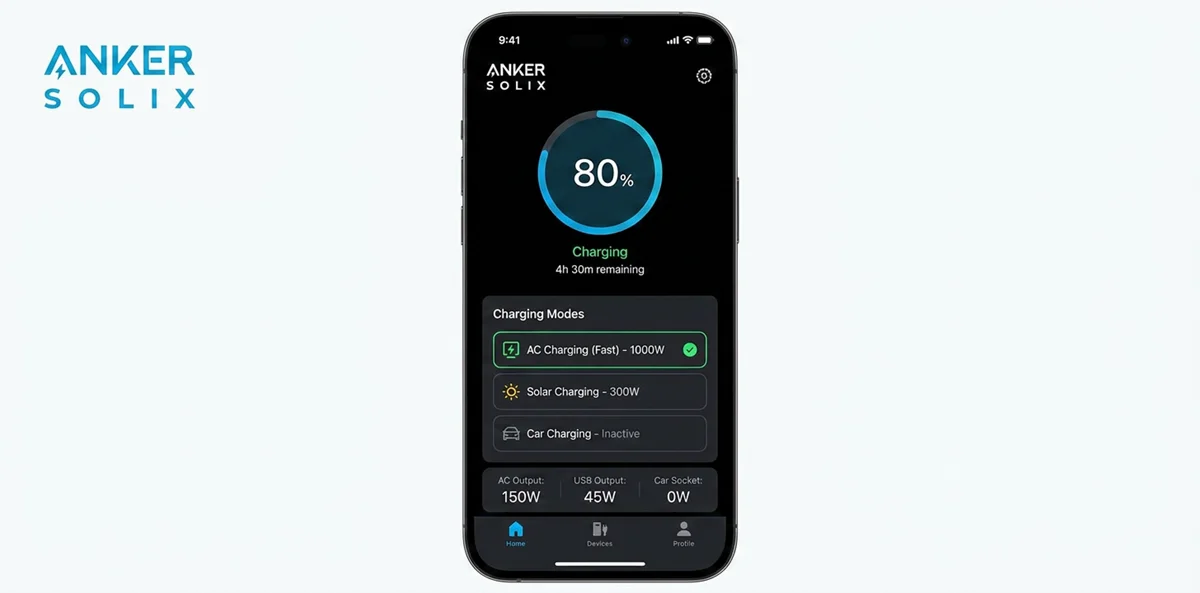
Anker SOLIX C1000 Gen 2: a 49-minute mains recharge with 2,000W output
| Capacity | 1024Wh |
| AC Output | 2000W |
| Solar Input | 600 max |
| MPPT Ports | Single |
| Battery | LFP |
| UK Warranty | 5 years UK |
- Recharges fully from a UK mains socket in about 49 minutes (Anker)
- 10ms UPS switchover also suits a home office backup setup
- 120W car input and output also suit campervan charging stops
- 11.3kg stays manageable for a solo lift into a car boot
- Fan gets loud at full power, measured at about 45dB by Notebookcheck
- Not expandable, so 1,024Wh is the fixed ceiling
- 600W solar input trails the 1,000W Delta 3 Plus and Elite 100 V2
The Anker SOLIX C1000 Gen 2 suits campers who value charge speed above everything else. Anker says a full mains recharge takes about 49 minutes, so you spend less time waiting between trips. The 120W car input and output suit campervan stops, and the 10ms UPS switchover makes it a capable home office backup. The fan runs loud at full power, so if you want a quiet pitch, look at the Delta 3 Classic instead.
Also worth considering for camping
If none of the four main picks fit exactly, these three also work well for camping trips.
| Model | Why consider it | The catch | Link |
|---|---|---|---|
| EcoFlow RIVER 3 Plus | At 4.7kg it weighs less than any of our four main picks, with 3 UK AC sockets | 286Wh covers small loads only, not a kettle or heater. For camping, Amazon UK currently includes a 110W solar panel, so you can recharge away from the mains. | EcoFlow RIVER 3 Plus review |
| Bluetti Elite 100 V2 | 1,000W solar input, the highest on this page, useful for multi-day off-grid trips | Only 2 AC sockets and no IP rating | Bluetti Elite 100 V2 review |
| EcoFlow Delta 2 | A dependable 1,024Wh all-rounder with 13 outputs including 4 UK AC sockets | Previous generation, no longer sold new by EcoFlow UK | EcoFlow Delta 2 review |
Which One Should You Buy?
If you already know how you camp, this table gets you to a decision faster than reading all four picks above.
| If you | We'd recommend |
|---|---|
| Want the single best all-round pick for most UK camping trips | EcoFlow Delta 3 Classic |
| Are carrying gear on foot and want to keep weight down | Jackery Explorer 500 v2 (5.7kg), or the EcoFlow RIVER 3 Plus (4.7kg, also worth considering) for even less weight |
| Want quiet running at the pitch | EcoFlow Delta 3 Classic (under 30dB at 600W, EcoFlow's figure) or Jackery Explorer 500 v2 (28dB when discharging, Jackery's figure) |
| Want a full mains recharge in under an hour | Anker SOLIX C1000 Gen 2 (Anker quotes a 49-minute full mains charge) |
| Are relying mainly on solar, off-grid for several days | Bluetti Elite 100 V2 (1,000W solar input, also worth considering) |
| Need a 12V socket built in, for a cool box or 12V accessories | Jackery Explorer 1000 v2, or the EcoFlow RIVER 3 Plus (also worth considering) |
| Want one dependable unit without chasing an edge case | EcoFlow Delta 2 (also worth considering) |
| Want higher-draw appliances covered, including many kettles | Bluetti Elite 100 V2 (2,700W Lifting Power, also worth considering) or Anker SOLIX C1000 Gen 2 (2,000W continuous, 3,000W surge) |
What can you actually run on 6A, 10A and 16A campsite hook-up?
Most UK sites offer 10A hook-up as standard. Some budget sites still run 6A, and a smaller number of larger pitches offer 16A. The number tells you the maximum current the bollard can supply, not what any single appliance draws. It’s worth doing the sum before you plug in a kettle and trip the whole pitch.
UK mains runs at 230V, so amps convert to watts by multiplying by voltage. A 6A hook-up gives you roughly 1,380W to share across everything running at once. A 10A hook-up gives roughly 2,300W. A 16A hook-up gives roughly 3,680W, close to the ceiling of a standard UK socket.
In practice, that means a 6A pitch can run a kettle or a hairdryer, but not both together with anything else drawing power. A 10A pitch comfortably runs a kettle and charges a power station at the same time. A 16A pitch is the only one of the three that gives real headroom for a kettle, a heater and charging equipment simultaneously. That’s why larger caravans, and pitches running air conditioning, tend to book 16A specifically.
None of this is about whether power stations themselves are allowed. They are, at effectively every UK site, including ones with strict quiet-hours rules, because they’re quiet and don’t run a combustion engine.
Petrol generators are a different matter. Generators aren’t banned at UK sites; they’re restricted. The Caravan and Motorhome Club’s own generator guidance states that on its club sites, “generators should not be used between 6pm and 9am.”
The Camping and Caravanning Club’s site policy takes a different approach. It permits generators with staff permission, provided they don’t disturb other campers. Either way, check the specific site’s rules before you pitch, not after you’ve started the generator up.
Do you need a power bank or a power station for camping?
A decent power bank is enough for phones, a torch and maybe a small camera battery over a weekend. Once you need a UK three-pin socket, that changes. A laptop charger, mains-adaptor camp lights or a cool box all need a power station, because a power bank has no AC output. That’s the whole decision: no AC socket, no power station.
The crossover point is usually the cool box. A 20,000mAh power bank, a common size, holds roughly 74Wh. That’s enough for several full phone charges, but nowhere near enough to run a compressor cool box for a day.
Even the smallest unit on this page, the EcoFlow RIVER 3 Plus at 286Wh, holds close to four times that capacity. Critically, it also has the AC and 12V outputs a cool box actually needs.
If you’re only camping once or twice a year and only need phones charged, a good power bank is the cheaper, lighter answer. There’s no reason to spend more. If you camp regularly, run a cool box, or want lights and a laptop working off-grid, a power station earns its keep quickly.
How long will a power station run your camping gear?
A 1kWh power station won’t keep a cool box, phones and lights going for two to three nights. Here’s how the sums work, appliance by appliance. A compressor cool box drawing 30 to 60W doesn’t run constantly. The compressor cycles on and off to hold temperature, so it runs about 33 to 50% of the time. Real-world data for 12V compressor fridges puts a 40 to 45 litre box at around 400Wh a day. A 60 litre box in warm weather needs around 600Wh a day. Those daily figures are what matter, not the box’s rated wattage.
| Appliance | Typical draw | Daily use, 1kWh unit lasts about |
|---|---|---|
| Compressor cool box, 40 to 45 litre | 30 to 60W, 350 to 400Wh a day | 2.5 days on its own |
| Compressor cool box, 60 litre, warm weather | up to 600Wh a day | 1.7 days on its own |
| Kettle (2,700W Lifting Power model) | 2,700W for 2 to 4 minutes | roughly 100 to 180Wh per boil |
| CPAP machine, overnight | 30 to 60W average | 270 to 540Wh per night |
| LED camp lantern | 3 to 5W | 200+ hours |
| Laptop, full charge | 45 to 65Wh per charge | 15+ charges |
| Phone, full charge | 10 to 18Wh per charge | 55+ charges |
Add those up for a cool box, phones, a lantern and the odd laptop charge. On a 1,024Wh unit, you’ll get roughly a day and a half before you need to recharge. That’s not two to three nights, but it’s still useful, especially with a mains hookup or a solar panel. Plan around the realistic number, not the optimistic one.
How big a solar panel do you need to recharge overnight?
Solar charging in the UK works, but it’s slower than the panel’s rated wattage suggests. A panel’s number is a lab figure taken in direct, overhead sun. British weather rarely gives you that, so plan around 40 to 60% of the rated output on a genuinely sunny day, and less under cloud.
| Panel size | Realistic UK output (decent day) | Time to charge a 1kWh unit from empty |
|---|---|---|
| 100W | 40 to 60W | 17 to 25 hours (2 to 3 days of sun) |
| 200W | 80 to 120W | 8.5 to 13 hours (1 to 2 days of sun) |
| 220W | 90 to 130W | 8 to 11 hours (around a day of sun) |
| 400W | 160 to 240W | 4 to 6.5 hours (a single good day) |
Panels are sold separately from every unit on this page, so factor that into your budget before choosing solar as your main charging plan. For the full picture on panel types, MPPT charging and matching a panel to your specific unit, see our solar charging guide. If you’re relying on solar for a multi-day trip off-grid, the Bluetti Elite 100 V2 helps. Its 1,000W input on a single XT60 port gives headroom for larger panel arrays. That cuts charge times in genuinely cloudy conditions.
Pick the right capacity for how you camp
Match capacity to trip length and what you’re actually running, not to the biggest number on the shelf. A weekend with just phones and a torch needs the lightweight tier. Add a cool box, camp lights and a laptop and you want the 1kWh tier. Multi-day trips without a hookup mean either a 1kWh unit paired with solar, or accepting a mid-trip recharge somewhere with mains power.
The “aim for under 10kg” advice describes the lightweight tier’s job: gear you carry on foot from a car park to a pitch. It’s not a realistic target for a 1kWh unit.
LiFePO4 versus older lithium: does chemistry matter for camping?
Yes, and it’s worth checking before you buy anything outside this page’s four picks. LiFePO4 (lithium iron phosphate) cells last four to eight times longer than the older lithium-ion cells in some budget power banks and older power stations. They also hold their charge more reliably in cold weather. Every product on this page uses LiFePO4, which is why none of them were dropped on chemistry grounds.
Camping in the cold: what actually changes?
LiFePO4 batteries lose some usable capacity as the temperature drops, typically noticeable below around 0°C. Most units also restrict or pause charging below freezing, to protect the cells. In practice, that means bringing the unit into your tent or the car overnight in genuinely cold weather. Don’t leave it in an outside porch.
Expect slightly less runtime from a full charge on a frosty night than you’d get in summer, too. None of the four units here has a heated battery built specifically for sub-zero charging. If you’re planning genuinely cold-weather trips, gentle overnight storage matters more than any single spec on the sheet.
Frequently Asked Questions
For most UK campers, our best all-round pick is the EcoFlow Delta 3 Classic. It recharges to 80% in 45 minutes and runs at under 30dB at 600W. If you’re carrying gear on foot, the Jackery Explorer 500 v2 (5.7kg) is lighter. The EcoFlow RIVER 3 Plus (4.7kg) is lighter still.
Yes. Power stations are permitted at effectively every UK campsite, including ones with strict quiet-hours rules, because they’re quiet and don’t burn fuel. Petrol generators are treated differently. The Caravan and Motorhome Club restricts generator use between 6pm and 9am on its sites, and the Camping and Caravanning Club requires staff permission first.
Not directly, because panels connect to the power station rather than to appliances, but it’ll comfortably keep up with one. On a decent UK day, a 400W panel realistically delivers 160 to 240W. That comfortably outpaces a 40 to 60W compressor cool box drawing 350 to 600Wh a day. The surplus tops up your power station’s charge.
For camping specifically, it comes down to what you’re carrying and what you’re running. The Jackery Explorer 1000 v2 is the lighter of the two, at 10.8kg with a built-in 12V outlet. The EcoFlow Delta 3 Classic charges faster and handles higher surge loads instead. For a broader Jackery-versus-EcoFlow comparison across the full range, see our portable power station guide.
Mostly weight and the built-in torch. The Jackery Explorer 1000 v2 is 0.7kg lighter than the Bluetti Elite 100 V2 and includes an LED light, useful at a pitch after dark. In exchange, Bluetti offers far higher solar input (1,000W against 400W). It’s a genuine trade-off, not a clear winner either way.
A 1,024Wh unit running a compressor cool box, phones, a lantern and the odd laptop charge lasts roughly a day and a half. That’s not the two to three nights sometimes claimed. See the full appliance run-time table on this page for the working behind that figure.
Yes, and LiFePO4 cells, used in every product on this page, perform noticeably better in the cold than older lithium-ion. Expect slightly reduced runtime below around 0°C. Bring the unit inside your tent or car overnight in frosty conditions. Most units restrict charging below freezing to protect the battery, so don’t leave it outside.
A power bank has no AC socket, so it can charge phones and USB gadgets but can’t run anything with a UK three-pin plug. A power station adds that AC output, and even the smallest unit on this page holds close to four times a typical power bank’s charge. If you only need phones charged over a weekend, a power bank is the cheaper, lighter choice. Once a cool box, camp lights or a laptop charger are involved, you need a power station instead.
Yes, and if you’re carrying it any distance across a festival site, go lightweight. The Jackery Explorer 500 v2 or EcoFlow RIVER 3 Plus makes far more sense there than a 1kWh unit. Check the festival’s power policy before you travel, though. Some larger events restrict power station capacity or require them to be declared at the gate.
If you camp more than a couple of times a year, yes. The upfront cost is higher than a power bank, but a single unit covers cool boxes, lights and device charging across dozens of trips. Most of the units on this page double as home backup during a power cut, too. If you camp once a year and only need phones charged, the cost is harder to justify.
A 2,000W unit like the Anker SOLIX C1000 Gen 2 runs one high-draw item at a time. That could be a kettle, a hairdryer or a small electric heater, with lights and a laptop alongside. It won’t run an air-conditioning unit or an electric shower. Those need dedicated hookup rather than a portable unit.
Yes, though the products on this page are sized for tent and pitch camping rather than permanent van installs. If you’re kitting out a campervan or motorhome, our campervan and motorhome power guide covers the heavier, higher-capacity units better suited to that use.