Best Lightweight
Affiliate Disclosure: We may earn a small commission when you buy through links on this site. This never affects our recommendations. Read our full disclosure →
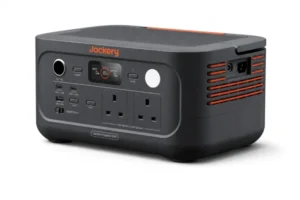
Jackery power stations are widely rated as the quietest option for UK campers and van lifers. The Explorer v2 range spans 256Wh to 3,072Wh, all on LFP with ChargeShield 2.0 fast charging.
| Brand origin | Founded 2012, headquartered in California, USA (products manufactured in China) |
| UK models covered | Explorer 240 v2, 500 v2, 1000 v2, 2000 v2, 3000 v2 |
| Battery chemistry | LiFePO4 (lithium iron phosphate) on every current v2 model |
| Charging | Fast AC charging via ChargeShield 2.0 |
| UK warranty | 3 years standard, up to 5 years with registration or extension |
| Solar panels | SolarSaga 100W and 200W, rated 25% efficiency, IP68 waterproof (sold separately) |
| Best for | Quiet camping, caravans and motorhomes, portable off-grid, home backup |
Jackery keeps everything under the one Explorer name, so the real decision is capacity and weight. The compact units are built to be carried and are ideal for topping up devices and running small 12V gear. The high-capacity units are built to run appliances, and only the larger ones have the output to handle high-draw items. If you’re charging devices on the move, a compact model is plenty. If you need to run a fridge, tools, or mains appliances, move up to the high-capacity tier.
| Tier | Models | Capacity | Best for |
|---|---|---|---|
| Compact Explorer | Explorer 240 v2, 500 v2 | 256Wh to 512Wh | Day trips, backpacking, charging phones, laptops and cool boxes |
| High-Capacity Explorer | Explorer 1000 v2, 2000 v2, 3000 v2 | 1,070Wh to 3,072Wh | Caravans, motorhomes, weekend and longer camping, home backup |
The Jackery models below have been fully reviewed using in-depth research across UK buyer data, manufacturer specifications, and verified owner feedback. Click any model to read the full review.

Quiet is Jackery’s calling card. Across the Explorer v2 range, the units are widely reported by UK owners as unobtrusive under everyday loads, which is the main reason campers and caravanners pick them over louder rivals. The fans do spin up and become more noticeable when you’re pulling heavy power or charging at full speed, so it isn’t silent in every situation. But for the typical jobs of charging devices, running a cool box, and keeping things topped up overnight, most buyers describe them as barely there.
For camping it matters a lot. A unit that hums audibly all night is a real annoyance in a tent or a small campervan, so low noise under light load is a feature you’ll appreciate every trip. For home backup it matters less, since the unit usually sits in a garage or utility room, though it’s still welcome if you’re running it in a hallway during a power cut. If overnight quiet is high on your list, Jackery is one of the safer picks in this market. For more, see our best power stations for camping guide.
Jackery’s SolarSaga 100W and 200W panels are rated at 25% conversion efficiency with IP68 weatherproofing, which puts them ahead of the cheaper panels bundled with budget kits. Efficiency ratings are measured in ideal lab light, though, so real-world output in the UK is always lower. On a bright but broken-cloud British day, expect a panel to deliver well under its rated figure. That’s normal for any solar panel in our climate, not a Jackery-specific shortfall, so plan your charge times around realistic UK sun rather than the headline number.
For short stints, yes, especially with the higher-capacity Explorer models paired with enough panels in good light. Through spring and summer, solar can genuinely keep a unit topped up across a weekend. Through autumn and winter, treat it as a helpful top-up rather than a full daily recharge, and keep a mains charge as your fallback. For a realistic breakdown of UK solar performance, see our solar generator guide, and for the wider field our best portable power stations UK guide.
It comes down to what you’re after. EcoFlow tends to lead on raw charge speed and higher output, and its X-Boost feature lets it run some appliances above the unit’s rated wattage. Jackery counters with quieter running under normal loads and a strong reputation for build and longevity, which is why it’s a favourite for camping and caravan use. Bluetti tends to lead on solar input at the top of its range, and Anker on raw output at the 1kWh level. No single brand wins on everything, so the right pick depends on whether quiet running, charge speed, output, or solar headroom matters most to you. See our full EcoFlow vs Jackery comparison for a model-by-model view.
Not sure which Jackery model fits your setup? Use our power station sizing calculator to work out the capacity you need, or try our power station finder quiz for a personalised recommendation.
Jackery is a portable power station and solar panel maker founded in 2012, headquartered in California with products manufactured in China. In the UK it sells through its official store at uk.jackery.com, Amazon UK, and retailers including Currys, with UK-specific warranty and customer support. All current UK models use Type G three-pin sockets.
No. Jackery is a US-founded company with manufacturing in China, which is standard across nearly every brand in this category, including EcoFlow, Bluetti and Anker. It does run a dedicated UK operation with Type G sockets, UK-compliant cables and local warranty support, so the buying and warranty experience is fully localised even though the company isn’t British.
Every current Explorer v2 model uses LiFePO4 (lithium iron phosphate) cells, which are rated for far more charge cycles than the older lithium-ion packs used in earlier generations. In everyday terms that means many years of regular use before you’d notice meaningful capacity loss. LiFePO4 is also more thermally stable, which is reassuring for summer camping or a warm caravan.
Yes, and it’s arguably where Jackery is strongest. The compact Explorer 240 v2 and 500 v2 are light enough to carry to a pitch for device and cool-box duty, while the Explorer 1000 v2 and larger models suit caravan and motorhome use, running a compressor fridge for many hours and taking a solar top-up during the day. Quiet running under normal loads is the recurring reason UK campers choose the brand. Solar panels are bought separately.
Yes. Jackery’s standard cover is 3 years from purchase, and this can be extended to a full 5 years by registering the product or buying direct from the official Jackery UK store. Warranty support is handled by Jackery UK. Units bought from unauthorised sellers or grey imports may not qualify for the full UK cover, so check the seller before buying.
ChargeShield 2.0 is Jackery’s fast-charging and battery-protection system. It manages the charge across different modes to balance speed against long-term battery health, with temperature monitoring and multiple safeguards during rapid charging. In practice it lets the current Explorer v2 models charge quickly from the mains while protecting the cells.
A standard UK kettle draws roughly 2,000W to 3,000W, so it needs a high-output unit. The Explorer 1000 v2 (1,500W) can’t run a full-size kettle, whereas the Explorer 2000 v2 (2,200W) and the larger 3000 v2 have the output to handle most UK kettles and other high-draw appliances. If boiling a kettle off-grid is a priority, look at the 2000 v2 or above.
EcoFlow generally charges faster and offers higher output, which suits home backup and power-hungry jobs. Jackery runs quieter under normal loads and has a strong reputation for camping and caravan use. Both use LiFePO4 batteries on their current models and both can reach a 5-year warranty from authorised UK sellers. Read our full EcoFlow vs Jackery comparison for the detail.
Yes. Every current model supports solar charging via Jackery’s SolarSaga panels, which are rated at 25% efficiency with IP68 weatherproofing. Real-world UK output sits below the rated figure because of our cloud and low winter sun, so treat solar as a top-up rather than a guaranteed daily full charge, and keep a mains option as backup. Panels are sold separately.
Yes, especially for campers and caravan owners who value quiet running. The Explorer v2 range uses LiFePO4 cells, and you can buy it from Jackery’s UK store, Amazon UK or Currys. The weak spot is the app, which some owners criticise for slow response. Our Jackery Explorer 1000 v2 review covers its quiet modes and app in detail.
Use our free tools to get a personalised recommendation in minutes
Enter your devices and usage to calculate exactly what capacity you need
Calculate NowAnswer 5 quick questions and get a personalised power station recommendation
Start Quiz