Large Capacity
Affiliate Disclosure: We may earn a small commission when you buy through links on this site. This never affects our recommendations. Read our full disclosure →
Bluetti is the solar-first power station brand in the UK. The Elite and Apex ranges lead on solar input, with Power Lifting for kettles and heaters, and 6,000-cycle LFP batteries across the range.
| Brand origin | Founded 2019, built on the Shenzhen-based PowerOak energy-storage business; headquartered in Shenzhen, China |
| UK models covered | Elite 100 V2, Elite 200 V2, Elite 300, Elite 400, Apex 300 |
| Battery chemistry | LiFePO4 (lithium iron phosphate) on every current model |
| Charging | Fast AC charging plus high-wattage MPPT solar: up to 1,000W solar on the Elite 100 V2, up to 2,400W dual input on the Apex 300 |
| UK warranty | Varies by model (roughly 2 to 6 years); the Elite 100 V2 and Apex 300 both carry a 5-year UK warranty |
| Signature tech | High-wattage MPPT solar input, Power Lifting mode for resistive loads, modular expansion on the Apex 300 |
| Best for | Off-grid solar charging, van life and caravans, home backup, camping |
Bluetti’s Elite and Apex ranges lead the market on solar input, from 1,000W on the Elite 100 V2 to 2,400W dual input on the Apex 300, all built on LFP cells with Power Lifting for high-draw appliances.
The portable tier suits camping, short power cuts and topping up devices on the move. The high-capacity tier suits van life, caravan power, off-grid cabins and serious home backup, where you need to run a fridge, cooking appliances or several devices at once for a full day or longer. If you’re mostly charging phones and laptops or running a cool box overnight, a portable model is plenty. If you need to keep a fridge running through a multi-day cut or live off-grid for stretches, move up to the high-capacity tier, and consider the Apex 300 if you want the option to expand later.
| Tier | Models | Capacity | Best for |
|---|---|---|---|
| Portable | Elite 100 V2, Elite 200 V2 | 1,024Wh to 2,073.6Wh | Camping, short power cuts, portable solar charging |
| High-Capacity | Elite 300, Elite 400, Apex 300 | 2,764.8Wh to 3,840Wh (Apex 300 expandable) | Van life, caravans, off-grid cabins, serious home backup |
We’ve fully reviewed three Bluetti models using in-depth research across UK buyer data, manufacturer specifications and owner feedback: the Bluetti Elite 100 V2, the Bluetti Elite 200 V2 and the Bluetti Apex 300.
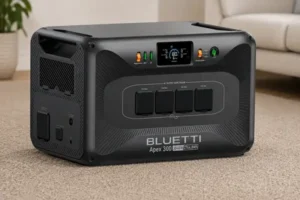

The Elite 100 V2 accepts up to 1,000W of solar through its built-in MPPT controller, and the Apex 300 doubles that with 2,400W across two separate inputs. That’s a genuine gap over most rivals at the same capacity: the EcoFlow Delta 2 tops out at 500W and the Jackery Explorer 1000 v2 at 400W. In strong sun, the Elite 100 V2 can recharge in around an hour to 90 minutes from solar alone, and the Apex 300 can hit a full recharge in a similar window when both inputs are fed.
Yes, more than the headline figure suggests. UK sun is weaker and less consistent than the lab conditions used to rate solar input, so a unit that only accepts 400 to 500W struggles to make meaningful progress on an overcast day. A higher ceiling like Bluetti’s gives you more headroom to reach that theoretical charge time when the weather cooperates, and even in patchy sun you’ll pull noticeably more power than a lower-input rival with the same panels. For campers, van-lifers and anyone relying on solar as a genuine daily top-up rather than an occasional boost, that headroom is the practical difference between running short and staying topped up.
Power Lifting is a Bluetti feature that lets Elite and Apex units run resistive heating loads, such as kettles, fan heaters and hairdryers, above their standard continuous output rating. On the Apex 300, independent UK reviewers including T3 and Trusted Reviews tested it running a kettle alongside other appliances without issue. On the Elite 100 V2, Power Lifting raises the ceiling from 1,800W to 2,700W, enough for most UK kettles and fan heaters. It isn’t intended for devices with strict voltage requirements, such as medical equipment or precision power tools.
The Apex 300 starts at 2,764.8Wh and can be expanded with additional battery packs, growing the system well beyond its base capacity. Each pack connects directly and the whole system is monitored through the Bluetti app, so you can start with the base unit for van life or backup and add capacity later as your needs grow, rather than committing to a large system upfront. Paired with a fast UPS switchover, that makes the Apex 300 a sensible platform for whole-room or multi-day home backup, though each added pack increases both weight and cost, so it suits a fixed installation more than something you move around.
Bluetti leads clearly on solar input: 1,000W on the Elite 100 V2 against 500W on the EcoFlow Delta 2, and 2,400W on the Apex 300. EcoFlow tends to lead on expandability and port count at the 1kWh level, and its X-Boost feature covers similar ground to Bluetti’s Power Lifting. Jackery leads on quiet running for overnight camping, and Anker leads on raw AC output and charge speed at the 1kWh class. For solar-first buyers dealing with the UK’s inconsistent weather, Bluetti is the stronger starting point. See our full EcoFlow vs Bluetti comparison for a model-by-model breakdown.
For a wider view, see our best portable power stations UK guide and our solar generator guide, which covers realistic charging expectations for the UK’s often overcast conditions.
Not sure which Bluetti model fits your setup? Use our power station sizing calculator to work out the capacity you need, or try our power station finder quiz for a personalised recommendation.
Bluetti is a portable power station manufacturer launched in 2019, built on the Shenzhen-based PowerOak energy-storage business. It’s headquartered in Shenzhen, China, and now sells in more than 100 countries. In the UK, Bluetti products are sold through its official storefront at bluettipower.co.uk and through Amazon UK, with UK-specific warranty and customer support.
No. Bluetti is a Chinese company, headquartered in Shenzhen. It isn’t British, but it operates a dedicated UK store with UK BS 1363 sockets, UK-compliant cables and a UK warranty backed by local support. So while the brand itself is Chinese, much like EcoFlow, Jackery and Anker, the buying and warranty experience for UK customers is fully localised.
All current Elite and Apex models use LiFePO4 (lithium iron phosphate) cells, rated to around 6,000 charge cycles, which Bluetti estimates at roughly 17 years of typical use. LiFePO4 chemistry is significantly more stable and longer-lived than the older NMC lithium-ion cells used in earlier power stations, which typically managed a few hundred cycles before noticeable capacity loss.
Yes, and the right model depends on your trip. For weekend camping and charging devices, the Elite 100 V2 (1,024Wh) is light enough to carry and quiet under normal use. For caravan or motorhome power where you need to run a fridge and appliances for longer, the Elite 200 V2, Elite 300 or Apex 300 give you more headroom. The Apex 300 in particular suits full-time van life thanks to its expandable capacity, though it’s heavy, so it’s better suited to a fixed install than a unit you move in and out each trip.
Yes. Bluetti’s official policy covers portable power stations for roughly 2 to 6 years depending on the model. Our two reviewed models, the Elite 100 V2 and the Apex 300, both carry a 5-year UK warranty from authorised sellers. Always check the specific term for the model you’re buying, since it varies across the range, and note that claims require proof of purchase from an authorised Bluetti or Amazon UK listing.
It depends on the model. The Elite 100 V2 accepts up to 1,000W through its built-in MPPT controller, and the Apex 300 doubles that with 2,400W split across two inputs. That’s ahead of most rivals at equivalent capacity: the EcoFlow Delta 2 accepts 500W and the Jackery Explorer 1000 v2 accepts 400W. In real UK conditions, actual charge speed depends heavily on cloud cover and season, so treat the rated figure as a best case rather than a guarantee.
Power Lifting lets Elite and Apex units power resistive heating loads, kettles, fan heaters and hairdryers, above their standard continuous output. On the Elite 100 V2 it raises the ceiling from 1,800W to 2,700W. On the Apex 300, independent UK reviewers including T3 and Trusted Reviews confirmed it handles a kettle reliably even alongside other appliances. It isn’t suitable for devices with strict voltage requirements, such as medical equipment.
It depends on what matters most. Bluetti leads clearly on solar input across its range, which is the more relevant factor if you’re charging off-grid in the UK’s inconsistent weather. EcoFlow tends to lead on expandability and port count at the 1kWh level. Both use LiFePO4 batteries and both offer UK warranties, though exact terms vary by model. Read our full EcoFlow vs Bluetti comparison for the detail.
Yes, on the Apex 300. It starts at 2,764.8Wh and can take additional battery packs, growing the system well beyond its base capacity. Each pack connects directly to the main unit and the whole system is monitored through the Bluetti app. Combined with a fast UPS switchover, that makes the Apex 300 a genuine platform for whole-room or multi-day home backup rather than a one-off purchase you outgrow. The Elite series models are fixed capacity and don’t offer this expansion.
Yes, particularly if you plan to charge from solar. The Elite and Apex models we cover use LiFePO4 cells, and the Elite 100 V2 accepts up to 1,000W of solar input. Warranty length varies by model, so check the term for the unit you want. Our Bluetti Elite 100 V2 review shows how that solar headroom works in practice.
Match the unit to the devices you run and for how long, then add some headroom. The Elite 30 V2 (288Wh) suits phones, lights and a laptop, while the Elite 100 V2 (1,024Wh) covers weekend camping and short power cuts. The Elite 200 V2 (2,073.6Wh, 24.2kg) and the expandable Apex 300 (2,764.8Wh) suit campervans, van life and home backup rather than carrying. Our power station size guide shows how to add up your devices and work out the capacity.
Use our free tools to get a personalised recommendation in minutes
Enter your devices and usage to calculate exactly what capacity you need.
Calculate NowAnswer 5 quick questions and get a personalised power station recommendation.
Start Quiz