What Is the EcoFlow Delta 3 Plus and Who Is It For?
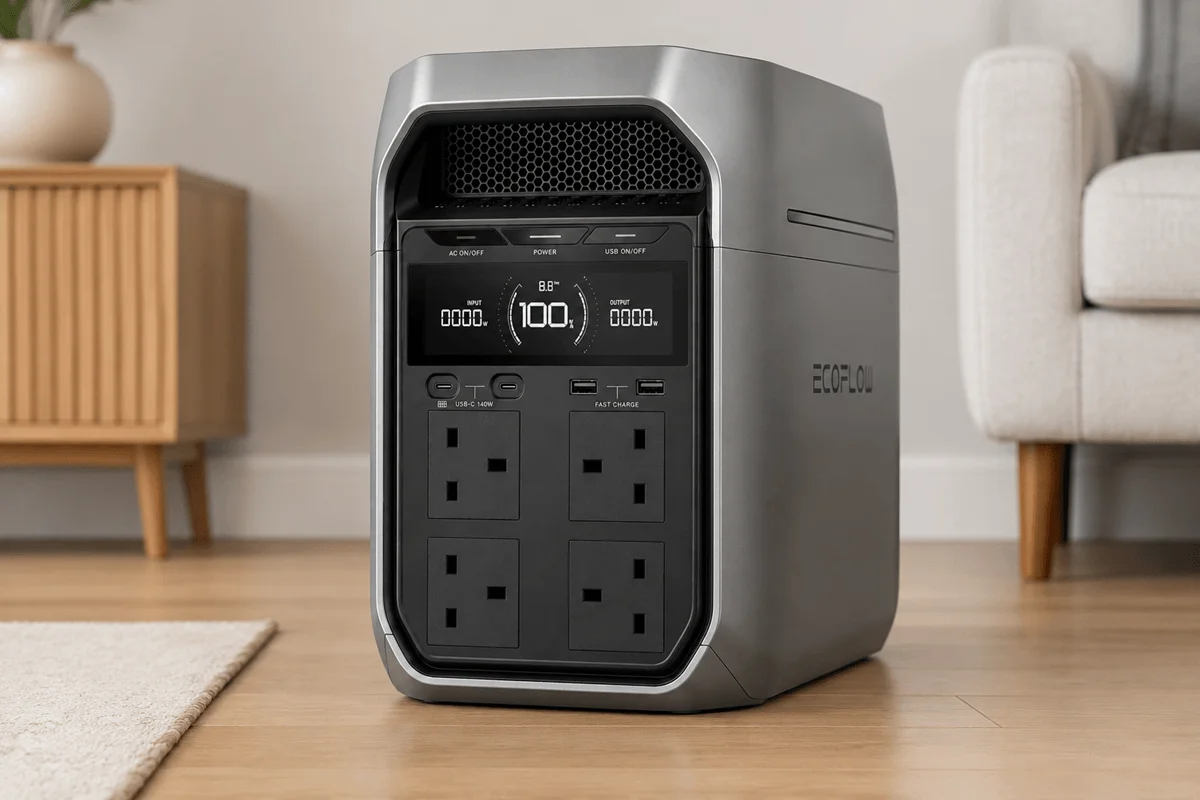
The EcoFlow Delta 3 Plus sits above the standard Delta 3 in EcoFlow’s current UK line-up. It keeps the same 1,024Wh LiFePO4 battery, the same 1,800W continuous output and the same sub-10ms UPS switchover as the standard Delta 3, then adds faster solar charging, quicker USB output and the network protocols that let it work properly as a UPS for a NAS or home server. It’s a refinement, not a redesign, and understanding that difference is the whole point of this review.
It’s built for UK buyers who want dependable backup power rather than a camping toy that happens to have a battery indicator. That means homeowners in areas prone to power cuts, remote workers who can’t afford their router and monitor to drop out mid-call, and anyone building a small home energy setup around solar. At 12.5kg it’s light enough to move between a hallway cupboard and a home office without ceremony, which matters if it’s going to double as both a UPS and an occasional weekend battery.
If you’re not sure whether 1,024Wh covers your household’s needs, our power station sizing calculator is worth ten minutes before you spend anything. For where this sits in EcoFlow’s wider range, see our EcoFlow UK brand guide. And if home backup is the whole point of the purchase, our best power stations for home backup guide runs through the full field.
Key Specifications at a Glance
| Specification | Detail |
|---|---|
| Battery Capacity | 1,024Wh (LiFePO4 / LFP) |
| AC Output | 1,800W continuous |
| Surge | 3,600W |
| X-Boost | 2,400W |
| AC Input | 1,500W max |
| Charge 0–80% (AC) | 40 minutes |
| Charge 0–100% (AC) | 56 minutes |
| Solar Input | 1,000W total, dual 500W MPPT ports |
| Solar Charge 0–80% | 1 hour (ideal conditions) |
| Solar Charge 0–100% | 70 minutes (ideal conditions) |
| Alternator Charging | 800W alternator: 80% in 1 hour, full in 1.3 hours |
| UPS Switchover | Under 10ms |
| Battery Cycles | 4,000 to 80%+ capacity |
| Expandable | Up to 5kWh |
| Weight | 12.5kg |
| Noise | Under 30dB below 600W, 40dB at 1,200W (X-Quiet) |
| Outlets | 11 devices simultaneously |
| Ingress Protection | IP65 (LFP cells) |
| App | EcoFlow app: storm/outage alerts, low battery reminders, usage dashboard, charge speed control, power schedules, Time-of-Use mode |
How Fast Does the EcoFlow Delta 3 Plus Charge?
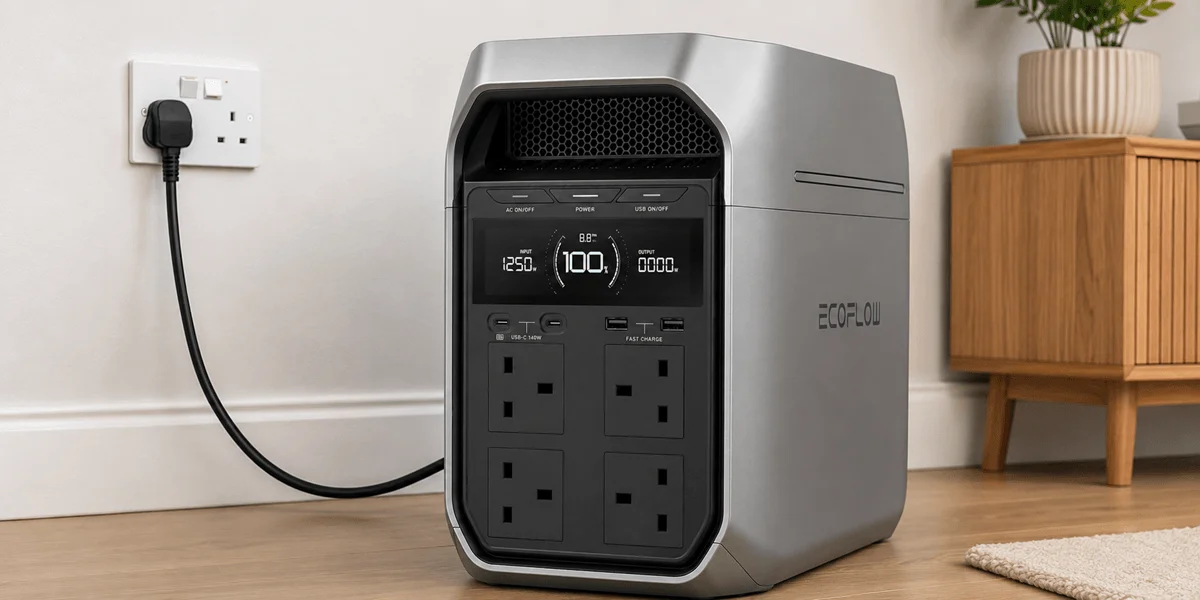
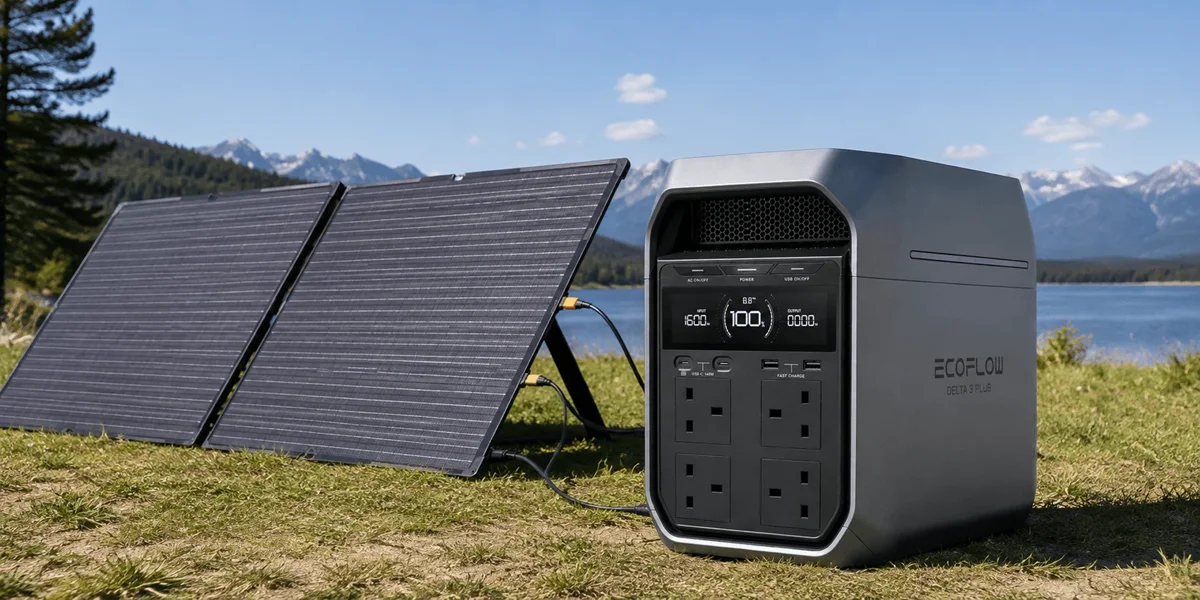
The EcoFlow Delta 3 Plus charges from flat to 80% in 40 minutes and to 100% in 56 minutes using its 1,500W AC input. That’s quick enough to top up over a lunch break if a storm warning has just landed in your inbox. Solar charging via the dual 500W MPPT ports reaches 80% in an hour and 100% in 70 minutes, though EcoFlow’s figures assume strong, direct sun, not a typical overcast UK afternoon.
The 1,500W AC input is identical to the standard Delta 3, so the charging speed advantage of the Plus doesn’t come from mains charging at all. It comes from solar, where the Plus doubles the input ceiling. If you mostly charge from a wall socket, this part of the spec sheet won’t influence your decision much either way.
Does Solar Charging Actually Work in UK Weather?
The dual 500W MPPT ports give a combined 1,000W of solar input, but that 70-minute full-charge figure is a best-case number from EcoFlow’s own testing conditions. In real UK weather, expect meaningfully longer, particularly outside the summer months. Two ports rather than one still matters in practice: if part of your panel array falls into shade, common with roof-mounted or lean-to setups, the unshaded portion keeps charging at its own rate instead of the whole system being dragged down. For a fuller picture of what solar charging delivers across the seasons here, our UK solar charging guide sets realistic expectations before you buy panels to match.
How Does Alternator Charging Work for Vans and Motorhomes?
EcoFlow’s 800W alternator charger takes the Delta 3 Plus to 80% in about an hour and a full charge in roughly 1.3 hours while you’re driving. That’s a genuine option for van or motorhome owners who want to arrive at a pitch with a full battery without needing a hook-up first, and it can run alongside solar input if you’re using both at the same time.
What Can the EcoFlow Delta 3 Plus Actually Power?
With 1,800W continuous output and X-Boost extending that to 2,400W for short bursts, the Delta 3 Plus covers most of what a UK household needs during a power cut: a fridge, a router, a laptop and monitor, lighting, a television, and phone charging, all running at once without tripping the inverter. It supports 11 devices simultaneously across its AC, USB-C, USB-A and DC outputs.
Those figures are estimates based on the 1,024Wh capacity and typical UK appliance draw, not a lab measurement, so treat them as a planning guide rather than a guarantee. A few more reference points at around 85 to 90% inverter efficiency:
- 60W mini fridge: around 14–15 hours
- Laptop (55W): around 14–15 full charges
- CPAP machine (30W): over 27 hours
- LED lighting (20W): well over a day continuous
- Broadband router (10W): several days on its own
Runtime for Common UK Devices
The pattern that matters most for home backup: low-draw essentials such as a router, lights and phone charging can run for days, while anything with a heating element, a kettle, a toaster, a hairdryer, eats through capacity fast even with X-Boost engaged. Plan around keeping the essentials alive for the length of a typical UK outage, not around running the whole kitchen.
What the Delta 3 Plus Can't Run
Anything that sustains a draw above 1,800W is out, and X-Boost’s 2,400W ceiling is for short bursts, not hours of continuous use. That rules out an electric shower, an oven, a tumble dryer, and most air conditioning units. A standard kettle will run briefly on X-Boost, but don’t plan on it as a daily habit; the battery drains fast at that draw.
Delta 3 vs Delta 3 Plus: What Are You Actually Paying For?
Strip away the marketing and the Delta 3 and Delta 3 Plus are the same unit on almost every spec that matters: 1,024Wh capacity, 1,800W output with 3,600W surge, the same 1,500W AC input and charge speeds, a 4,000-cycle LFP battery, sub-10ms UPS switchover, and the same expansion ceiling of 5kWh. The Plus costs more for three specific upgrades: double the solar input (1,000W vs 500W), faster USB-C (140W vs 100W), faster USB-A (36W vs 18W), and NAS and HID communication protocols for UPS-managed server shutdowns. That’s the entire list.
This is the single most-searched question about this product, so we’re answering it plainly rather than burying it. If you were hoping the Plus badge meant more capacity, higher output, or a genuinely different UPS mechanism, it doesn’t. What you’re paying for is charging speed and one specific compatibility feature.
Who should pay the difference: anyone who solar charges regularly, since doubling the input from 500W to 1,000W roughly halves your recharge time in decent UK sun. Anyone who leans on USB-C for fast laptop charging without tying up an AC socket. And anyone running a NAS or home server that needs to receive a proper shutdown signal from the UPS before the battery runs out, rather than just losing power abruptly.
Who shouldn’t: if you mainly charge from the wall, don’t own a NAS, and just want dependable backup power for lights, a router and a fridge, the standard EcoFlow Delta 3 does the same core job for less money. Community discussion around this exact upgrade decision on Reddit, and reflected in Google’s AI Overview for the comparison, lands in the same place: for a lot of buyers, the extra solar input and UPS capabilities aren’t worth the price gap.
What Ports Does the EcoFlow Delta 3 Plus Have?
The Delta 3 Plus supports 11 devices running simultaneously across its AC sockets, USB-C outputs (up to 140W), USB-A outputs (up to 36W) and DC outputs. Those USB figures are the Plus’s clearest practical upgrade over the standard Delta 3, which caps out at 100W USB-C and 18W USB-A.
The 140W USB-C output is fast enough to charge most modern laptops at full speed without needing an AC adaptor in between, which avoids the small efficiency loss of converting DC to AC and back to DC. For anyone working from a home office setup that leans on USB-C peripherals, that’s a genuine, if modest, day-to-day convenience.
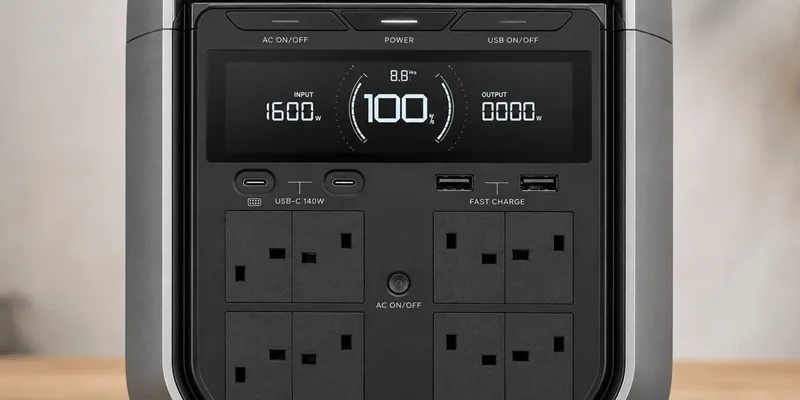
The Delta 3 Plus supports 11 devices at once, with 140W USB-C and 36W USB-A outputs ahead of the standard Delta 3.
The EcoFlow app manages all of this remotely: you can check what’s drawing power, switch individual outlets on or off, and monitor input and output in real time. That’s useful if the unit ends up tucked away in a cupboard doubling as a UPS, since you don’t need physical access to check on it.
How the 5kWh Expansion Works
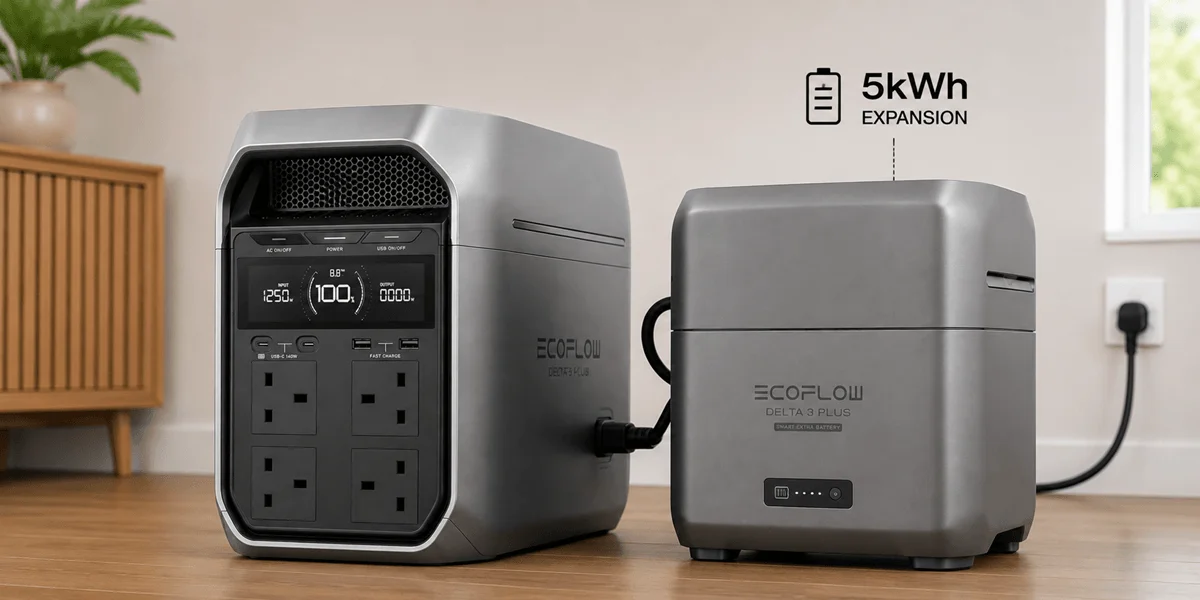
The Delta 3 Plus starts at 1,024Wh and connects to EcoFlow’s compatible Smart Extra Batteries to grow total capacity up to 5kWh. The extra batteries plug into the expansion port on the back of the unit and are managed automatically by its battery management system, so there’s no manual configuration once they’re connected.
Add compatible EcoFlow Smart Extra Batteries via the rear expansion port. Capacity scales as you add batteries, up to a combined ceiling of 5kWh.
Expansion is the practical answer if a 1,024Wh unit covers your daily needs but you want a bigger buffer for longer outages. It’s worth deciding early whether you’ll need it, since buying compatible expansion batteries from day one is simpler than retrofitting them later. If you already know you’ll want more than 1kWh from the outset, it may be worth comparing against the EcoFlow Delta 2 Max, which starts at double the base capacity.
Time-of-Use Mode and Storm Alerts
The EcoFlow app adds two features worth understanding before you buy, because both are easy to misread from the marketing copy. Time-of-Use (TOU) mode charges the Delta 3 Plus automatically during your cheapest electricity hours and switches it to battery power during your most expensive hours. It only powers whatever is plugged directly into the unit itself, not your home’s wiring, so it won’t shave pounds off your whole electricity bill. What it will do is run a specific appliance, a freezer, a router, or a home office setup, on stored cheap-rate power during peak pricing windows.
Storm and outage alerts work off the local weather feed built into the app, giving you roughly 12 hours’ warning before severe weather that’s likely to knock out power in your area. Paired with the low battery reminders and the usage dashboard, it’s a genuinely useful early-warning system for anyone using the unit as planned home backup rather than an occasional camping battery. Power schedules let you automate charge and discharge windows without touching the unit itself once it’s set up.
The Honest Problems: What UK Owners Report
The Delta 3 Plus is a genuinely capable unit, and most verified UK owners are happy with it. But two issues come up often enough in real feedback that they deserve their own section rather than a line buried in the cons list.
Random AC socket shutoffs. A verified UK Amazon review from “Wanderer” (2 stars, 24 May 2026) reports the AC sockets switching off at random over five to six weeks of ownership, typically with around 30% battery remaining, with port memory enabled and sleep mode disabled. EcoFlow support couldn’t explain the cause. The reviewer’s conclusion was blunt: they couldn’t trust it as a UPS, which was the entire reason they’d bought it. That’s the exact failure mode you don’t want from a unit you’re relying on for home backup, and it’s worth knowing before you buy, not after.
Misreading Time-of-Use mode. A separate verified review from “Mark” (3 stars, 19 May 2026) wanted the Delta 3 Plus to charge overnight at cheap rates and then discharge into his house circuits during peak pricing. It won’t do that. It runs whatever’s plugged directly into it, which is a different thing entirely, and it’s a common enough misunderstanding that we’ve addressed it directly above as well.
Independent coverage lands somewhere between these two points. The Solar Lab titled its review “EcoFlow DELTA 3 Plus Review: Amazing, but One Big Quirk?”, which tells you the general shape of the verdict without spelling out the specifics. A Reddit thread titled “Ecoflow delta 3 plus, test in real life, disappointed” ranks highly for buyers searching the model name, and the useful clarification that comes out of that discussion is that the Delta 3 Plus is a standby UPS, meaning it switches to battery in under 10ms via a transfer switch, rather than a true online double-conversion UPS that never actually drops the connection. For most home backup uses that distinction doesn’t matter. For protecting equipment that can’t tolerate even a brief interruption, it does.
Set against that, the positive verified reviews are specific and credible. “ukw” (5 stars, 21 March 2026), upgrading from a Delta 2, reports fan noise was never an issue, praises the more accessible socket layout, and says the UPS has kept essential devices running through the three or four power cuts they get each year, paired with a Delta 2 Max battery for 3kWh of total capacity. “SPD” (5 stars, 26 November 2025) has used it in a van with a 175W EcoFlow solar panel and a 500W alternator charger every weekend and says it has never let them down. “Kris F.” (5 stars, 3 October 2025) confirms the UPS function works exactly as intended, keeping lights and the TV on through a power cut.
Our read: most verified UK owners get exactly what the spec sheet promises. But the AC socket dropout report is specific enough, and the buyer’s stated reason for purchase specific enough, that anyone buying this purely as a set-and-forget UPS for something critical, a medical device or a server, should go in with eyes open and keep an eye on the unit after the first few weeks rather than assuming it’s fully proven.
Battery Life: How Long Will It Last?
The Delta 3 Plus uses LiFePO4 (LFP) cells rated to 4,000 cycles before dropping to 80% of original capacity. At one full cycle a day, that works out to roughly 11 years of use. Realistic home backup use rarely means a full flat-to-full cycle daily, since most power cuts only draw the battery down partially, so in practice the cells should comfortably outlast most of the unit’s other components.
The LFP cells themselves carry an IP65 ingress protection rating, a meaningful detail if the unit ends up living somewhere less than pristine: a garage, a shed, or a van. LFP chemistry is also the reason the cycle life claim is credible rather than marketing gloss; it’s a fundamentally more stable chemistry than the older lithium-ion cells used in cheaper power banks and older power stations. For more on why that distinction matters when you’re comparing products, see our LiFePO4 vs Li-ion guide.
The EcoFlow app lets you cap charging at 80% or 90% rather than always topping up to full. If the Delta 3 Plus is going to sit plugged in permanently as a UPS, using a charge limit is worth doing: keeping LFP cells away from 100% during long periods of storage is one of the simplest things you can do to protect long-term capacity.
EcoFlow Delta 3 Plus vs Delta 3 Classic vs Delta 2
Against the standard Delta 3 Classic, the Plus wins on solar input, USB speed and UPS protocols, nothing else. Against the older EcoFlow Delta 2, both Delta 3 models pull ahead on cycle life, UPS switchover speed and noise, while the Delta 2 remains the cheaper way into a 1kWh EcoFlow unit if you don’t need the newer features.
The table makes the shape of the decision clear. The Delta 3 Plus and Delta 3 Classic are near-twins, so that choice comes down to how much you value solar speed and UPS protocols, covered in detail above. Against the Delta 2, both newer models are quieter, cycle for longer, and switch over faster during a power cut, exactly what you want from anything marketed as home backup. For the full field of options at this capacity and beyond, see our best portable power stations in the UK guide.
Who This Is NOT For
Buyers who mainly charge from the wall and don’t own a NAS or home server: the standard Delta 3 gives you the same core unit for less
- Anyone needing a true online double-conversion UPS for equipment that can’t tolerate any interruption: this is a fast standby UPS, not a zero-gap one
- Anyone hoping Time-of-Use mode will offset their whole electricity bill: it only powers what’s plugged directly into the unit, not house circuits
- Buyers who need to run an electric shower, oven, tumble dryer or air conditioning: all draw more than the 1,800W continuous ceiling
- Anyone who wants total certainty against any socket dropout: rare in the evidence, but reported, and worth knowing before you commit it to a critical job
Pros and Cons
- 0–80% AC charge in 40 minutes, full charge in 56
- 1,000W dual solar input, genuinely useful in UK sun
- Sub-10ms UPS switchover for real home backup
- Expandable up to 5kWh with compatible extra batteries
- Under 30dB below 600W: genuinely quiet indoors
- 4,000-cycle LFP battery, roughly 11 years at one cycle a day
- 140W USB-C and 36W USB-A, ahead of the standard Delta 3
- IP65-rated LFP cells
- 12-hour storm and outage alerts through the app
- Time-of-Use mode for running specific appliances on cheap-rate power
- 12.5kg: light enough to move between rooms
- Costs more than the near-identical standard Delta 3
- Verified reports of AC sockets switching off at random
- Standby UPS, not a true online double-conversion UPS
- Time-of-Use mode can't power house circuits, only what's plugged in
- 1,800W ceiling rules out an electric shower, oven or tumble dryer
- Expansion batteries are a separate, additional purchase
Alternatives Worth Considering
The Delta 3 Plus is a strong pick for UK home backup, but it isn’t the only reasonable choice at this capacity. Here’s how the main alternatives compare.
- EcoFlow Delta 3 Classic: The near-identical sibling. Same capacity, output and UPS switchover, just slower solar and USB charging. The obvious choice if you don't solar charge often and don't need NAS-grade UPS protocols.
- EcoFlow Delta 2: The previous generation. Fewer cycles, slower AC input, a louder fan and a slower UPS switchover, but a genuinely cheaper way into a 1kWh EcoFlow unit if the newer specs don't matter to you.
- EcoFlow Delta 2 Max: Worth a look if 1,024Wh won't be enough from day one. Double the base capacity and output, at a higher weight and price.
- Bluetti Elite 100 V2: A solar-focused alternative at a similar capacity, worth comparing if you're weighing brands rather than staying loyal to EcoFlow.
- Anker Solix C1000 Gen 2: A mid-range option worth a look if you want to compare across brands before committing.
For the fuller field, our best portable power stations in the UK guide covers all the current options side by side.
Final Verdict
The EcoFlow Delta 3 Plus does what it sets out to do. Fast AC charging, genuinely useful 1,000W solar input, a sub-10ms UPS switchover, and an expansion path to 5kWh if 1,024Wh isn’t enough on its own. It’s quiet enough to sit in a hallway or home office without becoming background noise, and the app’s storm alerts and Time-of-Use scheduling are the kind of detail that separates a proper home backup unit from a repurposed camping battery.
The honest caveats: it costs more than the nearly identical standard Delta 3 for a narrow set of upgrades, and a small but specific number of verified UK owners report the AC sockets switching off unexpectedly, exactly the failure you don’t want from a UPS. It’s also worth understanding it as a fast standby UPS rather than a true zero-gap one, and that Time-of-Use mode only powers what’s plugged into it, not your house wiring.
If you want dependable backup for a fridge, a router, lighting and a home office setup during UK power cuts, and you’ll actually use the solar input or need NAS-grade UPS signalling, the Delta 3 Plus earns its higher price. If you just want the same core protection for less, look at the standard Delta 3 first.
Frequently Asked Questions
Yes. EcoFlow UK lists the standard Delta 3 as a variant on its Delta 3 Series product page, rather than as a separate product. Pick the Delta 3 option there if you want the version with 500W of solar input and 100W USB-C.