What Is the Anker SOLIX C300?
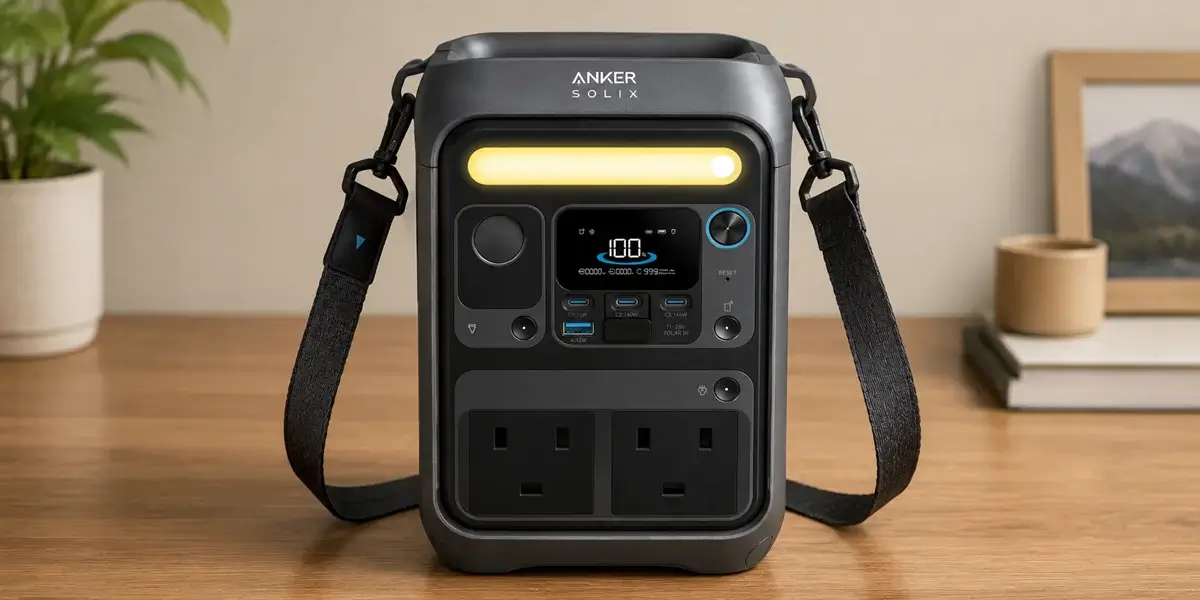
The Anker SOLIX C300 is a small LiFePO4 power station built for grab-and-go power rather than whole-home backup. It holds 288Wh of usable capacity and outputs 300W continuously, with a 600W SurgePad mode for short bursts from appliances that need a bit more at start-up. At 4.13kg and roughly 16.4 x 16.1 x 24cm, it is built to be carried in one hand, with a moulded unibody handle and a strap loop if you’d rather sling it over a shoulder.
Here’s the bit worth knowing before you buy: Anker’s own UK store sells this unit as the SOLIX C300, whilst the Amazon UK listing for the same 288Wh station is badged the C300X (model A1723). Same battery, same 300W output, same seven ports, same built-in light, same 5-year warranty. The practical differences we could verify: the Amazon C300X ships with the adjustable carry strap in the box, whereas Anker’s store sells the strap separately. So if you search “Anker SOLIX C300” and land on a C300X listing, you have not been sent to the wrong product. There’s also a third variant, the C300 DC, which drops the AC sockets entirely, gains a larger pop-up light, and carries a shorter 3-year warranty. Throughout this review we use C300, the name Anker itself uses in the UK.
For context on where this sits against the rest of Anker’s range, see our guide to the wider Anker SOLIX lineup. And if you’re not sure whether 288Wh is enough capacity for your trips, our power station size guide is worth five minutes before you commit.
Key Specifications at a Glance
| Specification | Detail |
|---|---|
| Battery Capacity | 288Wh (LiFePO4 / LFP) |
| AC Output | 300W continuous, pure sine wave |
| Surge / Peak Power | 600W (SurgePad mode) |
| Full Charge Time (mains) | ~50 minutes to 80%, ~1.1 hours to 100% |
| Other Charging Methods | Car socket (120W) or 140W USB-C input |
| Solar Input | 100W max (XT-60 connector, 11-28V) |
| Car Charging | 120W (12V car socket) |
| Weight | 4.13 kg |
| Ports | 7 total: 2 AC (300W shared), 1 car socket (120W), 3 USB-C (two 140W, one 15W), 1 USB-A (12W) |
| Battery Cycles | 3,000+ cycles to 80% capacity (built for around 10 years of use) |
| Noise | ~25dB at 1 metre |
| Built-In Light | Yes, multi-mode camping light |
| App Control | Yes: Anker app, Bluetooth and WiFi |
| Warranty | 5 years UK |
| UK Price | Under £300 (check current price) |
How Fast Does the Anker SOLIX C300 Charge?
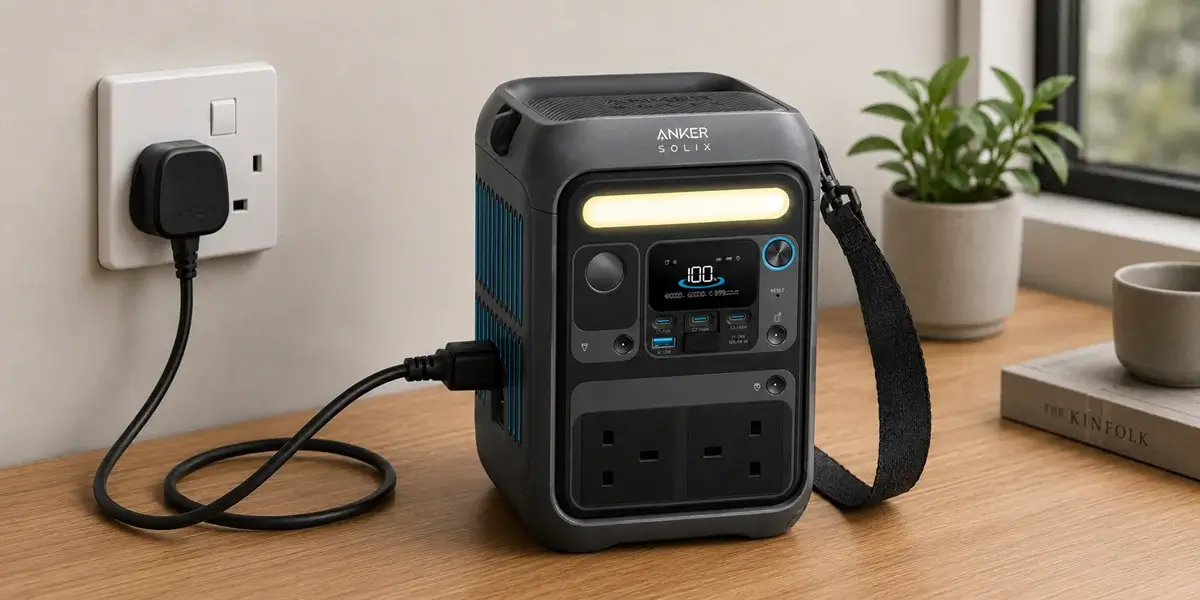
The Anker SOLIX C300 charges from flat to 80% in around 50 minutes from a UK mains socket, and reaches 100% in about 1.1 hours. That’s quick for a budget-class 288Wh unit and means a lunchtime top-up is realistic. You can also recharge it through a car’s 12V socket or via its 140W USB-C port, useful if the mains isn’t nearby.
Three ways to top the C300 up: a UK mains socket for the fastest full charge, a car socket for topping up on the move at up to 120W, or the 140W USB-C port if you’re already carrying a compatible charger or power bank for other gear. Having three options is a genuine convenience for festival-goers and campers who don’t always have a plug socket handy.
Can You Switch It Off While It's Charging?
No, not currently. UK owners on forums including Reddit’s r/anker have reported that the unit will not power down while it’s actively charging, a firmware quirk rather than a safety feature you can override. It’s a minor inconvenience rather than a dealbreaker, but worth knowing if you like to switch devices fully off overnight.
How Much Solar Can It Take in the UK?
This is where the budget positioning shows. A 100W input is fine for keeping the battery topped up over a day of light use, but it is not built for fast off-grid recovery. Cloud cover, low winter sun angles, and panel positioning all cut into that 100W ceiling further, which is normal for any solar setup but worth factoring into your trip planning.
For a wider look at how solar charging actually performs across the UK, and how to get the most out of a panel you already own, see our guide to solar charging in the UK.
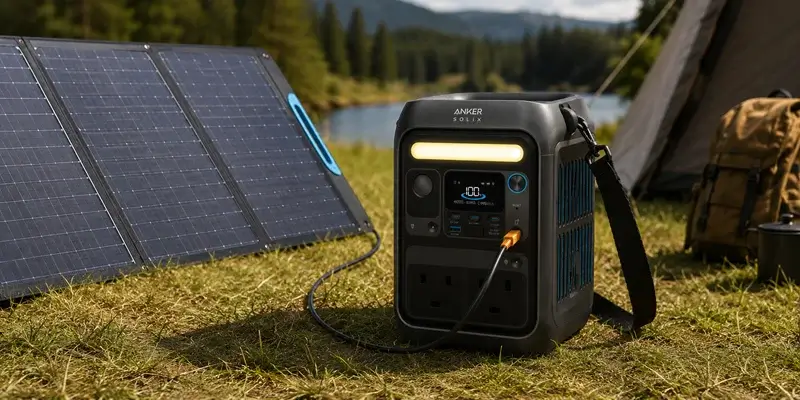
The 100W solar input tops up the C300 in around 2.5 hours of strong sun, slower in typical UK conditions.
What Can 288Wh Actually Run?
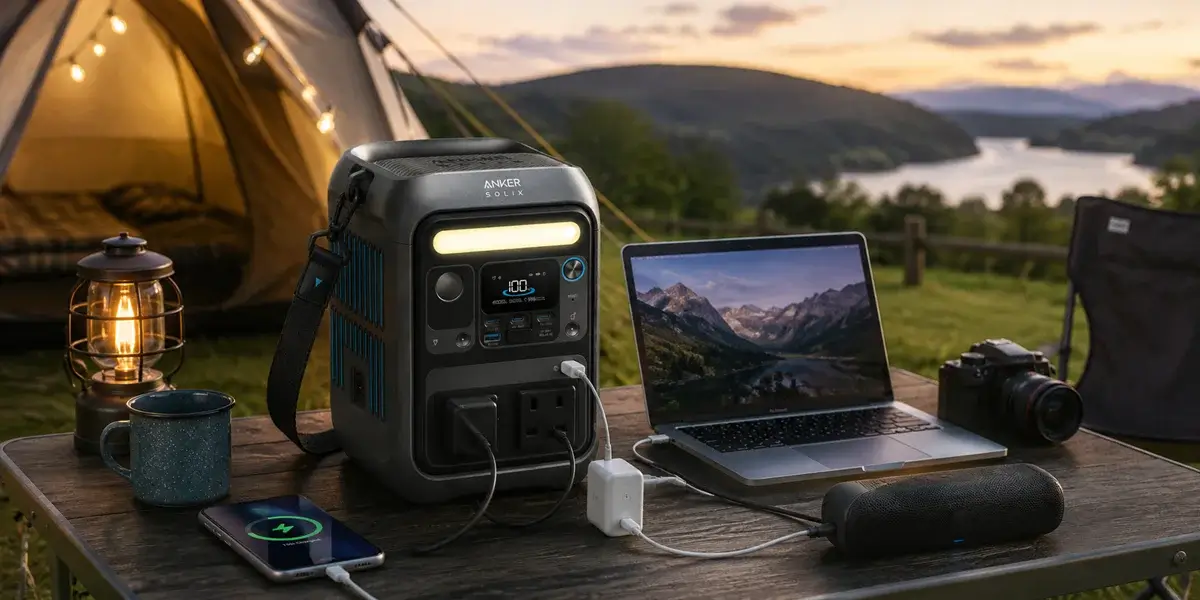
With 300W of continuous output (600W SurgePad), the C300 covers the essentials: phone and laptop charging, camp lighting, a CPAP machine, or a small camping fridge for a few hours. Based on spec analysis rather than hands-on testing, expect roughly 20 phone charges, two to three nights of CPAP use, or four to five full laptop charges from a single full battery.
These are estimates drawn from typical device draw and the C300’s 288Wh capacity, not figures from our own bench testing. Real-world results will vary with device efficiency, screen brightness, and ambient temperature, but they give a reasonable planning benchmark.
One independent data point worth knowing: in Trusted Reviews’ bench test, their C300 sample would not hold a sustained full 300W AC load (it cut out), whilst running faultlessly at 255W and below. Most camping kit sits far under that, so it rarely matters in practice, but treat roughly 250W as the comfortable ceiling for continuous AC use rather than the headline 300W.
Need more than that? Our guide to the best portable power station for camping has the other options.
A small camping fridge or cool box will run for several hours depending on its draw and how often the compressor cycles, making the C300 a sensible choice for a day trip or a short weekend where you’re not trying to keep food cold for a week.
What Can It Not Run?
It cannot run high-wattage heating appliances. A standard UK electric kettle draws around 3,000W, ten times the C300’s 300W continuous ceiling, and the same applies to heaters, microwaves and hairdryers. At a constant 300W draw, the battery itself would empty in roughly 45 to 50 minutes, so this unit is built for light, intermittent loads rather than anything that pulls hard and continuously. If you need to run heating appliances off-grid, you’ll need a considerably larger unit; our size guide walks through the maths.
What Ports Does the Anker SOLIX C300 Have?
The Anker SOLIX C300 has 7 ports in total: 2 AC sockets sharing 300W, 1 car socket rated at 120W, 3 USB-C ports (two at 140W each, one at 15W), and 1 USB-A port at 12W. The middle 140W USB-C port is two-way, meaning you can use it to charge the unit itself as well as to charge a laptop or other device from it.
Those two 140W USB-C ports are the standout feature on the spec sheet. Most rivals at this price and capacity top out at a single 100W USB-C, so the C300 can fast-charge two laptops at once, and the two-way middle port doubles as one of the four charging routes for the unit itself (mains, solar, car or USB-C). The third USB-C port at 15W and the 12W USB-A cover phones, earbuds and other small electronics without tying up the fast ports; Anker caps that 15W port and the USB-A at 20W combined when both are in use.
The Anker app connects over Bluetooth and WiFi for monitoring charge levels and output. One quirk worth flagging: some UK users report that the app needs an active internet connection to function properly, even for basic status checks, which is less convenient than a purely local Bluetooth connection if you’re somewhere with no signal.
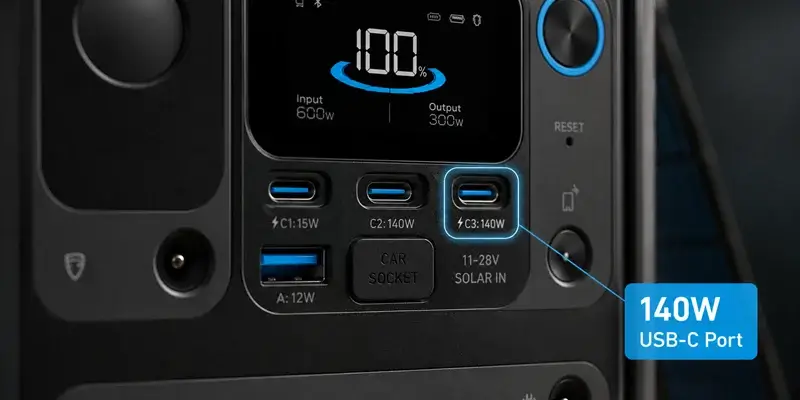
The two-way 140W USB-C port doubles as a charging input and a fast output for laptops.
Noise and the Built-In Camping Light
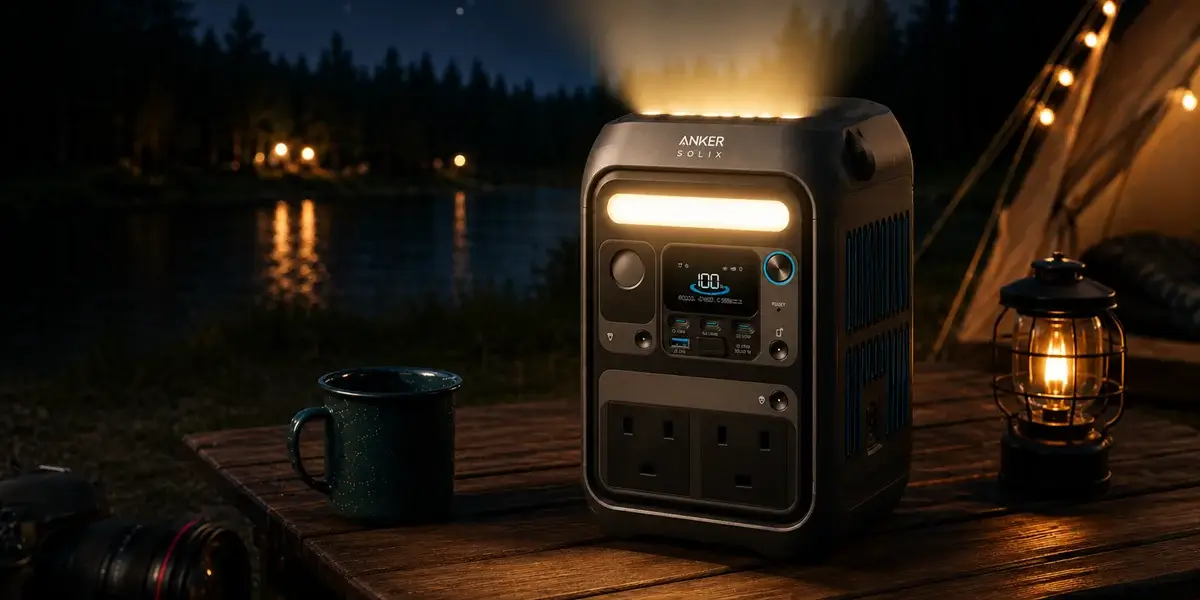
The Anker SOLIX C300 runs at around 25dB at 1 metre, quiet enough to sit inside a tent or beside a bed without being noticeable over background sound. It also has a built-in multi-mode camping light, a feature many rivals in this price bracket leave out entirely.
Independent bench testing backs the quiet claim. Trusted Reviews recharged the C300 at its full 330W mains rate and reported barely any fan noise, with the unit staying reasonably cool throughout. The real ceiling on this unit is output, not noise (see the runtime section above). Low operating noise matters more for a compact camping unit than for a larger home-backup station, since this one is designed to live inside a tent, campervan or festival gazebo rather than a garage.
The built-in light has multiple brightness and flash modes, useful as a backup torch or a low-level ambient light for a tent at night. It’s a small addition, but it saves packing a separate lantern for short trips, and it’s one of the genuine perks of buying into this family over a rival that skips a light entirely.
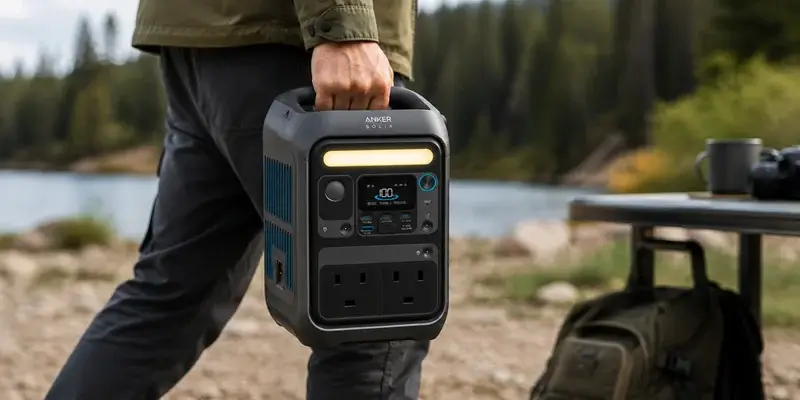
At 4.13kg and around 24cm tall, the C300 is light enough for a one-handed carry to the tent.
Anker SOLIX C300 vs EcoFlow River 3 vs Jackery Explorer 300 Plus vs Bluetti EB3A
Here is how the C300 stacks up against the three closest rivals in the UK’s sub-£300 bracket, one from each of the big four brands:
Each rival wins somewhere. The EcoFlow River 3 is the lightest of the four and matches the Anker on fast mains charging, but it holds the least capacity and its warranty runs 2 years against the Anker’s 5. The Jackery Explorer 300 Plus matches the C300’s 288Wh in a lighter body, though its USB-C tops out at 100W. The Bluetti EB3A pushes double the output at 600W and takes 200W of solar, at the cost of less capacity, more weight and the oldest design here. Where the C300 keeps its lead is the combination: the biggest battery, the fastest USB-C, and the longest warranty in one unit.
Who This Is NOT For
- Anyone flying with it: at 288Wh it’s well over the 100Wh airline carry-on allowance, so it cannot go in hand luggage or the hold
- Anyone who needs to run a kettle, heater, microwave or hairdryer off-grid: the 300W continuous limit (600W surge) is far short of the 2,000W-plus these appliances draw
Buyers who want whole-home backup power: 288Wh will not cover a fridge-freezer and multiple circuits through a power cut; step up to the Anker SOLIX C1000 Gen 2 for that
- Off-grid campers wanting fast solar recovery: the 100W solar ceiling, and typical UK output of 60-75W from a 100W panel, means a full solar refill can take most of a day
- Anyone who wants to switch the unit off mid-charge: the firmware currently won’t allow this, an inconvenience some UK owners flag online
Pros and Cons
The C300’s standout strengths are its fast 50-minute mains charge, 288Wh LiFePO4 battery, 140W two-way USB-C, compact 4.13kg build, built-in light, and 5-year UK warranty. Its main weaknesses are the 300W output ceiling, slow 100W solar input, confusing C300/C300X naming, and a firmware quirk that stops it switching off while charging.
- ~50-minute charge to 80% from the mains, quick for this class
- 288Wh LiFePO4 battery rated for 3,000+ cycles, around a 10-year lifespan
- 140W two-way USB-C, one of the fastest at this price and capacity
- 7 ports in total, including a dedicated car socket
- Compact at 4.13kg, an easy one-hand carry
- Built-in multi-mode camping light saves packing a separate torch
- Quiet ~25dB operating noise
- 5-year UK warranty and a strong 4.7-star Amazon UK rating
- 300W output won't run a kettle, heater or hairdryer
- 100W solar ceiling, slower still in typical UK weather
- C300 and C300X naming across listings causes genuine confusion
- Cannot be switched off while actively charging
- Anker app reportedly needs internet access to work properly
- 288Wh is too far over the 100Wh airline limit to fly with
- Trusted Reviews' bench test couldn't hold a sustained 300W load; ~250W is the realistic continuous ceiling
- No car charging or solar cable in the box; each is a separate purchase
Alternatives Worth Considering
The C300 is a sound choice for day trips, festivals and budget camping, but it is not right for everyone. Here are the main alternatives:
- Anker SOLIX C1000 Gen 2: The natural step up if 288Wh feels tight. It holds 1,024Wh, outputs 2,000W continuous, and charges fully in around 49 minutes, enough headroom for tools, appliances and short home-backup use, at a higher price and a heavier 11.3kg build.
- Bluetti EB3A: Higher 600W output for the same rough footprint, at the cost of slightly less capacity (268Wh) and more weight (4.6kg). Worth a look if raw wattage matters more to you than USB-C speed.
- Jackery Explorer 300 Plus: The lightest of this group at 3.75kg, with the same 288Wh capacity, though its USB-C tops out at 100W rather than the Anker's 140W. A sensible pick if shaving off every gram matters for your trips.
- EcoFlow Delta 2: Our current top overall pick. It jumps to 1,024Wh and 1,800W of output, enough for kettles and most mains appliances the C300 can't touch, and still charges to 80% in around 50 minutes. The pick if your "occasional day trip" is turning into regular weekends away or home power-cut cover.
- Jackery Explorer 1000 v2: The compact option in the 1kWh class. You get roughly 3.7 times the C300's capacity in a body that still carries with one hand, which makes it the sensible middle ground between a day-trip unit and a full home-backup station.
For the full picture across the UK market, including the wider Anker range, see our guide to the best portable power stations in the UK.
Final Verdict
The Anker SOLIX C300 earns its place in the sub-£300 bracket by doing the fundamentals well. A charge to 80% in around 50 minutes is genuinely convenient, the 140W two-way USB-C port outpaces most rivals at this price, and the built-in camping light is a small but real perk. At 4.13kg it’s an easy carry for day trips, festivals and light camping, and the 5-year UK warranty backs a 3,000-plus cycle LiFePO4 battery built to last around a decade.
The honest limitations: 300W won’t touch a kettle or heater, the 100W solar input is slow, especially in UK weather, and the C300/C300X naming split across listings is a real source of confusion for buyers trying to work out what they’re ordering. It also cannot fly, since 288Wh sits well over the airline carry-on limit.
Who should buy it: anyone who wants dependable power for phones, laptops, camp lights and small electronics on day trips or weekend camping, without paying for capacity or output they won’t use. If you need to run heating appliances, want fast solar recovery, or need whole-home backup, look at the larger Anker SOLIX C1000 Gen 2 instead.
Frequently Asked Questions
There is no meaningful hardware difference: they are the same 288Wh, 300W unit sold under two names. Anker’s own UK store calls it the SOLIX C300, whilst the Amazon UK listing for the identical station is badged the C300X (model A1723) and includes the adjustable carry strap that Anker’s store sells separately. Capacity, output, ports, light and the 5-year warranty are all the same. The variant to watch for is the C300 DC, which has no AC sockets at all and a shorter 3-year warranty.
Based on spec analysis, a full 288Wh charge on the C300 delivers roughly 20 smartphone charges, though this varies with phone battery size and charging efficiency. This is an estimate drawn from the unit’s usable capacity and typical phone battery sizes, not a figure from our own hands-on testing. It’s a reasonable planning benchmark for a weekend away or a festival where mains power isn’t available.
Yes. Based on typical CPAP power draw and the C300’s 288Wh capacity, expect around two to three nights of use without a humidifier attached. Running a humidifier will reduce that figure, since it draws meaningfully more power. The C300’s 300W continuous output is well within a CPAP’s normal running requirements, so this is a genuinely practical use case for the unit, particularly for camping or as a backup during a power cut.
No. At 288Wh, the C300 far exceeds the 100Wh limit most airlines set for lithium batteries carried in hand luggage or hold luggage. This isn’t specific to Anker; it’s a standard aviation safety rule that applies to any lithium battery power station in this capacity range. If you need portable power that can fly with you, you’ll need a much smaller unit rated under 100Wh, and the C300 isn’t it.
In strong, direct sun, the C300 can reach 80% in around 2.5 hours using its 100W solar input. In typical UK weather, a 100W panel usually delivers only 60 to 75W, so a realistic charge time is meaningfully longer, especially outside summer months or under cloud cover. Treat solar as a way to top the battery up over the course of a day rather than a fast standalone charging method.
Not reliably. Some UK users report that the Anker app needs an active internet connection to function properly, even for basic status checks over Bluetooth, which can be inconvenient if you’re somewhere with no signal, such as a remote campsite. The C300 itself works fine without the app; it’s only the monitoring and control features that may be affected.
No. A standard UK electric kettle draws around 3,000W, ten times the C300’s 300W continuous output limit (600W with SurgePad), and electric heaters draw similarly high wattage. The C300 is built for lower-draw devices like phones, laptops, camp lights and small fridges, not high-wattage heating appliances. If boiling water or heating off-grid is a priority for you, you’ll need a considerably larger power station.