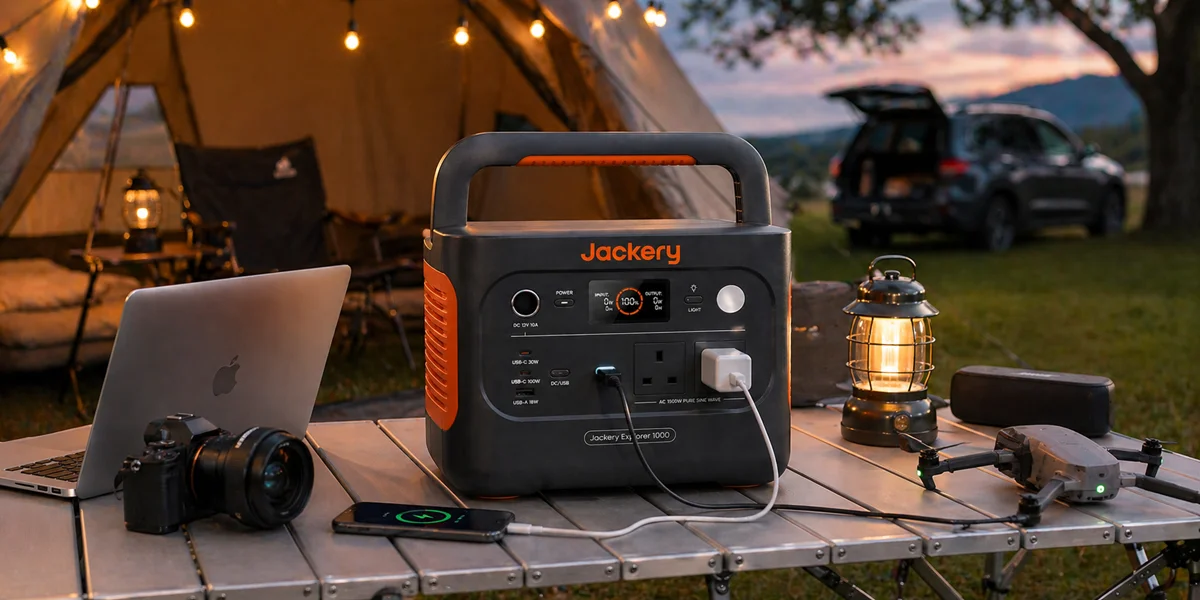
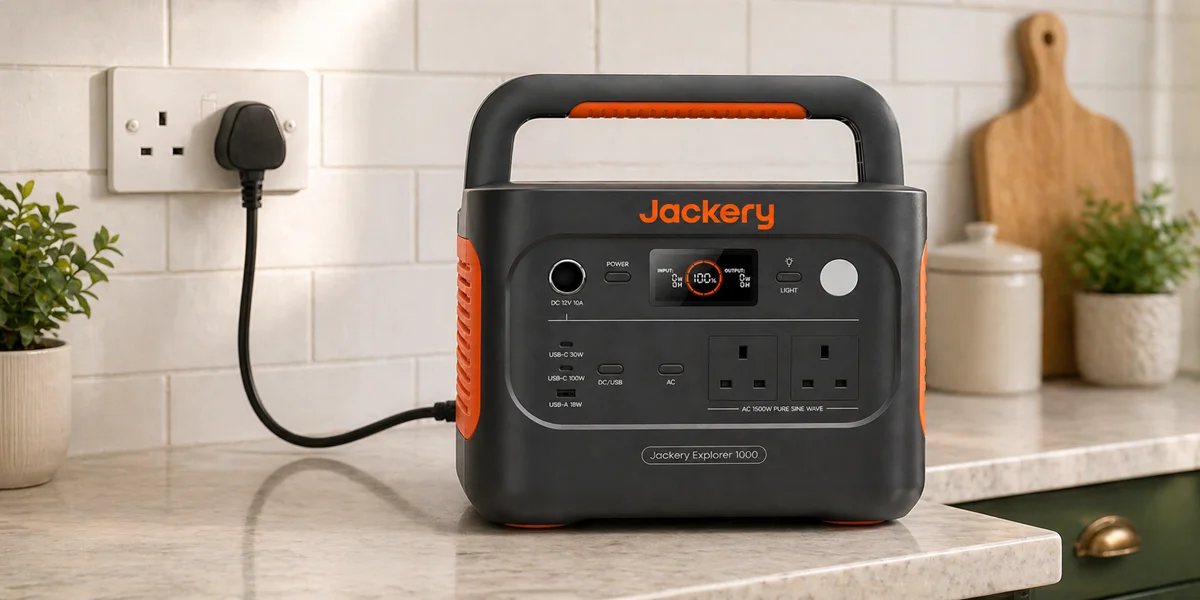
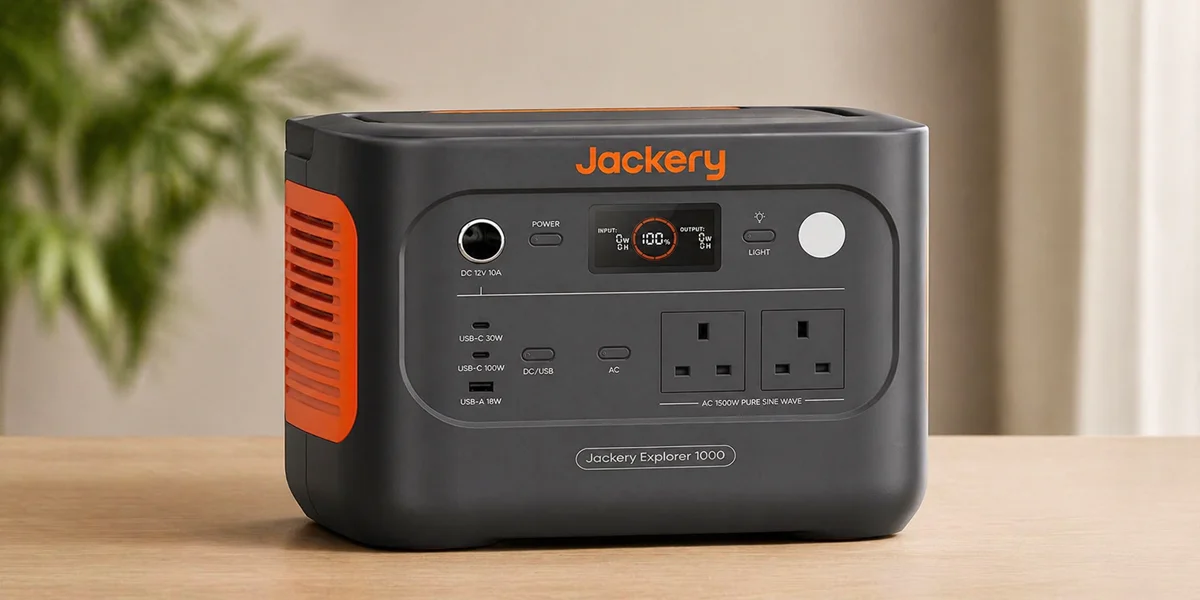
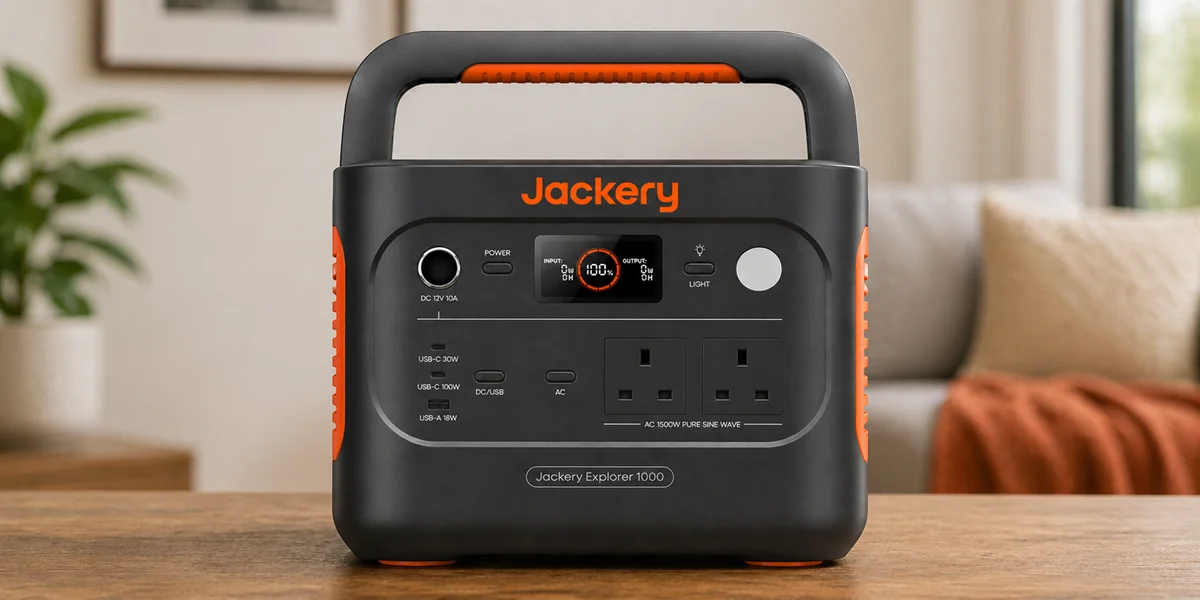
What Is the Jackery Explorer 1000 v2 and Who Is It For?
The Jackery Explorer 1000 v2 is Jackery’s updated mid-range power station. It launched in 2024 with a major internal overhaul: swapping the old NMC lithium-ion battery for LFP chemistry, adding dual 100W USB-C ports, and cutting the charge time from 7.5 hours to 1 hour in Emergency Mode. The recognisable orange design stayed, but almost everything underneath changed.
At 10.8kg, it is the lightest 1kWh LFP power station among the top-selling UK models. According to Jackery UK, it was the lightest and smallest in its class at Amazon UK launch in 2024. For campers and caravan owners who carry their kit to a site, that weight saving matters more than it sounds.
It is a strong fit for UK campers, motorhome owners, van lifers, and homeowners who want quiet backup power during a power cut. It is also a popular choice among photographers, videographers, and outdoor workers who need reliable portable power for a day’s shoot. Check our power station sizing calculator if you are not sure whether 1,070Wh is enough for your needs. For the full Jackery UK range, see our brand guide.
Key Specifications at a Glance
| Specification | Detail |
|---|---|
| Battery Capacity | 1,070Wh (LiFePO4 / LFP) |
| AC Output | 1,500W continuous |
| Surge Power | 3,000W |
| Weight | 10.8 kg (lightest 1kWh LFP in class) |
| Charge (Standard AC) | 0–100% in 1.7 hours |
| Charge (Emergency Mode) | 0–100% in ~1 hour (via Jackery app) |
| Solar Input | 400W max (MPPT) |
| Car Charging | Yes (12V input) |
| Noise Level | Under 22dB (Quiet Charging Mode) |
| UPS / EPS Mode | Yes, under 20ms (IEC 62040 certified) |
| Ports (UK version) | 2 UK AC sockets, 2 USB-C 100W, 1 USB-A 18W, 1 USB-A 12W, 1 DC car port, 1 DC barrel port |
| Built-in Light | Yes (integrated LED torch) |
| Foldable Handle | Yes (v2 upgrade) |
| Battery Cycles | 4,000 to 70% capacity |
| App Control | Yes (Jackery app, Wi-Fi + Bluetooth) |
| ChargeShield 2.0 | 62 layers of battery protection |
| Expandable | No |
| Warranty | 5 years (authorised sellers including Amazon UK) |
Explorer 1000 v1 vs v2: What Actually Changed?
The single most important change is the battery chemistry: the v1 used NMC lithium-ion with just 500 cycles. The v2 uses LFP with 4,000 cycles. That is the difference between a battery lasting roughly 2 years of daily use vs over 10 years. The v2 also charges 7 times faster (1 hour vs 7.5 hours in emergency mode), adds dual 100W USB-C ports, a Jackery app, and whisper-quiet 22dB operation.
This is the upgrade that makes the v2 a genuinely different product rather than a minor refresh. The original Explorer 1000 was a strong seller for Jackery, but by 2023 its NMC battery and 7.5-hour charge time had started to look dated against newer LFP rivals. The v2 fixes both weaknesses.
Original Explorer 1000 (v1)
| Explorer 1000 v2 (Current)
|
If you still own the original Explorer 1000, upgrading is not urgent if it is working well for you. But if you are buying new and comparing the two, the v2 wins on every meaningful spec at a similar or lower price point.
How Fast Does the Jackery Explorer 1000 v2 Charge?
The Jackery Explorer 1000 v2 has two AC charging speeds. Standard Mode charges 0–100% in around 1.7 hours and is better for long-term battery health. Emergency Super Charge Mode, activated through the Jackery app, reaches 100% in about 1 hour. Solar charging via 200W input takes around 3 hours in strong sunlight, or 5–6 hours in typical UK overcast conditions.
Jackery markets Emergency Mode as being 7 times faster than the original Explorer 1000, which previously took 7.5 hours. That comparison is accurate, and the practical difference is huge. If you are preparing for a storm or topping up before leaving for a campsite, a 1-hour charge changes the whole workflow.
The TechRadar UK review confirmed standard AC charging at around 1 hour 40 minutes, with Emergency Mode completing in close to 1 hour. One thing worth knowing from the T3 review: the input power drops noticeably when you are running devices at the same time as charging. Under light loads (around 100W), the input stays close to full. Under heavy loads (above 1,000W), pass-through charging slows down significantly.
How Fast Is Solar Charging in the UK?
The Explorer 1000 v2 accepts up to 400W of solar input via its MPPT controller. Two Jackery SolarSaga 200W panels will get you close to that in good sun. In a real UK test by TechRadar, solar charging times varied between 4 and 15 hours depending on the number of panels and available light. For UK camping use, pairing with a single 200W panel is a practical starting point, with full charge typically achievable over a sunny day.
Jackery’s SolarSaga panels include a feature to help you angle them for optimal collection, which is useful at UK latitudes where the sun sits lower in the sky.
What Can the Jackery Explorer 1000 v2 Actually Power?
The Explorer 1000 v2 can power most devices UK campers and home backup buyers actually need. With 1,500W continuous output and a 3,000W surge, it handles fridges, laptops, televisions, CPAP machines, cameras, power tools, and most camping appliances. It will not run a standard UK kettle (2,000–3,000W) or an electric shower. Coffee makers under 1,500W are fine.
Here are runtime estimates based on Jackery UK data and verified buyer reports, at around 85% inverter efficiency:
- Standard household fridge (120W): 8-10 hours
- CPAP machine (30W): around 28 hours
- Pod coffee maker (under 1,000W): approximately 25–30 cups per charge
- MacBook Pro 16" (100W USB-C): about 9 full charges
One situation that comes to mind here: a buyer who contacted us after purchasing a 500Wh unit for a weekend camping trip planned to run a small compressor fridge, checked the running watts, and felt confident the numbers worked. The fridge’s running draw was around 45W, well within the unit’s capacity on paper.
The moment he plugged it in, the power station shut down instantly. The compressor’s startup surge hit close to 900W, nearly 20 times the running wattage, and the unit’s inverter tripped before the fridge had a chance to cycle on.
This is the gap between spec sheets and real-world use that catches buyers out most often. The Jackery Explorer 1000 v2 handles this correctly. Its 3,000W surge rating absorbs the startup spike of most compressor fridges without issue, which is exactly why the 3,000W surge figure matters far more than the 1,500W continuous output when fridges are involved.
The dual 100W USB-C ports deserve mention here. They let you charge two laptops simultaneously at full speed, or keep a laptop and a tablet topped up without touching the AC outlets. TechRadar confirmed in their field test that a MacBook Pro M1 Max with a near-continuous 100W draw lasted around 6 hours from a single charge.
Does the Jackery explorer 1000 v2 have a built-in light?
The Explorer 1000 v2 has an integrated LED torch on the front panel. It is a small feature that gets mentioned consistently in UK camping reviews as genuinely useful. Whether you are setting up at a campsite after dark, navigating a motorhome at night, or dealing with a power cut indoors, having a light built into the power station means one fewer thing to pack.
How Quiet Is the Jackery Explorer 1000 v2?
In Quiet Charging Mode, the Jackery Explorer 1000 v2 operates at under 22dB, which is quieter than the ambient noise in most rooms. That makes it the quietest 1kWh power station among the top UK sellers at this capacity. Under heavy loads above 1,000W, the fans spin up and become more audible. The unit is described consistently by UK buyers as quiet enough for overnight use in a tent or motorhome bedroom.
Quiet Charging Mode is activated through the Jackery app. In this mode, the charging rate slows slightly to keep heat and fan noise down. For most overnight use or indoor backup scenarios, this is the mode you will want.
Amazon UK buyers consistently report that the unit remains noticeably quieter than louder competitors in its class under equivalent loads. For comparison: the EcoFlow Delta 2 gets considerably louder at full 1,200W AC charge speed. The Jackery’s 22dB rating in quiet mode is a genuine advantage for users who plan to run it while sleeping.
One honest note: at loads above 1,000W, fan noise rises to around 55dB. That is not unusual for a unit of this capacity, but it is worth knowing if you plan to run high-draw appliances for extended periods while in an enclosed space.
Ports and Connectivity
The Explorer 1000 v2 has 8 output ports: 2 UK AC sockets, 2 USB-C at 100W each, 1 USB-A at 18W, 1 USB-A at 12W, 1 DC car socket, and 1 DC barrel port. There is also a built-in LED torch. The foldable handle creates a flat top surface, which makes it much easier to stack things on top when packed in a car.
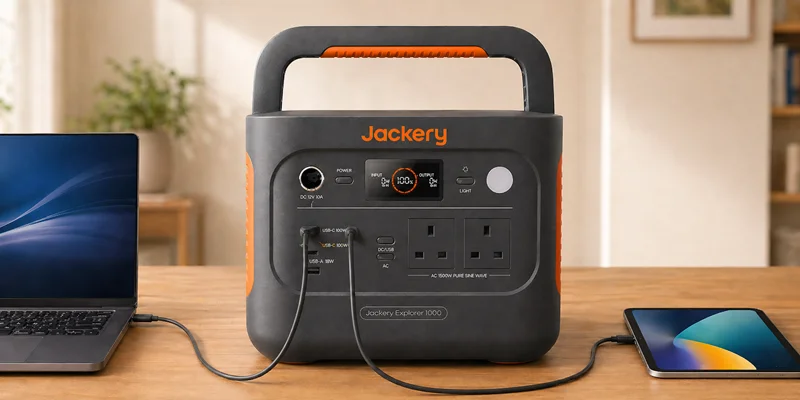
The v2's dual 100W USB-C ports let you charge two laptops simultaneously at full speed.
The two 100W USB-C ports are one of the standout upgrades from the v1. You can charge a MacBook Pro at full speed from USB-C alone, which avoids the inverter losses of going through an AC socket. That means roughly 15–20% better laptop runtime from the same battery compared to using the AC outlet.
The Jackery app connects via Wi-Fi or Bluetooth and lets you monitor battery level, input and output wattage, and estimated runtime. You can also activate Emergency Super Charge Mode, Quiet Charging Mode, and set charging timers. The interface is straightforward and UK buyers on Amazon consistently mention it as easy to set up.
One design improvement in the v2 that UK buyers have flagged positively: the foldable handle lies flat when not in use, creating a usable flat top. The original Explorer 1000 had a fixed upright handle that made stacking or storing things on top of the unit awkward. According to VanTour.net’s motorhome test, this is a noticeably more practical design for vehicle use.
Battery Life: How Long Will It Last Over the Years?
The Explorer 1000 v2 uses LFP (lithium iron phosphate) battery chemistry rated to 4,000 charge cycles before dropping to 70% capacity. Jackery rates it for 10+ years of reliable use. Used once a week for camping, that is well over 70 years of charge cycles. For daily home backup use, it is still 10+ years of service.
The jump from 500 cycles (v1 NMC) to 4,000 cycles (v2 LFP) is the most important upgrade in this model. For context: a 500-cycle battery used twice a week lasts just under 5 years. A 4,000-cycle battery used twice a week lasts over 38 years before reaching 70% capacity. In practice, you will replace the unit for other reasons long before the battery degrades.
LFP chemistry also runs safer and more stable than NMC. It is less prone to thermal runaway, handles a wider temperature range, and maintains more consistent output across its discharge cycle. UK Tech News noted in their November 2025 review that LFP’s longevity reduces replacement waste, which matters for buyers who want a power station that lasts rather than one they need to replace every few years.
Jackery includes ChargeShield 2.0 technology, which uses 62 layers of battery protection covering thermal management, voltage regulation, and AI variable charging rate adjustment. The system monitors conditions and adjusts charge rate to protect the cells over time.
Warranty note: The Jackery Explorer 1000 v2 comes with a 3-year standard warranty plus 2 years extended, totalling 5 years when purchased from the official Jackery website or authorised dealers, including Amazon UK. The 5-year warranty requires purchase from an authorised channel. Jackery explicitly states their warranty does not cover units purchased from auction sites like eBay.
Jackery 1000 v2 vs EcoFlow Delta 2 and Delta 3 Classic
The Explorer 1000 v2 is lighter (10.8kg), quieter (22dB), and has more battery cycles (4,000) than both EcoFlow models. The EcoFlow Delta 2 and Delta 3 Classic both have higher surge power (2,700W and 3,600W vs 3,000W) and the Delta 2 has more ports (13 vs 8). Neither EcoFlow is expandable at the Classic level. See the full comparison below.
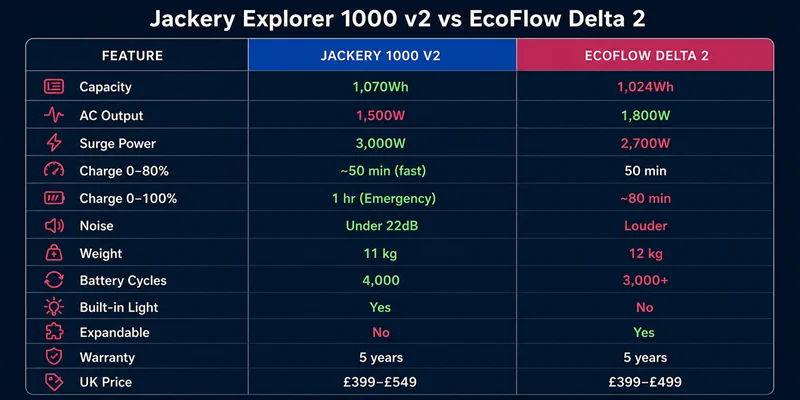
The Jackery is 1kg lighter than the Delta 2 and the quietest in this group at under 22dB.
The comparison table makes the trade-offs clear. The Jackery wins on weight, noise, and battery cycles. The EcoFlow Delta 2 wins on output power, number of ports, and expandability. For camping and caravan buyers where portability and noise matter, the Jackery is the stronger choice. For home backup or anyone who might want to expand capacity later, the Delta 2 is worth the look. For a full brand comparison, see our EcoFlow vs Jackery guide.
What Can the Jackery Explorer 1000 v2 NOT Run?
The Explorer 1000 v2 cannot run a standard UK kettle (2,000–3,000W), electric shower (7,000W+), standard oven (2,000–5,000W), or electric hob. All of these require sustained wattage well above the unit’s 1,500W continuous output. The 3,000W surge rating does not help here: unlike a fridge compressor, these appliances need high wattage continuously, not just for a startup spike.
Who This Is NOT For
- Anyone who needs to run a standard UK kettle (2,000–3,000W) or electric shower: both draw more than the 1,500W continuous output.
- Full-time van lifers who need to run a compressor fridge 24/7: at 1,070Wh with no expansion option, you will drain it overnight without solar.
- Anyone who needs more than 1,070Wh now or might want to expand later: the Jackery 1000 v2 has no expansion support. Look at the EcoFlow Delta 2 (expandable to 3,040Wh) if you might need more capacity.
- Heavy power users who regularly run appliances above 1,000W for long periods: fan noise rises significantly above that load, and 1,500W output limits your options.
- Anyone wanting more than 8 ports: the Delta 2’s 13 ports are better suited to powering many devices at once.
Pros and Cons
The Explorer 1000 v2’s biggest strengths are its 10.8kg weight, 22dB quiet operation, 4,000-cycle LFP battery, and built-in LED light. Its main weaknesses are 1,500W output (lower than EcoFlow rivals), no expansion capability, and fan noise above 1,000W load.
- 10.8kg: lightest 1kWh LFP power station in its class
- Under 22dB in quiet mode: quietest in its class
- 4,000 LFP cycles: more than any rival at this price
- 1-hour Emergency Super Charge via app
- Dual 100W USB-C: charge two laptops at full speed
- Built-in LED torch: genuinely useful for camping
- Foldable handle: flat top for easy stacking
- UPS mode under 20ms: IEC 62040 certified
- 5-year warranty (authorised sellers)
- ChargeShield 2.0: 62 layers of battery protection
- Jackery app: easy setup, quiet mode, emergency charge
- 1,500W output: lower than EcoFlow Delta 2 (1,800W) and Anker C1000 Gen 2 (2,000W)
- Not expandable: stuck at 1,070Wh
- Fan noise rises above 1,000W load
- Pass-through charging slows under heavy load
- Solar panels sold separately
- will not run a kettle, electric shower, or oven
- 5-year warranty only applies to authorised sellers, not eBay
Alternatives Worth Considering
The three strongest alternatives at this price point are the EcoFlow Delta 2 (1,800W output, 13 ports, expandable to 3,040Wh), the EcoFlow Delta 3 Classic (45-minute charge to 80%, 3,600W surge), and the Anker Solix C1000 Gen 2 (highest output at 2,000W).
The Jackery Explorer 1000 v2 is a strong choice for camping and caravan use, but it is not perfect for everyone. Here are the main alternatives:
- EcoFlow Delta 2: Higher 1,800W output, 13 ports, expandable to 3,040Wh, 5-year warranty. Heavier at 12kg and louder at full charge. Better for home backup or anyone who might want to expand capacity.
- EcoFlow Delta 3 Classic: Higher surge at 3,600W, 45-minute charge to 80%, Storm Guard Mode. 3-year warranty, or 5 with app registration, fewer ports, and not expandable. Best for buyers wanting the fastest charge in a fixed-capacity unit.
- Anker Solix C1000 Gen 2: Highest output at 2,000W, expandable, 5-year warranty, 49-minute charge. Pricier but more capable for higher-draw appliances.
For the full picture of what’s available in the UK, see our guide to the best power stations UK and our roundup of the best for camping.
Final Verdict
The Jackery Explorer 1000 v2 earned its place as one of the most portable 1kWh units in the UK by focusing on what campers and caravan owners actually need: light enough to carry without a struggle, quiet enough to run overnight, fast enough to top up before you leave, and reliable enough to last a decade of regular use.
The 4,000-cycle LFP battery is the most important spec here. It lasts longer than any rival at this price point. The 22dB quiet mode is genuinely impressive and makes a real difference in a tent or motorhome. And the 1-hour emergency charge means you can fill it up on a lunch break.
The honest weaknesses are real: 1,500W output is lower than the EcoFlow Delta 2 and Anker Solix C1000 Gen 2, and there is no expansion option. If you need more power output or want room to grow, look at the Delta 2 first. But if portability and quiet operation are your priorities and you can work within 1,500W, the Jackery Explorer 1000 v2 is one of the most refined, reliable options in its class.
Frequently Asked Questions
Yes, if you want a quiet, light 1kWh power station for camping, caravanning or home backup. You get an LFP battery rated to 4,000 cycles and a 1-hour Emergency Super Charge through the app. It runs under 22dB in Quiet Charging Mode and weighs 10.8kg. Check two limits: it is not expandable, and its 1,500W output trails the Anker SOLIX C1000 Gen 2’s 2,000W.
The most important change is the battery chemistry: the v1 used NMC lithium-ion with just 500 cycles, while the v2 uses LFP with 4,000 cycles. That is the difference between roughly 2 years of daily use versus over 10 years. The v2 also charges much faster (1 hour vs 7.5 hours in emergency mode), has dual 100W USB-C ports, adds Jackery app control via Wi-Fi and Bluetooth, a foldable handle, and whisper-quiet 22dB operation in quiet mode. The v2 is a significantly better product at a similar or lower price.
The Jackery Explorer 1000 v2 has two charging speeds. Standard Mode charges from flat to 100% in around 1.7 hours from a UK mains plug, which is gentler on the battery and recommended for regular use. Emergency Super Charge Mode, activated through the Jackery app, charges from flat to 100% in about 1 hour when you need power quickly. Solar charging via 400W input takes around 3 hours in strong sunlight, or 5 to 6 hours in typical overcast UK conditions. Car charging is also possible via the 12V input for topping up on the road.
In Quiet Charging Mode, the Jackery Explorer 1000 v2 operates at under 22dB, which is roughly the volume of rustling leaves. That makes it the quietest 1kWh power station among the top UK sellers in this capacity class. it is quiet enough for a tent, a motorhome bedroom, or indoor use at night. At loads above 1,000W, the cooling fans spin up and become more audible, reaching around 55dB under heavy load. For overnight camping use at moderate loads, the 22dB quiet mode is a genuine advantage over louder rivals.
Yes. The Jackery Explorer 1000 v2 can run a standard UK fridge or a camping fridge. A 12V camping fridge averaging around 35W runs for over 20 hours on a full charge. A standard household fridge averaging 120W runs for roughly 8 to 10 hours. The 3,000W surge rating handles the startup spike of most compressor-based fridges without issue. According to Jackery UK, you can make approximately 25 to 30 cups of pod coffee on a single charge, which gives a practical sense of what the capacity means in everyday use.
Yes. The Explorer 1000 v2 switches to battery power within 20 milliseconds of a mains failure, which is fast enough to protect computers, routers, NAS drives, and other sensitive electronics. This is certified to IEC 62040 standards. Most computers and routers will not notice the switchover at all. The UPS feature works best when the unit is plugged in and in pass-through mode, with your devices connected to the AC outlets. UK buyers consistently report it working reliably for protecting home office equipment during power cuts.
It depends on what matters most to you. The Jackery Explorer 1000 v2 is lighter (10.8kg vs 12kg), quieter (under 22dB in Quiet Charging Mode) and rated for more cycles (4,000 vs 3,000). The EcoFlow Delta 2 has more ports (13 vs 8), a higher 1,800W output and expands to 3,040Wh. The Delta 2 is no longer available on EcoFlow UK, so for those strengths in a current model, look at the EcoFlow Delta 3 Plus, which expands to 5kWh.
No. The Jackery Explorer 1000 v2 has no expansion battery support, so its capacity stays fixed at 1,070Wh. Jackery offers expansion on its separate Explorer Plus v2 series instead. If you want room to grow, the EcoFlow Delta 3 Plus expands to 5kWh with extra batteries.
Yes. The Jackery Explorer 1000 v2 connects to the Jackery app over both Bluetooth and Wi-Fi. Its Wi-Fi only works on 2.4GHz networks, so pick that band on your router if setup fails. Jackery’s manual also says Wi-Fi and Bluetooth switch off if no device connects within 5 minutes.