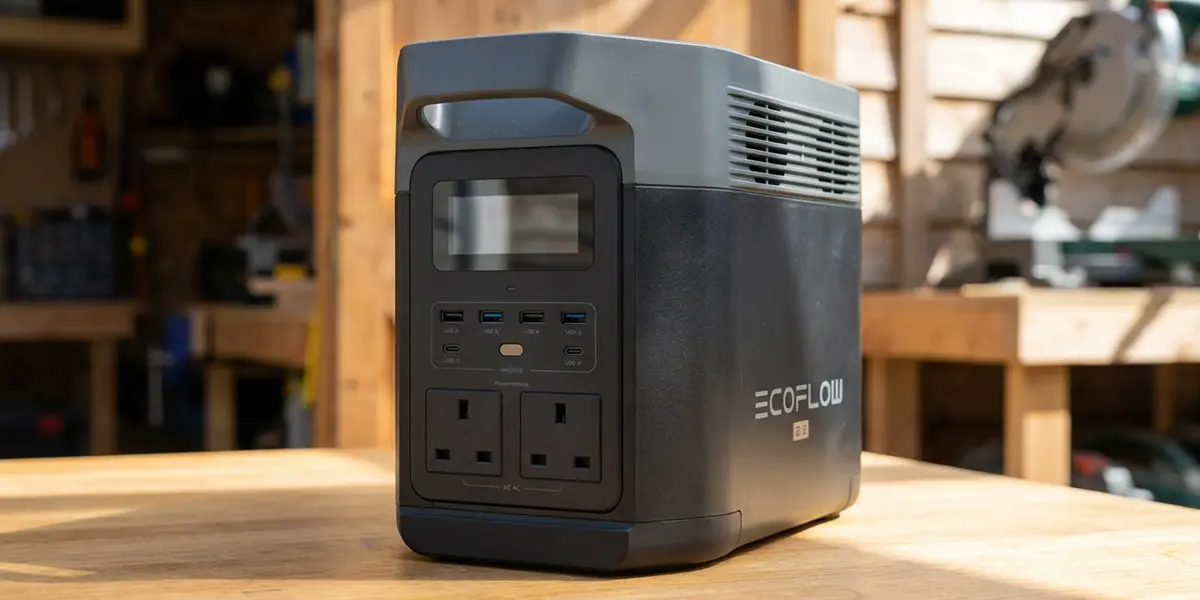
What Is the EcoFlow Delta 2 and Who Is It For?
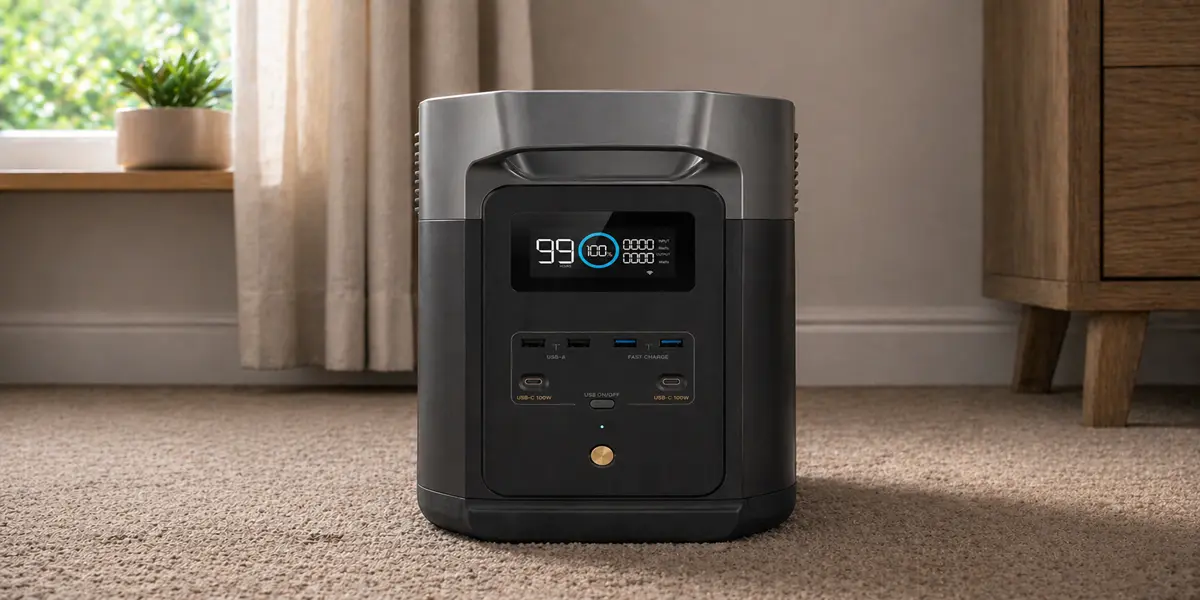
The EcoFlow Delta 2 is a mid-range portable power station aimed at UK buyers who want something they can rely on. As a portable battery and energy storage unit, it sits in the 1,000Wh capacity class. That makes it big enough to power a fridge for most of a day, and small enough to carry to a campsite without hurting your back.
It launched in 2022 and has been one of the best-selling portable power stations in the UK since. As of April 2026, it holds a 4.7-star rating across 714+ verified UK reviews on Amazon. That kind of consistency over several years tells you a lot.
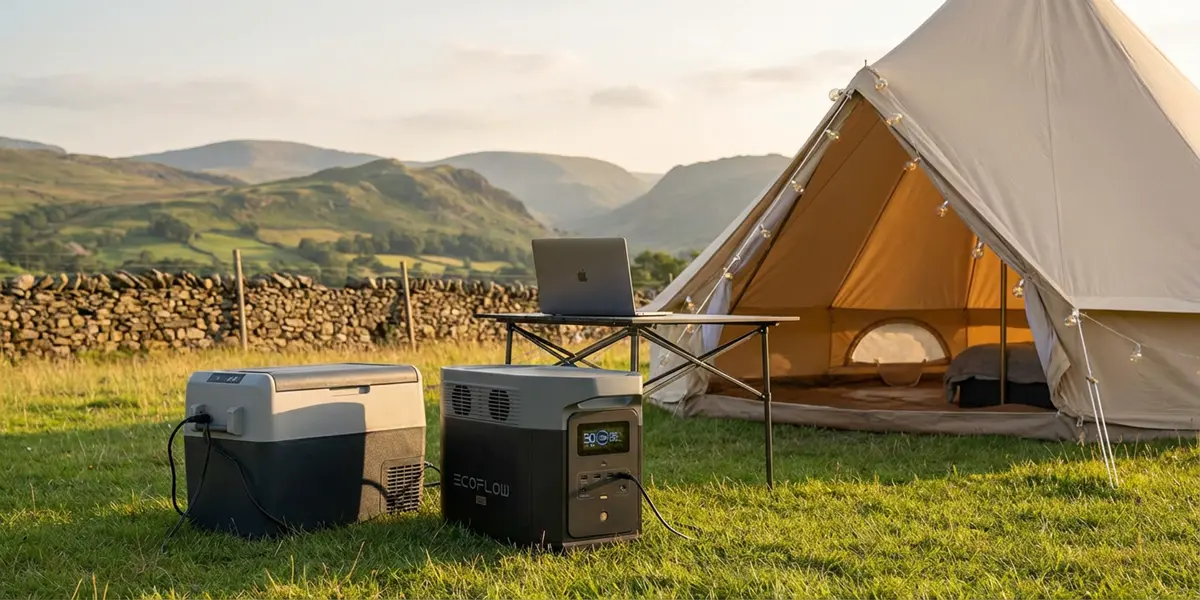
It suits campers, caravan owners, van lifers, and homeowners who want a reliable power cut backup or a quiet alternative to a petrol generator. If you need off-grid power for weekend trips or want to keep essentials running during a storm, this is a strong choice. If you want something ultra-light or have a very tight budget, it may not be the right fit. We cover that clearly in the “Who This Is NOT For” section below.
Key Specifications at a Glance
| Specification | Detail |
|---|---|
| Battery Capacity | 1,024Wh (LiFePO4) |
| AC Output | 1,800W continuous (2,700W surge) |
| X-Boost Output | Up to 2,200W compatible devices |
| Weight | 12 kg |
| AC Charging Speed | 0–80% in 50 minutes (1,200W input) |
| Full Charge Time | ~80 minutes from flat |
| Solar Input | 500W max (MPPT) |
| Car Charging | 126W max via 12V/24V input |
| Total Ports (UK version) | 13 ports (4 UK AC, 2 USB-C 100W, 2 USB-A, 2 USB-A fast, 12V car, 2 DC5521) |
| UPS / EPS Mode | Yes (30ms switchover) |
| Battery Cycles | 3,000+ to 80% capacity |
| App Control | Yes (EcoFlow app via Wi-Fi and Bluetooth) |
| Expandable | Yes, up to 3,040Wh with extra batteries |
| Warranty | 5 years UK |
How Fast Does the EcoFlow Delta 2 Charge?
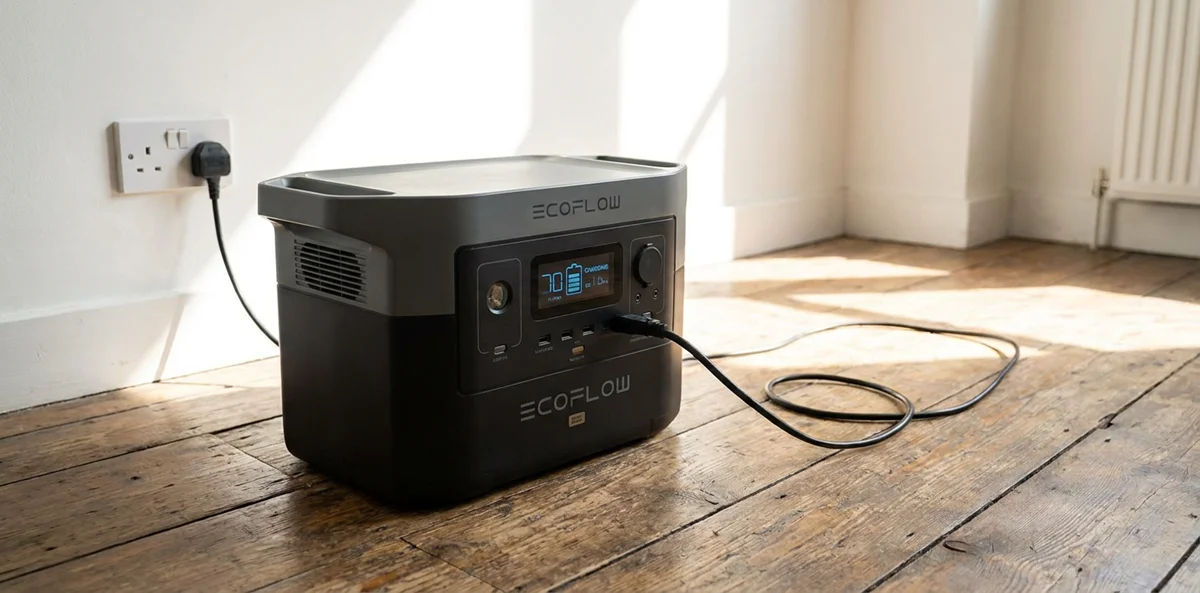
The EcoFlow Delta 2 charges from flat to 80% in 50 minutes using a standard UK mains plug. A full charge takes around 80 minutes at 1,200W input. Solar charging via 500W input (two 220W panels in good sun) takes three to four hours. In typical overcast UK conditions, budget around five to six hours for a full solar charge.
That 50-minute charge time is genuinely impressive. Most portable power stations in this price range take 3–5 hours from mains power. EcoFlow calls its system X-Stream charging, and it works by pulling up to 1,200W directly from the wall.
If you are preparing for an incoming storm or a power cut you know is coming, you can top it up from flat in under an hour. That matters in a way that slow chargers simply do not.
How Fast Is Solar Charging in the UK?
The Delta 2 accepts up to 500W of solar input via its MPPT controller. In a field test shared by Camping Secrets UK, two 220W EcoFlow solar panels peaked at 295W on a bright day. When the sun went behind a cloud, input dropped to just 31W. So the three to four hour solar charge time assumes strong sun. On a typical British overcast day, plan for five to six hours or longer.
Car charging via the 12V input tops out at 126W. That is useful for topping up on a long drive, but it is not fast enough to be a main charging method.
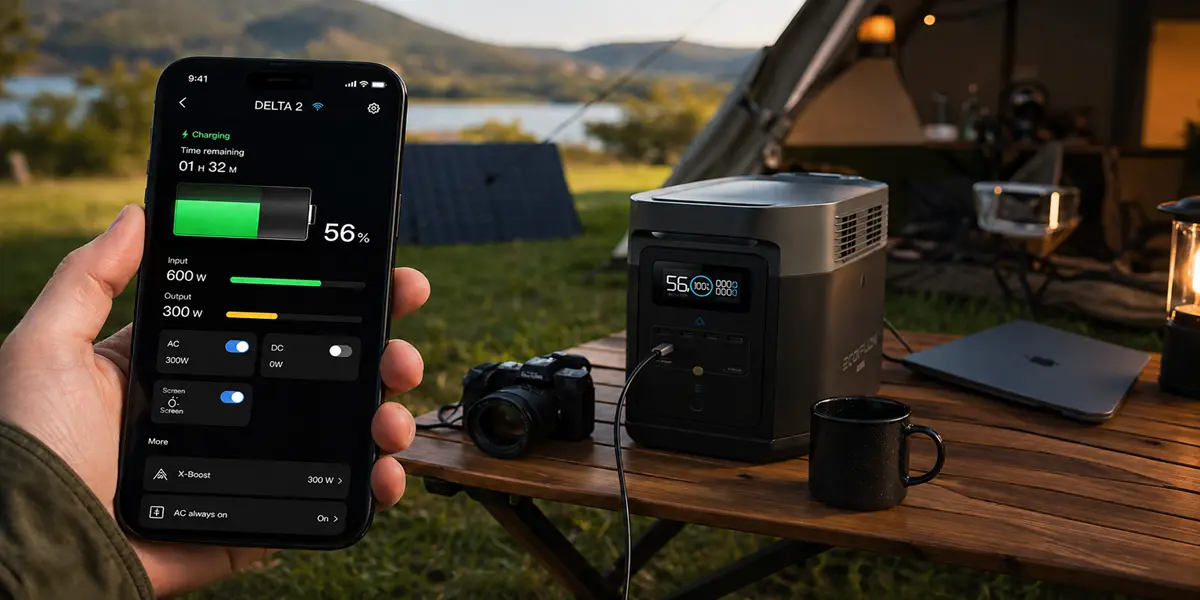
You can also manage charging speed through the EcoFlow app. If the fan noise at full 1,200W bothers you, dropping input to 400W quiets things down a lot while still charging faster than most rivals.
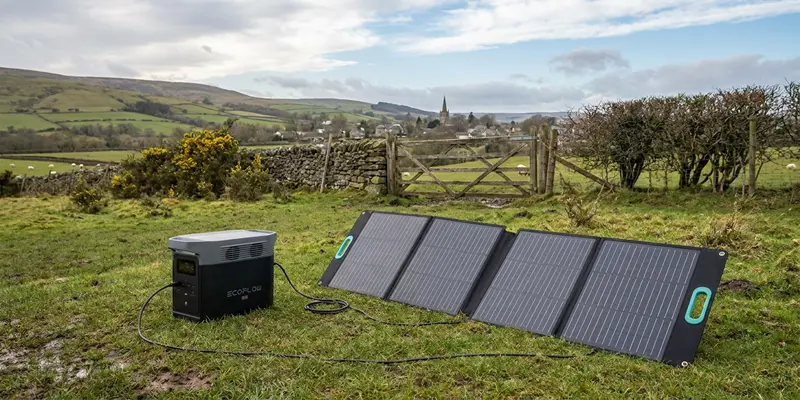
The Delta 2 accepts up to 500W of solar input. That is enough for a full charge in 3–4 hours of strong UK summer sun.
What Can the EcoFlow Delta 2 Actually Power?
The EcoFlow Delta 2 can power around 90% of UK household appliances. With 1,800W output and X-Boost technology that stretches compatible devices up to 2,200W, it handles TVs, laptops, mini-fridges, electric blankets, CPAP machines, and most camping appliances. It will not run a kettle, electric shower, or standard oven because all of these draw more than 2,200W.
How Long Does the EcoFlow Delta 2 Run Common UK Devices?
The EcoFlow Delta 2 can run a typical UK fridge for six to fourteen hours, a laptop through around 15 full charges, and phones, a router, and lighting for 50+ hours.
- 60W mini fridge: up to 14 hours
- CPAP machine (30W): up to 29 hours
- LED lights (5W): multiple days
- Camping kettle (750W): around 10 boils
A rough way to work it out yourself: divide 1,024Wh by the wattage of your device, then multiply by 0.85 to account for inverter efficiency. So a 100W device gives you about 8.7 hours (1,024 × 0.85 / 100).
A rough way to work it out yourself: divide 1,024Wh by the wattage of your device, then multiply by 0.85 to account for inverter efficiency. So a 100W device gives you about 8.7 hours (1,024 × 0.85 / 100). For a more detailed calculation, use our power station size guide.
What Is X-Boost and How Does It Work?
X-Boost lets the Delta 2 run appliances rated up to 2,200W, even though its native output is 1,800W. It works by reducing the power draw of compatible devices to match what the unit can supply. It works well for simple heating devices and most camping appliances. It is not suitable for devices with tight voltage requirements, such as some medical equipment or precision tools.
What Can the EcoFlow Delta 2 NOT Run?
The EcoFlow Delta 2 cannot run a standard UK kettle (2,000–3,000W), an electric shower (7,000W+), a standard electric oven (2,000–5,000W), or a full air conditioning unit. If powering any of these is your main goal, look at the EcoFlow Delta 2 Max or a larger unit instead.
How Long Will the Battery Last Over the Years?
The EcoFlow Delta 2 battery is rated to 3,000+ charge cycles before dropping to 80% of its original capacity. For most UK buyers using it weekly for camping or during power cuts, that is well beyond 10 years of reliable service. At daily use, it still delivers over eight years before any meaningful decline.
LFP is worth understanding because it is one of the main reasons the Delta 2 has held up so well against newer competition.
Older power stations used NMC (nickel manganese cobalt) lithium-ion batteries, which typically last 500–800 cycles before they degrade. A 500-cycle battery used weekly lasts about 10 years. But if you use it daily, it is gone in just over a year.
LFP changes that equation completely. It is the same chemistry used in many electric vehicles. It is more stable, safer, and far longer-lasting. EcoFlow backs the Delta 2’s LFP cells with a 5-year warranty that includes a guarantee on battery capacity.
One practical note: UK buyers on the Motorhome Fun forum have reported the Delta 2 holding up well after two or more years of regular use, including solar and car charging cycles.
What Ports Does the EcoFlow Delta 2 Have?
The UK version of the EcoFlow Delta 2 has 13 ports: four UK AC sockets (230V, BS 1363 three-pin), two USB-C ports (100W each), two standard USB-A ports, two fast-charge USB-A ports, one 12V car socket, and two DC5521 outputs. You can run multiple devices at once, as long as the total draw stays under 1,800W. The Delta 2 uses a pure sine wave inverter, which means it is safe to run sensitive electronics, including laptops, CPAP machines, and medical equipment, without risk of damage.
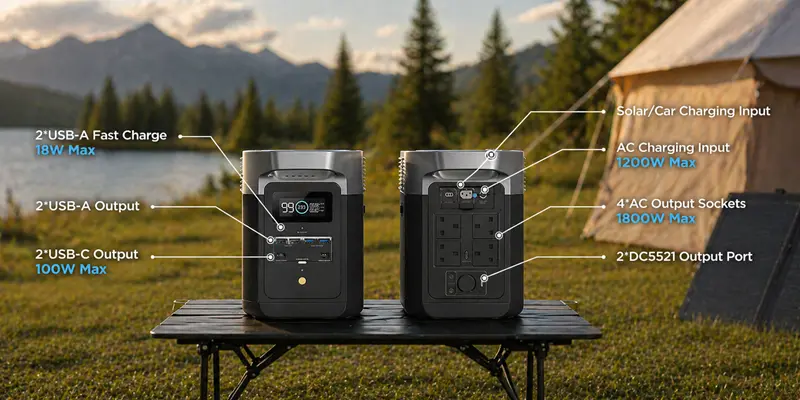
The Delta 2 UK version has 13 output ports, more than most rivals in this class.
The two 100W USB-C ports are a highlight for anyone working from a laptop. They are fast enough to charge most modern MacBooks and Windows laptops at full speed. The USB-A fast-charge ports (18W each) work well for phones and tablets.
The EcoFlow app connects via Wi-Fi or Bluetooth and gives you real-time monitoring of input, output, and remaining runtime. You can also switch individual ports on or off remotely, which is handy if you want to preserve battery life by cutting power to devices you are not actively using.
Is the EcoFlow Delta 2 Noisy?
The EcoFlow Delta 2 is near-silent during light use. But the cooling fans get noticeably loud when charging at full 1,200W from the mains. UK buyers often compare the noise to a laptop under load. The easy fix: reduce AC input to 400–600W via the EcoFlow app, which cuts fan activity significantly while still charging much faster than most rivals.
This is the most common complaint in UK reviews, and it is fair. EcoFlow has been upfront about it: high-power charging needs heat dissipation, and that means fans. It is not a defect, it is a trade-off for the fast charge speed.
During discharge (running your devices), the unit is quiet at low to medium loads. You are unlikely to notice it in a tent or a motorhome while watching TV or charging phones. It only becomes an issue when you are actively topping it up at full speed.
EcoFlow Delta 2 vs Delta 3 Classic: Which Should You Buy?
If both are at a similar price, the EcoFlow Delta 3 Classic is worth choosing for its higher surge rating and faster charge time. If the Delta 2 is significantly cheaper, or the 5-year warranty matters to you, it remains the better buy. The EcoFlow Delta 3 Classic launched in the UK in March 2026, matching the Delta 2 on capacity (1,024Wh) and output (1,800W), but with a slightly faster 45-minute 0–80% charge and a higher 3,600W surge rating.
A few things stand out. The Delta 2 wins on ports (13 vs the Delta 3’s 5), expandability, and warranty length. The Jackery Explorer 1000 v2 leads on battery cycles (4,000+) and is the lightest at 10.8 kg. The Delta 3 has the fastest charge and highest surge. For a full head-to-head on brands, see our EcoFlow vs Jackery comparison.
Is the EcoFlow Delta 2 Expandable?
Yes. The EcoFlow Delta 2 connects to EcoFlow Delta 2 Extra Batteries, expanding total capacity from 1,024Wh up to 3,040Wh. That is roughly triple the base capacity. It is enough to run a fridge for over 24 hours or power essential home circuits through a multi-day outage without solar recharging.
Add extra batteries via the expansion port on the back of the unit. Capacity scales linearly. Fridge runtime scales proportionally.
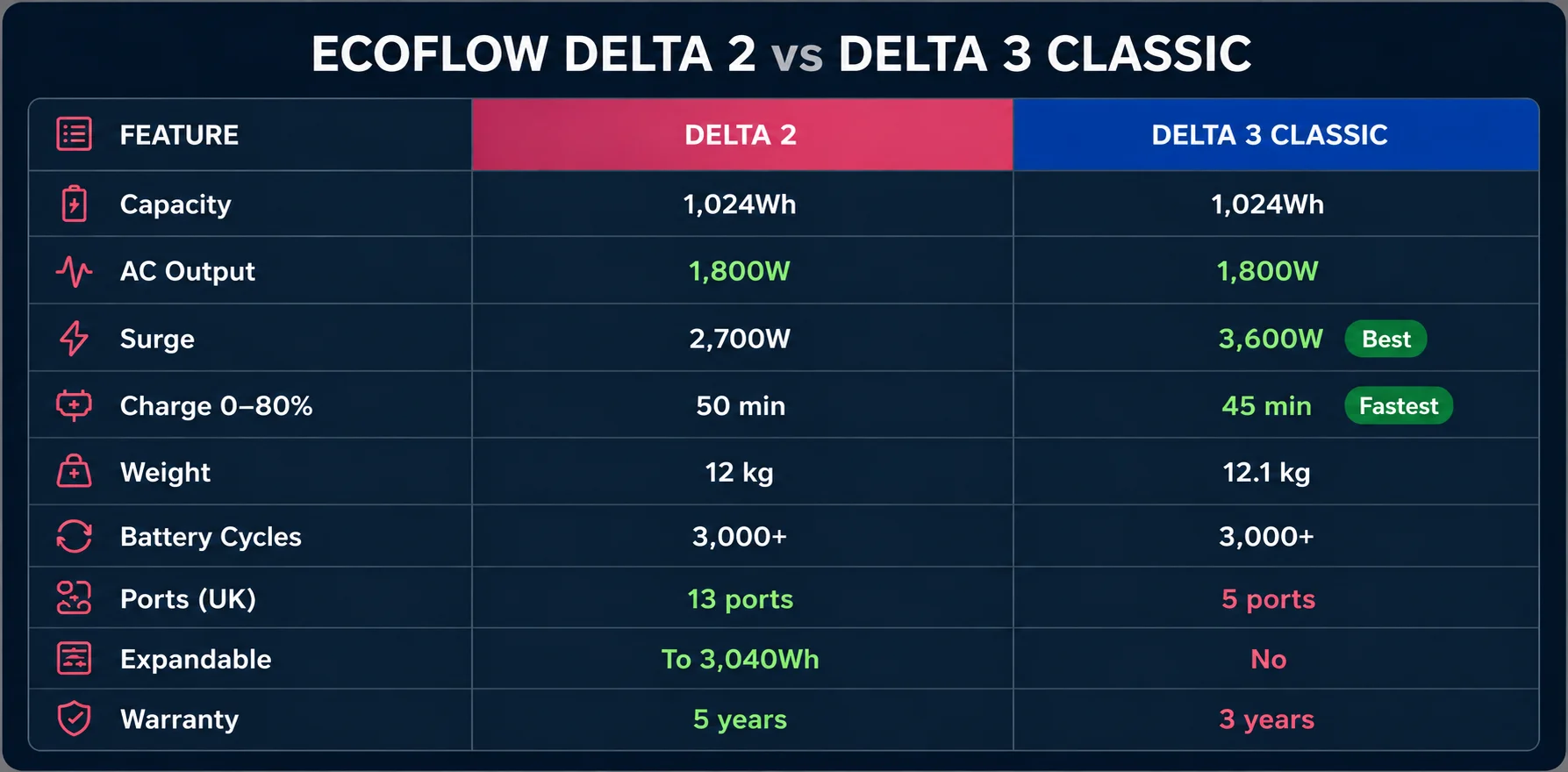
The Delta 3 Classic is a newer challenger with a higher surge rating (3,600W vs 2,700W) and faster 0–80% charging (45 min vs 50 min). The Delta 2 wins on ports (13 vs 5), expandability to 3,040Wh, and a longer 5-year warranty.
Who This Is NOT For
- Anyone who needs to run a kettle, electric shower, or standard oven (these all draw more than 2,200W).
- Full-time van lifers who need to run a compressor fridge 24/7 without solar, because 1,024Wh runs out overnight.
- Backpackers who need something ultra-light. At 12kg, it is a two-handed carry, not a pack item.
- Anyone needing whole-home backup for more than a few hours. Look at the Delta 2 Max (2,048Wh) instead
Pros and Cons
The Delta 2’s biggest strengths are its fast charge speed, long battery life, and 5-year warranty. Its main weaknesses are fan noise at full charge speed and 12kg weight. it is not the lightest or the quietest, but it is one of the most complete packages in its class.
- 0–80% charge in 50 minutes, much faster than most rivals
- LFP battery with 3,000+ cycles, far longer than older lithium-ion
- 5-year warranty backed by EcoFlow UK
- 13 output ports including two 100W USB-C
- Expandable to 3,040Wh with extra batteries
- EcoFlow app with remote control and real-time monitoring
- UPS / EPS mode with 30ms switchover for computers and networking
- Solar ready with 500W MPPT input
- X-Boost for running 2,400W-rated devices
- Fan noise at full 1,200W AC charge speed
- 12kg, heavier than some rivals at this capacity
- 1,024Wh limit, not enough for multi-day off-grid use alone
- Solar panels sold separately (not included in box)
- Car charging is slow at 126W ceiling
- will not run a kettle, shower, or oven
Alternatives Worth Considering
The Delta 2 is a strong all-rounder, but it is not the right choice for everyone. Here are three alternatives worth checking:
- EcoFlow Delta 3 Classic: Same price, slightly faster charge (45 min), higher surge (3,600W). Shorter warranty at 3 years vs the Delta 2's 5 years. Good if you want the latest model at the same price.
- Jackery Explorer 1000 v2 : Lighter at 11kg, quieter under 22dB, 4,000 battery cycles. Output is lower at 1,500W. Best choice for camping where weight and noise matter most.
- Anker Solix C1000 Gen 2: Higher 2,000W output, 49-minute charge, 5-year warranty. A stronger choice if you need more power output. Slightly pricier.
For a wider look at the market, see our guide to the best portable power stations in the UK.
Final Verdict
The EcoFlow Delta 2 has been one of the best-selling portable power stations in the UK for good reason. It charges faster than almost anything at this price, its LFP battery is built to last well over a decade of regular use, and the 5-year warranty gives you genuine peace of mind.
It is not perfect. The fan noise at full charge speed is a genuine gripe, and 12kg means it is not something you will carry on your back. And with the Delta 3 Classic now available at the same price, new buyers should compare the two carefully. The Delta 3 has a slightly faster charge and higher surge rating, though it comes with a shorter 3-year warranty.
If the Delta 2 is genuinely cheaper than the newer Delta 3 Classic, or the 5-year warranty matters most to you, it still holds up well, it remains a very solid buy. For most UK campers, caravan owners and anyone who wants dependable backup power during a power cut, it’s still a solid choice.
Scores reflect our assessment based on manufacturer specifications, verified UK buyer reviews on Amazon and Trustpilot.
Frequently Asked Questions
The EcoFlow Delta 2 is still a strong buy in 2026 for most UK buyers. Its combination of 1,024Wh capacity, 1,800W output, LFP battery chemistry (3,000+ cycles), 50-minute fast charge, and 5-year warranty is hard to match at its current UK price. The main thing to check is whether the newer EcoFlow Delta 3 Classic is at a similar price when you are buying. It has slightly better specs, though only a 3-year warranty compared to the Delta 2’s 5 years. If you find the Delta 2 at a meaningful discount, it is still a great choice.
A standard UK fridge with an average draw of around 120W will run for roughly 7 to 14 hours on a single EcoFlow Delta 2 charge. The range is wide because it depends on your fridge model, how warm the room is, and how often you open the door. A more efficient modern fridge averaging 80W could run for close to 10 hours. For longer outages, pairing the Delta 2 with a solar panel for daytime top-ups is the most practical approach, letting you keep the fridge running through a multi-day power cut.
The EcoFlow Delta 2 reaches 80% charge in around 50 minutes from a standard UK mains plug, using its 1,200W X-Stream fast charging. A full charge from flat takes about 80 minutes. Solar charging via a 500W panel setup (such as two 220W panels) takes 3 to 4 hours in strong sunlight. In typical UK overcast conditions, plan for 5 to 6 hours or longer. You can also charge via a 12V car socket, though this tops out at 126W and is best used as a top-up rather than a main charging method.
X-Boost is EcoFlow’s power management technology that lets the Delta 2 run appliances rated up to 2,200W, even though its native AC output is 1,800W. It works by reducing the power draw of compatible devices to match what the unit can supply. It works well for simple heating devices and most camping appliances. It is not suitable for devices with tight voltage requirements, such as some medical equipment or precision tools, so check compatibility if you plan to use it with anything specialist.
The EcoFlow Delta 2 is quiet during light use. You are unlikely to notice it while watching TV or charging phones. The cooling fans get noticeably louder when you charge it at full 1,200W AC speed, and UK buyers often compare the sound to a laptop under load. The simplest fix is to lower the charging input to 400 to 600W via the EcoFlow app. This cuts fan activity considerably while still charging much faster than most rivals. During discharge at low to medium loads, it is close to silent.
Yes. The EcoFlow Delta 2 has a built-in EPS (Emergency Power Supply) mode that switches to battery power within 30 milliseconds of a mains failure. That is fast enough to protect most computers and networking equipment without any interruption. UK buyers consistently report it working reliably for laptops and routers during power cuts. it is worth noting that some owner feedback suggests it may not be fully reliable for highly sensitive electronics, such as certain specialist medical devices, so check the specific compatibility requirements if That is your use case.
The EcoFlow Delta 2 is silent, produces no fumes, and does not need fuel, making it far more practical for indoor use during a power cut or on a campsite where noise and emissions are a concern. A petrol generator of similar output costs less upfront but involves ongoing fuel costs, maintenance, and cannot be used safely indoors. For most UK households, campers, and caravan owners, the Delta 2 is the better day-to-day choice. A petrol generator may be worth considering if you need days of continuous high-power output with no access to solar or mains charging.