The Bluetti AC180 Is Discontinued: Here Is What to Know
The Bluetti AC180 was one of Bluetti’s best-selling power stations in the UK throughout 2023 and 2024. It offered 1,152Wh of LFP capacity, 1,800W output, and a fast 45-minute charge to 80%. For a lot of UK campers, caravan owners, and home backup buyers, it hit the right balance of price and power.
Bluetti discontinued the AC180 in 2025, replacing it with the Elite series. The Elite 100 V2 is the direct replacement: same price bracket, same core purpose, but a significantly updated design. At 11.5kg, it is 5.5kg lighter than the AC180. It accepts 1,000W of solar input compared to the AC180’s 500W. And it comes with a better warranty.
The full AC180 specs are preserved in the comparison table below for reference. If you are an AC180 owner, your unit continues to be supported under whatever warranty you registered at time of purchase. For new buyers, the Elite 100 V2 is the unit to look at. The full Bluetti UK range is covered in our brand guide.
What Is the Bluetti Elite 100 V2?
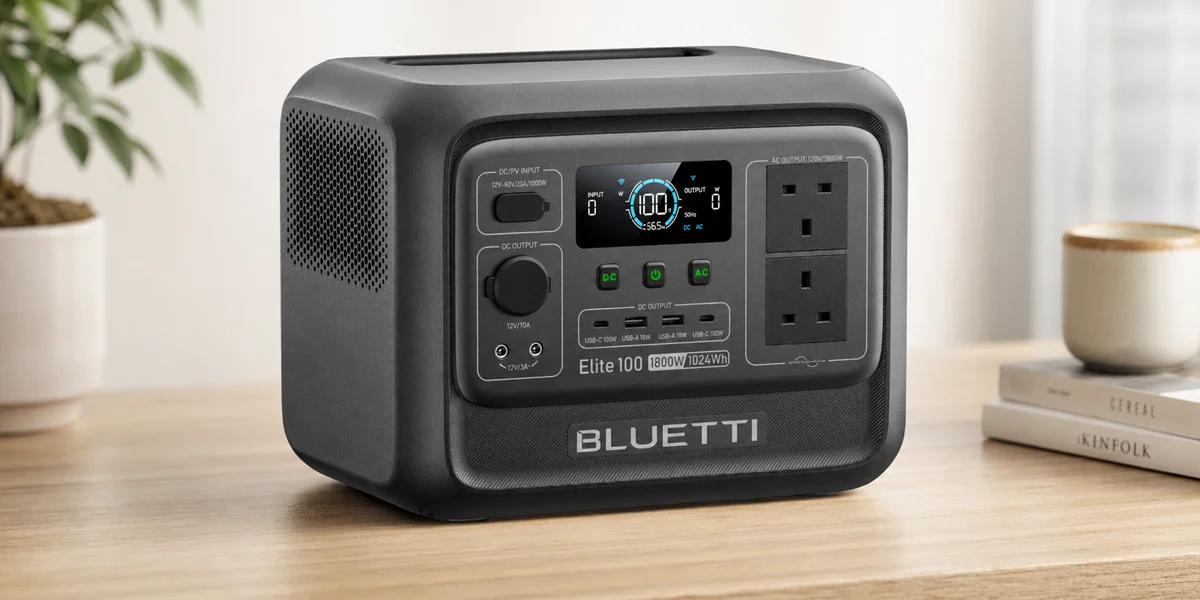
The Bluetti Elite 100 V2 is Bluetti’s current 1kWh portable power station for UK buyers. It was launched in mid-2025 as a ground-up redesign of the AC180 series: same output power (1,800W) but built into a much smaller, lighter chassis. At 220 × 250 × 320mm and 11.5kg, it is roughly the size of a case of beer, according to Bluetti UK.
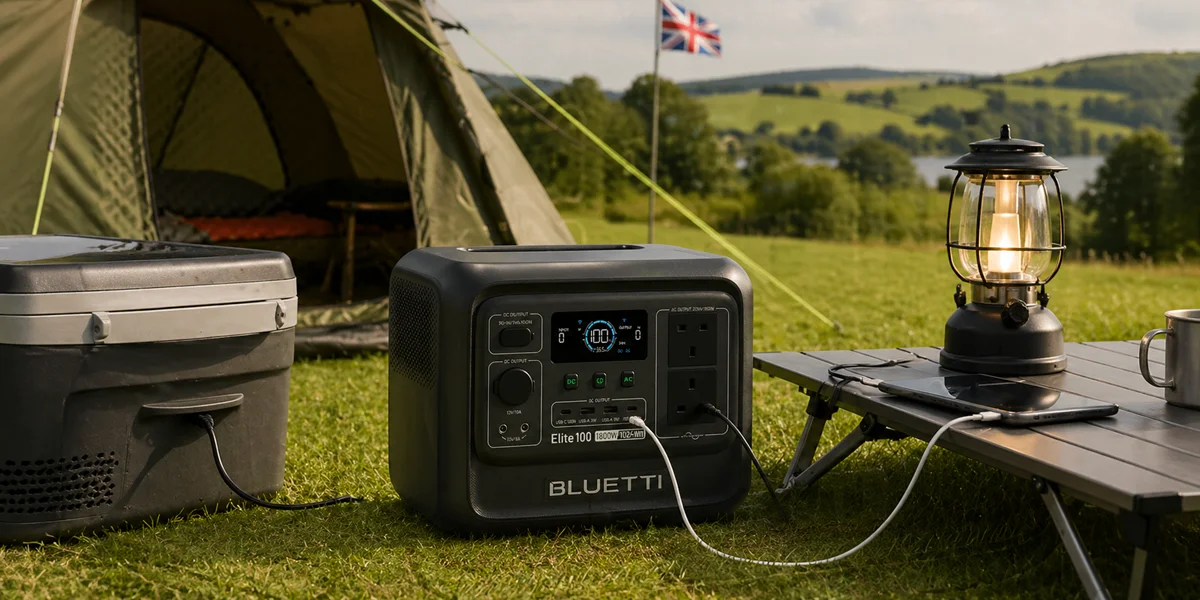
It is designed for three use cases: camping and outdoor power, backup power during UK power cuts, and mobile working on the road. The 1,000W solar input makes it one of the fastest solar-charging 1kWh units in the UK. The 10ms UPS switchover makes it a reliable home office backup generator. And the 30dB quiet operation means you can run it overnight in a tent or motorhome without disturbing anyone.
Not sure how much power you actually need? Use our power station sizing calculator before committing to a 1kWh unit.
Key Specifications at a Glance
| Specification | Detail |
|---|---|
| Battery Capacity | 1,024Wh (LiFePO4 / LFP) |
| AC Output | 1,800W continuous (3,600W surge) |
| Power Lifting Mode | 2,700W (heating devices via app) |
| HyperVolt Surge | 3,600W |
| Weight | 11.5 kg |
| Charge 0–80% | 45 minutes (TurboBoost, 1,200W AC) |
| Full Charge Time | ~70 minutes from flat |
| Solar Input | 1,000W max (MPPT, 12–60V) |
| Noise Level | 30dB under 600W load |
| UPS / EPS Mode | Yes, 10ms switchover |
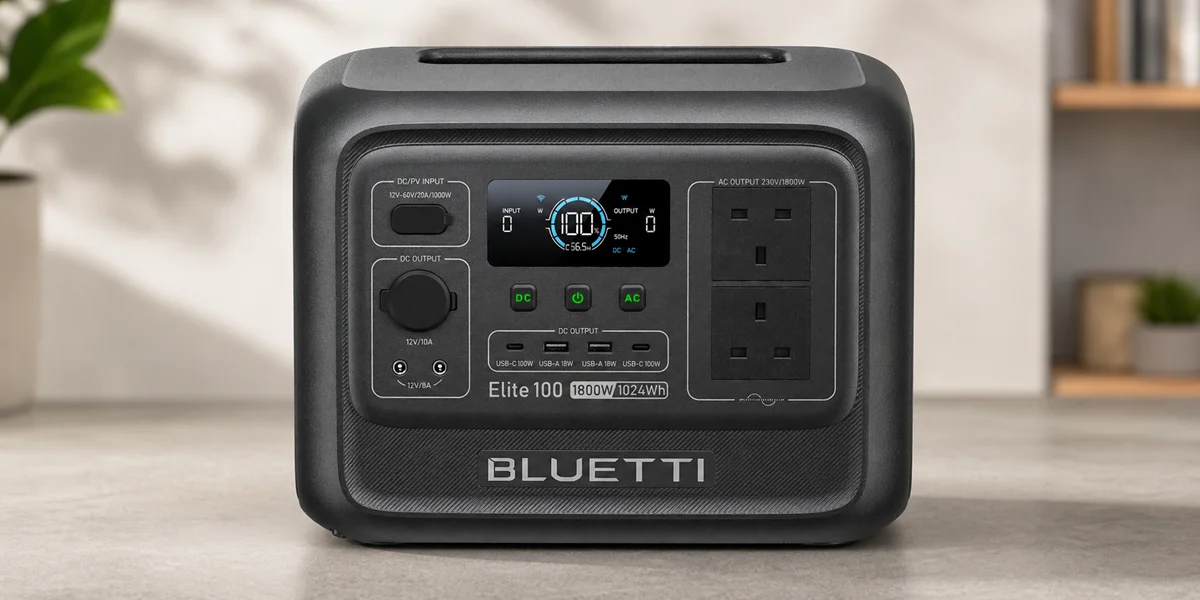
| Ports (UK version) | 9 ports: 2 UK AC (230V), 1 USB-C 140W, 1 USB-C 100W, 2 USB-A 15W, 1 car socket 12V, 2 DC5521 |
| Battery Cycles | 4,000+ to 80% capacity |
| App Control | Yes: Bluetti app (Wi-Fi + Bluetooth), modes: Standard, Silent, Turbo, Custom |
| Warranty | 5 years UK |
How Does the Elite 100 V2 Compare to the AC180?
The Elite 100 V2 improves on the AC180 in every key spec except battery capacity. It is 5.5kg lighter (11.5kg vs 17kg), accepts double the solar input (1,000W vs 500W), has a higher surge rating (3,600W vs 2,700W), more battery cycles (4,000+ vs 3,500), a faster UPS (10ms vs 30ms), and a longer warranty (5 years vs 3 years). The only honest trade-off: the Elite 100 V2 has 1,024Wh vs the AC180’s 1,152Wh. For the complete side-by-side, see our full Bluetti Elite 100 V2 vs AC180 comparison.
The capacity difference is real and worth flagging. At 1,024Wh vs 1,152Wh, the Elite 100 V2 gives you about 11% less runtime from a full charge. For most use cases, camping, power cuts, van life, that difference is small. You would lose roughly 30 to 40 minutes of fridge runtime. For buyers who regularly pushed the AC180 to its limits, it is worth noting. For everyone else, the weight saving (5.5kg less to carry) and double the solar input are a better trade-off in practice.
How Fast Does the Bluetti Elite 100 V2 Charge?
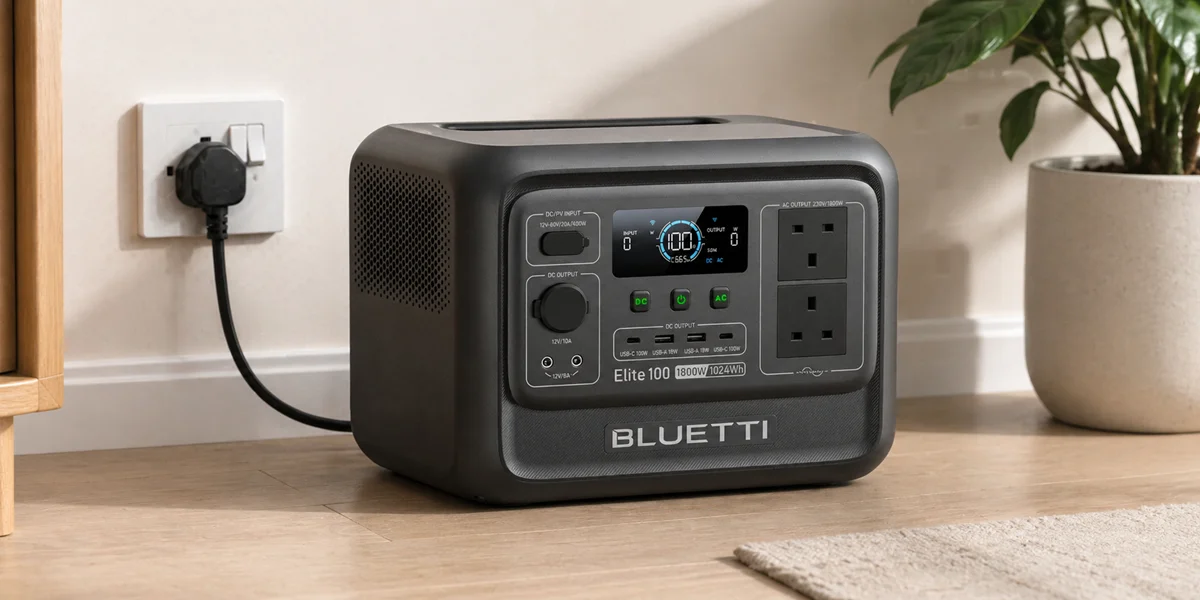
The Bluetti Elite 100 V2 charges from flat to 80% in 45 minutes using TurboBoost fast charging at 1,200W AC input. A full charge from flat takes around 70 minutes. Solar charging via 1,000W input takes about 1 to 1.5 hours in strong sunlight, the fastest solar charge time in the 1kWh class. In typical overcast UK conditions, allow 3 to 5 hours for a full solar charge.
The 45-minute charge to 80% matches the AC180, so existing AC180 buyers will not notice a difference in their day-to-day charging routine. The full 70-minute charge is faster than the AC180’s roughly 90-minute full charge, because the Elite 100 V2 accepts 1,200W input continuously rather than tapering.
The app gives you four charging modes: Standard (gentler on the battery, best for daily use), Silent (reduced input, less fan noise), Turbo (fastest charge, most fan noise), and Custom (set your own input level). TechRadar confirmed in their September 2025 review that the unit genuinely delivers the rated 1,200W input. For most users, Standard mode will be the default. It is faster than most rivals while being kinder to the cells over time.
Why Is Solar Charging the Standout Upgrade?
The jump from 500W to 1,000W of solar input via the integrated MPPT controller is the most practically significant upgrade in the Elite 100 V2. With a 1,000W solar panel setup in strong sun, TheSolarLab recorded a near-full recharge in around 1 hour 39 minutes under ideal conditions. Two Bluetti 200W panels give you 400W input in good conditions, getting you to full in about 2.5 hours. That is a meaningful improvement for UK campers relying on solar during summer trips. In December sun, OutdoorTechLab achieved 380W input from a 400W setup and recovered from 15% to 85% in 2.5 hours, which is impressive for winter off-grid conditions.
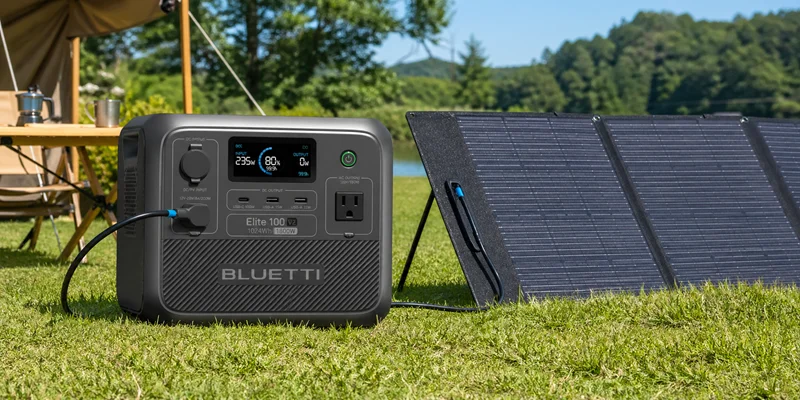
The 1,000W solar input is double the AC180's 500W, making it the biggest practical upgrade in the Elite 100 V2.
What Can the Bluetti Elite 100 V2 Actually Power?
The Elite 100 V2 handles around 90% of appliances UK campers and home backup buyers actually use. With 1,800W continuous output, 2,700W Power Lifting for heating devices, and 3,600W HyperVolt surge, it covers TVs, laptops, fridges, CPAP machines, hair dryers, mini electric kettles (under 2,700W), and most camping appliances.
Here are real-world runtime estimates from Bluetti UK data and UK buyer reports, factored with typical pure sine wave inverter efficiency:
Other notable runtime capabilities include up to 27 hours for a CPAP machine (30W), roughly 10 hours for an LED television (100W), and about 1 hour of continuous use for a high-draw 1,000W coffee maker. These estimates reflect the unit’s roughly 81% pure sine wave inverter efficiency.
What Is Power Lifting Mode?
Power Lifting is a feature in the Bluetti app that lets the Elite 100 V2 power heating devices rated up to 2,700W, beyond the standard 1,800W continuous output. It works by managing voltage delivery to reduce the device’s draw to within what the unit can supply. Bluetti’s own specifications confirm it works with heating appliances like hairdryers, fan heaters, and kettles. It is not for devices with tight voltage requirements, such as medical equipment or precision tools.
What Devices Can It Not Run?
The Elite 100 V2 will not run an electric shower (7,000W+), a standard oven (2,000–5,000W), or an air conditioning unit without Power Lifting. For whole-home backup covering kitchen appliances, you would need a larger energy storage unit like the Bluetti AC200P.
The 1,000W Solar Input: What It Means in Practice
The Elite 100 V2’s 1,000W solar input is double the AC180’s 500W and one of the highest in the 1kWh class. With four 250W panels in strong UK summer sun, you can recharge from flat in around 1 hour. That is fast enough for a realistic off-grid camping setup where you generate power through the day and use it in the evening.
To put that in context: the EcoFlow Delta 2 accepts 500W of solar input. The Jackery Explorer 1000 v2 takes 400W. At 1,000W, the Elite 100 V2 accepts twice as much solar as its closest EcoFlow rival and 2.5 times as much as the Jackery. For anyone planning a solar-first off-grid setup, this is the most relevant spec on the sheet.
You do not need to hit 1,000W to benefit. Even with two Bluetti 200W panels giving you 350–400W in normal UK summer conditions, you would fully recharge the unit in about 2.5 to 3 hours. That is enough to run a fridge all evening from a morning’s worth of solar charging.
The MPPT controller accepts panels with 12V–60V input voltage and is compatible with Bluetti’s own range and most third-party panels with MC4 connectors. Bluetti UK recommends two or four 200W panels for the best charging balance. A solar charging cable is included in the box.
How Quiet Is the Bluetti Elite 100 V2?
The Bluetti Elite 100 V2 operates at 30dB under 600W load, which is about as loud as a quiet library. TechRadar confirmed the fans are quiet during normal operation, and multiple UK Amazon reviewers mention being able to use it in a caravan or indoors at night without it being disruptive. You can lower noise further by switching to Silent Mode in the app, which reduces the charging rate and fan speed.
The 30dB rating under 600W is the same as the EcoFlow Delta 3 Classic and quieter than the EcoFlow Delta 2 under full AC charge. Above 600W load, the fans do spin up. UK Amazon buyers report it is noticeably quieter than older Bluetti AC-series units, which were criticised for fan noise in earlier reviews.
For anyone using the Elite 100 V2 as a CPAP backup, overnight campsite power, or home backup during a power cut, the low-noise operation is a genuine advantage. OutdoorTechLab’s 30-day field test confirmed the unit could sustain quiet office loads (135W average) for 7.5 hours without any noticeable noise increase.
Ports and Connectivity
The UK version of the Elite 100 V2 has 9 output ports: 2 UK AC sockets (230V), 1 USB-C at 140W, 1 USB-C at 100W, 2 USB-A at 15W each, 1 car socket (12V), and 2 DC5521 outputs. All output ports are on the front panel. Both AC sockets are UK three-pin (BS 1363, 230V, 50Hz) with no travel adapter required. The 140W USB-C is one of the highest-output USB-C ports on any portable power station in this class and charges most laptops at or above their rated speed.
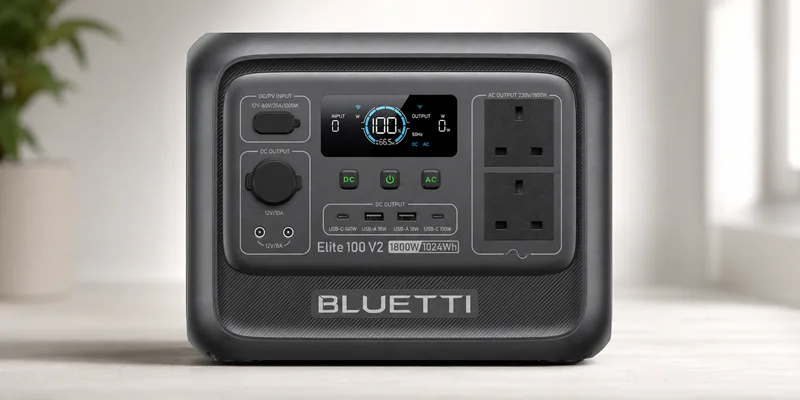
The 140W USB-C port is one of the highest-output in its class, fast enough to power-charge a MacBook Pro at full speed.
The 140W USB-C port stands out. Most power stations in this class top out at 100W USB-C. At 140W, it handles the newest MacBook Pro models at full charge speed and can simultaneously charge a USB-C laptop and power the unit’s AC outlets without any noticeable performance drop.
The Bluetti app connects via Wi-Fi or Bluetooth and gives you real-time input/output monitoring, remaining runtime, and the four charging modes (Standard, Silent, Turbo, Custom). You can also set scheduled charging to take advantage of overnight off-peak electricity tariffs, which is increasingly relevant for UK buyers on time-of-use energy deals. UK Amazon buyers consistently mention the app as reliable and easy to set up.
Battery Life: How Long Will It Last?
The Elite 100 V2 uses LFP (lithium iron phosphate) battery cells rated to 4,000+ cycles before dropping to 80% capacity. Bluetti rates it for a 10-year lifespan under normal use. Used twice a week for camping, that is over 38 years of charge cycles. Used daily as a home backup, you would still expect 10+ years of reliable service.
The improvement from AC180’s 3,500 cycles to 4,000+ cycles is incremental but real. More practically, the LiFePO4 chemistry is what matters: it is more stable, runs cooler, and lasts far longer than the NMC lithium-ion batteries found in older power stations. Bluetti UK’s FAQ confirms the cells are “ultra-safe LiFePO4” and the unit comes with a 5-year warranty covering battery capacity.
NotebookCheck’s January 2026 CES coverage noted the Elite 100 V2 Bio-Based Edition shares the same core specs as the standard model, including the 4,000-cycle claim in Bluetti’s own announcement data.
One practical note from OutdoorTechLab’s 30-day field test: the unit ran cooler under sustained load than larger competitors in infrared temperature tests. The compact design does not compromise thermal performance, the opposite appears to be true.
Bluetti Elite 100 V2 vs EcoFlow Delta 2 vs Jackery 1000 v2
Here is how the Elite 100 V2 stacks up against the other main 1kWh options in the UK:
The Elite 100 V2’s clear wins are solar input (by a wide margin at 1,000W), surge power at 3,600W, and the fastest UPS switchover at 10ms. The EcoFlow Delta 2 still leads on expandability and number of ports. The Jackery 1000 v2 is the lightest and quietest overall. The Anker C1000 Gen 2 leads on raw AC output power. For solar-focused use, the Elite 100 V2 is the standout choice in this group. For the full one-to-one head-to-heads, see our EcoFlow Delta 2 vs Bluetti Elite 100 V2 and Jackery Explorer 1000 v2 vs Bluetti Elite 100 V2 comparisons.
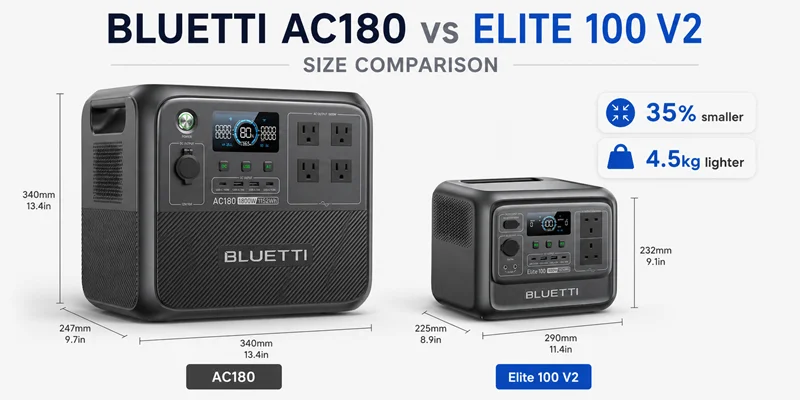
The Elite 100 V2 is 35% smaller and 5.5kg lighter than the AC180 it replaced.
Who This Is NOT For
Anyone who needs more than 1,024Wh of capacity: the Elite 100 V2 cannot be expanded. If you might need more capacity in future, the EcoFlow Delta 2 (expandable to 3,040Wh) is a better starting point.
- Anyone who regularly runs appliances above 1,800W that Power Lifting can’t cover: electric showers (7,000W), ovens, and large air conditioners are beyond this unit’s range.
- Buyers who need a 12V socket for high-draw 12V accessories: the car socket is rated at 12V but check your accessory’s draw before relying on it for sustained use.
- Anyone wanting more than 9 ports: if you need 13 output ports simultaneously, the EcoFlow Delta 2 is the better fit.
- Full-time off-grid van lifers who need 24/7 fridge power without solar: at 1,024Wh with no expansion, a standard fridge will drain the unit overnight. You would need reliable daily solar recharging to sustain that use case.
Pros and Cons
The Elite 100 V2’s standout strengths are its 1,000W solar input, 3,600W surge, 30dB quiet operation, 4,000+ cycles, and 5-year warranty. Its main weaknesses are no expansion capability and slightly less capacity than the AC180 it replaced.
- 35% smaller and 5.5kg lighter than the AC180
- Power Lifting to 2,700W: can run a UK kettle via app
- 10ms UPS switchover: tied for fastest in this comparison group
- 4,000+ LFP cycles: 10-year rated lifespan
- 30dB quiet under 600W: tent and bedroom friendly
- 140W USB-C: charges newest MacBook Pro at full speed
- 45-minute charge to 80% via TurboBoost
- 5-year warranty from Bluetti UK
- App modes: Standard, Silent, Turbo, Custom
- 1,024Wh: 128Wh less than the AC180 it replaced
- Not expandable: fixed capacity, no expansion battery option
- 9 ports: fewer than EcoFlow Delta 2's 13
- Will not run electric shower, standard oven, or air con
- Solar panels sold separately
- Fan noise rises above 600W load
Alternatives Worth Considering
The Elite 100 V2 is the strongest choice in this class for solar-focused buyers, but it is not right for everyone. Here are the main alternatives:
- EcoFlow Delta 2: Expandable to 3,040Wh, 13 ports, 500W solar. Better if you need to grow capacity or more port options. Heavier at 12kg.
- Jackery Explorer 1000 v2: Lightest in class at 10.8kg, quietest at 22dB, 4,000 cycles. Lower 1,500W output and 400W solar. Best for camping where weight and noise are top priorities.
- EcoFlow Delta 3 Classic: 45-minute charge, 3,600W surge, Storm Guard Mode. Only 3-year warranty. Good if you want the latest EcoFlow tech at a fixed price.
For a full overview of everything available in the UK, see our guide to the best portable power stations in the UK.
Final Verdict
The Bluetti Elite 100 V2 earns its place at the top of the 1kWh class on solar alone. At 1,000W input, it accepts twice as much solar as the EcoFlow Delta 2 and 2.5 times as much as the Jackery 1000 v2. For UK campers, caravan owners, and van-lifers who want to charge through the day and run devices in the evening, that difference is real and daily.
Stack in the full spec picture: 1,800W continuous output, 3,600W HyperVolt surge, a 10ms UPS switchover (tied for the fastest in this group with the Delta 3 Classic), 4,000-cycle LFP battery, and a 5-year UK warranty. At 11.5kg, it is also 5.5kg lighter than the AC180 it replaced.
The honest limitations: no expansion option, 1,024Wh is slightly less than some rivals, and 9 ports is fewer than the EcoFlow Delta 2’s 13. For solar-first buyers those trade-offs are minor. For buyers who need to grow capacity over time, the Delta 2 remains the better starting point.
Frequently Asked Questions
The Bluetti AC180 has been discontinued and is no longer available from Bluetti UK or major UK retailers. If you see it on secondary marketplaces, you may find limited stock at reduced prices, but it will not come with a current warranty. The direct replacement is the Bluetti Elite 100 V2, which improves on the AC180 in most specs: it is lighter (11.5kg vs 17kg), has double the solar input (1,000W vs 500W), a higher surge rating (3,600W vs 2,700W), more battery cycles (4,000+ vs 3,500), and a longer warranty (5 years vs 3 years). The one honest trade-off is that the Elite 100 V2 has a slightly smaller battery at 1,024Wh compared to the AC180’s 1,152Wh.
The Bluetti Elite 100 V2 is the closest direct replacement. It has the same 1,800W output and 45-minute charge to 80%, but it is 35% smaller, ~33% lighter at 11.5kg, accepts 1,000W of solar input compared to the AC180’s 500W, has a higher 3,600W surge, and comes with a 5-year warranty. The main difference to note is that the Elite 100 V2 has a slightly smaller 1,024Wh battery compared to the AC180’s 1,152Wh, which means roughly 10 to 15% less runtime per charge on appliances over 100W.
The Bluetti Elite 100 V2 charges from flat to 80% in 45 minutes using TurboBoost fast charging from a standard UK mains plug at 1,200W input. A full charge takes around 70 minutes. Solar charging via 1,000W input takes about 1 to 1.5 hours in strong sunlight, which is the fastest solar charge time in the 1kWh class. In typical overcast UK conditions, allow 3 to 5 hours depending on your panel setup. You can also combine mains and solar charging simultaneously.
Power Lifting is a feature in the Bluetti app that lets the Elite 100 V2 run heating appliances rated up to 2,700W, beyond its standard 1,800W continuous output. It works by managing voltage delivery to the appliance to reduce its draw to within what the unit can supply. Bluetti confirms it works with kettles, hairdryers, and fan heaters when those devices are within the 2,700W Power Lifting ceiling. It is not suitable for devices with strict voltage requirements such as medical equipment or precision tools.
Yes. The Bluetti Elite 100 V2 can run a standard UK fridge during a power cut. A fridge averaging 150W will run for around 6.5 hours on a full charge. A more efficient modern fridge averaging 80W can run for around 10 hours. The 10ms UPS switchover means the fridge will not even notice the mains going down if the Elite 100 V2 is already connected. UK Amazon buyers have confirmed successful fridge and kettle use during real power cuts, with one buyer noting they used Power Lifting mode to boil a kettle with no issues.
Yes. The Elite 100 V2 switches to battery power within 10 milliseconds of a mains failure, which is three times faster than the AC180’s 30ms switchover. That is fast enough to keep computers, routers, NAS drives, CPAP machines, and payment systems running without any interruption. Bluetti UK confirms UPS compatibility on their official product page. UK buyers consistently report reliable home office UPS performance during power cuts, with no laptop restarts or router disconnections.
The two are closely matched at similar price points. The Bluetti Elite 100 V2 has a higher surge rating (3,600W vs 2,700W), far more solar input (1,000W vs 500W), a faster UPS switchover (10ms vs 30ms), and is slightly lighter (11.5kg vs 12kg). The EcoFlow Delta 2 has more ports (13 vs 9) and can be expanded to 3,040Wh with an extra battery. Both hold the same 1,024Wh base capacity and carry a 5-year warranty. For solar-focused buyers, the Elite 100 V2 wins clearly. For buyers who want expandability or more ports, the Delta 2 is the stronger choice. See our full EcoFlow vs Bluetti comparison for the complete head-to-head.
On the headline specs, very little. Bluetti’s EU product page lists the Premium 100 V2 at 1,024Wh, 1,800W output, 1,000W solar input and 11.5kg, the same as the Elite 100 V2. That page does not compare it with the Elite 100 V2. Compare both product pages on Bluetti UK before you buy.
It depends on your use case. The Bluetti Elite 100 V2 is the stronger choice for solar-first buyers: 1,000W solar input versus the EcoFlow Delta 2’s 500W is a significant real-world gap. The EcoFlow Delta 2 wins on expandability (up to 3,040Wh with an extra battery) and port count (13 vs 9). Both carry 5-year UK warranties. For off-grid camping and solar charging, Bluetti. For a system you want to expand later, EcoFlow.
The Jackery 1000 v2 scores highly for portability and noise: at 11kg it is the lightest in its class, and at 22dB in quiet mode it is noticeably quieter than the Bluetti. For campers and caravan users where weight and noise are the top priorities, those are fair advantages. The Bluetti Elite 100 V2 leads on solar input (1,000W vs 400W) and surge power (3,600W vs 3,000W). The right choice depends on whether portability or solar capacity matters more to you.
These two are closely matched. The Anker SOLIX C1000 Gen 2 has a higher 2,000W AC output and charges 0 to 100% in 49 minutes via HyperFlash. The Bluetti Elite 100 V2 has a higher 1,000W solar input (vs Anker’s 600W) and a higher 3,600W surge (vs 3,000W). Neither unit is expandable. Both have 4,000-cycle LFP batteries, 10ms UPS switchover, and 5-year warranties. For solar-first use, the Bluetti wins clearly. For raw output power, the Anker leads.
No. Bluetti lists no expansion battery for the Elite 100 V2, so its capacity stays fixed at 1,024Wh. If you might need more capacity later, the Bluetti Apex 300 is built to expand with add-on batteries. It starts at 2,764.8Wh and weighs 38kg, so it suits home backup more than camping.